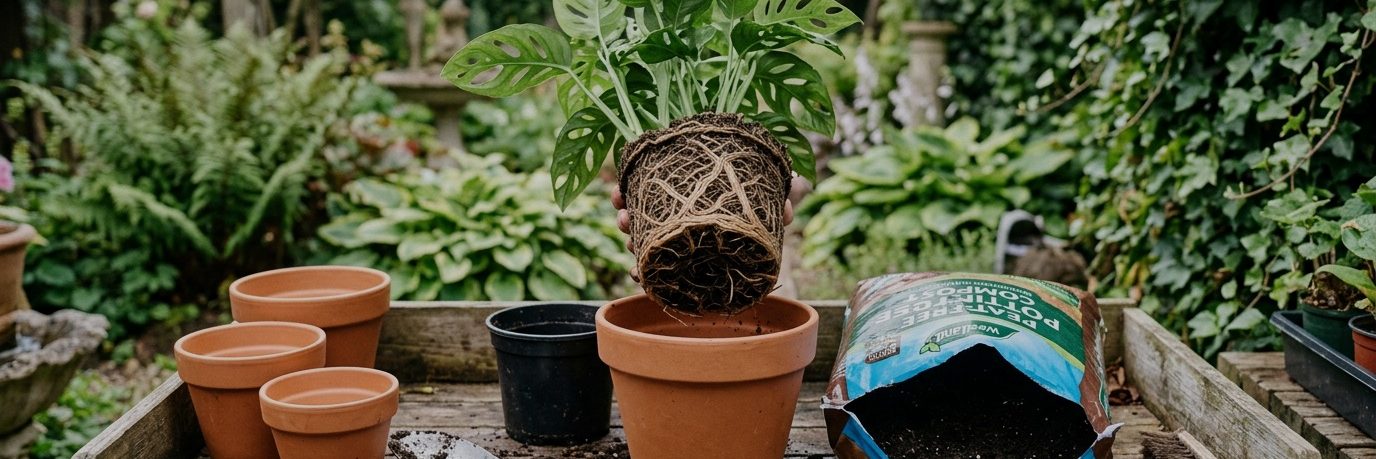
Repotting your plants and choosing the right potting mix
Most houseplants are repotted in early spring, when they start growing again, and only every one to two years, once the roots are cramped. The new pot should be only 2 to 4 cm larger in diameter than the old one: a pot that is too big is the leading cause of rot. The mix is chosen to suit the plant, from a free-draining blend for cacti to acidic ericaceous soil for blueberries. You only move plants outdoors once the last frosts have passed.
When to repot: the signs that don’t lie
The best time to repot most houseplants is early spring, when the plant emerges from its winter rest and starts growing again. Late summer, after the main growth flush, offers a second acceptable window. Most plants are only repotted every one to two years, and only when the roots are genuinely cramped and can no longer spread: repotting out of habit, a plant still comfortable in its pot, achieves nothing.
Six signs tell you a repot is due: roots poking out of the drainage holes or at the surface, a compact root ball that slides out of the pot in one piece, growth that has stalled despite good conditions, smaller leaves and frequent yellowing, declining flowering, and water that runs straight through the pot or, conversely, water that sits on top. You repot in spring but only move freshly repotted plants outdoors after your region’s average last frost date, once all risk of frost has passed: in a temperate climate, a late frost can still strike several weeks after the first mild days.
The right technique, step by step
The single most important point is the diameter of the new pot: it should be only 2 to 4 cm larger than the old one. An oversized pot is behind roughly 70 percent of repotting failures, through root rot: the excess of damp mix, uncolonised by roots, stays waterlogged and suffocates them. At the bottom you add a drainage layer of about 2 to 3 cm of clay pebbles or gravel, which limits direct contact between the root ball and residual water. This layer does not replace the drainage hole, which remains essential.
When you settle the plant back in, take care never to bury the collar, the junction between the roots and the stem: it stays at its usual level, about 2 cm below the rim of the pot to leave room for watering without overflow. After repotting, water generously to settle the mix and drive out the air pockets that harm the roots, then top up with a little mix if the level drops. Then wait 4 to 6 weeks before applying any fertiliser, giving the plant time to settle in.
Which mix for which plant
Universal potting mix only suits plants that need drainage if it is lightened with a third of draining material (river sand, perlite or clay pebbles): too rich in organic matter, it holds water and can rot the roots. For cacti and succulents such as aloe-vera, you need a very free-draining substrate: a typical recipe blends around 40 percent potting mix, 20 percent lime-free sand, 20 percent pozzolan or pumice, 15 percent garden soil and 5 percent perlite, the latter improving aeration and rooting. Orchid mix, for its part, is made of pine bark: it gives an airy structure that does not compact, essential for epiphytic roots.
Geranium or flowering-plant mix is lighter and better draining than the universal type, enriched with phosphorus and fertiliser to sustain a long flowering; in a window box, improve it further with 20 to 40 percent perlite or crushed clay pebbles. A mix that needs replacing is easy to spot: compact, broken-down substrate where water sits, a matted root ball that no longer absorbs water, or conversely an exhausted, over-draining blend that demands constant watering. When you unpot, check the roots: healthy ones are white and firm; rotten ones are brown, soft and slimy, with a rotten smell. A plant that is hungry for an airy substrate, such as monstera-deliciosa, ficus-lyrata or pilea, appreciates a well-lightened universal mix.
Acid-loving plants and acidic soil
Some plants only thrive in acidic soil and reject ordinary mix. Acid-loving plants (blueberry, hydrangea, azalea, camellia, rhododendron, Japanese maple, heather, magnolia, ferns) need ericaceous soil with an acidic pH of 4 to 5, below 6, light, free-draining and low in minerals. This acidity is not a whim: it allows the uptake of iron and trace elements and prevents chlorosis, that yellowing of the foliage which occurs when too high a pH locks up iron.
The blueberry (Vaccinium corymbosum) only thrives in very acidic soil, pH 4.5 to 5.5. Where soils are neutral or chalky, as in a great many gardens, growing it in a large pot of ericaceous soil is the most reliable solution, provided you water with rainwater: tap water, hard on many supply networks, raises the pH and makes the plant yellow then decline. Collecting rainwater in a water butt solves the problem. An acidic mulch (pine bark, conifer needles, wood chips) spread over ericaceous plants such as hydrangea keeps the soil cool and acidic over time.
The traps to avoid
The most common trap is a pot that is too big, tempting because you think you are giving room, but responsible for most rotten roots: better a pot only slightly wider, and repot more often. Two other reflexes do harm. Never repot a plant in flower: it systematically causes the flowers and buds to drop, so wait until flowering is over. And after buying, do not repot straight away: better to let the plant acclimatise for 10 to 15 days, since around 80 percent of plants recover better after this adjustment period. At purchase, repotting is only urgent when there are clear signs of root saturation.
Finally, some plants flower better when cramped and dislike being disturbed. The clivia is the textbook example: it flowers more when it stays tight in its pot, so you only repot it every 3 to 4 years, and only when its fleshy roots completely fill the container. The cactus-de-noel also tolerates staying cramped. The general rule remains the best safeguard: repot when the plant really asks for it, not by the calendar or out of a wish to please it.
The care sheets to read next
Every plant mentioned has its full sheet: watering, light, soil, pests and a month-by-month calendar.
Clivia
Clivia miniata
The clivia (Clivia miniata) is a sturdy, generous houseplant from the undergrowth of South Africa. Its broad strap-like…
Blueberry
Vaccinium corymbosum
The cultivated blueberry (Vaccinium corymbosum) is the large shrubby cousin of the wild bilberry, also called the…
Hydrangea
Hydrangea macrophylla
The hydrangea (Hydrangea macrophylla) is the flowering shrub for cool, partly shaded gardens, and one of the very few…
Orchid
Phalaenopsis
The moth orchid (Phalaenopsis) is the queen of houseplants, and for good reason: it flowers for months on end and copes…
Aloe vera
Aloe vera
Aloe vera (Aloe vera) is a succulent from the Arabian Peninsula, grown since antiquity for the soothing gel of its…
Swiss cheese plant
Monstera deliciosa
The Monstera deliciosa, or Swiss cheese plant, is a tropical liana from Central America that has become the star of…
Fiddle-leaf fig
Ficus lyrata
Ficus lyrata, or fiddle-leaf fig, is an African understorey tree recognisable by its large, glossy, violin shaped…
Chinese money plant
Pilea peperomioides
The Pilea (Pilea peperomioides) is an easy houseplant, recognisable by its round, fleshy leaves that look like little…
Geranium
Pelargonium
What is commonly called a balcony geranium is actually a pelargonium, a plant from South Africa, not to be confused…
Christmas cactus
Schlumbergera
The Christmas cactus (Schlumbergera) is a spineless cactus, but not a desert cactus: it comes from the mountain forests…
Mint
Mentha
Mint (Mentha) covers several species and hybrids, from spearmint to peppermint, all perennial and fragrant. It is a…
Olive tree
Olea europaea
The olive tree (Olea europaea) is a Mediterranean tree whose hardiness stops at around minus 8 to minus 10 degrees, in…
Snake plant
Dracaena trifasciata
The snake plant (Dracaena trifasciata), long classed under the name Sansevieria trifasciata and nicknamed…
Frequently asked questions
When should you repot your houseplants?
In early spring, when the plant starts growing again, with a second possible window in late summer. Most are repotted every one to two years, only when the roots are genuinely cramped: roots poking out of the pot, stalled growth, water that sits or runs through too fast. You only move them outdoors once your region’s average last frost date has passed.
Which potting mix should you choose for each plant?
Universal mix for most green plants, lightened with a third of draining material if they dislike excess water. A very free-draining blend (potting mix, sand, pozzolan, perlite) for cacti and succulents. Pine bark for orchids. Flowering-plant mix for geraniums. Acidic ericaceous soil for blueberry, hydrangea, azalea and camellia.
Why does a pot that is too big rot the roots?
An oversized pot holds a lot of mix that the roots do not colonise. This mix stays saturated with water after each watering, starves the roots of air and rots them: it is the cause of around 70 percent of repotting failures. Choose a pot 2 to 4 cm larger in diameter than the old one, no more, even if it means repotting more often.
How do you grow a blueberry in chalky soil?
The blueberry needs very acidic soil, pH 4.5 to 5.5, which neutral or chalky soils do not provide. The reliable solution is a large pot of ericaceous soil, watered exclusively with rainwater: hard tap water raises the pH and makes the plant yellow then decline. A pine bark mulch keeps it acidic over time.
Green Hub looks after your plants
Photograph a plant: Green Hub identifies it and writes its care sheet, with no account. Sign in afterwards to keep its dated photos and history over time.
Identify a plantUpdated on
How this sheet is written
Written for Green Hub with the help of language models, then reviewed. It offers gardening guidance, not professional advice: if you are unsure whether a plant is toxic to a child or an animal, ask a vet, a doctor or your national poison centre.