Rocket
Eruca vesicaria
.jpg)
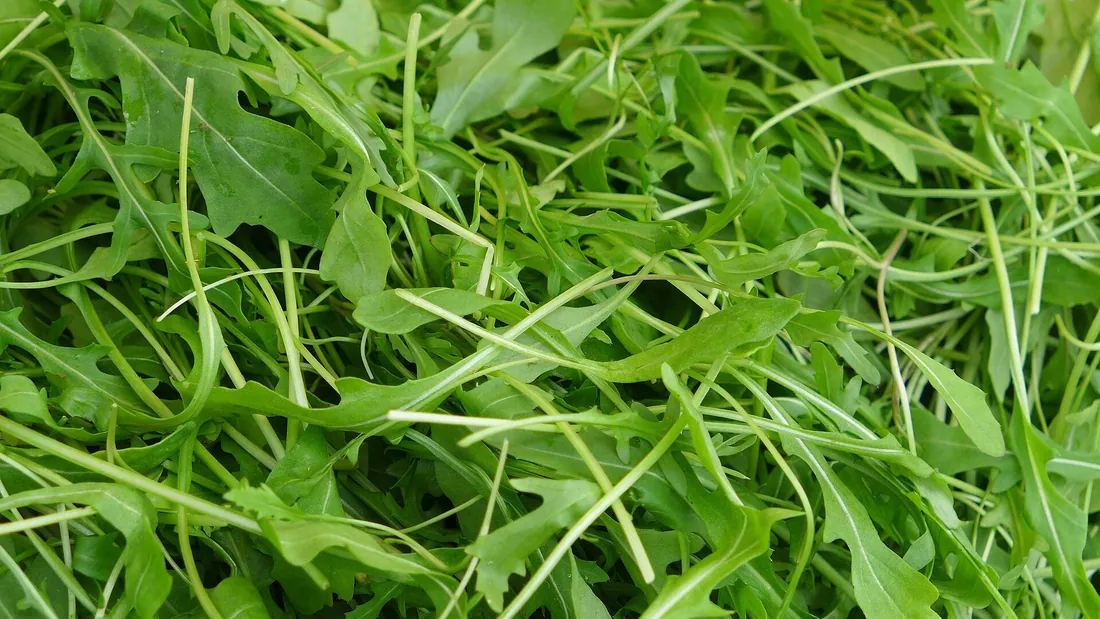
Rocket (Eruca vesicaria) is a salad with a pungent, peppery taste, one of the fastest in the garden: barely four to six weeks between sowing and the first leaves. It is an ideal vegetable for beginners or for those short on space, because it can be sown almost anywhere and grows back after each cut. Its only fault is its haste to run to seed as soon as it turns hot and dry. You tame it by sowing outside the peak of heat, when temperatures stay between 10 and 18 degrees.
Light and exposure
In spring and autumn, rocket enjoys full sun or bright light. In these seasons the heat stays moderate and the plant grows fast and thick without trying to flower. A well-exposed bed gives it full, well-coloured leaves.
In high summer, change your strategy: look for partial shade. A spot shaded during the hottest hours, at the foot of a taller crop or against a hedge positioned to cut the scorching sun, clearly delays bolting. The direct heat of high summer is its worst enemy, partial shade is the best way to keep it tender.
Watering
Rocket wants soil that stays cool at all times. This is even the key to keeping it mild: a plant that goes thirsty turns tough, fibrous and far more pungent, and it heads straight for flowering. Water regularly, without soaking, aiming at the base rather than the foliage.
In summer, watering becomes daily in dry, hot weather. The slightest touch of drought triggers bolting and spoils the harvest. A light mulch around the plants helps hold moisture and space out watering. In the cool seasons, and in a damp climate, rain is usually enough.
Soil and repotting
Ordinary soil, cool and well loosened at the surface, suits rocket very well. It is not demanding and grows in almost any garden soil, as long as it holds a little moisture. An addition of mature compost before sowing supports rapid growth and tender leaves.
Avoid soils that dry out too quickly, sandy and exposed, because they speed up bolting in summer. Soil that keeps cool, mulched if possible, is the best asset for prolonging harvests during the warm season. In a pot or window box, choose a deep enough container and keep a close eye on the watering.
Temperature and humidity
Rocket is a cool-season plant. It germinates and grows best between 10 and 18 degrees, which matches the shoulder seasons of temperate climates. Within that range it stays tender, mild and productive for several weeks.
Beyond 20 degrees everything gets complicated: the plant bolts to flower very fast, the leaves turn small, leathery and burning in the mouth. It withstands cold far better than heat and takes light autumn frosts without trouble. It is therefore not winter that stops it, but rather the heatwave.
Pruning and upkeep
Rocket is not pruned, it is harvested by cutting, and that is exactly what makes it so practical. Take the young leaves with scissors or a knife, a few centimetres from the soil, leaving the heart intact. The plant starts again and gives a fresh wave of leaves, often two or three harvests from a single sowing.
As soon as flower stems appear, cut them if you want to delay the plant’s end a little. But once bolting is well under way, it is better to pull it up and sow again elsewhere. You can also let it flower: the white veined flowers are edible, pretty and attract pollinators.
Pests and diseases
Rocket’s number one enemy is the flea beetle. These tiny jumping beetles riddle the leaves with small round holes, especially in hot dry weather on young plants. The best defence is an insect-proof net laid at sowing, which stops the flea beetles from reaching the leaves. Keeping the soil cool with regular watering also discourages them, as they prefer dry conditions.
Like all Brassicaceae, rocket can attract the caterpillars of the large white butterfly and, on heavy, damp soil, suffer from clubroot. Crop rotation, avoiding putting it back where cabbages, radishes or turnips have grown, limits this risk. Slugs also attack young seedlings in autumn, as with most salads.
Propagation
Rocket is propagated by direct sowing in place, very simple and very fast. Sow in rows or broadcast, under a few millimetres of fine soil, then firm down and keep cool. Emergence is express, often three to seven days, and the first leaves are cut four to six weeks later. Sow a little each time but often: this is the principle of successional sowing, which ensures a continuous harvest.
For your own seed, let a few plants run to flower, then form their pods. Rocket also self-seeds easily on its own if you let it. Harvest the pods when they dry and turn brown, before they burst, then extract and keep the seeds dry. They stay viable for several years.
Climate and hardiness
Where and in which climate it thrives
Rocket is not a plant its hardiness zone describes: it is a cool-season annual, and what decides the harvest is the temperature window, not the winter. It does best between 10 and 18 degrees, germinates fastest between 15 and 20 degrees, and switches to flowering above 20 degrees: the leaves shrink, toughen and turn burning in the mouth. On the cold side it is far tougher than people think: a mature plant takes brief frosts of -2 to -4 degrees without damage, and the chill even softens its bite. It is the barely emerged seedlings that suffer first, from -2 degrees.
So it is at home anywhere the year offers two mild windows, before and after the peak of heat. In a temperate climate, oceanic or continental, you sow as soon as the soil warms and until the days turn hot, then start again when they cool down, right up to the first frosts. In a Mediterranean or subtropical climate the window is reversed: the cool season, winter included, becomes the right period, and summer is the impossible one. Where the growing season is short, everything is decided in a few weeks and successional sowing, a short row every two or three weeks, counts more than anything else.
Two cases change the procedure. Under dry heat, bolting comes within days: partial shade, mulch and daily watering delay it, otherwise switch to wild rocket (Diplotaxis tenuifolia), far slower to run to seed. Under a mild, wet winter the crop carries on very late under a simple cloth, but slugs then take over from the flea beetles.
Growing rocket?
Green Hub keeps a dated history of your own plant: its photos, its progress, its repottings. An AI answers about yours specifically, not a generic sheet, for free.
Identify my plantMonth-by-month care calendar
| January | Nothing to sow in open ground. This is the time to order the seeds and plan the spot for the first spring sowings. |
|---|---|
| February | Still too cold outside. Possibility of a very early sowing under a cold frame or in a bright indoor spot to get ahead. |
| March | First sowings in place as soon as the soil dries out, possibly under cloth. This is the start of rocket’s good season. |
| April | Peak sowing period. Stagger every fortnight. First cut harvests from the earliest sowings. |
| May | Regular harvests, tender leaves. Keep up the successional sowings. Watch for flea beetles and lay a net if the leaves get holed. |
| June | Harvest still possible, but the heat pushes toward bolting. Sow rather in partial shade and water closely. |
| July | A difficult period. Rocket bolts fast. Sow in partial shade, mulch, water every day, or take a break until August. |
| August | Resumption of the late-season sowings. Keep the soil cool and shaded while it is hot. Insect-proof net advised from emergence. |
| September | An excellent month: the weather cools down, rocket turns tender again. Sow and harvest generously. Thin out crowded sowings. |
| October | Last harvests of the season. The plants withstand the first light frosts. A cloth prolongs the picking. |
| November | End of the season in the garden. Harvest the last protected plants. Clean the beds and note what worked well. |
| December | Rest. Optionally let a few plants self-seed on their own and plan next year’s successional sowings. |
Green Hub tips
- Sow in succession: a short row every two to three weeks gives young rocket continuously, rather than a mass that bolts all at once.
- In summer, look for partial shade and water without fail: it is drought and heat, not cold, that make it run to seed.
- Lay an insect-proof net from sowing. Flea beetles are the main enemy and riddle the leaves with small round holes in a few days.
- Harvest by cutting and leaving the heart intact: rocket grows back and gives two or three waves of leaves from a single sowing.
Related species
Broccoli
Brassica oleracea var. italica
Broccoli (Brassica oleracea var. italica) is a cabbage whose central head we harvest, a cluster of flower buds still…
Brussels sprout
Brassica oleracea var. gemmifera
Brussels sprouts (Brassica oleracea var. gemmifera) are harvested from autumn into the heart of winter, and every frost…
Cauliflower
Brassica oleracea var. botrytis
Cauliflower (Brassica oleracea var. botrytis) is a demanding vegetable that thrives in a cool, damp climate but never…
Curly kale
Brassica oleracea var. sabellica
Curly kale (Brassica oleracea var. sabellica), also known simply as kale, is a leafy vegetable of uncommon hardiness.…
Radish
Raphanus sativus
The radish (Raphanus sativus) is the fastest vegetable in the garden, ready to bite into in three to five weeks. It is…
Turnip
Brassica rapa
The turnip (Brassica rapa) is a hardy, fast-growing root, one of the easiest crops in the vegetable garden. Count on 6…
The guides that mention it
Vegetable Garden Pests: The Natural Method That Holds All Season
A leaf riddled with holes, a lettuce shaved to the ground overnight, a twisted and sticky shoot: every kind of damage…
Gardening Under a Greenhouse or Cold Frame: Growing All Year Round
A greenhouse or even a simple cold frame changes everything: sowings brought forward by several weeks, harvests…
Updated on
How this sheet is written
Written for Green Hub with the help of language models, then reviewed. It offers gardening guidance, not professional advice: if you are unsure whether a plant is toxic to a child or an animal, ask a vet, a doctor or your national poison centre.