Radish
Raphanus sativus
.jpg)
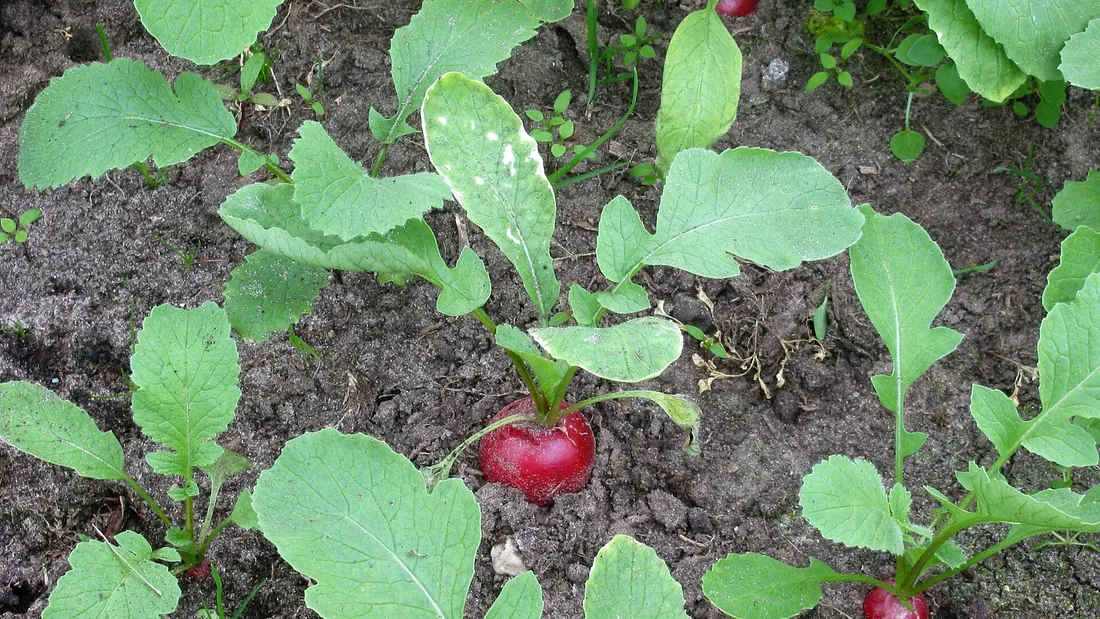
The radish (Raphanus sativus) is the fastest vegetable in the garden, ready to bite into in three to five weeks. It is the ideal crop for beginners, for keeping children busy and for filling the gaps between two slower vegetables. You can sow it very early, from the end of winter under a cold frame or a fleece, then in open ground right through the cool season. Its two enemies are the cabbage root fly and the flea beetles, those little beetles that riddle the foliage with holes in dry weather.
Light and exposure
In spring and autumn the radish likes full sun, which makes it grow fast and gives it crunch. Keep a well-exposed spot for the sowings from the end of winter to mid-spring, and again from late summer to mid-autumn.
In high summer it is the opposite. Long days and heat make it bolt and turn it hot and hollow: it is day length above about fourteen hours combined with mean temperatures over 25 degrees that triggers flowering. A spot in partial shade, or the light shade of a taller vegetable, suits it better through the hottest weeks of the year.
Watering
Water is the key to a good radish. Regular watering, without swings, gives tender, juicy, mild roots. The soil must never dry out completely during the crop’s short life.
A lack of water or a crop that drags on makes the radish hollow, fibrous and strong in heat. In dry weather, water every day at the end of the day. A sowing well watered and without interruption is ready in a month, that is the whole secret.
Soil and repotting
The radish thrives in a light, loose, cool soil, neither too rich nor too stony. A soil too heavily manured favours the foliage at the expense of the root. A simple pass with the hand fork and a fine raking before sowing are enough.
In heavy or stony ground the roots deform and fork. A little well-rotted compost and some sand to lighten it clearly improve the shape and the regularity of the radishes.
Temperature and humidity
The radish is hardy and stands the cool far better than the heat. It germinates as soon as the soil reaches 5 to 8 degrees and tolerates light frosts, down to about minus two or minus three degrees, which allows very early sowings.
Direct sowing is possible four to six weeks before your last frost, under a cold frame, a tunnel or a simple fleece that warms the soil and protects from cold snaps. A light fleece gains three to five degrees over the open air. In open ground with no cover, wait rather until the soil holds ten degrees. Conversely, the radish bolts when the days pass about fourteen hours of light and mean temperatures rise above 25 degrees, so you then have to sow it in partial shade or take a break until the cool returns.
Pruning and upkeep
The radish is not pruned, but it calls for careful thinning, the most important operation in its cultivation. Sown too thickly, it makes plenty of leaves and no root. As soon as the seedlings have two true leaves, thin them to leave two to three centimetres between each plant.
To avoid having to thin too much, sow thinly from the start, one seed every two centimetres. The young plants pulled out when thinning can in fact be eaten in salad, leaves included, nothing is wasted.
Pests and diseases
The cabbage root fly can lay at the collar of the radishes, and its larvae tunnel galleries into the roots that make them inedible. An insect-proof fleece laid from sowing is the surest defence, and it also keeps the fly away from the other brassicas.
Flea beetles are the other plague, especially in dry, hot weather. These tiny jumping beetles riddle the leaves with small round holes and weaken the young plants. Soil kept moist bothers them a great deal, and a fleece stops them. Slugs, for their part, attack the seedlings in wet weather.
Propagation
The radish is always sown in place, straight in open ground, because it does not like being transplanted. Sow in rows fifteen centimetres apart, or broadcast on a small bed, only one centimetre deep. Cover with fine soil and water.
To harvest continuously, sow a small row every two or three weeks right through the cool season rather than one large sowing all at once. Emergence is very fast, often three to five days, and the harvest follows three to five weeks after sowing depending on the season.
Climate and hardiness
Where and in which climate it thrives
The radish does not need to be hardy for long: its whole life lasts three to five weeks. What matters is that it stands cool far better than heat. The seed germinates from five to eight degrees in the soil, but slowly, in ten to fifteen days; between fifteen and twenty degrees emergence drops to three or four days. The young plants then take light frosts, down to about minus two or minus three degrees, which allows a first sowing well ahead of the rest of the garden, four to six weeks before your average last frost date, as soon as the soil has thawed. The root itself forms best between ten and twenty degrees.
The upper limit is more interesting than the lower one, because it is not purely thermal. The radish bolts when day length passes about fourteen hours and mean temperatures go above 25 degrees: it is the combination of the two that triggers flowering, not heat alone. At a high latitude, where summer days are very long, the window closes even in moderate weather; at a low latitude, where the day rarely exceeds thirteen hours, heat is what rules, and the radish becomes a cool-season crop.
In practice, sow on either side of high summer, in partial shade through the hottest weeks, and gain three to five degrees under a light fleece at both ends of the season. In a mild climate without hard frost, the winter crop is simply the best of the year: short days, cool soil, no bolting.
Growing radish?
Green Hub keeps a dated history of your own plant: its photos, its progress, its repottings. An AI answers about yours specifically, not a generic sheet, for free.
Identify my plantMonth-by-month care calendar
| January | Nothing in the garden. Order the seed and prepare the cold frame or fleece for the very early sowings. |
|---|---|
| February | Under a heated cold frame or a veranda, the very first trials are possible. In open ground, still too cold and too wet. |
| March | First real sowing, under a cold frame, tunnel or fleece that warms the soil and protects from frost. This is the earliest radish. |
| April | Sowing in open ground with no cover. First harvest of the March sowings. Lay a fleece against the fly and the flea beetles. |
| May | Regular sowings in open ground. Thin out, water without fail. Sow a small row every two weeks. |
| June | The heat arrives. Move the sowings to partial shade and water every day to keep the radish from bolting and turning hot. |
| July | High summer. Sow in partial shade only, or take a break. The radish bolts fast in strong heat in the sun. |
| August | At the end of the month, the cool returns. Resume the sowings for the autumn harvests. Water the young rows well. |
| September | An excellent time. Regular sowings in open ground, fast growth in the cool. Abundant harvests. |
| October | Last harvests of the September sowings. Under a cold frame or fleece, one final sowing is still on the cards. |
| November | The season is ending. Harvest the last radishes under cover. Clean the beds and feed the soil. |
| December | The garden rests. Note the varieties that held up well and prepare next year’s staggered sowing calendar. |
Green Hub tips
- Sow little but often, a small row every two or three weeks, rather than one large sowing at once that all comes together.
- Water makes the radish. Regular watering without swings gives tender, mild roots, a lack of water makes them hollow and hot.
- Lay an insect-proof fleece from sowing. It is the simplest defence against the cabbage root fly and against the flea beetles that riddle the leaves.
- In high summer, sow in partial shade or take a break. In sun and heat, the radish bolts before it even forms its root.
Related species
Broccoli
Brassica oleracea var. italica
Broccoli (Brassica oleracea var. italica) is a cabbage whose central head we harvest, a cluster of flower buds still…
Brussels sprout
Brassica oleracea var. gemmifera
Brussels sprouts (Brassica oleracea var. gemmifera) are harvested from autumn into the heart of winter, and every frost…
Cauliflower
Brassica oleracea var. botrytis
Cauliflower (Brassica oleracea var. botrytis) is a demanding vegetable that thrives in a cool, damp climate but never…
Curly kale
Brassica oleracea var. sabellica
Curly kale (Brassica oleracea var. sabellica), also known simply as kale, is a leafy vegetable of uncommon hardiness.…
Rocket
Eruca vesicaria
Rocket (Eruca vesicaria) is a salad with a pungent, peppery taste, one of the fastest in the garden: barely four to six…
Turnip
Brassica rapa
The turnip (Brassica rapa) is a hardy, fast-growing root, one of the easiest crops in the vegetable garden. Count on 6…
The guides that mention it
The vegetable garden calendar, from sowing to harvest
Two dates are enough to build an entire vegetable garden year: your last spring frost and your first autumn frost.…
Making Compost: Steering the Thermal Biology of the Heap
A compost heap is not a pile of waste you stir, it is a thermal process you steer. The real carbon/nitrogen ratio of…
Vegetable Garden Pests: The Natural Method That Holds All Season
A leaf riddled with holes, a lettuce shaved to the ground overnight, a twisted and sticky shoot: every kind of damage…
Garden Diseases: Recognising What Is Attacking Your Plants, and Acting Before the Spot Appears
A white bloom that wipes off on a fingertip, an angular lesion stopped dead by a vein, a fruit browned from the bottom…
Gardening on a Balcony or Terrace: Vegetables and Flowers in Pots
Weight, wind, exposure: what really changes when you garden up high instead of in open ground, and how to choose your…
Gardening Under a Greenhouse or Cold Frame: Growing All Year Round
A greenhouse or even a simple cold frame changes everything: sowings brought forward by several weeks, harvests…
Companion Planting in the Vegetable Garden: Which Plants Belong Together
Tomatoes and basil get along beautifully, while potatoes and tomatoes make each other sick: companion planting explains…
Living soil: the no-dig method for a garden that thrives without a spade
Giving up digging means letting earthworms and mycorrhizae build a living soil that feeds the garden in your…
Updated on
How this sheet is written
Written for Green Hub with the help of language models, then reviewed. It offers gardening guidance, not professional advice: if you are unsure whether a plant is toxic to a child or an animal, ask a vet, a doctor or your national poison centre.