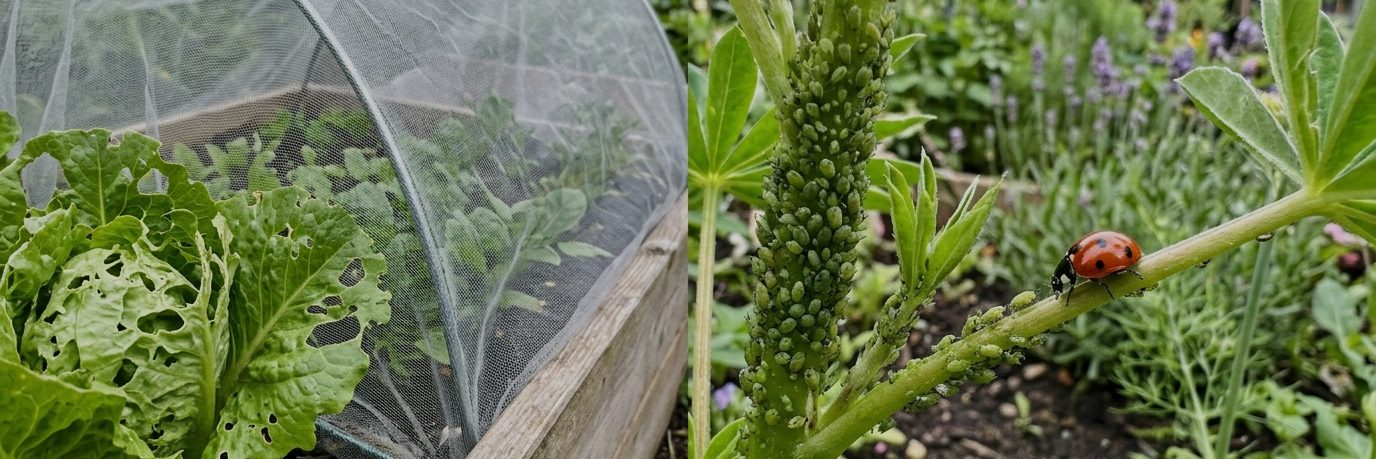
Vegetable Garden Pests: The Natural Method That Holds All Season
In the vegetable garden, the useful question is not which product to spray but in what order to act: identify the pest by the signature of its damage, check that it passes the threshold that justifies an intervention, then exclude it physically rather than treat it. Fine-mesh netting, a rotation matched to the way the pest moves and a habitat that settles the beneficials do most of the work. Spraying does far less than people believe, and often at the cost of the insects that were already regulating the plot.
Against vegetable garden pests, the order of the moves matters more than the choice of product. You identify first by the signature of the damage: a scatter of small round holes for flea beetles, large ragged bites and dried slime for slugs, dark green droppings and leaves reduced to their veins for caterpillars, distorted shoots and sticky foliage for aphids, a plant wilting for no visible reason for a maggot installed in the roots. You then ask whether the damage passes the threshold that justifies acting, because a vegetable tolerates far more lost foliage than anyone imagines and because a broad-spectrum intervention costs you the beneficials. Then comes the method that fails least often, exclusion: netting whose aperture suits the pest you are after, put on before the first flight, weighted down or buried right around its perimeter, and never installed over a bed the pest is about to emerge from. Rotation completes the netting, provided it is matched to the way the insect moves: a few metres are sometimes enough for a pest that walks, never for one that flies. Beneficials, finally, are not bought, they settle in, and they ask for accessible pollen flowers, a little-disturbed ground cover and a reserve of prey already in place before the crop pests arrive. The products approved for organic growing bring up the rear, insecticidal soap, nettle preparations, Bacillus thuringiensis, spinosad, pyrethrum: none of them is neutral, and pyrethrum in particular is a broad-spectrum insecticide that kills bees and beneficials just as surely as the pest you were aiming at.
Reading the damage: every pest signs its work
Almost every mistaken treatment begins with a mistaken identification, and most of them are settled by looking at two things: the shape of the damage and the hour at which it happens. A scatter of small round holes riddling the blade of a young brassica leaf is the signature of flea beetles, tiny jumping beetles. Large torn patches, seedlings gone overnight and dried slime trails point to slugs and snails. Leaves chewed in from the margin or reduced to their veins, with dark green droppings caught in the foliage, point to caterpillars. Twisted shoot tips and sticky foliage that blackens soon after point to sap-sucking insects and to the sooty mould growing on their honeydew. A plant that wilts through the hot hours, picks up again overnight, then gives out for good while its neighbours are fine, points to a larva installed in the roots, and nothing applied to the leaves will ever reach it.
The hour settles what the shape leaves open. Going out with a flashlight one to two hours after nightfall answers the slugs-against-caterpillars question in a single trip: the former are on the ground and on the lower leaves, the latter sit under the leaves and down in the heart of the plant. A pale winding tunnel seen against the light, within the thickness of the leaf itself, means a leafminer, that is, a larva lodged between the two leaf surfaces, out of reach of any contact product.
| What you see | Prime suspect | When to check | The check that settles it |
|---|---|---|---|
| A scatter of small round holes riddling the young leaves | Flea beetles (Phyllotreta and related genera) | In hot dry weather, in the middle of the day | Sweep your hand just over the foliage: flea beetles jump, nothing else does that |
| Large ragged bites, seedlings gone, dried shiny trails | Slugs and snails | One to two hours after nightfall, or in damp weather | Go out with a flashlight and inspect the soil around the plant, not just the leaf |
| Leaves chewed in from the margin or reduced to their veins, dark green droppings | Caterpillars of cabbage whites and of noctuid moths | By day, under the leaves and in the heart of the plant | Turn the leaves over: yellow egg clusters for the large white, single eggs for the small white |
| Distorted shoot tips, sticky foliage that blackens soon after | Aphids, with sooty mould on their honeydew | Continuously, from the moment growth restarts | Look at the shoot tips and the undersides of the leaves, then look at the ants climbing up them |
| A plant that wilts through the hot hours, picks up overnight, then dies while its neighbours are fine | Root-feeding maggot (cabbage maggot fly, carrot rust fly, onion maggot fly) | As soon as one isolated plant fails on an otherwise healthy bed | Pull the plant gently: it lifts without resistance and the roots are hollowed out |
| A pale winding tunnel within the thickness of the leaf | Leafminer, a larva lodged between the two leaf surfaces | Held up against the light | Establish that the larva is inside: no contact product will reach it |
| Potato or eggplant foliage devoured, red humpbacked larvae | Colorado potato beetle, where it is established | From emergence onward, under the leaves for the orange egg clusters | Count the larvae per plant rather than judging by eye; where the species is regulated, report it instead of treating |
| Small soft fruit collapsing within a few days on raspberry or blueberry | Spotted wing drosophila, where it is established | From the first colouring of the fruit | Drop a few fruits into salted water: the maggots come out |
Second habit, less obvious: do not condemn the insect you can see. An attacked plant draws visitors, and several of the most useful ones look nothing like the adult you would recognise. A lady beetle larva is an elongated creature, grey to black flecked with orange, which brings nothing to mind of the round red beetle; a hoverfly larva is a small translucent slug with no visible legs, sitting in the middle of the aphid colony it is busy emptying; a swollen, motionless aphid, brown to golden, is not a healthy aphid but a mummy from which a parasitoid micro-wasp will emerge. Squashing those three as a precaution is one of the most effective ways to make an attack worse.
One last point, often absent from guides: pest distribution is geographic, and an article cannot tell you who lives where you are. The Colorado potato beetle, native to North America, spread through most of continental Europe from the 1950s onward, but it is not established in Great Britain, where it remains a notifiable quarantine organism: spotting it there is something you report, not something you pick off. The large white (Pieris brassicae), common in Europe, North Africa and Asia, is not established in North America and has been eradicated from New Zealand, while its relative the small white (Pieris rapae), whose larva is the imported cabbageworm, introduced in Quebec around 1860, now occupies every continent except South America and Antarctica. The leek moth, a European species, was detected near Ottawa in 1993 and then in New York State in 2009. Before applying any recommendation, then, it is worth checking that the pest concerned is actually present where you garden, and a trap or a flashlight tells you that better than any text can.
The threshold: the question that comes before the treatment
Most of the insects in a vegetable garden are not pests, and most pests do not justify intervening. Great Britain alone has more than five hundred species of aphid, many of them tied to one or two host plants: the aphid living on a nettle or on a neighbouring shrub is not going to move onto your beans. The same logic holds for gastropods: of the forty-odd slug species recorded in the United Kingdom, very few eat living plants, the rest working on dead material. That is the reason the Royal Horticultural Society stopped in 2022 describing garden animals as pests, and now recommends not using pesticides in the ornamental garden or the home vegetable plot.
The second reason to slow down is that plants compensate. On potato, the trade worked for a long time with a very cautious threshold of 10% of foliage lost, whereas later work shows a clearly higher tolerance, and above all one that depends on the stage: the same percentage of defoliation does not cost the same thing before tuber initiation, during bulking, and after. On determinate processing varieties, an artificial defoliation trial found no measurable loss of total yield, only marketable size being affected. Put another way, foliage full of holes is not a lost harvest, and the eye always overestimates the damage.
The action thresholds actually used in production give a useful order of magnitude for the garden. Against the Colorado potato beetle, the figures circulated by agricultural extension services are of the order of one to one and a half large larvae per plant, or four small larvae per plant, or half an adult to one adult per plant. These numbers are counted plant by plant, not across the whole vegetable garden: three Colorado potato beetles on one bed are not an emergency, and the right move is to pick them off by hand rather than reach for a sprayer.
Counting calls for a minimal method, otherwise the count becomes an impression. Pick ten plants, mark them, and come back to the same ten every week: it is the variation from one week to the next that tells you something, not the value on any one day. A population that holds steady or falls back while hoverfly larvae are appearing calls for nothing at all. A population that doubles despite the presence of beneficials may well call for something.
Finally, acting has a cost that the gardener never puts on the invoice. Predators and parasitoids follow their prey, they never arrive ahead of it: wiping out the first aphid colony wipes out what was going to settle them on the plot. A broad-spectrum product does worse, since it also removes the ones that were already there. The plot then finds itself with no regulation at all just as the next wave arrives, carried by winged females from somewhere else, and the treatment becomes the cause of its own necessity.
Exclusion: netting fails least often, and here is how people still manage to fail with it
Physical exclusion is the only method that depends neither on the weather, nor on the time of day, nor on how sensitive the pest happens to be to an active ingredient. The principle is mechanical: the mesh aperture has to be smaller than the width of the thorax of the insect you are after, the one dimension it cannot compress. For flea beetles, the aperture generally used is of the order of 0.8 mm. For spotted wing drosophila, the exclusion work converges on openings smaller than about 1 mm in at least one dimension. Butterflies and moths, and the vegetable root flies, are stopped by wider meshes: a fine mesh therefore covers every case at once, but at the cost of reduced ventilation.
The effectiveness is not theoretical. In a trial run on young leafy brassicas, fine-mesh covers brought flea beetle damage down from 0.87 to 0.07 holes per square centimetre on spring arugula, and from 5.12 to 0.19 on late-season mizuna, reductions of the order of 92% and 96% on those two treatments. The sampling also showed that several species share the same bed, Phyllotreta striolata dominating by a wide margin, alongside P. cruciferae, P. bipustulata and Chaetocnema concinna: you are not fighting one species, you are fighting a guild.
| Pest | Barrier and aperture | When to put it on | What cancels the protection |
|---|---|---|---|
| Flea beetles | Netting with an aperture no larger than 0.8 mm | At sowing or planting, before emergence | An unweighted edge, or a bed that already carried attacked brassicas |
| Cabbage whites and other caterpillars | Fine-mesh netting stretched over hoops | Before the first flight, spotted by eye or by trap | Foliage touching the netting: the female lays straight through it |
| Carrot rust fly | Full coverage of the bed rather than a vertical barrier alone | From sowing, put straight back after every thinning | Relying on the vertical barrier alone: it protects an early crop, not several stacked generations |
| Cabbage maggot fly | A collar at the base of the plant, or full netting | At planting | The rim of the collar, where egg laying remains possible; full coverage does better |
| Leek moth | Fine-mesh netting | Before the flight, tracked with a pheromone trap | Laying the netting over an Allium bed and leaving the debris of the previous crop in place |
| Spotted wing drosophila | Netting whose openings stay under 1 mm in at least one dimension | From the first colouring of the fruit | Putting the netting on after the first eggs are laid: it shuts the pest in with the harvest |
Netting fails for four reasons, always the same ones. The first is the timing of the covering: put on after the first flight, it shuts the pest in with the crop. A pheromone trap or a sticky card trap gives you that date far better than a calendar does, and the biology explains why a calendar cannot work everywhere. The leek moth, for instance, needs about 445 degree-days above a developmental threshold of 7 °C to go from egg to adult: the number of generations in a season therefore depends directly on the heat accumulated at that place, and two gardens at the same latitude do not share a calendar.
The second reason is the edge. Netting that is not weighted, not buried, or simply lifted for the length of a thinning, no longer protects anything. The case of the collars laid at the base of brassica plants against cabbage maggot fly is instructive: they clearly reduce the damage, but egg laying remains possible around the rim of the disc, where it meets the soil, which is why full coverage does better than a spot protection.
The third reason is contact. A leaf touching the netting is a leaf within reach: the female lays straight through it. Hoops are not there to look neat, they are there to keep a gap between the fabric and the crop.
The fourth is the most expensive, because it is invisible: stretching netting over a bed the pest is about to emerge from. Carrot rust fly, cabbage maggot fly, flea beetles and Colorado potato beetle all spend the off season in the soil or in the debris of the crop that fed them. On a recycled bed, the netting becomes a cage that protects the pest from its predators. This is also the limit of vertical barriers against carrot rust fly: trials show they do good service on an early crop, but that they no longer suffice once the pressure builds up over several generations, and that full coverage of the bed is what gives an acceptable result.
Two trade-offs, finally, are worth knowing before you buy. A fine mesh reduces ventilation and drives up the temperature and the humidity under the cover, which can do more harm than the pest you were worried about. What settles it is how long the cover stays on: a fine mesh is justified over a short window, for the length of the smallest pest’s flight, whereas a cover that stays in place all season calls for the widest mesh that still stops the target. And a crop that needs pollinating insects, zucchini, pumpkin, cucumber, has to be uncovered at flowering, or hand-pollinated if the protection has to stay in place.
Aphids: the life cycle explains why it all happens at once
Aphids do not colonise gradually, they land. Understanding why saves you both the panic and the pointless treatment. Through the growing season, the colonies are made up of wingless females that reproduce without males and give birth to young already formed, themselves already carrying the embryos of the generation after: this telescoping of generations makes the population grow far faster than an ordinary egg-larva-adult cycle would suggest. When the colony saturates or the plant toughens up, winged forms appear and leave to found colonies elsewhere.
Several major species also alternate between two very different hosts, which explains how abruptly they turn up. The black bean aphid, Aphis fabae, spends the off season as an egg on a woody host, the European spindle tree (Euonymus europaeus); the stem mothers hatch there as growth resumes, a few generations follow one another, then winged forms migrate to herbaceous hosts, fava bean, bean, beet, nasturtium and many others. Late in the season the movement reverses and sexual forms go back to lay on the woody host. The green peach aphid, Myzus persicae, follows the same pattern from Prunus species and then proves remarkably polyphagous on crops. So the gardener sees a colony appear within a few days on a plant that was clean, and wrongly concludes that they were not paying attention.
Out of this cycle comes one very profitable move on fava beans. The black bean aphid colonises the soft tip of the stem first, the part still growing. Once the number of flowering tiers you want is in place, pinching out those tips removes at a stroke the tissue the pest prefers and the part of the colony sitting on it, and it also steers the plant towards filling its pods. The pinched-out tips are not left lying on the ground.
Before treating, you also have to look at the ants, which are often the real reason a colony is thriving. Ants harvest the honeydew and protect the aphid in exchange: they attack predators and hinder parasitoids, so that tended colonies grow faster and are less parasitised. A colony under ant guard is not an ordinary colony, and restoring access for the beneficials does more there than a spray.
The point that really changes the decision concerns viruses. Non-persistent viruses, such as potato virus Y or cucumber mosaic virus, are acquired and then inoculated within seconds, during the brief exploratory probes an aphid makes while testing a plant, and they stay attached to its mouthparts only for a few minutes to a few hours. No insecticide acts fast enough to prevent that transmission, and antifeedant products do not stop the probe in time. Against the virus, what counts is keeping the winged aphid from landing, so the cover, the mulches, the vigour of the plants, and the removal of symptomatic ones. Not the spray.
When an intervention is justified all the same, insecticidal soap works strictly by contact, with no residual action: what is not wetted is not reached, the undersides of the leaves and the heart of the shoots have to be covered, and the product does nothing whatever to protect tomorrow’s growth. It hits small soft-bodied arthropods and leaves caterpillars and beetle larvae untouched.
Slugs and snails: what the controlled trials actually showed
This is the area where the gap between the advice everyone repeats and the measured results is widest. The Royal Horticultural Society followed 108 lettuces, split between pots and raised beds, protected by five classic barriers: crushed eggshells, pine bark mulch, copper tape, crushed gravel and wool pellets. After six weeks, the protected lettuces were no less damaged than the ones left with nothing at all. The explanation is physiological: a well-hydrated slug produces extra mucus and crosses a dry, rough or sharp surface as soon as what waits on the other side is worth it. Copper, often presented as the safe bet of the group, was no exception.
Before looking for a countermeasure, the target has to be narrowed down. Of the forty-odd slug species in the United Kingdom, very few attack living plants; in Europe, the two genuinely problematic species in gardens and in field crops are the grey field slug, Deroceras reticulatum, and the large invasive slug Arion vulgaris. The others work on dead matter and take part in recycling. An indiscriminate elimination campaign therefore hits mainly species of no agricultural importance.
What does work falls into three registers. The first is hand-picking, thankless but effective, by flashlight one to two hours after nightfall, or in damp weather. The second is cultural: watering in the morning rather than the evening leaves the surface drier at the hour when they come out, and setting out sturdy transplants rather than sowing in place carries the crop past the stage where a few nights are enough to make it disappear. The third is biological. Phasmarhabditis nematodes are applied to moist soil whose temperature sits between about 5 and 20 °C, penetrate the slug, stop it feeding, and give something like six weeks of protection per application, provided the soil is kept moist afterwards.
Predators deserve a precise reading, because it explains why they do not let you off the hand-picking. Ground beetles are the best documented beneficials in this field: Pterostichus melanarius readily attacks and eats slugs weighing under about 40 mg, with a practical ceiling somewhere around 100 mg, and it also destroys the eggs. Trials combining several ground beetle species show more egg destruction than any single species achieves. Translated for the vegetable garden: ground beetles work on the next generation and on the small slugs, not on the big one shaving your lettuce tonight. They ask for permanent ground cover and little-disturbed soil, and they add to hand-picking instead of replacing it.
That leaves pellets and beer traps. The Royal Horticultural Society considers that slug pellets, including those accepted in organic growing, have shown negative effects on garden wildlife. On iron phosphate, the point under discussion is not the iron but the chelating agent that comes with it: laboratory work has linked baits containing EDTA to reduced feeding, weight loss and mortality in earthworms, while a field study observed deeper burrowing, read as avoidance behaviour, with no significant difference in abundance four months after application. This is neither harmless nor catastrophic: it is a reason not to scatter the stuff out of habit. As for beer traps, they catch, which is not the same thing as protecting, and an open trap also drowns the very ground beetles you were trying to keep.
Caterpillars: breaking the generation, and what Bacillus thuringiensis really hits
Two cabbage whites account for most of the damage on brassicas, and they are not handled in quite the same way. The large white, Pieris brassicae, lays yellow eggs in tight clusters under the leaves, and its yellow and black caterpillars feed in groups: one cluster spotted and removed is a whole colony gone. The small white, Pieris rapae, whose larva is the imported cabbageworm, lays its eggs singly instead, and its green, solitary caterpillar hides along the midrib, which makes it far more discreet for an equivalent amount of damage. The distribution of the two species differs sharply: the first is European, North African and Asian, is not established in North America and has been eradicated from New Zealand, while the second, introduced in Quebec around 1860, has spread to every continent except South America and Antarctica. In a temperate climate the small white runs three to five overlapping generations, more where the season is long, and the large white two to four.
That overlap is what makes a weekly inspection so profitable. Turning the leaves over once a week and removing the egg clusters costs a few minutes and breaks the generation before it exists, whereas waiting for the caterpillar means acting on the hungriest and most mobile stage. One detail worth knowing during that inspection: a motionless caterpillar surrounded by small yellow cocoons is not one to squash. It has been parasitised by micro-wasps of the genus Cotesia, and leaving it in place releases the generation of parasitoids that will work for you on the following batches of eggs.
Bacillus thuringiensis subspecies kurstaki, the only common microbial material against caterpillars, deserves to be described without indulgence, because its reputation as a harmless product is wrong at one precise point. Its mode of action first: it has to be ingested, so it only acts on a caterpillar that actually eats the treated surface, and it is clearly more effective on the early instars than on large caterpillars. Ultraviolet light is the main factor degrading the spores and the toxin, which limits the duration of action to a few days and makes repeat applications necessary for as long as egg laying continues.
Its selectivity next, and this is the part that rarely gets said: kurstaki does not tell a cabbage caterpillar from any other caterpillar. Field studies have measured its toxicity on non-target lepidoptera, including butterflies feeding on their natural host plants, and the literature notes a real risk to populations of rare species where it is applied broadly. The practical consequences are clear: you treat the crop concerned, not the hedge, not the flower strip, not a patch of nettles at the bottom of the garden; you do not spray an area as a precaution; and you always prefer the netting and the removal of eggs, which have no collateral effect at all.
Another moth deserves a mention, because it wrong-foots anyone not expecting it: the leek moth, whose caterpillar mines the leaves of leek, garlic, onion and shallot before boring down towards the shaft. European in origin, it has become invasive in eastern North America after its detection near Ottawa in 1993, then in New York State in 2009. Its full cycle needs about 445 degree-days above 7 °C, which explains why the number of generations rises with the length of the season. Against it, exclusion put in place before the flight gives the best result, releases of Trichogramma brassicae during the flights cut damage by more than half in trials, and clearing away crop debris at the end of the season deprives the adults of their overwintering shelter.
Flea beetles and Colorado potato beetle: two beetles, two ways of travelling, two strategies
Flea beetles are a problem of growth stage, not a problem of numbers. The same number of bites that kills a seedling at the cotyledon stage goes unnoticed on an established plant: the whole strategy therefore consists in carrying the crop past its window of vulnerability. In practice that means covering from sowing or planting onward, keeping the soil moist, because the adults are favoured by hot dry spells, and preferring to set out well-grown transplants rather than direct sow where the pressure is known. The netting has to be laid before emergence, on a bed that did not carry brassicas the year before, failing which the adults overwintering on the spot find themselves shut in with the crop.
The trial on young brassicas already mentioned brings, alongside its result on netting, a piece of information that amounts to a warning. The essential oil sprays tested in comparison rarely did better than the untreated control, and they caused damage to the crop: leaf burn for rosemary and neem oils, with yields down for rosemary, and complete destruction of the crop within twenty-four hours for thyme oil. A plant-derived product is not a gentle version of an insecticide, and a homemade recipe with no established dose is a risk to the crop before it is a risk to the pest.
The Colorado potato beetle follows another logic, because it travels differently. Native to North America, having moved onto cultivated potato, it reached Europe and spread through most of the continent from the 1950s onward; it remains absent and regulated in Great Britain, where its presence has to be reported to the official services. Where it is established, a few figures frame the problem: a female lays 300 to 800 eggs over her lifetime, in clusters of 20 to 30 under the leaves; the larva passes through four instars in two to three weeks, the last causing most of the damage; and the region determines one to three generations a year.
The usable detail lies elsewhere: the adults overwinter in the soil, come back up as it warms, somewhere around 13 °C, and reach the crop on foot rather than on the wing while temperatures stay cool. Three non-chemical methods follow directly from that. Rotation works provided the distance is real: recommendations in production speak of several hundred metres, of the order of four hundred to eight hundred metres from last year’s plot, which is out of reach for a home vegetable garden and explains why moving the potatoes over by two rows changes nothing. A plastic-lined trench with sloping walls intercepts the adults walking in, and they cannot climb back out. Finally, a thick straw mulch blurs the location of the crop and shelters the predators, with reduced populations in mulched plots.
In the garden, the conclusion is down to earth: inspect every two or three days through the colonisation period, crush the egg clusters under the leaves, pick off the adults and the larvae, mulch, and count rather than estimate, remembering that the action threshold sits around one to one and a half large larvae per plant. Hand-picking, over the area of a vegetable garden, remains the best targeted method and the only one with no collateral effect.
Beneficials are not bought, they settle in
A beneficial insect does not settle in because a pest has arrived, but because it found, beforehand, something to eat and somewhere to lay. The lag between the prey and its predator is the real problem in a vegetable garden, and the way to shorten it is to have a reserve of prey that is not on the crop.
The best documented case is the nettle. It hosts its own aphid, Microlophium carnosum, which is tied to it and does not move onto vegetables, and it therefore serves as an early larder. A classic study of the nettle’s role as a reservoir of natural enemies showed that the species shared with crops, the seven-spot lady beetle Coccinella septempunctata, the hoverfly Episyrphus balteatus and the parasitoid Aphidius ervi, were present on nettle before they appeared on the neighbouring crops. The same work notes that cutting the nettle clumps at the wrong moment strongly alters which lady beetles are present: a patch of nettles is therefore not a neglected corner, it is a working part of the system, and it does not get mown while the lady beetles are busy in it.
The second lever is the food of the adults, which is almost never the same as the food of the larvae. Female hoverflies need pollen to produce their eggs: without accessible flowers they do not lay, and the predatory larvae do not exist. In California, intercropping sweet alyssum in organic lettuce increased hoverfly egg laying, hence the number of larvae, and reduced aphids; the larvae of the hungriest species observed there kill more than one hundred and sixty lettuce aphids a day. What works are flat flowers with accessible nectar, umbellifers left to run to flower such as coriander, fennel and chervil, sweet alyssum, buckwheat, rather than deep corollas meant for long tongues. One practical consequence that is rarely applied: let a few herbs and root vegetables flower instead of harvesting or pulling everything.
Third lever, remove what gets in the way. Ants exploiting the honeydew attack predators and disturb parasitoids, to the point that ant management is used in production as a biological control lever in its own right. Ground beetles, for their part, ask for permanent cover, uncultivated areas and refuges at ground level; a vegetable garden that is entirely clean and turned over houses none of them.
That leaves the question of buying them in. The North American lady beetle sold in bulk, Hippodamia convergens, is collected at its overwintering sites: it arrives physiologically programmed to migrate, and published work reports that around 95% of the individuals fly off within the 48 hours following release, the rest leaving over a few days. In an open garden the exercise therefore has little effect; in a closed greenhouse, the same species behaves quite differently. The difference is as much about the life stage as about the place: a larva does not fly, it stays where you put it and feeds until it pupates, which makes releasing larvae more coherent than releasing adults. And for a vegetable garden, the free version remains the most effective: pollen flowers spread across the whole season, a reserve of prey off the crop, cover at ground level, and no broad-spectrum spray to reset the counter to zero.
What the products approved for organic growing really do, and to whom
Approved for organic farming does not mean free of non-target effects, and that is probably the costliest misunderstanding in natural gardening. Each of these products has a real target, narrower than its reputation, and a set of documented side effects.
| Product | Real target | Documented non-target effects | Practical limit |
|---|---|---|---|
| Insecticidal soap (potassium salts of fatty acids) | Small soft-bodied arthropods: aphids, young scale insects, whiteflies, psyllids, mites | No residual action, hence little delayed effect on beneficials; leaf burn above 1 to 2% | Strictly contact: what is not wetted is not reached, and caterpillars and beetle larvae are not concerned |
| Nettle preparation (Urtica spp.) | Insecticidal, acaricidal and fungicidal use, under its European approval as a basic substance | Basic substance status, meaning low concern, but a spray also hits insects that were not the target | A supporting effect: it replaces neither the netting, nor the hand-picking, nor the counting |
| Natural pyrethrum (Tanacetum cinerariifolium) | Almost every insect reached by the spray | Very toxic to honey bees and wild bees, to beneficials, and to fish and aquatic invertebrates | Breakdown in about a day, which limits residues but not the mortality at the moment of treatment |
| Azadirachtin (neem) | Insects with a larval cycle, by ingestion and disruption of development | Mild phytotoxic burn measured on young brassicas, with necrosis of the apical leaf tissue | Regulatory status varies from country to country: active substance approved in the European Union, placing on the market declared illegal in the United Kingdom, product registered in the United States |
| Bacillus thuringiensis kurstaki | Lepidopteran caterpillars that ingest it, above all in the early instars | Does not distinguish the target caterpillars from other lepidoptera, including rare species | Degraded by ultraviolet light: short action, and no effect at all if the caterpillar does not eat the treated surface |
| Spinosad | Colorado potato beetle larvae, caterpillars, thrips | Very toxic to bees for as long as the spray stays wet, effect strongly reduced once the deposit has dried | The whole of its safety rests on the timing of the application and the drying time |
Insecticidal soap, based on potassium salts of fatty acids, works by contact and only by contact: it has no residual action, which is at once its virtue, since the beneficial that turns up the next day is untouched, and its limit, since it does not protect the next flush of growth. It hits small soft-bodied arthropods, aphids, young scale insects, whiteflies, psyllids and mites, and leaves caterpillars, beetle larvae and sawflies untouched. Commercial formulations are used at 1 to 2% in solution, and beyond that leaf burn appears; some plants mark even within that range, hence the trial on a few leaves first. Dish soaps are not a cheap equivalent: extension services warn against using them in the garden, they can damage plants, degrade the soil and pollute water, and their composition is neither stable nor designed for the purpose.
Nettle preparations have a precise regulatory status in the European Union: Urtica spp. is approved there as a basic substance, under Implementing Regulation 2017/419, for insecticidal, acaricidal and fungicidal use. That status describes a substance of low concern, not a knockdown insecticide, and it is better to expect a supporting effect from it than a result. It does away with neither the netting, nor the hand-picking, nor the counting.
Natural pyrethrum, extracted from Tanacetum cinerariifolium, is the product whose image is furthest from its actual behaviour. It is a fast-acting, broad-spectrum neurotoxin, highly toxic to every insect the spray reaches, honey bees and wild bees included, and very toxic to fish and aquatic invertebrates. Its rapid breakdown, on the order of a day, limits residues but changes nothing about what was killed at the moment of application. If you do resort to it, it has to be a one-off, localised move, never on a plant in flower, never while pollinators are active.
Azadirachtin, extracted from neem, raises a different problem, that of the law that applies. It has been approved as an active substance in the European Union since 2011, whereas the British health and safety authority has stated that it is illegal to place plant protection products containing azadirachtin on the market in the United Kingdom, and it is registered and sold in the United States. A product that is perfectly legal on one side of a border is not legal on the other, and ordering online does not change that fact. Agronomically, the trial on young brassicas already cited recorded mild phytotoxic burn with neem oil, with necrosis of the apical leaf tissue.
Bacillus thuringiensis kurstaki and spinosad close the list. The first concerns only lepidopteran caterpillars that ingest it, without distinguishing the target species from any other, and it degrades under ultraviolet light. The second, derived from a soil bacterium, is effective on Colorado potato beetle larvae, on caterpillars and on thrips; it is very toxic to bees for as long as the spray stays wet, and that toxicity drops sharply once the deposit has dried, within a few hours to a day depending on the product, with lady beetles, lacewings and predatory mites tolerating dry residues relatively well. The whole difference between an acceptable use and an accident therefore comes down to the timing of the application and the drying time.
One last rule holds for all of them: no dose is invented. A dilution that appears neither on a label nor in a verifiable source has no phytotoxicity reference point, no pre-harvest interval, and no guarantee about what it kills besides the target.
Common pitfalls to avoid
MistakeStretching insect netting over the very bed where a crop from the same family was attacked the year before.
Why :Carrot rust fly, cabbage maggot fly, flea beetles and Colorado potato beetle spend the off season in the soil or in the debris of the crop that fed them. The netting then prevents nothing at all: it shuts the adults in with the crop at the moment they come up out of the ground, and at the same time it bars the way to their predators. The gardener sees damage under an intact protection and concludes that netting is useless.
Do this instead :Line the netting up with the rotation: the bed has to be new to the botanical family concerned, and the netting laid before the first flight, edges buried or weighted right around the perimeter, on hoops so the foliage does not touch the fabric. On garlic, onion and leek crops, also clear away the debris of the previous crop, where the adult leek moths overwinter.
MistakeSpraying at the first aphid you spot, to get ahead of the problem.
Why :Predators follow their prey and never arrive ahead of it: wiping out the first colony wipes out what was going to settle them on the plot, and a broad-spectrum product also removes the ones already there. The next wave, carried by winged females from somewhere else, then lands on a vegetable garden with no regulation left. Against non-persistent viruses such as potato virus Y or cucumber mosaic virus, the treatment is on top of that useless by construction: the aphid acquires and inoculates the virus within seconds, during simple exploratory probes, long before any insecticide takes effect.
Do this instead :Count before acting, on the same plants from one week to the next, and look first at the ants, which protect the colonies whose honeydew they harvest. Squash the colonies with your thumb, pinch out and carry away the infested tips on fava beans, and leave in place the swollen aphids that have turned brown to golden, which are mummies with parasitoids inside them. If an intervention is justified, insecticidal soap works by contact alone and without residual action: wet the undersides of the leaves, and do not count on it to protect tomorrow’s growth.
MistakeRinging the plants with eggshells, ash, gravel, copper tape or wool pellets and considering the protection done.
Why :A Royal Horticultural Society trial followed 108 lettuces, in pots and in raised beds, with five barriers of this kind. After six weeks, the protected lettuces were no less damaged than the ones left with nothing at all. A well-hydrated slug produces extra mucus and crosses a dry, rough or sharp surface as soon as what waits on the other side is worth it.
Do this instead :Move the effort to where it has actually been measured: hand-picking by flashlight one to two hours after nightfall, watering in the morning rather than the evening so the surface is dry at the hour they come out, setting out sturdy transplants rather than sowing in place under heavy pressure, Phasmarhabditis nematodes on moist soil whose temperature sits between about 5 and 20 °C, and permanent cover for the ground beetles, which destroy the eggs and the young slugs.
MistakeReaching for pyrethrum when nothing else has worked, on the assumption that a plant-derived insecticide has no consequences.
Why :Pyrethrum is a broad-spectrum neurotoxin: it kills every insect the spray reaches, honey bees and wild bees included, along with the lady beetles, hoverflies and parasitoid micro-wasps the plot took a whole season to settle. It is also very toxic to fish and aquatic invertebrates. Its breakdown in about a day is reassuring as far as residues go, but changes nothing about what is dead at the moment of treatment, and the plot is left with no regulation for the next wave.
Do this instead :Keep it for a one-off, localised move, never on a plant in flower, never while pollinators are active, on the affected area alone and at the end of the day. Before getting that far, check that the threshold really has been passed, and see whether exclusion, hand-picking or the removal of the affected parts settles the problem.
MistakeMixing your own spray from dish soap, a few drops of essential oil and a dose worked out by eye.
Why :These are not gentle versions of commercial products. Dish soaps are not formulated for foliage and extension services advise against using them in the garden: they can damage plants, degrade the soil and pollute water. As for essential oils, a trial on young brassicas compared several of them against an untreated control: they rarely did better, they caused leaf burn and yield losses, and thyme oil destroyed the crop within twenty-four hours. An invented dose offers no reference point either: nothing tells you the concentration at which the foliage starts to mark.
Do this instead :Stick to products whose use concentration is written down somewhere. Commercial insecticidal soaps are used at 1 to 2% in solution, and beyond that the foliage burns: follow the product label, test on a few leaves first, wait two or three days before going further, and give up on any recipe that nobody can account for in terms of what it kills besides the target.
The care sheets to read next
Every plant mentioned has its full sheet: watering, light, soil, pests and a month-by-month calendar.
Curly kale
Brassica oleracea var. sabellica
Curly kale (Brassica oleracea var. sabellica), also known simply as kale, is a leafy vegetable of uncommon hardiness.…
Cauliflower
Brassica oleracea var. botrytis
Cauliflower (Brassica oleracea var. botrytis) is a demanding vegetable that thrives in a cool, damp climate but never…
Broccoli
Brassica oleracea var. italica
Broccoli (Brassica oleracea var. italica) is a cabbage whose central head we harvest, a cluster of flower buds still…
Brussels sprout
Brassica oleracea var. gemmifera
Brussels sprouts (Brassica oleracea var. gemmifera) are harvested from autumn into the heart of winter, and every frost…
Radish
Raphanus sativus
The radish (Raphanus sativus) is the fastest vegetable in the garden, ready to bite into in three to five weeks. It is…
Turnip
Brassica rapa
The turnip (Brassica rapa) is a hardy, fast-growing root, one of the easiest crops in the vegetable garden. Count on 6…
Rocket
Eruca vesicaria
Rocket (Eruca vesicaria) is a salad with a pungent, peppery taste, one of the fastest in the garden: barely four to six…
Lettuce
Lactuca sativa
Lettuce (Lactuca sativa) is the most widely grown salad in the vegetable garden, easy and quick, harvested six to ten…
Hosta
Hosta
The hosta (Hosta spp.) is a perennial native to the damp woodlands of East Asia, from Japan through China to Korea. It…
Dahlia
Dahlia
The dahlia (Dahlia) is a tuberous plant that offers one of the longest and most spectacular displays of the summer…
Strawberry
Fragaria x ananassa
The strawberry (Fragaria x ananassa) is a hardy perennial that fits very well into any vegetable garden. Hardy to…
Raspberry
Rubus idaeus
The raspberry (Rubus idaeus) is a small fruiting shrub, hardy down to -25 °C, that grows wild in the cool woodland of…
Blueberry
Vaccinium corymbosum
The cultivated blueberry (Vaccinium corymbosum) is the large shrubby cousin of the wild bilberry, also called the…
Potato
Solanum tuberosum
The potato (Solanum tuberosum) is one of the most rewarding crops in the vegetable garden: easy, productive and…
Eggplant
Solanum melongena
The eggplant (Solanum melongena) is the most cold-sensitive and the most heat-hungry of the garden nightshades, even…
Tomato
Solanum lycopersicum
The tomato (Solanum lycopersicum) is the queen of the vegetable garden, but it is a plant of sun and warmth that plays…
Broad bean
Vicia faba
The broad bean (Vicia faba) is one of the very first vegetables of the year, a rustic, sturdy legume that goes into the…
Bean
Phaseolus vulgaris
The green bean (Phaseolus vulgaris) is one of the easiest vegetables in the kitchen garden, provided you respect one…
Nasturtium
Tropaeolum majus
The nasturtium (Tropaeolum majus) is an annual native to the Andean highlands of Peru and Colombia that has become an…
Carrot
Daucus carota
The carrot (Daucus carota) is a staple root vegetable in the vegetable garden, keeping all winter and sown directly in…
Parsnip
Pastinaca sativa
The parsnip (Pastinaca sativa) is an old, hardy root vegetable, a cousin of the carrot, with white flesh and a mild,…
Celery
Apium graveolens
Celery (Apium graveolens) covers two vegetables from the same species: stalk celery, grown for its crisp ribs, and…
Leek
Allium porrum
The leek (Allium porrum) is the winter vegetable par excellence. Very hardy, it stands in the ground all winter and is…
Onion
Allium cepa
The onion (Allium cepa) is a hardy, no-fuss bulb vegetable, one of the easiest crops to succeed with in a vegetable…
Coriander
Coriandrum sativum
Coriander (Coriandrum sativum) is an annual herb grown for both its fresh leaves, with their pronounced flavour, and…
Florence fennel
Foeniculum vulgare var. azoricum
Florence fennel (Foeniculum vulgare var. azoricum) is the fennel grown for its swollen base, crisp and…
Frequently asked questions
How can I tell whether slugs or caterpillars are eating my lettuces?
The hour and the leftovers settle it in one trip outside. Slugs work at night and in damp weather: they leave large ragged bites and dried slime trails, they make whole seedlings disappear, and you find them on the soil around the plant as much as on the leaves. Caterpillars leave dark green droppings caught in the foliage, chew in from the margin or reduce the leaf to its veins, and sit under the leaves and in the heart of the plant, by day as much as by night. An inspection by flashlight one to two hours after nightfall answers the question. And if nothing is eating the leaves while plants wilt through the hot hours and then die, it is neither of the two: a larva is installed in the roots, and the plant lifts out without resistance.
Should you treat at the first aphids?
No, and for three reasons that stack up. Predators and parasitoids always arrive after their prey: destroying the first colony removes what was going to settle them on the plot, and a broad-spectrum product also removes the ones that were already there. Insecticidal soap has no residual action, so it offers no protection against the winged females that will land the next day. Finally, against non-persistent viruses such as potato virus Y or cucumber mosaic virus, no insecticide is fast enough: transmission happens within seconds, during the exploratory probes. What does help at this stage: counting on the same plants from one week to the next, dealing with the ants that protect the colonies, squashing them with your thumb, pinching out and carrying away the infested tips on fava beans, and leaving in place the swollen aphids that have turned brown to golden, which are mummies with a parasitoid inside.
What mesh aperture should I choose for insect netting?
The one that falls below the thorax width of the pest you are after, the one dimension an insect cannot compress. For flea beetles, the aperture generally used is of the order of 0.8 mm; for spotted wing drosophila, the exclusion work converges on openings smaller than about 1 mm in at least one dimension; butterflies, moths and the vegetable root flies are stopped by wider meshes. A net sized on the smallest pest does indeed cover the others, but the finest mesh is not taken by default: the tighter the mesh, the lower the ventilation and the higher the temperature and the humidity under the cover. The call is made on how long the cover stays on: fine mesh over a short window, wider mesh for a cover that stays in place all season. Whatever the mesh, four conditions decide the outcome: put on before the first flight, edges buried or weighted right around the perimeter, hoops so the foliage does not touch the fabric, and never over a bed the pest is about to emerge from.
Are insecticidal soap and nettle tea really insecticides?
Not in the usual sense of the word. Insecticidal soap, based on potassium salts of fatty acids, works by contact and only by contact, with no residual action at all: it hits small soft-bodied arthropods, aphids, whiteflies, young scale insects, psyllids and mites, and leaves caterpillars, sawflies and beetle larvae untouched. Commercial formulations are used at 1 to 2% in solution, and beyond that the foliage burns; dish soaps are not an equivalent and extension services advise against using them in the garden. As for nettle, Urtica spp. is approved in the European Union as a basic substance for insecticidal, acaricidal and fungicidal use: that status describes a substance of low concern, not a knockdown product, and what you should expect from it is a supporting effect. Neither of the two does away with physical exclusion, and no dilution is invented.
Is Bacillus thuringiensis harmless to the rest of the garden?
It is selective, which is not the same thing as harmless. The kurstaki subspecies acts only on lepidopteran caterpillars that ingest it, and above all on the early instars; on the other hand, it makes no distinction at all between a cabbage caterpillar and any other caterpillar. Field studies have measured its toxicity on non-target lepidoptera feeding on their natural host plants, and the literature flags a risk to populations of rare species where it is applied broadly. The practical consequences are simple: treat the crop concerned and nothing else, not the hedge, not the flower strip, never spray an area as a precaution, aim for the young caterpillars, repeat only for as long as egg laying continues, and remember that ultraviolet light degrades the product quickly. Netting and the removal of egg clusters remain preferable, because they have no collateral effect.
Does buying lady beetles actually work?
For adult lady beetles sold in bulk, no, not in an open garden. The most widely marketed North American species, Hippodamia convergens, is collected at its overwintering sites and arrives physiologically programmed to migrate: published work reports that around 95% of the individuals fly off within the 48 hours following release, the rest leaving over a few days. In a closed greenhouse, the same species gives a completely different result. The difference also comes down to the life stage: a larva does not fly, it stays where you put it, which makes a release of larvae far more coherent than a release of adults. For a vegetable garden, the free version does better than the purchase: accessible pollen flowers spread across the whole season, umbellifers left to run to flower and sweet alyssum foremost among them, a reserve of prey off the crop such as a patch of nettles carrying its own aphid with no risk to the vegetables, permanent cover for the ground beetles, and no broad-spectrum spray to reset the counter to zero.
Green Hub looks after your plants
Photograph a plant: Green Hub identifies it and writes its care sheet, with no account. Sign in afterwards to keep its dated photos and history over time.
Identify a plantUpdated on
How this sheet is written
Written for Green Hub with the help of language models, then reviewed. It offers gardening guidance, not professional advice: if you are unsure whether a plant is toxic to a child or an animal, ask a vet, a doctor or your national poison centre.