Gardening Under a Greenhouse or Cold Frame: Growing All Year Round
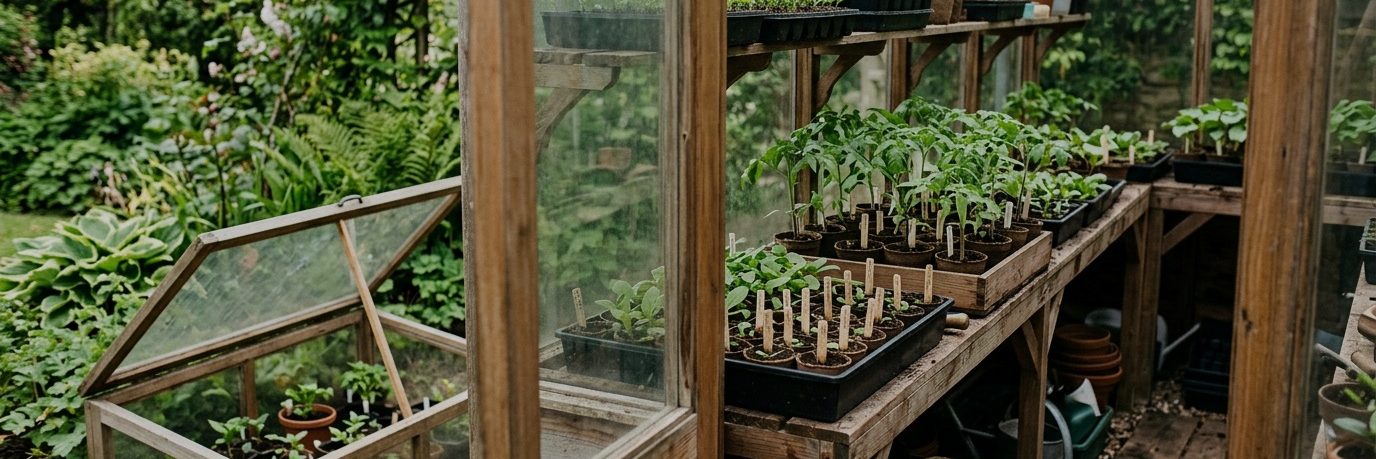
Gardening under a greenhouse or cold frame means growing behind an unheated transparent wall to gain warmth without spending any energy. A well-exposed cold greenhouse typically gains 2 to 10°C depending on insulation and sunlight; a cold frame offers more modest protection, usually around 3 to 5°C. This thermal cushion lets you sow tomatoes, peppers, aubergines and cucumbers four to six weeks ahead of open-ground planting, and harvest lettuce and spinach in the depths of winter under an unheated cold frame. The downside, in a damp climate, is condensation: without daily airing, downy mildew and grey mould take hold fast.
Greenhouse, Cold Frame, Tunnel, Mini-Greenhouse: Which Structure for Which Use
A greenhouse is an enclosed structure, made of glass or polycarbonate, tall enough to work standing up inside; it can be heated (thermostat set around 5 to 10°C, frost-free) or cold, simply closed off with no added heat. A cold frame is more modest: a low box, often made of wood, topped with a glazed or polycarbonate lid, sitting on the ground and used for sowings and young plants, opened and closed by hand depending on the day’s weather. A polytunnel, for its part, covers a whole bed of open ground under a tarpaulin stretched over hoops; it costs less per square metre than a greenhouse but offers less comfort to work in. The mini-greenhouse, finally, fits on a terrace and is mainly used to overwinter a few potted plants.
For a family vegetable garden, the most effective combination remains a cold frame for early sowings and winter salads, complemented by a cold greenhouse or a polytunnel as soon as you want to plant out early crops in open ground. A heated greenhouse is only really worthwhile for very early sowings, from the end of winter onward, or for demanding crops such as peppers and aubergines, which dislike nights below 12°C.
What You Really Gain by Growing Under Cover
The first benefit is time. Sown under cover six to eight weeks before the average last frost date, tomatoes, peppers, aubergines and cucumbers gain four to six weeks over an open-ground sowing that has to wait for the frosts to end. That head start translates directly into harvest: a tomato planted out under a cold greenhouse just before that date starts fruiting about eight weeks later, against twelve for a plant sown and planted outdoors on the classic calendar.
The second gain plays out at the other end of the season. A cold frame or cold greenhouse extends autumn harvests by several weeks: lettuce, lamb’s lettuce, spinach and radish keep growing when they would otherwise have frozen with the first sub-zero nights of late autumn. The third gain is protection against late frosts: a night frost remains possible right up to your region’s average last frost date, and a plant set out too early under a cold greenhouse rides out that risk unharmed, where it would lose its leaves in open ground. The structure is no substitute for heating: it follows the outside temperature and can drop back to 0°C on some winter nights.
Ventilation and Condensation: The Real Challenge in a Damp Climate
In a damp climate, where annual rainfall readily exceeds 800 mm, consistently high humidity turns a greenhouse or cold frame left shut all day into a fungal incubator. The air needs to be renewed at least once every two hours, and the total ventilation area, ridge vents plus side openings or the cold frame’s lid, should amount to at least 20% of the ground surface. In practice, you open the cold frame or greenhouse every morning as soon as the temperature climbs, even in winter for just half an hour, and close it again before the evening chill sets in.
Grey mould, or botrytis, is the number-one disease in poorly ventilated greenhouses come autumn; downy mildew, for its part, can spread explosively as soon as the air stagnates in spring on tomatoes or cucumbers. The rule to remember: keep relative humidity under 80% and foliage dry, especially at night. In practice, water in the morning and at the base of the plant, never over the leaves, space plants out so air can circulate, and wipe away the condensation beading on the glazing before it drips onto the crops.
What to Grow Depending on the Season
In spring, the greenhouse and cold frame mainly serve to get frost-tender crops off to an early start. Tomatoes, peppers and aubergines are sown indoors or under a cold frame six to eight weeks before the average last frost date, pricked out into pots two to three weeks later, then planted out in open ground under a cold greenhouse as soon as night temperatures no longer drop below 5 to 8°C, which usually coincides with that last frost date. Cucumbers follow the same rhythm and benefit from the warmth and the shelter from wind that a greenhouse provides, which also limits powdery mildew.
In winter, it’s a completely different use: an unheated cold frame, simply closed up and shielded from direct frost, allows harvesting right through the depths of winter. Lamb’s lettuce is the champion of this use: sown at the end of summer, it grows slowly in the cold and can be picked all winter long. Winter spinach, hardy down to -5°C, winter lettuce and rocket follow the same principle, sown in early autumn and protected by nothing more than the cold frame’s glazing. Radish, finally, benefits from the cold frame both at winter’s end, for the very earliest harvests, and in late autumn to stretch out the season.
Location, Orientation and Setup
Location determines the whole success of a greenhouse or cold frame. Choose an open spot, free of shade cast by a tree, a hedge or a wall when the sun sits lowest, that is, early morning and late afternoon in winter. A face turned toward the midday sun, or shifted slightly toward the morning sun, captures the most light over the year; if the main goal is growing early crops and stretching out the summer, an east-west orientation with the long glazed side benefits more from morning and evening sun without overheating at midday.
The ground should be flat, or with a slope under 5%, and well drained: a greenhouse set in a hollow that holds water after a heavy rain shower quickly turns into a quagmire at the foot of the crops. For a cold frame, the ideal orientation faces the midday sun, with the lid tilted slightly toward it, which improves light capture and helps rainwater run off. As for the soil, enrich it with compost before installing the structure, since more intensive growing under cover depletes the soil faster than ordinary open-ground cultivation.
The care sheets to read next
Every plant mentioned has its full sheet: watering, light, soil, pests and a month-by-month calendar.
Tomato
Solanum lycopersicum
The tomato (Solanum lycopersicum) is the queen of the vegetable garden, but it is a plant of sun and warmth that plays…
Bell pepper
Capsicum annuum
The bell pepper (Capsicum annuum) is an annual fruiting vegetable and a genuinely cold-shy one, the sweet cousin of the…
Eggplant
Solanum melongena
The eggplant (Solanum melongena) is the most cold-sensitive and the most heat-hungry of the garden nightshades, even…
Cucumber
Cucumis sativus
The cucumber (Cucumis sativus) is an annual vegetable from the warm regions of the southern Himalayas, and it shows: it…
Zucchini
Cucurbita pepo
The zucchini (Cucurbita pepo) is the easy summer vegetable par excellence, one plant yields more than a family can eat.…
Basil
Ocimum basilicum
Basil (Ocimum basilicum) is an annual, cold-sensitive herb that comes from the warm regions of Asia. It is a summer…
Lettuce
Lactuca sativa
Lettuce (Lactuca sativa) is the most widely grown salad in the vegetable garden, easy and quick, harvested six to ten…
Corn salad
Valerianella locusta
Corn salad (Valerianella locusta) is the winter salad par excellence, the tender rosette that fills the vegetable…
Spinach
Spinacia oleracea
Spinach (Spinacia oleracea) is a cool-season leaf vegetable, hardy and in a hurry to live. Coolness suits it very well:…
Radish
Raphanus sativus
The radish (Raphanus sativus) is the fastest vegetable in the garden, ready to bite into in three to five weeks. It is…
Rocket
Eruca vesicaria
Rocket (Eruca vesicaria) is a salad with a pungent, peppery taste, one of the fastest in the garden: barely four to six…
Carrot
Daucus carota
The carrot (Daucus carota) is a staple root vegetable in the vegetable garden, keeping all winter and sown directly in…
Celery
Apium graveolens
Celery (Apium graveolens) covers two vegetables from the same species: stalk celery, grown for its crisp ribs, and…
Leek
Allium porrum
The leek (Allium porrum) is the winter vegetable par excellence. Very hardy, it stands in the ground all winter and is…
Turnip
Brassica rapa
The turnip (Brassica rapa) is a hardy, fast-growing root, one of the easiest crops in the vegetable garden. Count on 6…
Frequently asked questions
How many degrees do you actually gain under a cold greenhouse or cold frame?
It depends heavily on insulation and exposure. A poorly insulated, single-skin tunnel greenhouse often gains only 1 to 2°C over outside conditions, while a well-exposed glass greenhouse backed against a wall can hold up to 10°C more. A cold frame, smaller and better sealed, generally offers 3 to 5°C of protection, enough to fend off a light frost but not a hard freeze.
Can you grow tomatoes under a cold greenhouse before the last frosts?
Yes, provided you sow early, six to eight weeks before the average last frost date, and plant out under a cold greenhouse rather than in open ground, which protects against the last frosts and brings the harvest forward by several weeks. The risk is never fully gone until that date has passed: on a night forecast to drop below 2 to 3°C, laying a horticultural fleece over the plants inside the greenhouse adds an extra safety margin.
How do you avoid condensation and disease in a greenhouse during winter?
By airing it out every day, even in cold weather: a few minutes in the morning, as soon as the temperature climbs, are enough to clear out the moisture that built up overnight. Water at the base of the plants rather than over the foliage, space plants out to let air circulate, and wipe away the mist that settles on the glazed panels before it drips onto the crops. These habits noticeably cut down on grey mould and downy mildew, both encouraged by stagnant, damp air.
Which vegetables can you grow in winter under an unheated cold frame?
Lamb’s lettuce, sown at the end of summer, is the classic choice: it grows slowly in the cold and can be picked all winter long with no extra protection. Winter spinach, hardy down to -5°C, winter lettuce and rocket are sown in early autumn and hold up under nothing more than the cold frame’s glazing. Radish, sown later, stretches the harvest season out until the first hard frosts.
Green Hub looks after your plants
Photograph a plant: Green Hub identifies it and writes its care sheet, with no account. Sign in afterwards to keep its dated photos and history over time.
Identify a plantUpdated on
How this sheet is written
Written for Green Hub with the help of language models, then reviewed. It offers gardening guidance, not professional advice: if you are unsure whether a plant is toxic to a child or an animal, ask a vet, a doctor or your national poison centre.