Turnip
Brassica rapa
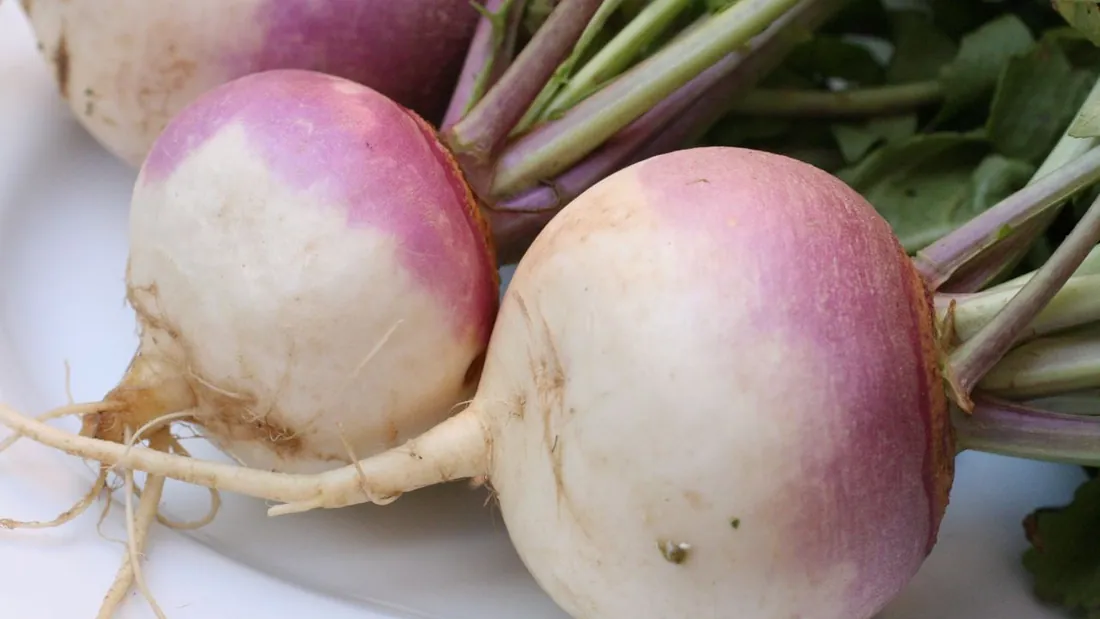

The turnip (Brassica rapa) is a hardy, fast-growing root, one of the easiest crops in the vegetable garden. Count on 6 to 10 weeks from sowing to plate, a vegetable that moves quickly and rewards the impatient. Two useful windows stand out: spring for tender turnips to eat straight away, and above all late summer, for the autumn and winter turnips that keep for weeks. You sow directly in place, thin out, and never forget to water, because a thirsty turnip turns pungent, tough or hollow.
Light and exposure
The turnip likes sun without needing to be baked all day long. A sunny to lightly shaded spot suits it, which is handy for summer sowings where a bit of shade during the hottest hours keeps the soil from drying out. In spring, give it full sun instead for brisk growth.
Since it grows fast and holds the ground only briefly, the turnip slips easily between two longer crops or after an early harvest of peas or lettuce. It benefits from an open position with good air flow, which limits standing moisture on the foliage and therefore disease.
Watering
Regular watering is the key to a good turnip. Soil that stays cool gives tender, sweet, juicy roots. As soon as the ground dries out, the plant is stressed, which makes the turnip pungent, fibrous, sometimes hollow at the core. Sudden swings are the worst of all: a dry spell followed by heavy watering causes the roots to split.
So aim for steady moisture, with regular watering during dry spells, especially for the late-summer sowings, when the soil is still warm. A light mulch between the rows helps keep things cool. In soil kept cool, the turnip’s fast growth does the rest and the root stays sweet.
Soil and repotting
The turnip prefers loose, cool soil that has not been manured too recently. Light ground, worked deeply, lets the root form without obstacle and without distortion. Heavy, compact soils give twisted turnips, so it is better to lighten them with well rotted compost and good digging.
Avoid fresh manure just before sowing, as it encourages forked roots and lush foliage at the expense of the turnip itself. A neutral to slightly acid pH suits it. Like all brassicas, the turnip appreciates soil that is not short of calcium, which calcareous and clay-limestone ground supplies naturally; on acid soil a liming amendment fills the gap and hampers clubroot along the way.
Temperature and humidity
The turnip is a cool-climate vegetable, and it is heat, not cold, that limits it. It germinates and grows best between 10 and 20 degrees. The strong heat of high summer does not suit it: it makes the roots pungent and sometimes pushes the plant to run to seed instead of forming its turnip.
It is a vegetable that tolerates cold, and even seeks it out for the autumn varieties. Winter turnips hold in the ground until the frosts, and a light frost even sweetens their taste by turning part of the starch into sugars. Late summer sowings take advantage of the cool nights of the late season to form firm, sweet roots.
Pruning and upkeep
The turnip is not pruned, but one action is crucial: thinning. After emergence, when the seedlings have two or three true leaves, remove the weakest to keep only one turnip every 10 to 15 centimetres. Without this room, the roots stay tiny and compete with one another, each no bigger than a radish.
Thinning in two stages is better still: a first pass fairly early, a second one or two weeks later, eating the young plants you pull out, leaves included, which cook like spinach. Hoe regularly between the rows to keep weeds at bay, as the turnip dislikes competition.
Pests and diseases
The turnip’s main enemy in the garden is the flea beetle, that small black jumping beetle that riddles young leaves with many little round holes. On plants that have just emerged, a heavy attack can seriously slow the crop. It strikes mostly in hot, dry weather, hence the value of keeping the soil cool and putting an insect-proof mesh over young sowings.
The cabbage root fly lays at the collar and its larvae attack the root, making it maggoty. A protective net laid at sowing is the most effective defence. Like all brassicas, the turnip is also prone to clubroot in acid, wet soils: avoid growing cabbages and turnips in the same spot year after year, as rotation is your best ally.
Propagation
The turnip is grown from seed, and always directly in place, because its root does not tolerate transplanting. Sow thinly in rows 25 to 30 centimetres apart, one centimetre deep, in fine, cool soil. Emergence is fast, often within a few days in mild weather, which makes the turnip an excellent vegetable for reassurance when you are starting out.
Stagger the sowings every two to three weeks to spread the harvest rather than picking everything at once. To produce your own seed, you would need to let a few plants overwinter and flower the following year, but the turnip crosses easily with other brassicas, which makes selection tricky in the amateur garden.
Climate and hardiness
Where and in which climate it thrives
The turnip is a cool-climate vegetable: it germinates and swells best between 10 and 20 °C, and it is heat, not cold, that limits it. The autumn and winter varieties take moderate frost, down to about -5 °C depending on the variety, and light cold even sweetens their taste; beyond that you lift them for the cellar, in sand, or leave them in place under a thick mulch wherever the winter stays mild and damp. It is an annual crop: the hardiness zone matters less than the length of the cool seasons.
Two windows shape the year in a temperate climate. The first, from late winter into spring, under a cold frame and then in open ground as soon as the soil settles above 10 to 12 °C, gives tender turnips to eat young: very early varieties such as 'Petrowski' or 'Boule d’Or', done in six to eight weeks, fit that short window before the heat. The second, the more productive one, is sown in late summer, ten to twelve weeks before the first frosts: the cool nights of the late season build the fine, firm roots that keep, with storage varieties such as 'Blanc Dur d’Hiver' or 'De Croissy'.
What changes from one climate to another is the pressure of heat and pests. Under a hot, dry summer the summer sowing is the trickiest: the soil must stay cool throughout, or the roots turn pungent and hollow, and a mulch smooths out the swings in moisture. In a mild climate the cabbage root fly stays active through the whole growing season and runs three to four generations: an insect-proof mesh laid at sowing settles the question, as it does for flea beetles. And everywhere, rotation with the other brassicas over three to four years remains the only real protection against clubroot.
Growing turnip?
Green Hub keeps a dated history of your own plant: its photos, its progress, its repottings. An AI answers about yours specifically, not a generic sheet, for free.
Identify my plantMonth-by-month care calendar
| January | Nothing to sow outdoors. Choose the varieties: a round spring turnip such as Milan, a winter turnip such as Boule d’Or or Nancy for storage. |
|---|---|
| February | Still too cold in open ground. Under a cold frame or heated tunnel, a first very early sowing is possible for the most eager. |
| March | First sowings in place under protection as soon as the soil warms. A forcing fleece is welcome against cold and flea beetles. |
| April | Peak season for spring sowings in open ground. Sow thinly, thin to 10 centimetres, water to keep the soil cool. |
| May | Continue the spring sowings. Harvest the first turnips sown in March. Watch for flea beetles in dry weather and water regularly. |
| June | Harvest of spring turnips. The strong heat is approaching, so ease off on sowings to avoid pungent roots. |
| July | Start of the late summer sowings for autumn turnips. Water generously, the soil must never dry out, and shade from the sun during the hottest hours. |
| August | Best window for winter storage turnips. Sow, thin, lay an insect-proof mesh against the cabbage root fly and flea beetles. |
| September | The cool nights swell the roots. Thin, hoe, keep the moisture up. First harvests of the July sowings. |
| October | Full harvest of autumn turnips. A light frost sweetens their taste. Begin harvesting and storing in a cellar in sand. |
| November | Harvest the last winter turnips before the hard frosts, or mulch thickly to keep them in the ground in mild winters. |
| December | Rest. Check the turnips stored in the cellar and remove any that are spoiling. Plan the rotation to move cabbages off the plot. |
Green Hub tips
- Always sow in place and thin without regret: a crowded turnip stays no bigger than a radish.
- Never stop watering. A thirsty turnip turns pungent, tough or hollow, so keep the soil cool, above all during the late-summer sowings.
- The real window is late summer. Sowings made ten to twelve weeks before the first frosts give the autumn and winter turnips that keep.
- Lay an insect-proof mesh at sowing: it heads off the flea beetles that hole the leaves and the cabbage root fly.
- A light autumn frost sweetens winter turnips: do not rush to pull everything up before the first cold snaps.
Related species
Broccoli
Brassica oleracea var. italica
Broccoli (Brassica oleracea var. italica) is a cabbage whose central head we harvest, a cluster of flower buds still…
Brussels sprout
Brassica oleracea var. gemmifera
Brussels sprouts (Brassica oleracea var. gemmifera) are harvested from autumn into the heart of winter, and every frost…
Cauliflower
Brassica oleracea var. botrytis
Cauliflower (Brassica oleracea var. botrytis) is a demanding vegetable that thrives in a cool, damp climate but never…
Curly kale
Brassica oleracea var. sabellica
Curly kale (Brassica oleracea var. sabellica), also known simply as kale, is a leafy vegetable of uncommon hardiness.…
Radish
Raphanus sativus
The radish (Raphanus sativus) is the fastest vegetable in the garden, ready to bite into in three to five weeks. It is…
Rocket
Eruca vesicaria
Rocket (Eruca vesicaria) is a salad with a pungent, peppery taste, one of the fastest in the garden: barely four to six…
The guides that mention it
The vegetable garden calendar, from sowing to harvest
Two dates are enough to build an entire vegetable garden year: your last spring frost and your first autumn frost.…
Vegetable Garden Pests: The Natural Method That Holds All Season
A leaf riddled with holes, a lettuce shaved to the ground overnight, a twisted and sticky shoot: every kind of damage…
Garden Diseases: Recognising What Is Attacking Your Plants, and Acting Before the Spot Appears
A white bloom that wipes off on a fingertip, an angular lesion stopped dead by a vein, a fruit browned from the bottom…
Gardening Under a Greenhouse or Cold Frame: Growing All Year Round
A greenhouse or even a simple cold frame changes everything: sowings brought forward by several weeks, harvests…
Square Foot Gardening: Fitting More Crops Into Less Space
A twelve-inch grid and a well-placed trellis: how a square foot garden yields more vegetables than a traditional row on…
Sowing Seeds Successfully: Why It Fails, and What Fixes It
A seed that never comes up was not unlucky. Germination temperatures by species, correct depth, seeds that need light,…
Updated on
How this sheet is written
Written for Green Hub with the help of language models, then reviewed. It offers gardening guidance, not professional advice: if you are unsure whether a plant is toxic to a child or an animal, ask a vet, a doctor or your national poison centre.