Clivia
Clivia miniata
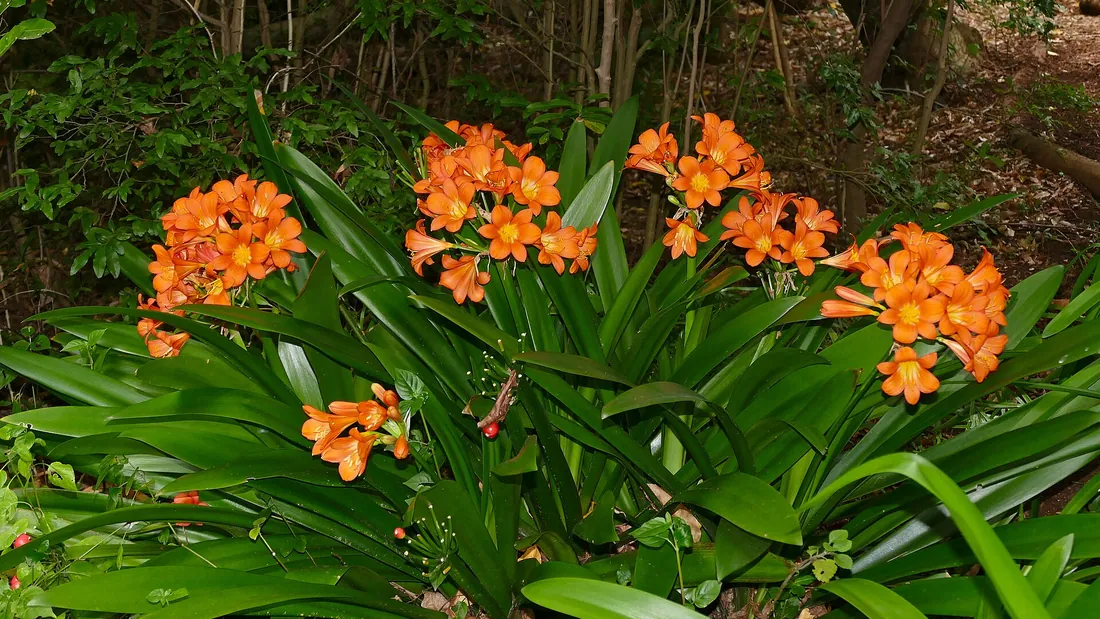
_(32985230915).jpg)
The clivia (Clivia miniata) is a sturdy, generous houseplant from the undergrowth of South Africa. Its broad strap-like leaves stay green all year, and in late winter it sends up a spike of bright orange flowers that lights up the home while everything is still grey outside. It is an easy plant, provided you know its secret: to flower again each year, it needs a real winter rest, cool and dry. Without this chill, it stays handsome but sulks at flowering. It also likes to be cramped in its pot, which makes it an undemanding and lasting companion.
Light and exposure
The clivia comes from the undergrowth, so it hates direct sun, which burns and bleaches its foliage. Give it bright but filtered light: an east window, or a little set back from a brighter window. In summer, a shady corner of the garden or terrace suits it very well, sheltered from midday sun.
Avoid moving it or turning the pot when the flower buds are forming, it likes stability. A spot that is too dark gives fine foliage but few flowers, while too much sun yellows the leaves: look for the soft light of a bright undergrowth.
Watering
During the growing season, from spring to autumn, water regularly as soon as the top few centimetres of soil are dry, never letting water sit in the saucer. The clivia stores reserves in its fleshy roots and copes better with a slight lapse than with an excess that rots the base.
The key moment comes in winter. To prepare flowering, cut watering back to almost nothing from November to January: a few sips a month at most, just so the foliage does not dry out. This near stop, combined with the cold, triggers the rise of the flower spike. Resume normal watering as soon as the stem appears, often in February.
Soil and repotting
A rich, well-drained potting soil, enriched with a little mature compost and a handful of sand or perlite, makes an excellent substrate. The clivia does not like mixes that hold water: its thick roots need air and rot in soaked soil.
Always keep a good drainage hole and a layer of clay pebbles at the bottom of the pot. A slightly coarse substrate, close to an orchid mix with added potting soil, reproduces well the airy humus of its native undergrowth.
Temperature and humidity
In full growth, the clivia is happy between 18 and 22 degrees, ordinary indoor temperature. It enjoys spending the summer outdoors as soon as the nights climb back above 10 degrees, but it is not hardy: it must be brought in before the first autumn frosts.
In winter, everything hinges on the cold. From November to January, set it in a cool room between 8 and 10 degrees: a bright garage, an unheated veranda, a cold stairwell. This rest of eight to ten weeks in the cool is the condition for flowering. A plant kept all winter in a heated living room stays green but does not flower.
Pruning and upkeep
The clivia is not really pruned. Simply remove damaged or dry leaves by cutting them at the base with a clean tool. Every leaf counts to feed the plant, so only remove what is truly dead.
After flowering, cut the faded spike at its base once it has yellowed, unless you want to harvest the seeds. Clean the foliage now and then with a damp cloth: its broad leaves gather dust and breathe better clean.
Pests and diseases
The clivia’s main enemy is too much water, which rots the collar and the roots. A base that softens and leaves that yellow from the bottom almost always signal overly generous watering or a poorly drained pot. Ease off the watering and check the drainage.
On the pest side, watch for mealybugs, small white cottony clusters in the leaf axils, common on plants brought in for winter in a dry room. Remove them with a cotton bud dipped in diluted methylated spirits. Slugs can nibble the foliage when the plant spends the summer outside.
Propagation
The simplest way is dividing the clumps. An adult clivia produces offsets on its sides: taking advantage of a repotting, gently separate an offset with a few roots and three or four leaves, then repot it on its own. Do it just after flowering, in spring.
Sowing is possible but calls for patience: you must harvest the fully ripe red berries, extract the large seeds and sow them warm. Germination is slow and a seedling takes five to seven years before flowering. Division remains the way of the gardener in a hurry.
Toxicity
The clivia is toxic. All its parts, but especially the leaves, stems and fleshy roots, contain lycorine and other alkaloids of the amaryllis family. Swallowed, they cause salivation, vomiting, diarrhoea and abdominal pain, in humans as in cats and dogs. The thick white roots are particularly loaded: be wary when repotting if an animal digs in the pot.
The risk stays moderate as long as the plant is not chewed, but keep it out of reach of young children and animals that nibble the foliage. Wear gloves if your skin is sensitive, as the sap can irritate. In case of significant ingestion, call the poison centre or the vet.
Climate and hardiness
Where and in which climate it thrives
In a temperate climate, the clivia is a houseplant that enjoys the fine season outdoors but spends the cold season under shelter. Put it out on a shaded terrace or under a tree once the last frosts have passed, and bring it in before the first cold nights, as it tolerates no frost.
The real move is to use the cold season to make it flower. A garage, a utility room or an unheated veranda that naturally drops to 8 or 10 degrees is the perfect place. Set the clivia there through the two or three coldest months, water barely, and leave it in the cold for eight to ten weeks. When you bring it back into a warmer room and resume watering, the flower spike rises and you get an orange bouquet as winter ends. Without this spell of cold, it would stubbornly stay green. One last reflex: only repot it every three or four years, it flowers better when cramped.
Growing clivia?
Green Hub keeps a dated history of your own plant: its photos, its progress, its repottings. An AI answers about yours specifically, not a generic sheet, for free.
Identify my plantMonth-by-month care calendar
| January | Rest in the cool, between 8 and 10 degrees, watering cut to the strict minimum. Watch for the flower spike appearing at the base of the leaves. |
|---|---|
| February | As soon as the flower stem shows, bring the plant back into a warmer, brighter room and resume normal watering. Flowering begins. |
| March | Full orange bloom. Do not turn the pot, keep bright filtered light and regular watering. A little feed can begin. |
| April | End of flowering. Cut the faded spike at the base once yellowed. A good time to divide an offset or repot if the plant really overflows. |
| May | Foliage growth. Feed every two weeks. Harden the plant off before putting it out, in the shade, after mid-May. |
| June | The clivia enjoys the summer in the shade on the terrace. Water regularly and watch for slugs, which like its tender foliage. |
| July | Full vegetation. Keep the substrate moist without excess and continue feeding. Keep it sheltered from the scorching afternoon sun. |
| August | Keep up watering and feeding. The plant builds its reserves for the following year. Clean the dusty leaves with a damp cloth. |
| September | Last feed of the month. Prepare the return indoors: the plant must come back inside before the cold nights at month’s end. |
| October | Bring the clivia in if not done already. Start spacing out watering to begin the rest. Stop feeding. |
| November | Set the plant in a cool room between 8 and 10 degrees and cut almost all watering. The winter rest begins, and it is what prepares the flowers. |
| December | Cold, dry rest, no feed. A few sips of water a month are enough. Be patient, the reward comes in late winter. |
Green Hub tips
- The secret of the flowers: eight to ten weeks cool and dry from November to January, in a garage or an unheated veranda. Without this cold rest, no flowering.
- Leave it cramped. The clivia flowers better when its roots fill the pot, so only repot it every three or four years.
- Do not put it in full sun: it comes from the undergrowth and its leaves burn. Bright shade outdoors, filtered light indoors.
- Mind children and animals, the plant is toxic, especially its thick roots. Wash your hands after handling it when repotting.
Related species
Chives
Allium schoenoprasum
Chives (Allium schoenoprasum) are a small perennial of the onion family, with fine hollow stems tasting mildly of…
Daffodil
Narcissus
The daffodil (Narcissus) is the first big signal of spring in the garden. Long before the tulips, its yellow trumpets…
Garlic
Allium sativum
Garlic (Allium sativum) is one of the easiest vegetables in a kitchen garden, provided you grasp two things. You don’t…
Leek
Allium porrum
The leek (Allium porrum) is the winter vegetable par excellence. Very hardy, it stands in the ground all winter and is…
Onion
Allium cepa
The onion (Allium cepa) is a hardy, no-fuss bulb vegetable, one of the easiest crops to succeed with in a vegetable…
Shallot
Allium ascalonicum
The shallot (Allium ascalonicum) is a classic of the vegetable garden, a cousin of the onion but with a finer, milder…
The guides that mention it
Overwintering your plants without losing them
Clivia, lavender, verbena, geranium, olive: which to bring indoors, which to protect outside, which to leave to face…
Repotting your plants and choosing the right potting mix
The right moment, the right technique and the right substrate for each plant, so you can repot without rotting the…
Toxic Plants for Cats and Dogs: Recognising the Danger Rather Than Memorising a List
A list of toxic plants is easily forgotten and always incomplete. What actually protects a cat or dog is recognising…
Updated on
How this sheet is written
Written for Green Hub with the help of language models, then reviewed. It offers gardening guidance, not professional advice: if you are unsure whether a plant is toxic to a child or an animal, ask a vet, a doctor or your national poison centre.