Daffodil
Narcissus
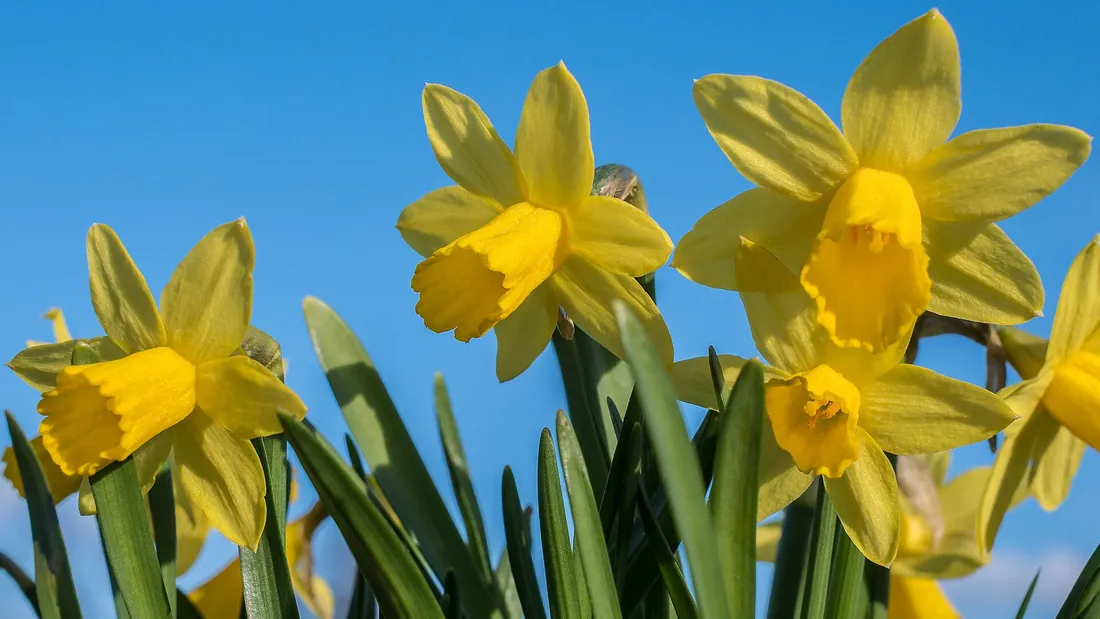

The daffodil (Narcissus) is the first big signal of spring in the garden. Long before the tulips, its yellow trumpets open the bulb season, sometimes as winter is barely over when it has been mild, but usually at the very start of spring. It is a tough plant in a temperate climate: once established, it comes back every year with no attention at all, and a clump planted today can keep multiplying for decades.
Light and exposure
Daffodils like sun but cope very well with partial shade, which makes them one of the few bulbs that thrive under deciduous trees. By the time they flower, at the very start of spring, the branches overhead are still bare and plenty of light reaches the ground, even under a big oak or an apple tree.
Once flowering is over, the growing shade cast by the trees’ leaves is no problem at all, because daffodil foliage finishes its cycle before summer arrives. That is exactly what allows it to naturalise in woodland edges or lawns, where almost no other bulb flower settles in so easily.
Watering
In open ground, daffodils get by on rainfall alone and need almost no watering at all. A bulb planted in autumn draws on reserves in the soil through winter and only needs a helping hand in an exceptionally dry spring, while the foliage is still green and active.
In a pot, things are different: the compost dries out faster, and regular watering in spring stops the bulbs coming under stress while in full flower. Once the foliage has died back, though, stop watering altogether: the daffodil goes into summer dormancy and hates wet feet at that time, since too much water in summer easily rots the bulb.
Soil and repotting
An ordinary garden soil suits daffodils fine, as long as it drains well. They grow in most soils, including fairly heavy clay, as long as water does not sit around the bulb in winter.
On very heavy, compacted clay, loosen the soil to a good depth before planting and work a little coarse sand or well-rotted compost into the bottom of the hole. In a pot, an ordinary potting mix lightened with a bit of sand and good drainage at the base is more than enough.
Temperature and humidity
Daffodils are fully hardy from USDA zone 3 to zone 8 and shrug off even the harshest frosts, the bulb sitting safely under some fifteen centimetres of soil. In fact the bulb needs that winter cold to trigger flowering the following spring, a natural mechanism known as vernalisation: count on twelve to sixteen weeks below seven degrees.
That is exactly why you should never bring daffodil bulbs indoors for winter the way you would a dahlia or a tuberous begonia: without enough cold, the plant will not flower well, or at all, the following year. Just leave them in the ground, that is what they are built for. In a mild climate, where winter never drops low enough, the logic is reversed: you give the bulbs ten to fifteen weeks in the fridge before planting them.
Pruning and upkeep
Deadhead the spent flowers as they fade, cutting only the flower stem, to stop the plant wasting energy on setting seed. This simple habit feeds straight back into the bulb, which rebuilds its reserves for next year.
The most important point, and the one most gardeners get wrong: let the foliage yellow and die back completely before cutting it, which takes around six weeks after flowering. During that time the still-green leaves are recharging the bulb through photosynthesis. Never tie the leaves into a knot or braid, and never mow them while green, however untidy it looks on the lawn, that is the surest way to weaken the bulbs year after year.
Pests and diseases
The narcissus bulb fly (Merodon equestris) is the main pest: its larva burrows into the bulb and eats it from the inside, leaving stunted plants with thin, sparse leaves, or bulbs that simply fail to come back. You usually only spot it in hindsight, finding a soft, hollow bulb when you dig one up.
Bulb rot, caused by Fusarium fungi, takes hold mainly in waterlogged or poorly drained soil, turning the bulb brown and soft underground. The good news: unlike tulips or crocuses, daffodils hold no interest for field mice or voles, which avoid them because of their toxicity, and that cuts losses to below-ground pests right down.
Propagation
Dividing clumps is the simplest and most reliable method. Every three to five years, once a clump flowers less freely or produces smaller blooms, a sign it has become overcrowded, dig it up after the foliage has died back fully in summer, separate the bulbs by hand and replant them straight away, spaced well apart.
Daffodils also produce small offset bulbs naturally around the parent bulb, tiny bulbs that will bulk up and flower within two to three years. This is exactly the mechanism behind their spontaneous naturalising in lawns: left undisturbed, a clump of daffodils spreads on its own, year after year, without any input from the gardener.
Toxicity
The whole plant, and especially the bulb, contains toxic alkaloids, including lycorine. The bulb can easily be mistaken for an onion, and poisonings happen fairly regularly when it is picked up for cooking by mistake, causing nausea, vomiting and stomach pain. The sap can also irritate the skin when handling bulbs or stems, particularly for sensitive people, so it is worth wearing gloves when planting or dividing large quantities.
Climate and hardiness
Where and in which climate it thrives
The daffodil is hardy from USDA zone 3 to zone 8: planted about fifteen centimetres deep, the bulb comes through winters of minus thirty-five degrees unharmed, and the early foliage takes late frosts without flinching. The difficulty never comes from cold, but from the lack of it. Flowering is triggered by vernalisation: twelve to sixteen weeks below seven degrees. Without that cold, the bulb makes leaves and no flowers.
That is what decides how you grow it from one climate to another. In a temperate climate, oceanic or continental, you plant and forget: the bulb stays in the ground for decades and multiplies on its own. From zone 8b upwards, winter no longer does the job. You then have to pre-chill the bulbs for ten to fifteen weeks between two and seven degrees before planting, and treat them as annuals. One useful exception: the tazetta daffodils, such as 'Grand Soleil d’Or' or the paperwhites 'Ziva', need no cold at all and are the only ones that truly naturalise in a mild or Mediterranean climate.
The other sensitive point is summer water. The bulb is dormant once the foliage has died back and rots quickly if it stays waterlogged: under a climate with wet summers, plant in free-draining soil or on a slight mound. Where winters are mild and wet, it is not frost that kills the bulb, it is standing water.
One advantage that holds in every climate: unlike tulips, which are regularly eaten underground by field mice and voles, daffodils are toxic and so completely ignored by these rodents. This makes them the bulb of choice for a wildlife garden or a flowering meadow you do not want to replant every year.
Growing daffodil?
Green Hub keeps a dated history of your own plant: its photos, its progress, its repottings. An AI answers about yours specifically, not a generic sheet, for free.
Identify my plantMonth-by-month care calendar
| January | Nothing to do in the garden, the bulbs are dormant underground. In a mild winter, the first green tips can already push through late in the month. |
|---|---|
| February | Green tips emerge everywhere. Do not protect them, daffodils shrug off late frost on their young foliage without any trouble. |
| March | Flowering begins, sometimes as early as mid-March in an early spring. Deadhead spent flowers as they go over to save the bulb’s energy. |
| April | Full flowering in most temperate gardens. Cut off faded flowers but leave the green foliage strictly alone. |
| May | Flowering winds down. The foliage starts to yellow, do not cut it yet, it keeps feeding the bulb for around six more weeks. |
| June | The foliage finishes yellowing and dying back. Once it is fully dry and brown, you can finally cut it or pull it away by hand. |
| July | The bulb rests underground. A good time to dig up and divide overcrowded clumps that flowered poorly in spring. |
| August | Still resting. If you divided clumps, replant the bulbs without delay, they dislike sitting out of the ground for long. |
| September | The planting season begins. Order and plant new bulbs as soon as the soil has cooled down a little. |
| October | The ideal month to plant in a temperate climate. Set the bulbs at roughly three times their own height, pointed end up. |
| November | The last real planting window before the soil turns too cold and compact. Finish off any planting early in the month. |
| December | Complete rest. Bulbs planted in autumn settle in quietly underground while they wait out the cold they need in order to flower. |
Green Hub tips
- Never cut back the green foliage after flowering: let it yellow and die down completely, around six weeks, that is what recharges the bulb for next year.
- Plant bulbs at a depth of roughly three times their height, pointed end up, six to eight weeks before the first autumn frosts.
- Let clumps naturalise in a lawn or under trees: daffodils multiply on their own and come back thicker every year with no upkeep at all.
- Unlike tulips, daffodils are left well alone by field mice and voles thanks to their toxicity, a real advantage anywhere those rodents go after bulbs.
Related species
Chives
Allium schoenoprasum
Chives (Allium schoenoprasum) are a small perennial of the onion family, with fine hollow stems tasting mildly of…
Clivia
Clivia miniata
The clivia (Clivia miniata) is a sturdy, generous houseplant from the undergrowth of South Africa. Its broad strap-like…
Garlic
Allium sativum
Garlic (Allium sativum) is one of the easiest vegetables in a kitchen garden, provided you grasp two things. You don’t…
Leek
Allium porrum
The leek (Allium porrum) is the winter vegetable par excellence. Very hardy, it stands in the ground all winter and is…
Onion
Allium cepa
The onion (Allium cepa) is a hardy, no-fuss bulb vegetable, one of the easiest crops to succeed with in a vegetable…
Shallot
Allium ascalonicum
The shallot (Allium ascalonicum) is a classic of the vegetable garden, a cousin of the onion but with a finer, milder…
The guides that mention it
Perennial Flowers: Choosing, Planting and Blooming Without a Gap All Season
What genuinely comes back year after year, how to read hardiness by zone rather than by promise, and how to string…
Toxic Plants for Cats and Dogs: Recognising the Danger Rather Than Memorising a List
A list of toxic plants is easily forgotten and always incomplete. What actually protects a cat or dog is recognising…
Lawn Care: From Seeding to Mowing, and Renovation
Mowing higher changes more than any fertilizer can: turf density, drought resistance, weeds, moss. Everything else in…
The Cutting Garden: How to Pick Flowers and Make Your Bouquet Last
Dahlias, peonies, hydrangeas: what separates a flower that lasts ten days in a vase from one that droops by the next…
Designing your garden by colour: the combinations that work
Warm harmonies, cool harmonies, monochrome schemes or bold contrasts: colour changes everything in a garden, from the…
Updated on
How this sheet is written
Written for Green Hub with the help of language models, then reviewed. It offers gardening guidance, not professional advice: if you are unsure whether a plant is toxic to a child or an animal, ask a vet, a doctor or your national poison centre.