Overwintering your plants without losing them
Overwintering means sorting your plants into three families. The tender ones (geranium, lemon verbena, citrus, young olive, dahlia to lift) come into a cool, bright, frost-free room at 5-10 C, before the first frost. The borderline-hardy ones (lavender, established rosemary) stay outdoors but protected with mulch and fleece. The truly hardy ones spend winter on their own once their rating clears the annual minimum of your zone: in USDA zone 8a, for instance, the cold drops to -9 / -12 C. The marker for late frosts is your region’s average last-frost date.
Understand your own climate before you act
Many gardens in a temperate oceanic climate lie in hardiness zone 8a, which means annual minimum temperatures between -12.2 C and -9.4 C. That is the first figure to keep in mind: in zone 8a, a plant whose label promises hardiness down to -15 C will get through winter on its own outdoors, whereas a plant rated for -5 C will not survive outdoors without protection. Under a mild, wet winter, it is not so much raw cold that kills as cold combined with water standing at the plant’s base.
The other marker is on the calendar. Every region has an average last-frost date, published by the local weather service: this is the cut-off beyond which the risk of frost on the plains becomes very low. Late frosts remain possible after that date if the air is polar, the sky clear and the wind light, but a tender plant is only considered safe to go back out for good once that date has passed, with two or three weeks of margin at altitude or in a valley bottom. In short, read the USDA zone on the label, compare it with the annual minimum of your own zone, and time your spring move-out around your last-frost date.
Sort your plants into three families
The first family is the tender plants, those that cannot stand frost and must be sheltered. Geranium (pelargonium), lemon verbena, citrus and the young olive belong to this group, as does the dahlia, whose tubers you lift before the frosts, and non-hardy succulents grown in pots such as aloe vera, which also join the overwintering room. Lemon verbena is a good example: it tolerates -5 C only for a few hours, so it is grown in a pot so it can be brought in. The young olive fears damp cold above all, more than dry cold, which makes it all the more vulnerable in a rainy climate.
The second family gathers the borderline-hardy plants: they take the cold but deserve a hand on the harshest nights. Common lavender withstands down to -15 C, but outside wine-growing regions it needs protection at the base. Rosemary, hardy in USDA zones 7a to 9a, suffers damage around -12 C and benefits from mulch and fleece on very cold nights. Hydrangea and yucca also belong here, kept in place but with their young plants protected in harsh winters. The third family, finally, is the truly hardy plants left to face winter alone: mint, which dies back at the surface and regrows from the base in spring, fruit trees well suited to zone 8a such as fig and kiwi, or a lavender and a rosemary well established in drained, sheltered soil.
When and how to bring tender plants indoors
The calendar is simple: bring tender plants in as late as possible, but without fail before the first frost. So keep an eye on temperatures from mid-autumn, since the first night frosts usually arrive in the second half of that season. Choose the overwintering room according to light: a dark cellar or attic should stay between 5 and 10 C, while a bright room is best kept between 8 and 12 C to limit yellowing and etiolation, and up to about 15 C if it is well lit. Throughout overwintering, watering is cut back sharply: a modest drink once a month is generally enough.
Before storing them away, a little tidying prevents disease. On the geranium (pelargonium), cut the stems back to a few centimetres and remove flowers, buds and dead leaves to avoid fungal disease in the stale air of a closed room. Do not do any structural pruning at this stage: the real pruning waits for spring. Prepare the move-out gradually, with daytime re-acclimatisation once spring is around 20 C, then a final move-out only once your last-frost date has passed. Putting a geranium or verbena back out too early means risking losing a whole winter’s work in a single night.
Protecting plants outdoors without bringing them in
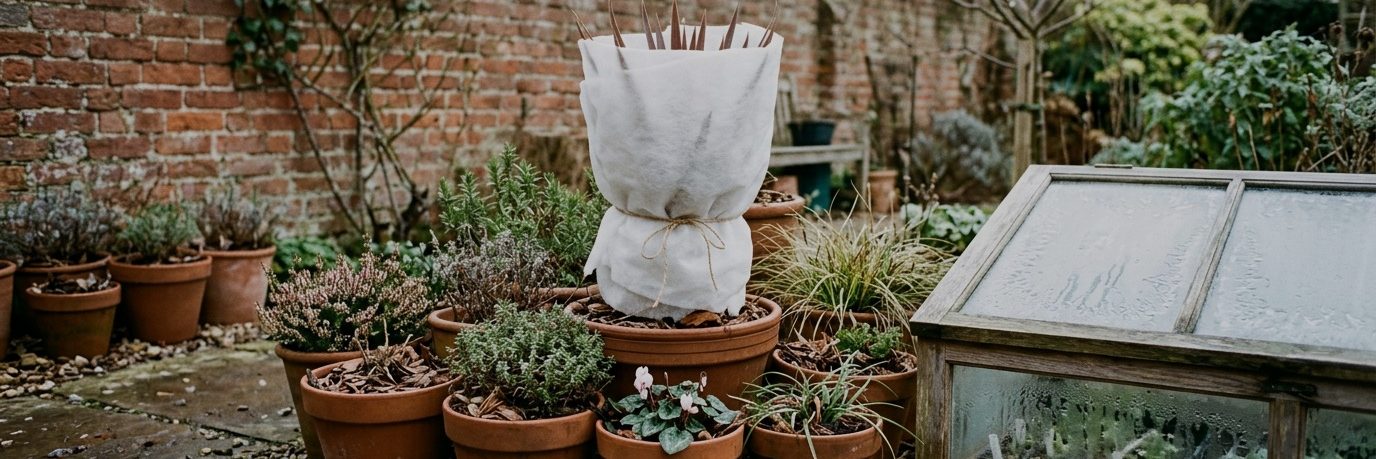
For plants kept in the open ground, two actions are usually enough. Winter fleece adds about 2 C: for a borderline-hardy plant, sometimes just doubling the thickness of the fleece is enough to gain enough margin. Fit it without pressing the fabric directly onto the foliage, leaving a layer of air, and use it mainly on the coldest nights. It is the ideal fix for a rosemary on nights below -8 C, or for a lavender in an exposed spot that is not well sheltered.
The second action is mulching the base. On common lavender, put a layer of mulch at the base and a cover of fir branches or straw. On rosemary in a continental zone, mulch the base to 8 to 12 cm and add a P30 fleece on nights below -8 C. The same principle applies to the deciduous agapanthus, only moderately hardy (around -5 C), which needs a cover or foliage in hard frosts, even if a few selected varieties hold down to -15 C. Good mulch protects the crown and the roots, the part that really matters for spring regrowth.
Case studies: clivia, dahlia, citrus and olive
The clivia is the great misunderstanding of overwintering: without a cold rest, it will not flower again. It absolutely needs 2 to 3 months of winter rest at 10-12 C (never below 7 C), with very reduced watering. It is this warm-cold alternation that triggers the flower stalk to rise; without it, the plant stays all leaf. When the stalk reaches about 15 cm tall, move the clivia back to around 15 C and increase watering slightly to launch flowering. The dahlia, for its part, is lifted before the frosts, at the very end of autumn: cut the stems to about 10 cm, let the tubers dry for a few days in the shade in an airy spot, then keep them in crates of sand, in a frost-free room away from light.
Citrus and the lemon tree are overwintered in a bright, unheated room at 5-10 C, with spaced-out watering; aim for at least 5 C for stress-free overwintering, a cold greenhouse being ideal because it is very bright. Their hardiness thresholds vary a great deal once the specimens are well established (5-6 years): the lemon tree holds -5 to -6 C, the orange tree -7 to -8 C, the Satsuma mandarin and the kumquat -10 to -12 C, the yuzu -12 to -15 C and Poncirus trifoliata down to -20 C, but young plants and fruit remain far more fragile. The olive, finally, fears damp cold more than dry cold: in a rainy climate, it is better to shelter it from driving rain and give it a perfectly drained base.
The care sheets to read next
Every plant mentioned has its full sheet: watering, light, soil, pests and a month-by-month calendar.
Clivia
Clivia miniata
The clivia (Clivia miniata) is a sturdy, generous houseplant from the undergrowth of South Africa. Its broad strap-like…
Lavender
Lavandula angustifolia
True lavender (Lavandula angustifolia) is a hardy Mediterranean plant that scents the air and draws bees all summer…
Lemon verbena
Aloysia citriodora
Lemon verbena (Aloysia citriodora) is a shrub whose leaves give off a clean, intense lemon scent, the one in an evening…
Mint
Mentha
Mint (Mentha) covers several species and hybrids, from spearmint to peppermint, all perennial and fragrant. It is a…
Olive tree
Olea europaea
The olive tree (Olea europaea) is a Mediterranean tree whose hardiness stops at around minus 8 to minus 10 degrees, in…
Geranium
Pelargonium
What is commonly called a balcony geranium is actually a pelargonium, a plant from South Africa, not to be confused…
Dahlia
Dahlia
The dahlia (Dahlia) is a tuberous plant that offers one of the longest and most spectacular displays of the summer…
Rosemary
Salvia rosmarinus
Rosemary (Salvia rosmarinus, long known as Rosmarinus officinalis) is an evergreen Mediterranean shrub with needle-like…
Fig tree
Ficus carica
The fig tree (Ficus carica) is a Mediterranean tree, yet it really can be grown up to USDA zone 7 provided you shelter…
Kiwi
Actinidia deliciosa
Kiwi (Actinidia deliciosa) is a vigorous fruiting vine from the mountain valleys of central China, later popularised in…
Aloe vera
Aloe vera
Aloe vera (Aloe vera) is a succulent from the Arabian Peninsula, grown since antiquity for the soothing gel of its…
Yucca
Yucca elephantipes
The indoor yucca (Yucca elephantipes) is a shrub from Central America with a thick swollen trunk, without the prickly…
Hydrangea
Hydrangea macrophylla
The hydrangea (Hydrangea macrophylla) is the flowering shrub for cool, partly shaded gardens, and one of the very few…
Frequently asked questions
Which plants should you bring in before winter?
The tender ones: geranium (pelargonium), lemon verbena, citrus and the young olive, as well as the dahlia, whose tubers you lift. Bring them in as late as possible but before the first frost, keeping watch on temperatures from mid-autumn. The room must be cool, bright and frost-free, between 5 and 10 C, with watering cut back to once a month.
At what temperature should you overwinter tender plants?
In a dark room such as a cellar or attic, aim for 5 to 10 C. In a bright room, keep rather between 8 and 12 C to avoid yellowing and etiolation, and up to about 15 C if it is well lit. Citrus are happy with 5-10 C. The clivia, though, wants 10-12 C without ever dropping below 7 C.
Can you leave lavender and rosemary outdoors in winter?
Yes, in zone 8a (-9 to -12 C). Common lavender withstands down to -15 C but needs mulch at the base and a cover of fir branches or straw outside wine-growing regions. Rosemary suffers damage around -12 C: mulch it to 8 to 12 cm and add a P30 fleece on nights below -8 C. Mint, for its part, gets through winter on its own.
Why isn’t my clivia flowering?
Because it is missing its cold rest. The clivia needs 2 to 3 months of overwintering at 10-12 C (never below 7 C), with very reduced watering: it is this warm-cold alternation that triggers the flower stalk. Without a rest, it stays all leaf. When the stalk reaches 15 cm, move it back to around 15 C and increase watering a little.
Green Hub looks after your plants
Photograph a plant: Green Hub identifies it and writes its care sheet, with no account. Sign in afterwards to keep its dated photos and history over time.
Identify a plantUpdated on
How this sheet is written
Written for Green Hub with the help of language models, then reviewed. It offers gardening guidance, not professional advice: if you are unsure whether a plant is toxic to a child or an animal, ask a vet, a doctor or your national poison centre.