Florence fennel
Foeniculum vulgare var. azoricum
_Pflanzen,_Josef_Schlaghecken.jpg)
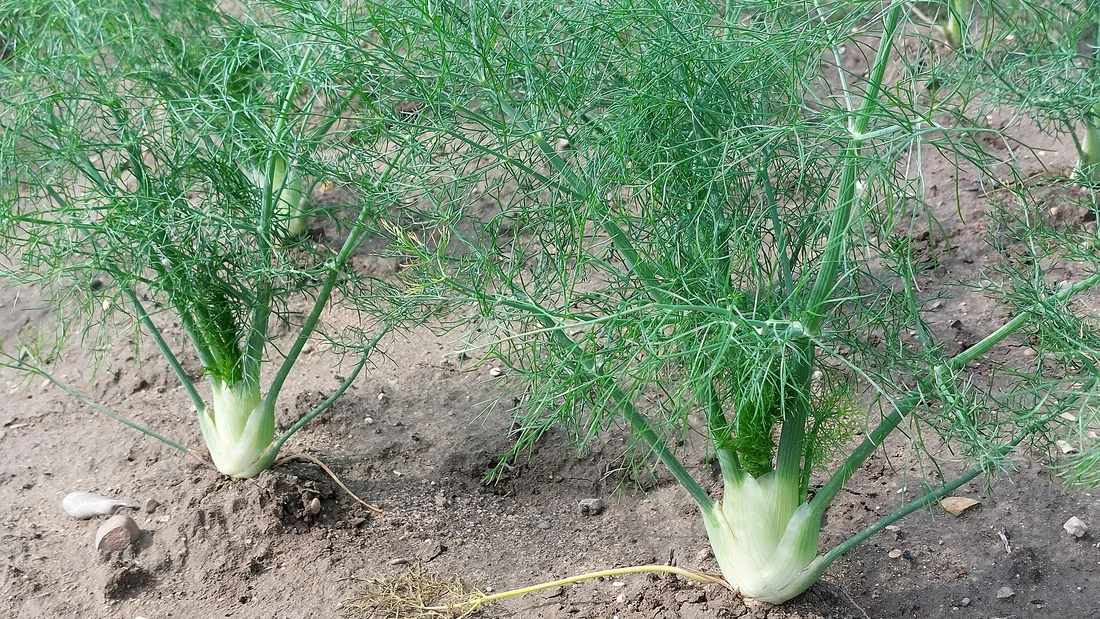
Florence fennel (Foeniculum vulgare var. azoricum) is the fennel grown for its swollen base, crisp and aniseed-flavoured, not to be confused with dill nor with the wild fennel kept for its leaves and seeds. It is a late-season plant more than a spring one. Its great weakness is bolting: at the slightest stress, drought, cold snap or too-early sowing, it runs to flower and no longer forms a bulb. The rule is therefore simple: sow late, once the soil is thoroughly warm and the cold snaps are behind you, in soil that stays cool, and never stop watering.
Light and exposure
Florence fennel likes full sun and mild warmth. Set aside a clear bed for it, with no shade cast by a hedge or taller plants, because a bulb forms better when the plant gets light all day long. A spot sheltered from wind is a plus, young plants do not like being shaken.
The warmth of the late season suits it well. Avoid, however, spots that bake and dry out too fast, such as the foot of a wall that takes the midday sun with no chance of watering. Fennel wants sun on the foliage but coolness at the base, which naturally points to good garden soil rather than a dry corner.
Watering
This is the gesture that decides everything. Florence fennel needs constantly cool soil, never dry. A shortage of water, even brief, is perceived as a stress and triggers bolting: the plant runs up a flower stem and the bulb stays stringy or non-existent. Water regularly and generously, especially in hot spells and while the bulb is forming.
In practice, it is better to water abundantly two to three times a week than a little every day, so the water reaches deep down. A mulch at the base, straw or dried clippings, keeps the moisture and limits the swings. Under a humid summer the rain does part of the work, but dry spells in the hot season remain the most dangerous moment, to watch closely.
Soil and repotting
Fennel calls for rich, deep soil, and above all soil that can hold water. Good garden soil enriched with ripe compost before sowing gives it the fertility and coolness it needs. Sandy soils that dry fast should be corrected with organic matter, otherwise bolting looms.
Drainage counts too, because permanently waterlogged soil rots the collar. So you look for the balance of a worked garden soil, supple, that stays moist without being saturated. A neutral to slightly limey pH suits it perfectly.
Temperature and humidity
Florence fennel grows well between 15 and 25 degrees. It is a plant sensitive to extremes in both directions. A cold snap early in life, below 10 degrees for several days, acts as a winter signal and pushes the plant to run to seed as soon as the warmth returns, hence the failure of too-early spring sowings.
At the other end, strong dry heat also speeds up bolting. The ideal compromise is the mildness of late summer and early autumn: still-warm days, cool nights, moist soil. The bulb withstands light autumn frosts, but not real prolonged frost, which sets the end of harvest around the first hard frosts.
Pruning and upkeep
Fennel is not pruned like a shrub, but one gesture matters a lot: earthing up. When the base begins to swell and reaches the size of a small egg, draw soil around the bulb to cover it partly. This blanching makes it more tender, milder and less fibrous. Repeat the operation as the bulb swells.
You can also take a few fine leaves as you go to flavour cooking and salads, without ever stripping the plant, because the foliage feeds the bulb. If a plant bolts to flower anyway, leave it: its yellow umbels attract beneficial insects and you will harvest aniseed seeds, in place of a fleshy bulb.
Pests and diseases
In the garden, fennel is fairly robust on the disease front, but a few troubles recur. Damping-off and collar rot strike when the soil stays waterlogged and cold, especially on too-early sowings. Foliage that yellows and a base that softens are the signs. The solution lies in well-drained soil and sowing on the right date.
On the pest front, slugs love tender young plants in spring and in a damp late season, to watch from emergence. The carrot fly, which affects the Apiaceae family, may lay at the collar; an insect-proof mesh protects young crops effectively. Aphids sometimes take refuge in the heart of the bulb, a jet of water and ladybirds see them off.
Propagation
Florence fennel is propagated from seed, and the best is to sow directly in place. Its roots do not like being disturbed, a rough transplant often ends in bolting. Sow in rows spaced 40 centimetres apart, at one centimetre deep, then thin to leave one plant every 20 to 25 centimetres.
If you insist on sowing in pots to save time, use deep pots or soil blocks, and prick out very young, before the root coils, keeping the block intact. Direct sowing, once the soil is thoroughly warm and preferably after the summer solstice, nonetheless remains the surest route. Emergence takes one to two weeks in soil kept moist.
Climate and hardiness
Where and in which climate it thrives
Florence fennel is grown as an annual: it is not trying to get through the winter, it is trying to make a bulb before it. Its growing range runs from 15 to 25 °C, and a formed bulb only takes light frost, of the order of -3 to -5 °C: the first serious freeze sets the end of the harvest. The common fennel it descends from is a far hardier perennial, but that hardiness is of no use for producing a bulb.
The whole difficulty lies in bolting, triggered by cold as much as by drought. A cold snap early in life, below 10 °C for several days in a row, is read as a winter: the plant flowers as soon as the warmth returns and gives a stem instead of a bulb. The rule is therefore the same everywhere: do not sow until the soil is thoroughly warm and the risk of a cold snap is behind you, even if that means waiting several weeks after your last frosts. It is the opposite of the usual reflex, which pushes you to sow early.
The right slot is the one that ends in a cool, damp late season: still-warm days to form the bulb, cool nights to make it tender, soil never dry. In a mild oceanic climate, the damp of that period does half the work. In a continental climate with a hot dry summer, or a Mediterranean one, watering becomes the critical gesture and some late-afternoon shade helps. In a subtropical climate, fennel is sown for the cool season. A forcing fleece laid over the bed as the nights turn cool gains a few weeks of harvest.
Two gestures never change: never let the soil dry out, with mulch and generous watering during dry spells, and earth up the bulbs as they swell to blanch them. Where space is short, keep a bed of its own for it, away from tomatoes and beans; a 'Zefa Fino' or a 'Mantovano', reputed to be slow to bolt, forgive swings in the weather better.
Growing florence fennel?
Green Hub keeps a dated history of your own plant: its photos, its progress, its repottings. An AI answers about yours specifically, not a generic sheet, for free.
Identify my plantMonth-by-month care calendar
| January | Nothing to sow. Leaf through the catalogues and choose a suitable variety, such as Zefa Fino or Montovano, reputed to be slow to bolt. |
|---|---|
| February | Too early and too cold for fennel. Prepare the bed instead: a dose of ripe compost on the plot that will host it in summer. |
| March | Patience with the fennel, early sowings run to seed. Work the soil as soon as it drains and break it down fine. |
| April | Still too early for a reliable sowing in open ground. If you want a head start, sow in deep soil blocks under cover, to prick out very young. |
| May | From the end of the month, once the mild nights are settled, first sowings in place possible. Thin as soon as they come up. |
| June | Main period for direct sowing. Sow in rows, thin to 20 centimetres, water to keep the soil cool. |
| July | Last good sowing slot. Watch for dry spells, water generously and mulch: it is the month most at risk of bolting. |
| August | The bulbs form. Earth them up to blanch them as soon as they reach the size of an egg. First harvests from the May sowings. |
| September | Full harvest. The cool nights make the bulbs tender and mild. Keep earthing up and watering the plants as they swell. |
| October | Harvest as you go. A forcing fleece protects from the first frosts and extends the season by a few weeks. |
| November | End of harvest before the hard frosts. Lift the last bulbs, they keep a few days in the cool. Clean up the bed. |
| December | Rest. Take stock of the season, note the sowing dates that gave the best bulbs to adjust next year. |
Green Hub tips
- Never sow while the nights are still cold. A sowing made too early in spring takes the night cold for winter and runs to seed instead of forming a bulb.
- Never stop watering. The slightest drought triggers bolting, keep the soil cool with a good mulch.
- Earth up the bulb as it swells to blanch it: it becomes more tender, milder and less fibrous.
- Sow in place rather than in pots. Fennel hates having its roots disturbed and often answers a transplant with a run to flower.
- Do not confuse it with aromatic wild fennel nor with dill: here you are after the fleshy bulb, not just the leaves.
Related species
Carrot
Daucus carota
The carrot (Daucus carota) is a staple root vegetable in the vegetable garden, keeping all winter and sown directly in…
Celery
Apium graveolens
Celery (Apium graveolens) covers two vegetables from the same species: stalk celery, grown for its crisp ribs, and…
Chervil
Anthriscus cerefolium
Chervil (Anthriscus cerefolium) is a fine annual herb with finely cut foliage and a delicate, slightly aniseed flavour.…
Coriander
Coriandrum sativum
Coriander (Coriandrum sativum) is an annual herb grown for both its fresh leaves, with their pronounced flavour, and…
Dill
Anethum graveolens
Dill (Anethum graveolens) is an annual herb with a lacy outline, a cousin of the carrot and fennel. It is a warm-season…
Parsley
Petroselinum crispum
Parsley (Petroselinum crispum) is the most used herb in the kitchen, flat or curled depending on taste. It is a…
The guides that mention it
Vegetable Garden Pests: The Natural Method That Holds All Season
A leaf riddled with holes, a lettuce shaved to the ground overnight, a twisted and sticky shoot: every kind of damage…
Companion Planting in the Vegetable Garden: Which Plants Belong Together
Tomatoes and basil get along beautifully, while potatoes and tomatoes make each other sick: companion planting explains…
Sowing Seeds Successfully: Why It Fails, and What Fixes It
A seed that never comes up was not unlucky. Germination temperatures by species, correct depth, seeds that need light,…
Updated on
How this sheet is written
Written for Green Hub with the help of language models, then reviewed. It offers gardening guidance, not professional advice: if you are unsure whether a plant is toxic to a child or an animal, ask a vet, a doctor or your national poison centre.