Carrot
Daucus carota
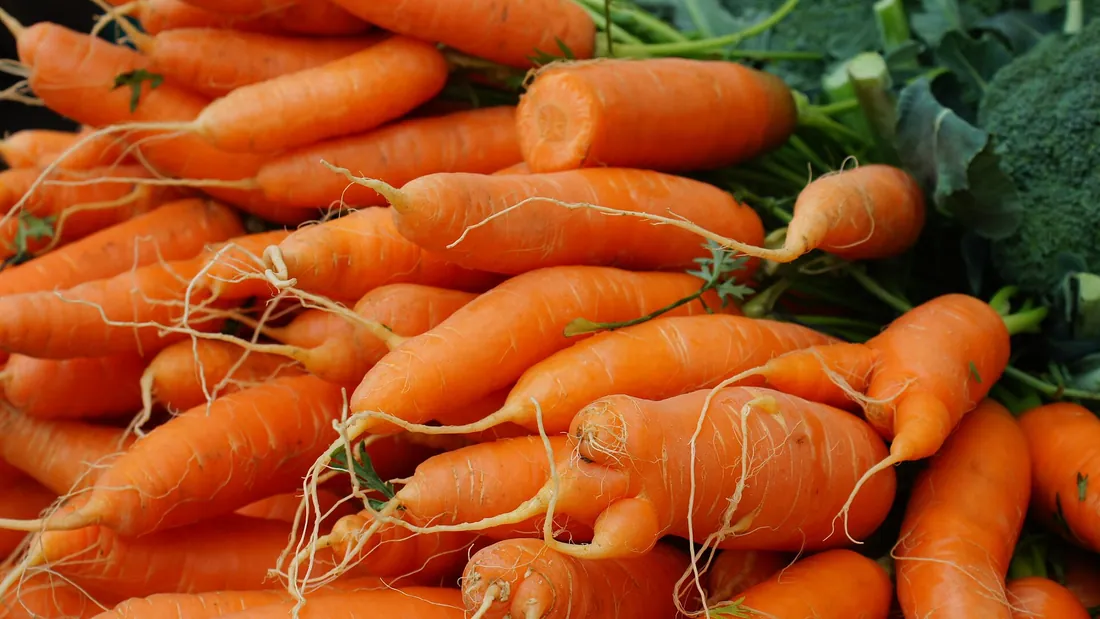

The carrot (Daucus carota) is a staple root vegetable in the vegetable garden, keeping all winter and sown directly in open ground. Growing it takes a little patience and care, because germination is slow and temperamental. In a temperate climate it is sown from early spring to early summer for harvest from summer into autumn, and the roots can be left in the ground until the hard frosts. Its sworn enemy is the carrot fly, Psila rosae, whose larvae tunnel galleries into the roots.
Light and exposure
The carrot wants sun, at least six hours a day, to form fine, sweet roots. An open, sunny position is ideal from spring to autumn.
It tolerates light shade in high summer, which is not much of an issue in a cool temperate climate but becomes a real asset wherever summer stays above 25 degrees. What matters above all is soil that does not obstruct the root and good light for vigorous foliage.
Watering
Regular watering is decisive, especially during germination and while the roots are forming. The soil should stay cool without ever being waterlogged. During germination, which is slow, do not let the surface crust and dry out, or the young seedlings cannot break through.
After that, consistency is key. Swings between drought and heavy watering make the roots burst and split. A prolonged lack of water makes them fibrous and tough. A light mulch, once the plants are well up, helps keep the moisture steady.
Soil and repotting
This is the critical point of the crop. The carrot requires deep, loose, fine soil free of stones. In heavy, stony or freshly manured soil, the roots fork, deform or stay stunted. Never add fresh manure before a carrot crop.
In heavy soil, as is found in a great many gardens, work the soil deeply, remove the stones and lighten it with well-rotted compost and a little sand. If your soil stays difficult, choose short or round varieties, or grow in a deep container filled with a fine mix.
Temperature and humidity
The carrot is hardy and enjoys cool conditions. The seed germinates from 7 to 8 degrees, slowly, often in two to three weeks. The young plants tolerate cool weather and light frosts, and late-season cold even concentrates the sugars in the roots.
Direct sowing in open ground begins as soon as the soil has drained and warmed past that threshold, and continues into early summer, a little later still for a late-season harvest. Sowing too early in cold, wet soil is pointless, the seed rots or germinates very poorly. A forcing fleece warms the soil and brings forward the very first sowings.
Pruning and upkeep
The carrot is not pruned, but thinning is the operation that makes or breaks the harvest. Sown densely, it gives stunted, tangled roots. Thin in two stages, first to three centimetres when the plants have a few leaves, then to five or six centimetres a little later.
Thin preferably in the evening and in calm weather, then water, because the smell of the crushed foliage is precisely what attracts the carrot fly. Gather up and remove the pulled tops. During the season, a light earthing up of the crown stops it greening in the light and protects it from the first frosts.
Pests and diseases
The carrot fly, Psila rosae, is the number one pest in temperate climates. The fly lays at the crown, and its larvae tunnel brown galleries into the roots that make them inedible. The best defence is an insect-proof fleece laid at sowing and left in place, backed up by sowings that are not too early to avoid the first generation and discreet thinning in the evening.
Watch too for powdery mildew on the foliage in late summer, root rot in soil that is too wet, and slugs on the young plants. A crop rotation, not putting carrots in the same spot again for three or four years, limits the build-up of the fly in the soil.
Propagation
The carrot is always sown where it will grow, in open ground, because it does not tolerate transplanting, which deforms the root. Sow thinly in rows spaced twenty-five to thirty centimetres apart, barely one centimetre deep, in a well-refined furrow. Cover with fine soil or potting mix and water with a gentle spray.
Germination is slow, two to three weeks, and the surface must not dry out during that time. Mixing the fine seeds with a little sand helps to sow thinly and thin less afterwards. An old trick is to sow a few radishes in the same row, they come up fast and mark the line.
Climate and hardiness
Where and in which climate it thrives
The carrot is a hardy biennial grown as an annual under almost any climate: the foliage takes light frosts, and roots left where they grew, protected by the soil and a good mulch of dead leaves, come through frosts of -8 to -10 °C undamaged. Cold does not spoil it, it improves it: below 5 °C the plant turns its starch into sugars to protect its cells, and roots lifted after the first frosts are markedly sweeter than midsummer ones. The sowing marker is therefore not a date but the soil temperature: below 7 to 8 °C the seed rots or takes three weeks to come up, whereas between 15 and 20 °C it emerges in eight to ten days. The costliest climatic trap is vernalisation: a full week between 5 and 10 °C, once the seedling is properly formed, is enough to make the carrot bolt the following season without swelling its root, which condemns any sowing made too early. Under a temperate climate with a mild winter, sow as soon as the soil has warmed and leave the crop in the ground through the cold season, lifting as you need it. Under a continental climate with a hard winter, the roots must come in before the soil freezes deep, and keep layered in sand between 0 and 10 °C. Under sustained heat above 25 °C the root turns pale, fibrous and bitter: there the carrot is a cool-season crop, never one for the hottest part of the year. One detail worth keeping in mind: the carrot fly flies mostly in calm, dry weather, between 18 and 22 °C.
Growing carrot?
Green Hub keeps a dated history of your own plant: its photos, its progress, its repottings. An AI answers about yours specifically, not a generic sheet, for free.
Identify my plantMonth-by-month care calendar
| January | Rest. Order the seeds and choose the varieties, short or round if your soil is heavy, long in deep soil. |
|---|---|
| February | Too early to sow. If the weather allows, start working and refining the soil deeply, without fresh manure. |
| March | Still too cold in open ground. Under a frame or forcing fleece, a very first early sowing is possible at the end of the month. |
| April | Start of sowing in open ground once the soil has drained. Sow thinly, water, and lay an insect-proof fleece straight away. |
| May | Main sowings. Thin for the first time. Keep the surface cool during germination. Keep the fleece in place. |
| June | Last sowings for the late season. Second thinning to five or six centimetres, in the evening. Water regularly. |
| July | Root growth. Regular watering to stop them splitting. First harvests from the April sowings. Earth up the crown. |
| August | Full harvest of the summer carrots. Watch for the fly and powdery mildew on the foliage. Keep watering without swings. |
| September | The cold concentrates the sugars, the carrots are at their best. Harvest as you need them. |
| October | Autumn harvest. Leave the roots in the ground under a mulch of leaves, or bring them in to a cool place in sand. |
| November | Before the hard frosts, pull the last carrots and keep them in the cellar, in sand or in a clamp. |
| December | Vegetable garden rest. Check the stored carrots, remove those spoiling, and plan next year’s rotation. |
Green Hub tips
- Lay an insect-proof fleece at sowing and leave it in place. It is the only truly reliable defence against the carrot fly.
- Thin in the evening, in calm weather, then water. The smell of crushed tops in broad daylight is what draws the fly to your rows.
- Work the soil deeply, without stones or fresh manure. In heavy soil, rather choose short or round varieties.
- Mix the seeds with sand to sow thinly, and slip a few radishes into the row: they come up fast and mark the line while the carrot germinates.
Related species
Celery
Apium graveolens
Celery (Apium graveolens) covers two vegetables from the same species: stalk celery, grown for its crisp ribs, and…
Chervil
Anthriscus cerefolium
Chervil (Anthriscus cerefolium) is a fine annual herb with finely cut foliage and a delicate, slightly aniseed flavour.…
Coriander
Coriandrum sativum
Coriander (Coriandrum sativum) is an annual herb grown for both its fresh leaves, with their pronounced flavour, and…
Dill
Anethum graveolens
Dill (Anethum graveolens) is an annual herb with a lacy outline, a cousin of the carrot and fennel. It is a warm-season…
Florence fennel
Foeniculum vulgare var. azoricum
Florence fennel (Foeniculum vulgare var. azoricum) is the fennel grown for its swollen base, crisp and…
Parsley
Petroselinum crispum
Parsley (Petroselinum crispum) is the most used herb in the kitchen, flat or curled depending on taste. It is a…
The guides that mention it
The vegetable garden calendar, from sowing to harvest
Two dates are enough to build an entire vegetable garden year: your last spring frost and your first autumn frost.…
Watering Plants Properly: Deciding Rather Than Following a Schedule
Beginners water too often and too little at the same time. How to read the soil instead of the calendar, tell thirst…
Making Compost: Steering the Thermal Biology of the Heap
A compost heap is not a pile of waste you stir, it is a thermal process you steer. The real carbon/nitrogen ratio of…
Improving Clay Soil: Diagnosis, Amendments and Drainage
Ground that clings to your boots in winter and cracks open in summer: a clay soil is not condemned, it changes with the…
Garden Mulching: Every Mulch Has an Effect and a Drawback
Mulching is presented everywhere as a benefit with no downside. There is one for every material: what nitrogen drawdown…
Vegetable Garden Pests: The Natural Method That Holds All Season
A leaf riddled with holes, a lettuce shaved to the ground overnight, a twisted and sticky shoot: every kind of damage…
Garden Diseases: Recognising What Is Attacking Your Plants, and Acting Before the Spot Appears
A white bloom that wipes off on a fingertip, an angular lesion stopped dead by a vein, a fruit browned from the bottom…
Gardening Under a Greenhouse or Cold Frame: Growing All Year Round
A greenhouse or even a simple cold frame changes everything: sowings brought forward by several weeks, harvests…
Updated on
How this sheet is written
Written for Green Hub with the help of language models, then reviewed. It offers gardening guidance, not professional advice: if you are unsure whether a plant is toxic to a child or an animal, ask a vet, a doctor or your national poison centre.