Companion Planting in the Vegetable Garden: Which Plants Belong Together
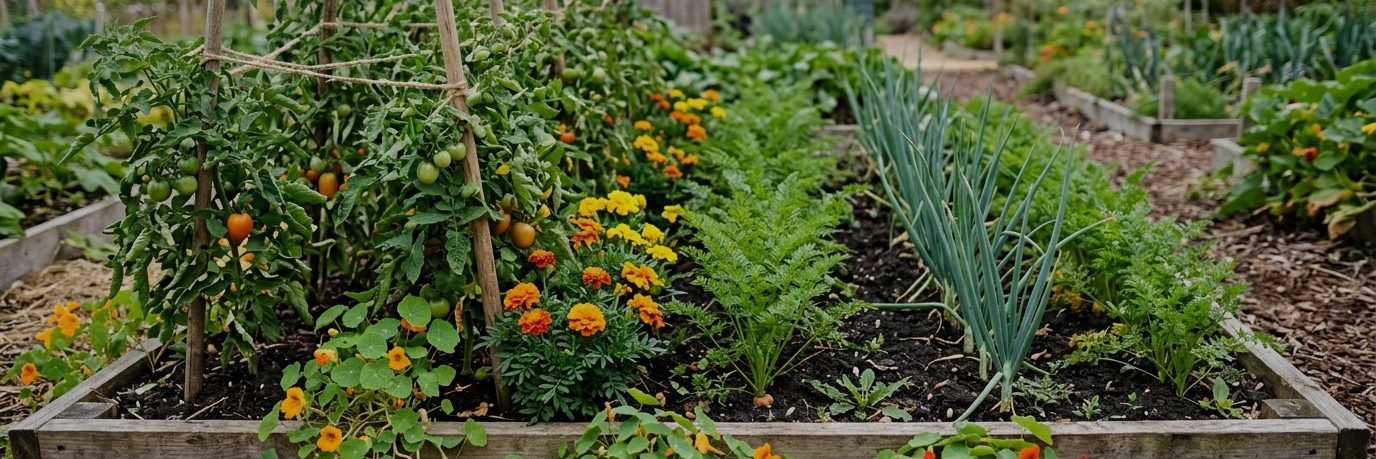
Companion planting means choosing which plants to grow side by side in the vegetable garden, and which to keep apart, to make the most of their natural interactions. Three mechanisms drive the pairings that actually work: scent confusion that throws pests off track (carrot and leek grown together), trap plants that lure aphids away (nasturtium), and root or nitrogen complementarity such as the classic corn-bean-squash trio. On the other hand, potatoes and tomatoes share the same blight, and both garlic and onion stunt the growth of beans. Pairing plants in space, then rotating families over time, keeps disease and pests in check without any treatment.
Why Pairing Plants Works: Four Mechanisms
Companion planting rests on observable mechanisms, not baseless folklore. The first is scent confusion: a pest finds its host plant by smell, and a foreign scent nearby throws it off. That is why carrots sown near leeks suffer less from carrot fly, and leeks in turn suffer less from leek moth. The second is the trap plant, which lures a pest toward itself rather than the crop it is meant to protect: nasturtium, with its highly sought-after sugary sap, draws aphids away from neighbouring tomatoes or broad beans. The third is attracting beneficial insects: flowering basil and nasturtium draw in hoverflies and ladybirds, whose larvae feed precisely on aphids. The fourth, less dramatic but just as real, is the physical complementarity between deep and shallow roots, or between low and tall foliage that shares the light without competing for it.
Pairings with a Proven Track Record
The tomato-basil-nasturtium trio remains the benchmark: planted at the foot of the tomato, basil curbs whitefly and attracts pollinators, while the nasturtium along the border draws off the aphids that would otherwise migrate to the fruit. Carrot and leek form the second classic pairing: the leek’s scent confuses carrot fly, and the carrot’s scent hampers leek moth; it is not an absolute shield, but pressure drops noticeably if a mesh cover is added during the egg-laying period. The corn-bean-squash trio, known as the three sisters, comes from Native American agriculture and remains the most scientifically studied polyculture: the corn acts as a stake for the climbing bean, the bean fixes nitrogen from the air in its root nodules and feeds the corn with it, and the squash or pumpkin covers the soil with its broad leaves, limiting evaporation and competing weeds. Another solid pairing in a humid climate: garlic planted between strawberry plants keeps some soil-borne fungal diseases at bay.
Pairings to Avoid in the Vegetable Garden
Conversely, some pairings come at a cost. Potatoes and tomatoes share the same pathogen, blight: both nightshades draw on the same nutrients, attract the same insects, and in a wet year a potato infected as soon as the first warm, muggy spell arrives can pass the disease on to neighbouring tomatoes within a matter of days. Always keep them in separate beds, and avoid replanting one where the other grew the previous year. Garlic, onion and shallot, all alliums, release sulphur compounds into the soil that slow the germination and growth of legumes: beans, peas and broad beans grow noticeably worse in direct contact with them, especially in poor or shallow soil. Fennel, finally, is the great loner of the vegetable garden: it produces allelopathic substances that inhibit the growth of nearly all its neighbours, tomato, bean, aubergine and cucumber above all. It should be grown on its own, at least a metre from any other crop, never mixed into a shared bed.
Crop Rotation: Companion Planting Over Time
Pairing plants in space is not enough if the same family returns to the same spot every year. Nightshades (tomato, potato, pepper, aubergine), legumes (bean, pea, broad bean), brassicas (cabbage, radish, turnip) and alliums (onion, garlic, leek) deplete the soil differently and harbour different diseases: repeating a family in the same spot two years running lets its own pathogens build up in the soil, blight for nightshades, clubroot for brassicas. The rule most gardeners agree on is a rotation of at least three to four years, cycling through a leaf vegetable, a root vegetable, a fruiting vegetable, then a legume that closes the cycle by returning nitrogen to the soil. Wherever summers are humid and favour blight and fungal disease in particular, this rotation is not a refinement: it is the best free protection against diseases that, once established in the soil, can persist there for several years.
Building Your Companion Planting Plan, Bed by Bed
On a vegetable bed, it pays to think in family blocks rather than scattering plants at random. Group the nightshades with their aromatic companions, tomato and basil at the centre, nasturtium along the edge, place carrot and leek in alternating rows, and set aside an isolated corner for fennel if it is part of the plan. Not all traditional pairings carry the same weight of evidence: the three sisters are backed by comparative trials, while some aromatic duos rest mainly on observation repeated across generations of gardeners, which remains a useful indication even without a published study behind every case. The most reliable approach is to note, bed by bed, year after year, what actually curbed aphids or carrot fly and what changed nothing, then adjust the following year’s rotation plan accordingly. Even a rough garden notebook beats a fixed list.
The care sheets to read next
Every plant mentioned has its full sheet: watering, light, soil, pests and a month-by-month calendar.
Tomato
Solanum lycopersicum
The tomato (Solanum lycopersicum) is the queen of the vegetable garden, but it is a plant of sun and warmth that plays…
Basil
Ocimum basilicum
Basil (Ocimum basilicum) is an annual, cold-sensitive herb that comes from the warm regions of Asia. It is a summer…
Nasturtium
Tropaeolum majus
The nasturtium (Tropaeolum majus) is an annual native to the Andean highlands of Peru and Colombia that has become an…
Carrot
Daucus carota
The carrot (Daucus carota) is a staple root vegetable in the vegetable garden, keeping all winter and sown directly in…
Leek
Allium porrum
The leek (Allium porrum) is the winter vegetable par excellence. Very hardy, it stands in the ground all winter and is…
Bean
Phaseolus vulgaris
The green bean (Phaseolus vulgaris) is one of the easiest vegetables in the kitchen garden, provided you respect one…
Sweet corn
Zea mays var. saccharata
Sweet corn (Zea mays var. saccharata) is a tall, tender annual grass grown for its sugary cobs, eaten fresh or grilled.…
Pumpkin
Cucurbita maxima
The pumpkin (Cucurbita maxima) is a large, sprawling, hungry and frost-tender squash that came from the Andes. It is a…
Onion
Allium cepa
The onion (Allium cepa) is a hardy, no-fuss bulb vegetable, one of the easiest crops to succeed with in a vegetable…
Potato
Solanum tuberosum
The potato (Solanum tuberosum) is one of the most rewarding crops in the vegetable garden: easy, productive and…
Curly kale
Brassica oleracea var. sabellica
Curly kale (Brassica oleracea var. sabellica), also known simply as kale, is a leafy vegetable of uncommon hardiness.…
Strawberry
Fragaria x ananassa
The strawberry (Fragaria x ananassa) is a hardy perennial that fits very well into any vegetable garden. Hardy to…
Garlic
Allium sativum
Garlic (Allium sativum) is one of the easiest vegetables in a kitchen garden, provided you grasp two things. You don’t…
Radish
Raphanus sativus
The radish (Raphanus sativus) is the fastest vegetable in the garden, ready to bite into in three to five weeks. It is…
Florence fennel
Foeniculum vulgare var. azoricum
Florence fennel (Foeniculum vulgare var. azoricum) is the fennel grown for its swollen base, crisp and…
Frequently asked questions
Which plants should be paired with tomatoes in the vegetable garden?
Basil and nasturtium form the benchmark trio: basil curbs whitefly and attracts pollinators, while nasturtium acts as an aphid trap along the border. Avoid planting tomatoes near potatoes, though, since they share the same blight, and keep fennel at a distance, as it is allelopathic to most nightshades.
Why shouldn’t potatoes and tomatoes be planted side by side?
Because they are both nightshades susceptible to the same pathogen, blight. In a wet year, potatoes are often affected first, as soon as the first warm, muggy spell arrives, and pass the disease on to neighbouring tomatoes within days. Always keep them apart in the vegetable garden, and avoid replanting one where the other grew the previous year.
What is the three sisters method of corn, beans and squash?
It is the pairing of corn, climbing beans and squash or pumpkin, inherited from Native American agriculture. The corn acts as a natural stake for the bean, the bean fixes nitrogen from the air into the soil and feeds the corn, and the squash covers the ground with its foliage, limiting evaporation and competing weeds. It is the most scientifically studied polyculture, with an overall yield higher than the same area grown as three separate blocks.
Why don’t onion or garlic get along with beans?
Alliums release sulphur compounds into the soil that slow germination and stunt the growth of legumes such as beans, peas or broad beans, especially in poor or shallow soil. The effect varies with soil type and planting density, but as a precaution these two families are always kept apart on the bed, and rotated through the plan instead.
Green Hub looks after your plants
Photograph a plant: Green Hub identifies it and writes its care sheet, with no account. Sign in afterwards to keep its dated photos and history over time.
Identify a plantUpdated on
How this sheet is written
Written for Green Hub with the help of language models, then reviewed. It offers gardening guidance, not professional advice: if you are unsure whether a plant is toxic to a child or an animal, ask a vet, a doctor or your national poison centre.