Celery
Apium graveolens
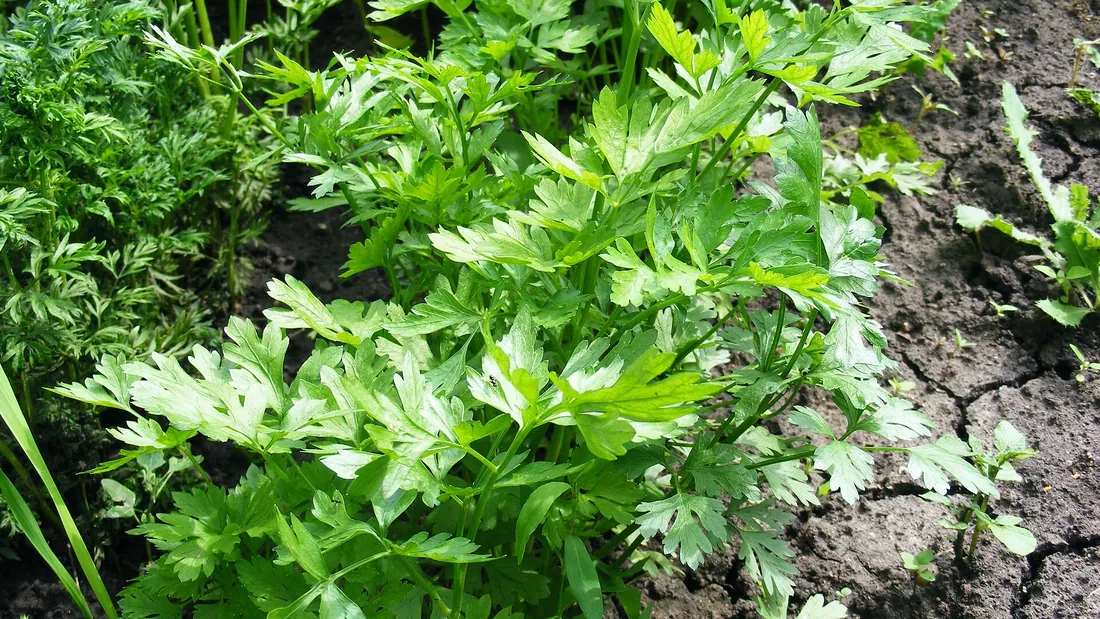

Celery (Apium graveolens) covers two vegetables from the same species: stalk celery, grown for its crisp ribs, and celeriac, harvested for its large round root. Both descend from wild celery, a plant of wet ground, which explains their main trait: an unquenchable thirst. Celery does not forgive drought, it needs rich, always-cool soil from start to finish. The tricky point is not the cold but the length of its growing season: it is sown very early indoors and occupies the bed almost all season, right up to the autumn harvest.
Light and exposure
Celery wants light and mild warmth, without excess. A sunny to lightly shaded spot during the hottest hours suits it well, all the more so because scorching full sun quickly dries out a soil that must be kept moist. Allow at least five to six hours of daylight a day.
Avoid overly confined corners where the air does not move: foliage that stays wet encourages leaf diseases. Look for the compromise, a bright but cool spot where the earth does not bake at the first July ray.
Watering
This is the crucial point. Celery descends from a marsh plant and demands soil that never dries out, from transplanting to harvest. A shortage of water, even brief, is paid for dearly: the ribs of stalk celery turn stringy and hollow, and the root of celeriac stays small and fibrous. Water generously and regularly, every day in strong heat if need be.
A good mulch at the base works wonders here: it holds the moisture, limits evaporation and spares you some of the trips with the watering can. In cool clay ground, nature helps you, but keep an eye on the dry spells of high summer all the same.
Soil and repotting
Celery is one of the hungriest vegetables in the garden. It calls for deep, rich, humus-filled soil that above all can hold water. Work in a good dose of ripe compost or well-rotted manure the previous autumn or at planting: it asks for more.
Heavy, cool ground, which would keep any other vegetable too wet, suits it perfectly. On light, sandy soil that dries fast, you have to make up for it with generous additions of organic matter and steadier watering. Aim for a neutral pH and a loose structure at depth, especially for celeriac, which must swell without obstacle.
Temperature and humidity
Celery likes coolness and mildness, between 15 and 20 degrees it feels at home. It dreads both dry heat, which makes it bolt, and the sharp cold of early season. A young plant exposed too soon to low temperatures, below 10 degrees for several days, takes a hit and risks flowering prematurely instead of forming ribs or a root.
That is why you do not put it out too fast. Wait until the nights warm up for good, above 10 degrees and the last frosts past, to transplant into open ground. At the other end, celery withstands the first autumn colds and is harvested before the hard frosts, which do damage the ribs and the root.
Pruning and upkeep
Celery is not pruned as such, but stalk celery calls for a particular gesture if you want tender, pale ribs: blanching. As harvest approaches, you deprive the base of the stalks of light so it stays pale and loses its bitterness. The simplest method is to earth up soil around the base, or to wrap the ribs in a sleeve of cardboard or paper, two to three weeks before harvesting.
For celeriac, the work is different: gradually clear the soil around the ball as it swells and remove the lateral roots that appear on the sides, to obtain a fine, regular root. In both cases, remove the yellowed outer leaves as the season goes on.
Pests and diseases
The disease to watch closely is septoria leaf spot, a fungus that covers the foliage with small brown spots ringed with yellow, sometimes speckled with black dots. It explodes in mild, damp weather, the profile of a cool oceanic summer and autumn, and can strip a plant bare if you let it run. To hold it back: space the plants, water at the base without wetting the foliage, remove and destroy affected leaves, and practise rotation.
Other troubles complete the list. The celery fly lays in the leaves where its larvae dig pale galleries; an insect-proof mesh protects effectively. Rust and boron deficiency, which hollows and browns the heart of the root, also occur. Slugs and snails, finally, love young plants freshly transplanted.
Propagation
Celery is propagated from seed, and it is the stage that demands the most care. Its seeds are tiny, slow to germinate, and they need light to come up: never bury them, lay them on the surface and press them barely into the compost. Sow early, from February or March, indoors in the warm between 18 and 20 degrees, because the crop is long and emergence can take two to three weeks.
Keep the sowing constantly moist and well lit until emergence, a transparent cover helps hold the air humidity. Then prick out into individual pots, harden the plants off gradually, and set them in open ground only after mid-May, once all risk of a cold snap is past. Space them 30 to 40 centimetres apart. For stalk celery, plant level with the soil without burying the heart.
Climate and hardiness
Where and in which climate it thrives
Celery has no cold problem, it has a water problem and a length problem. It grows at its ease between 15 and 20 degrees, takes white frosts and a few degrees below zero, but below -5 degrees both the ribs and the root freeze: you harvest before the hard frosts, whatever the calendar says.
Its real constraint is the length of the cycle, five to six months from sowing to harvest. In a climate with a short summer, you sow indoors ten to twelve weeks before the expected last frost, on the surface and in the light since the seed needs brightness to germinate, prick out into pots, and set the plants outside only once the nights stay reliably above 10 degrees. That delay is not caution for its own sake: a young plant left several days below 10 degrees is vernalised and bolts instead of forming ribs or a root. In a mild climate with frost-free winters the calendar flips: you sow at the end of summer for an autumn and winter crop, the season when heat no longer blocks anything.
The rest is a matter of soil and water. Cool clay ground, which holds moisture, offers it exactly what it seeks, and a mild, rainy summer suits it better than a heatwave; under dry heat you have to water every day and mulch generously, or the ribs turn hollow. Slightly acid soil suits it as long as it stays in the pH 6.0 to 7.0 range; below that, light liming helps limit boron deficiency. For celeriac, proven varieties such as Géant de Prague are lifted before the hard frosts: you bring in the roots and pick the stalks as you go. For tender ribs, blanch stalk celery by earthing it up two to three weeks before cutting.
Growing celery?
Green Hub keeps a dated history of your own plant: its photos, its progress, its repottings. An AI answers about yours specifically, not a generic sheet, for free.
Identify my plantMonth-by-month care calendar
| January | Rest in the garden. Choose your varieties, stalk celery for the ribs or celeriac for the root, and prepare fine compost and pots for the early sowings. |
|---|---|
| February | First sowings indoors, in the warm between 18 and 20 degrees. Seeds on the surface, never buried, under good light. Keep the compost moist, emergence is slow. |
| March | Carry on or start the sowings under cover. Prick out into individual pots the seedlings that have their first true leaves. Keep warmth and moisture constant. |
| April | Raise the young plants sheltered from cold. Start preparing the bed by working in plenty of compost. Too early to put out, cold would make the plants bolt. |
| May | Harden off the plants by taking them out during the day. Transplant into open ground only once the last frosts are past and the nights stay above 10 degrees. Space 30 to 40 centimetres and water abundantly. |
| June | Planting finished. Mulch the base to retain moisture and water regularly, the soil must never dry out. Hoe and watch for slugs and celery fly. |
| July | Full growth and great thirst. Water generously, every day in strong heat. A shortage of water now gives hollow, stringy ribs. |
| August | Keep up watering and mulching without let-up. Watch septoria closely in damp weather: remove spotted leaves and water at the base. Feed rich in nitrogen. |
| September | For stalk celery, start blanching by earthing up or sleeving the plants. The root swells, clear the soil around it and remove the lateral roots. |
| October | Harvest begins. Pick the stalks as needed, lift the first celeriac. Watch for forecast frosts, they spoil ribs and roots. |
| November | Bring in the rest of the celeriac before the hard frosts, store them cool in sand in the cellar. Last stalks to harvest. Clean up the bed. |
| December | Season over in the garden. Draw on the roots stored in the cellar. Note what worked and plan the very early sowings for next year. |
Green Hub tips
- Never cover celery seeds: they need light to germinate, lay them on the surface and press them barely in.
- Water is everything: soil that dries out gives hollow, stringy ribs and a stunted root. Mulch and water without ever letting thirst set in.
- Do not transplant before the nights stay reliably above 10 degrees: a cold snap on a young plant makes it bolt instead of forming ribs or a root.
- Blanch stalk celery by earthing up or sleeving the plants two to three weeks before harvest, for pale, mild ribs.
- Against the septoria that damp weather loves, always water at the base, air the plants and quickly remove leaves spotted with brown.
Related species
Carrot
Daucus carota
The carrot (Daucus carota) is a staple root vegetable in the vegetable garden, keeping all winter and sown directly in…
Chervil
Anthriscus cerefolium
Chervil (Anthriscus cerefolium) is a fine annual herb with finely cut foliage and a delicate, slightly aniseed flavour.…
Coriander
Coriandrum sativum
Coriander (Coriandrum sativum) is an annual herb grown for both its fresh leaves, with their pronounced flavour, and…
Dill
Anethum graveolens
Dill (Anethum graveolens) is an annual herb with a lacy outline, a cousin of the carrot and fennel. It is a warm-season…
Florence fennel
Foeniculum vulgare var. azoricum
Florence fennel (Foeniculum vulgare var. azoricum) is the fennel grown for its swollen base, crisp and…
Parsley
Petroselinum crispum
Parsley (Petroselinum crispum) is the most used herb in the kitchen, flat or curled depending on taste. It is a…
The guides that mention it
Making Compost: Steering the Thermal Biology of the Heap
A compost heap is not a pile of waste you stir, it is a thermal process you steer. The real carbon/nitrogen ratio of…
Vegetable Garden Pests: The Natural Method That Holds All Season
A leaf riddled with holes, a lettuce shaved to the ground overnight, a twisted and sticky shoot: every kind of damage…
Rainwater Harvesting for the Garden: Choosing and Sizing Your System
Rain barrel, above-ground tank, or underground cistern: how to choose the right size so your vegetable garden no longer…
Gardening Under a Greenhouse or Cold Frame: Growing All Year Round
A greenhouse or even a simple cold frame changes everything: sowings brought forward by several weeks, harvests…
Sowing Seeds Successfully: Why It Fails, and What Fixes It
A seed that never comes up was not unlucky. Germination temperatures by species, correct depth, seeds that need light,…
Updated on
How this sheet is written
Written for Green Hub with the help of language models, then reviewed. It offers gardening guidance, not professional advice: if you are unsure whether a plant is toxic to a child or an animal, ask a vet, a doctor or your national poison centre.