Prayer Plant
Maranta leuconeura
_(3073344552).jpg)
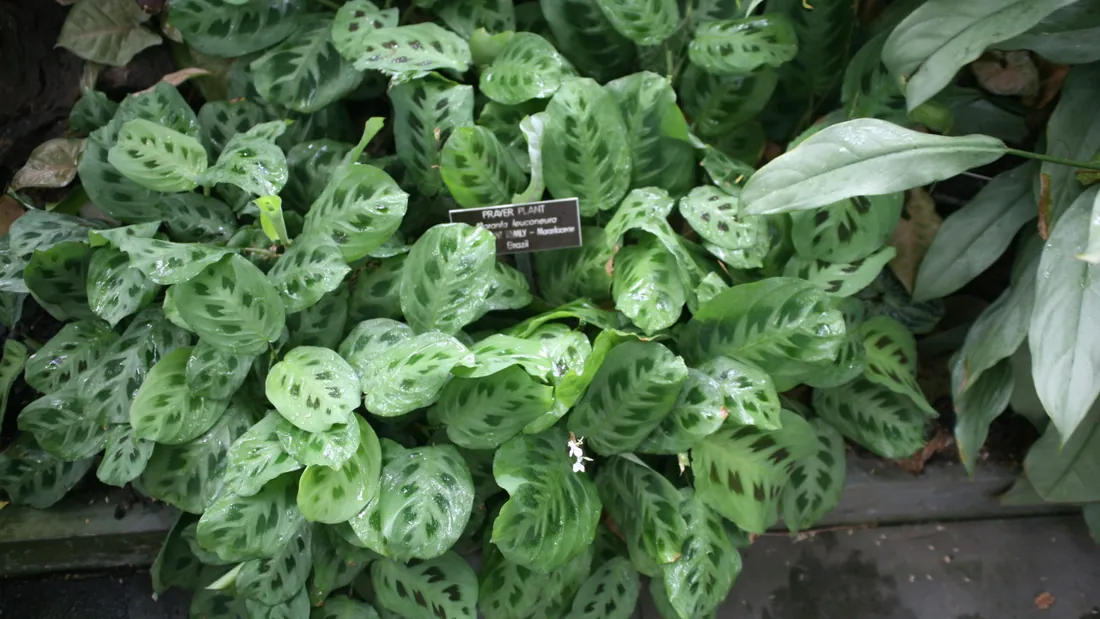
The prayer plant (Maranta leuconeura) is a houseplant with striking foliage, veined in red or marbled in light and dark green. Its nickname comes from a curious mechanism: its leaves lie flat during the day and rise up at night, folded together like hands in prayer. This movement, called nyctinasty, is visible to the naked eye as the hours pass. Born in the forest understory of Brazil, it wants warmth, humid air and filtered light, never direct sun. It is a year-round houseplant that above all asks you to look after air humidity, often too dry in a heated home.
Light and exposure
The prayer plant grows in the bright shade of the understory. In your home, give it strong but always filtered light: an east-facing window, a metre back from a south-facing bay, or behind a sheer curtain. Direct sun scorches its foliage within hours and washes out the colours that make it so appealing.
Too much shade, on the other hand, dulls it and spaces out the leaves. Under our grey, short winters, move it gently closer to a window from November to February to make up for the lack of light, without ever pressing it against a cold pane. It will tell you whether it is well placed: leaves that close up neatly at night and open wide in the morning signal a plant that feels at ease.
Watering
This is the sensitive point with the prayer plant, and the water matters as much as the amount. Keep the substrate constantly fresh, moist but never soggy. Water as soon as the top centimetre of the surface starts to dry out, more often in spring and summer, further apart in winter when growth slows.
Above all, avoid tap water wherever it runs hard, as it does over most limestone ground. Limescale turns the leaf edges brown and dry. Collect rainwater, or failing that let tap water stand overnight and serve it at room temperature. Cold water straight from the tap shocks the roots.
Soil and repotting
The prayer plant wants a light, airy substrate that holds moisture without turning into a sponge. A good mix combines houseplant potting soil, a handful of coco fibre or peat for water retention, and a little perlite or fine bark for drainage.
The pot must have drainage holes, this is non-negotiable: the roots rot quickly in standing water. Repot in spring roughly every two years, into a container barely larger. A pot that is too big holds too much water around still-fine roots and encourages rot.
Temperature and humidity
The prayer plant is a chill-sensitive tropical. It is happy between 18 and 24 degrees and hates anything below 15 degrees. A cold draught, a night near a poorly insulated window in the depths of winter, and the foliage takes the hit.
Keep it away from the trouble spots of a heated home: the top of a radiator that dries out the air, cold windowsills in winter, the draughts from a front door. A heated, stable room, a bright bathroom or a kitchen, suits it very well all year round.
Pruning and upkeep
The prayer plant is not really pruned in the strict sense, but regular care keeps it looking good. Cut off yellowed leaves, or those whose edges have browned too much, flush with the base and with clean scissors. This concentrates the energy on new growth and keeps the clump neat.
If the plant stretches out and goes bare in the centre, do not hesitate to cut back a few stems: it starts again from the base and thickens up. The healthy trimmings can be used as cuttings. A gentle dusting of the leaves with a damp sponge, now and then, also helps the plant breathe and catch the scarce light of winter.
Pests and diseases
The number one enemy in our heated homes is the spider mite. This tiny mite thrives as soon as the air turns dry, typically in the depths of winter when the heating is running. Signs to watch for: fine webs in the leaf axils, foliage that becomes speckled with pale dots and loses its shine. The answer comes down to one word: humidity. Humid air discourages the spider mite on its own.
Brown, dry edges are not a disease but almost always a problem of hard water or air that is too dry. As for the roots, overwatering causes rot: soft, yellowing leaves, a stem that goes mushy at the base. When in doubt, unpot, cut off the black roots and repot in fresh substrate.
Propagation
Division is the simplest and safest method. At the spring repotting, take the plant out and gently separate the root ball into two or three pieces, each with its roots and a few stems. Repot straight away and keep warm and humid while it settles in.
Stem cuttings work too. Take a stem with a node, that small swelling from which roots and leaves emerge, and place it in rainwater or directly in a light substrate kept moist. Enclose the whole thing in a translucent plastic bag to create a moisture-saturated atmosphere, like a mini greenhouse. Roots appear within a few weeks.
Climate and hardiness
Where and in which climate it thrives
The prayer plant never goes outside in a temperate climate: it is a year-round houseplant, far too chill-sensitive for nights below 15 degrees, even in high summer. The real challenge is not the outdoor cold but the dry air of a heated home through the whole heating season. Heating dries out the atmosphere, the leaf edges turn brown and the spider mite moves in. That is where everything is decided.
Two habits change everything. First the water: wherever the tap runs hard, that limescale damages the foliage. Collect rainwater in a can or a bucket under a gutter, it is the ideal and free water for this plant. Then air humidity: set the pot on a saucer of clay pebbles filled with water without the base of the pot sitting in it, group your plants together so they create their own microclimate, or place the prayer plant in a bright bathroom. In the cold season, keep it away from radiators and cold panes. Save repotting and division for the return of the light, when the plant starts up again.
Growing prayer plant?
Green Hub keeps a dated history of your own plant: its photos, its progress, its repottings. An AI answers about yours specifically, not a generic sheet, for free.
Identify my plantMonth-by-month care calendar
| January | Deep winter, the heated air is at its driest. Watch for spider mites, mist or set the pot on damp clay pebbles. Reduced watering, with tempered rainwater. |
|---|---|
| February | Still keeping an eye on air humidity. The light returns a little, move the plant closer to a bright window without pressing it against the cold pane. |
| March | Growth resumes. This is the right time to repot and divide if the plant is cramped. Go back to slightly more frequent watering. |
| April | Active growth. Repotting and division still possible. Resume a diluted feed for foliage plants, once a month. |
| May | A fine flush of new leaves. Keep up the light feed and regular watering with rainwater. Move it away from the rising sun. |
| June | Peak season. The surrounding air is more humid, the plant breathes. Keep the substrate fresh and turn the pot for a balanced shape. |
| July | Summer heat. The substrate dries out faster, water more often. Keep it in bright shade, never behind a pane in full sun. |
| August | Late summer. Carry on with watering and a light feed. Dust the foliage so it catches the light well. |
| September | Growth slows down gently. Space out the feeding. Enjoy the still-mild air before the heating comes back on. |
| October | The heating starts up again, the air dries out. Put the saucer of damp pebbles back in place and watch the leaf edges. |
| November | Rest settles in. Cut back on watering, stop feeding. Scarce light: give it the brightest spot in the house. |
| December | Winter rest. Minimal watering but never a fully dry substrate. Watch for spider mites and keep the air humid. |
Green Hub tips
- Always water with rainwater. Hard tap water turns the leaf edges brown for sure.
- Against the dry air of the heating, group your plants together and set the pot on a saucer of damp clay pebbles: it is more effective than a misting that is quickly forgotten.
- Leaves that fold up neatly at night are the sign of a happy plant. If the movement freezes, look to the light or the watering.
- At the first fine web between the leaves in winter, act fast: the spider mite spreads at high speed in dry air.
- A non-toxic plant, safe for cats and dogs that might nibble at it.
Related species
Calathea (peacock plant)
Goeppertia (anciennement Calathea)
The calathea (genus Goeppertia, long classified under Calathea), or peacock plant, brings together tropical understorey…
Aglaonema
Aglaonema commutatum
The aglaonema (Aglaonema commutatum) is a robust, easy houseplant, prized for its foliage variegated with green,…
Alocasia
Alocasia
The alocasia, nicknamed elephant ear, charms with its large, dramatically veined leaves. It is a demanding tropical…
Aloe vera
Aloe vera
Aloe vera (Aloe vera) is a succulent from the Arabian Peninsula, grown since antiquity for the soothing gel of its…
Anthurium
Anthurium andraeanum
The anthurium (Anthurium andraeanum) is a tropical houseplant known for its smooth, waxy red spathe, which people often…
Areca palm
Dypsis lutescens
The areca (Dypsis lutescens) is a tropical palm from Madagascar, frost-tender, grown indoors wherever winter freezes.…
The guides that mention it
Indestructible Houseplants: Tolerating Drought Is Not Tolerating Shade
Tolerating drought and tolerating shade are two different adaptations, and almost every list mixes them up. What these…
Toxic Plants for Cats and Dogs: Recognising the Danger Rather Than Memorising a List
A list of toxic plants is easily forgotten and always incomplete. What actually protects a cat or dog is recognising…
How to Compost in an Apartment with Worm Composting
Tiered bin, red worms and worm tea: how to compost your kitchen scraps without a garden or odor, even in a city…
Updated on
How this sheet is written
Written for Green Hub with the help of language models, then reviewed. It offers gardening guidance, not professional advice: if you are unsure whether a plant is toxic to a child or an animal, ask a vet, a doctor or your national poison centre.