Swiss cheese plant
Monstera deliciosa
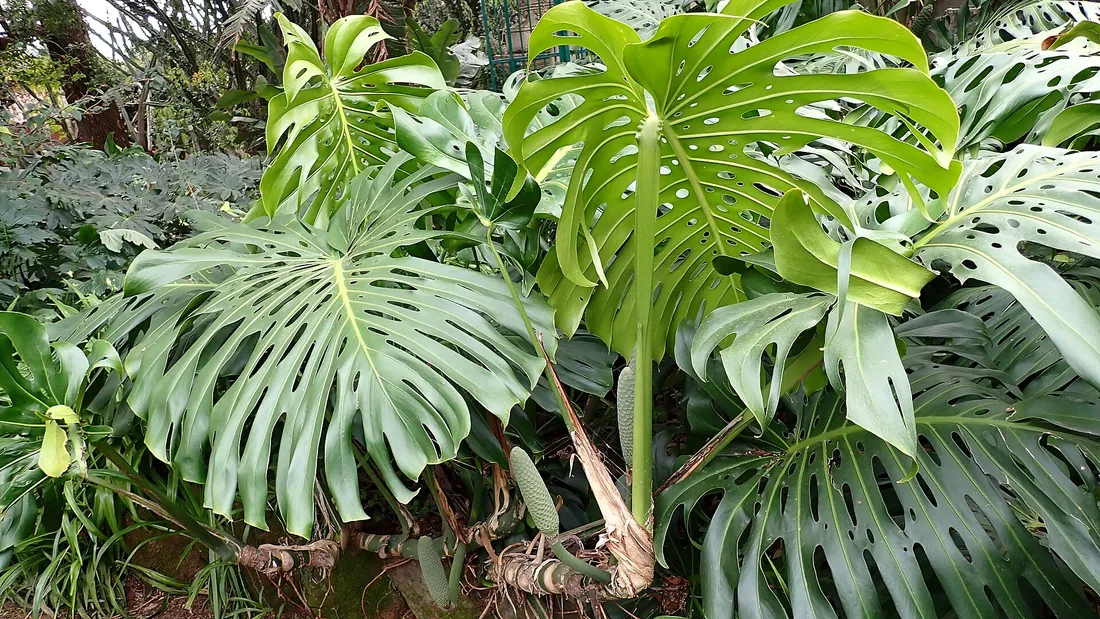

The Monstera deliciosa, or Swiss cheese plant, is a tropical liana from Central America that has become the star of interiors. Wherever it freezes, it is grown in a pot indoors, because it survives no frost and suffers from the dry air of heating. With bright light without direct sun, and watering only when the substrate has dried out over three to four centimetres, it ends up opening its large perforated leaves after two or three years.
Light and exposure
The Monstera wants bright but filtered light. A spot a metre from an east or west-facing window suits it perfectly. Avoid the direct midday sun in summer, which scorches the leaves and leaves dry brown patches. In too deep a shade, the plant survives but its leaves stay small and solid, without the cutouts that make all its appeal.
Well away from the equator, winter light is weak and short through the darkest months. Move the pot closer then to the brightest window in the house and turn it a quarter turn each week, otherwise the plant stretches towards the glass and leans to one side.
Watering
Let the first three to four centimetres of substrate dry out before watering again. In practice, that amounts to one watering a week in spring and summer, then one every ten to fifteen days in winter, when growth slows. Push a finger into the soil rather than following a fixed calendar.
Always empty the saucer after watering. Roots soaking in stagnant water rot fast, and that is by far the leading cause of death of the Monstera in a flat. Tap water is fine in most regions, but if your leaves get covered in white deposits, yours is hard: let it stand overnight, or collect rainwater.
Soil and repotting
The Monstera hates compact substrates that hold water. Mix a potting soil for green plants with a good handful of orchid bark and some perlite to keep it all aerated. A pot with drainage holes is essential.
Repot in spring every two years, or as soon as the roots come out through the drainage holes. Choose a pot barely larger than the previous one, because too large a volume of soil stays moist too long and rots the roots.
Temperature and humidity
The ideal range is between 18 and 27 degrees. Below 12 degrees, growth stops; below 10 degrees, the leaf margins blacken. Keep the Monstera away from scorching radiators as well as from cold draughts near doors and single-glazed windows.
The real problem is not the cold, it is the air dried out by heating throughout the heating season. Leaf tips that brown and dry out betray air that is too dry. Set the pot on a bed of moist clay balls, or run a humidifier in the room; misting, for its part, only lifts the humidity for a few minutes.
Pruning and upkeep
Give the Monstera a moss pole as soon as it grows: it is a climbing plant, and a support helps it produce larger and better-cut leaves. Guide the aerial roots towards the pole or into the pot.
In spring, cut the stems that have grown too long just above a node. Do not throw away these pieces, they are easy to propagate. Regularly wipe the dust off the leaves with a damp cloth so the plant can breathe and catch the light better.
Pests and diseases
Mealybugs, small cottony clusters in the leaf axils, and red spider mites, which weave fine webs under the foliage, appear mainly when the air is dry in winter. Remove them with a cotton pad soaked in diluted methylated spirit and increase the humidity of the room.
Leaves yellowing en masse almost always signal excess water and the start of root rot. Take out the rootball, cut off the soft brown roots, and repot in fresh, dry substrate.
Propagation
The Monstera is very easy to propagate in spring or summer. Spot a node, that little bump from which a leaf and often an aerial root emerge, and cut the stem just below it. Place the cutting in a glass of clear water, change the water every week, and wait for roots of a few centimetres to form before repotting in soil.
A cutting without a node will never make roots, even if it stays green for several weeks. It is the node that matters, not the leaf.
Toxicity
The whole plant contains calcium oxalate crystals. Chewed, a leaf causes a strong irritation of the mouth and throat. Keep the Monstera out of reach of cats, dogs and young children.
Climate and hardiness
Where and in which climate it thrives
The Monstera lives between 18 and 27 °C and only briefly goes down to 10 °C without damage: below that mark, the leaf margins blacken. It tolerates no frost at all. In the open ground it lasts only in USDA zones 10 to 12, under a frost-free climate; everywhere else it is a year-round houseplant that can go outside for the summer.
That summer spell is worth it, in light shade and out of the wind, once nights settle above 12 °C. Bring it back in when they drop below that, without waiting for the first frost: three weeks of nights at 8 °C already damage it. Move it from shade to full daylight gradually, as a leaf will scorch in a single afternoon of direct sun.
The two indoor difficulties are winter ones, and have nothing to do with cold. The first is light: under a temperate sky, between the solstice and the spring equinox, the plant slows down and puts out smaller, less divided leaves, which is normal and is made up when the light returns. The second is air dried out by heating, which browns the leaf tips; aim for 40 to 60 % humidity, by moving the plant away from radiators and cold panes rather than by misting it, whose effect lasts only a few minutes.
Growing swiss cheese plant?
Green Hub keeps a dated history of your own plant: its photos, its progress, its repottings. An AI answers about yours specifically, not a generic sheet, for free.
Identify my plantMonth-by-month care calendar
| January | Rest. Water little, every 12 to 15 days, when the soil is dry deep down. Away from radiators, in the brightest light possible. |
|---|---|
| February | Still at rest. Watch for mealybugs and red spider mites, favoured by the dry air. Wipe the leaves. |
| March | The light returns, growth starts up again. Resume slightly more regular watering. A good time to repot if the roots are overflowing. |
| April | Full restart. Repotting and cuttings ideal. Set up or reinforce the moss pole. First light feeding. |
| May | Active growth. Water about once a week. Feed every 15 days with a diluted green-plant fertiliser. |
| June | You can move the plant out into light shade on a sheltered terrace. Fine new leaves in prospect. |
| July | High summer. Water as soon as the surface has dried, mist in strong heat. Continue feeding. |
| August | Still a good growing period. Take cuttings from the pruned stems. Prepare the return indoors at the end of the month. |
| September | Bring the plant back in as soon as the nights drop below 12 degrees. Gradually re-acclimatise it to indoor light. |
| October | Space out the watering. Last light feeding of the year. Clean the foliage before winter. |
| November | Going into rest. Move the pot closer to a south-facing window. Stop feeding and reduce the water. |
| December | Winter rest. Beware the dry air of the heating: mist or set the pot on moist clay balls. |
Green Hub tips
- The leaves only fenestrate with age and good light. A young plant with solid leaves is nothing abnormal, you just have to give it time.
- Never cut off the dangling aerial roots: guide them towards the pole or plunge them into the pot, they feed the plant.
- A Monstera that leans is seeking the light. Turn the pot a quarter turn each week so it grows straight.
- To take cuttings with certainty, always keep a node below the cut. No node, no roots.
Related species
Aglaonema
Aglaonema commutatum
The aglaonema (Aglaonema commutatum) is a robust, easy houseplant, prized for its foliage variegated with green,…
Alocasia
Alocasia
The alocasia, nicknamed elephant ear, charms with its large, dramatically veined leaves. It is a demanding tropical…
Anthurium
Anthurium andraeanum
The anthurium (Anthurium andraeanum) is a tropical houseplant known for its smooth, waxy red spathe, which people often…
Dieffenbachia
Dieffenbachia seguine
Dieffenbachia (Dieffenbachia seguine) is a houseplant with large foliage variegated in cream and green, native to the…
Heartleaf philodendron
Philodendron hederaceum
The heartleaf philodendron (Philodendron hederaceum), also known as the sweetheart plant, is a vine from the tropical…
Peace lily
Spathiphyllum
The peace lily (Spathiphyllum) is a tropical understorey plant from Central America, prized for its glossy green…
The guides that mention it
Indestructible Houseplants: Tolerating Drought Is Not Tolerating Shade
Tolerating drought and tolerating shade are two different adaptations, and almost every list mixes them up. What these…
Watering Plants Properly: Deciding Rather Than Following a Schedule
Beginners water too often and too little at the same time. How to read the soil instead of the calendar, tell thirst…
Repotting your plants and choosing the right potting mix
The right moment, the right technique and the right substrate for each plant, so you can repot without rotting the…
Toxic Plants for Cats and Dogs: Recognising the Danger Rather Than Memorising a List
A list of toxic plants is easily forgotten and always incomplete. What actually protects a cat or dog is recognising…
How to Compost in an Apartment with Worm Composting
Tiered bin, red worms and worm tea: how to compost your kitchen scraps without a garden or odor, even in a city…
Updated on
How this sheet is written
Written for Green Hub with the help of language models, then reviewed. It offers gardening guidance, not professional advice: if you are unsure whether a plant is toxic to a child or an animal, ask a vet, a doctor or your national poison centre.