Yucca
Yucca elephantipes
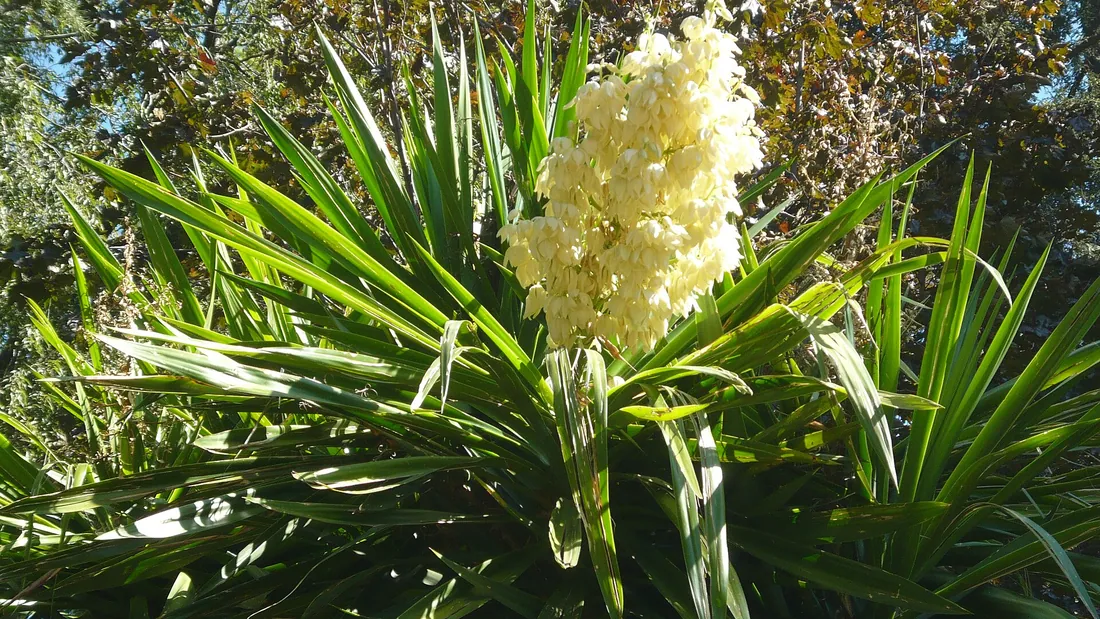

The indoor yucca (Yucca elephantipes) is a shrub from Central America with a thick swollen trunk, without the prickly leaves of its garden cousins. It is one of the easiest houseplants to live with: it forgives a missed watering but never an excess of water. It is grown in a pot indoors, with a possible spell on the terrace at the height of summer, then a return before the first cold nights.
Light and exposure
The yucca wants as much light as possible. Place it in front of a south or west-facing window, where it gets direct sun for a good part of the day. It is a full-sun plant: at the back of a dark room it becomes leggy, the leaves pale and the trunk stretches limply towards the light.
In winter, when light is scarce, move it closer to the brightest pane. A plant going bare at the bottom almost always lacks light above all else.
Watering
This is the point that makes a yucca live or die. It stores water in its trunk and tolerates drought very well, but hates roots sitting in moisture. Water only when the substrate is dry over several centimetres, then always empty the saucer. In full growth, this often comes down to watering every ten to fifteen days.
Excess water is the fatal mistake. A trunk that is soft, spongy or brown at the base signals a rot already established, almost always fatal. When in doubt, do not water: a thirsty yucca recovers in a day, a drowned yucca never.
Soil and repotting
A very free-draining substrate is essential. Mix potting soil for green plants with a third of coarse sand or perlite so the water passes through quickly. Ordinary potting soil that stays waterlogged condemns the plant in the long run.
Repot only every two to three years, in spring, into a barely larger pot always pierced at the bottom. The yucca likes to be a little cramped, and too large a pot keeps too much moisture around the roots.
Temperature and humidity
The yucca is happy between 18 and 24 degrees in the growing season and easily takes the heat of a flat in summer. In winter it appreciates a cooler room, around 10 to 15 degrees, but bright. It tolerates brief spells at 5 degrees, not below: it is a frost-tender plant that never overwinters outdoors here.
Air humidity does not concern it, it comes from a dry climate and does not mind our heated interiors. Just avoid placing it against a scorching radiator, which browns the tips of the leaves. Never leave it outdoors once the nights drop back below 5 degrees.
Pruning and upkeep
The yucca needs little care. Cut off the dry lower leaves that yellow as they appear, this is the plant’s normal ageing, not a disease. Dust the foliage with a damp cloth so it captures the light well.
If it gets too tall, top the trunk cleanly with a saw in spring: the plant will start again by forming new heads just below the cut, and the section serves as a cutting. Turn the pot a quarter turn every two weeks for an even shape.
Pests and diseases
Indoors, the number one enemy remains rot of the trunk and roots, caused by excess water and not by a true pathogen. A trunk soft at the base, a musty smell in the pot: the cause is almost always one watering too many in a poorly drained substrate. It is irreversible once established, only prevention counts.
As for pests, watch for mealybugs, white cottony clusters in the leaf axils, and red spider mites which thrive in the dry air of heating. Clean the mealybugs with cotton soaked in methylated spirit and shower the foliage against red spider mites at the first yellow spots.
Propagation
Trunk cuttings are the prime method. Cut a section of twenty to thirty centimetres, let the cut dry for two or three days to callus over, then plant it in a barely moist free-draining substrate. Roots and new shoots appear within a few weeks in warmth and light.
The offsets at the base of the plant can also be taken: detach them with a few roots and repot them separately. Do these operations in spring or early summer, when the plant is in full sap and heals quickly.
Toxicity
Mildly toxic. The leaves contain saponins that can cause mild digestive upset if a cat or dog chews on them in quantity. Nothing serious in an adult, but it is better placed out of reach of an animal that nibbles at everything.
Climate and hardiness
Where and in which climate it thrives
In a temperate climate, Yucca elephantipes is a pure houseplant. It is frost-tender and would not survive a winter outdoors, unlike Yucca gloriosa or Yucca filamentosa, its hardy cousins that are planted in the ground and that do withstand frost. This sheet is indeed about the indoor yucca, with its swollen trunk and supple foliage.
Growing in a pot is therefore the rule. It can be put out on the terrace at the height of the warm season for a real dose of sun, acclimatising it gradually and sheltered from beating rain. As soon as the nights drop back below 10 degrees it comes in, and it is never left outdoors below 5 degrees.
Winter is the delicate moment. A bright, cool room, almost no watering: a glass of water a month is enough when the plant is at rest and the heating is running. It is in winter, by continuing to water as in summer, that most yuccas are killed. Kept dry and bright, it gets through the bad season without flinching.
Growing yucca?
Green Hub keeps a dated history of your own plant: its photos, its progress, its repottings. An AI answers about yours specifically, not a generic sheet, for free.
Identify my plantMonth-by-month care calendar
| January | Full rest. Almost no watering, a little water once in the month if the substrate is completely dry. In front of the brightest window. |
|---|---|
| February | Still at rest. Check for the absence of mealybugs in the leaf axils. Water only if the soil is dry deep down. |
| March | The light returns, the plant restarts gently. Resume more regular watering. Ideal month to repot if the pot is too tight. |
| April | Growth resumes. Top the trunk if it is too tall and take a cutting from the section. A very light green-plant fertiliser can resume. |
| May | Active growth. Acclimatise it outdoors for a few hours on fine days but bring it in at night: the nights stay cool as long as the risk of a late frost remains. |
| June | From mid-June, out on the terrace sheltered from beating rain. Acclimatise to the sun gradually. Water when the substrate is dry. |
| July | Full summer outdoors. Watch for the pot drying out in strong heat, but always let it dry between two waterings. |
| August | Last month outdoors. Take and repot the offsets at the base to propagate. Water sparingly. |
| September | Bring the plant in as soon as the nights drop below 10 degrees. Clean the foliage before settling it back indoors. |
| October | Reduce watering markedly, growth slows. Place it in the brightest room to compensate for the lack of daylight. |
| November | Entering rest, rare watering. Keep it away from a scorching radiator and watch for red spider mites in the dry air of the heating. |
| December | Winter rest. Almost no water, plenty of light, a rather cool room. Do not give in to the urge to water, that is the season’s mistake. |
Green Hub tips
- When in doubt, do not water. A yucca takes thirst without flinching but a trunk gone soft from excess water is never saved.
- In winter, a glass of water a month is enough. Continuing to water as in summer is what kills the most indoor yuccas.
- Never leave it outdoors below 5 degrees: this is the frost-tender indoor yucca, not its hardy garden cousin.
- The section you cut when topping makes a perfect cutting. Let the cut dry for two or three days before planting it.
Related species
Asparagus
Asparagus officinalis
Asparagus (Asparagus officinalis) is an unusual perennial for a vegetable patch: once established, an asparagus bed…
Hosta
Hosta
The hosta (Hosta spp.) is a perennial native to the damp woodlands of East Asia, from Japan through China to Korea. It…
Hyacinth
Hyacinthus orientalis
The hyacinth (Hyacinthus orientalis) is a spring bulb whose heady scent announces the return of fine weather in gardens…
Lily of the valley
Convallaria majalis
Lily of the valley (Convallaria majalis) is the small perennial with white, fragrant bell flowers traditionally given…
Madagascar dragon tree
Dracaena marginata
The Madagascar dragon tree (Dracaena marginata) is a houseplant with a slender trunk and a tuft of strap-like leaves…
Snake plant
Dracaena trifasciata
The snake plant (Dracaena trifasciata), long classed under the name Sansevieria trifasciata and nicknamed…
The guides that mention it
Indestructible Houseplants: Tolerating Drought Is Not Tolerating Shade
Tolerating drought and tolerating shade are two different adaptations, and almost every list mixes them up. What these…
Overwintering your plants without losing them
Clivia, lavender, verbena, geranium, olive: which to bring indoors, which to protect outside, which to leave to face…
Toxic Plants for Cats and Dogs: Recognising the Danger Rather Than Memorising a List
A list of toxic plants is easily forgotten and always incomplete. What actually protects a cat or dog is recognising…
Which Plants to Choose for a Drought-Resistant Garden
Deep roots, silvery foliage, Mediterranean origins: the plants that get through a dry summer without watering, and how…
Updated on
How this sheet is written
Written for Green Hub with the help of language models, then reviewed. It offers gardening guidance, not professional advice: if you are unsure whether a plant is toxic to a child or an animal, ask a vet, a doctor or your national poison centre.