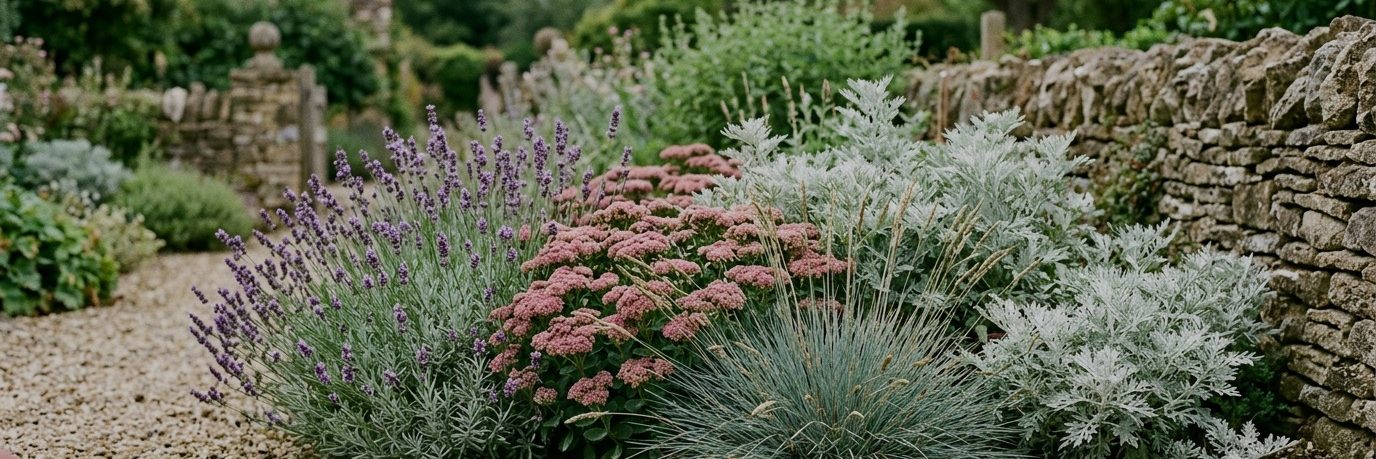
Which Plants to Choose for a Drought-Resistant Garden
A water-wise garden starts with the choice of plants: lavender, rosemary, sage, yucca, echinacea and fig can all go several weeks without rain once well established, thanks to deep roots and silvery or fleshy foliage that limits evaporation. In a temperate, damp climate, these species don’t need permanently dry soil, just soil that drains well in winter; their resilience is built mainly in the first year, as the roots push down in search of water. Planted well in autumn, in free-draining soil under a mineral mulch, they need almost no watering at all from the second season onward.
Why Some Plants Survive Without Watering
A water-wise plant doesn’t magically use less water: it has usually developed, in its native Mediterranean scrubland or dry prairie habitat, strategies to lose less of it and to go further afield to find it. The first mechanism is rooting. Lavender, rosemary, echinacea and fig all develop a taproot system that plunges deep within the first few years, well below the zone where the soil dries out in summer; it’s this taproot, more than the foliage, that explains why an established plant survives without watering where a young seedling wilts within a week.
The second mechanism is visible to the naked eye: silvery grey foliage, like that of lavender or sage, reflects part of the solar radiation and keeps the leaves cooler. The small, narrow leaves of thyme or yew, and the thick, waxy leaves of holly or olive, limit the evaporating surface or store a reserve of water. Keeping these two criteria in mind, deep roots and suitable foliage, is enough to spot a genuinely water-wise plant at the garden centre, without relying on the label alone.
Mediterranean Herbs, the Backbone of a Dry Border
Lavender, rosemary, sage, thyme and oregano form the most reliable base for a water-wise border in a temperate climate. All of them come from around the Mediterranean, where summers are dry and the soil is poor and stony; planted in full sun, in free-draining soil, lightened with sand or gravel if the ground is clay, they find again the conditions that shaped their toughness. True lavender and rosemary are far more troubled by standing damp in winter than by drought in summer: soil that holds water through the cold season will rot them more surely than a rainless midsummer.
Thyme and oregano, lower-growing and spreading, suit borders and stony patches where nothing else will grow. Marjoram, oregano’s more tender cousin, tolerates drought just as well but copes less well with prolonged wet winters; it does well in a pot or a sheltered spot, brought indoors or covered with fleece in the harshest winters. Together, these herbs scent the garden, draw in pollinators all summer long, and need supplementary watering only in their first season.
Flowering Perennials and Shrubs for a Dry, Lively Garden
Beyond the herbs, several flowering perennials and shrubs stand up to drought while bringing colour over a long season. Echinacea, a North American prairie perennial, develops a deep taproot by its second year and flowers from midsummer to late summer without any particular watering; its dried seed heads also feed seed-eating birds in winter if left standing. Buddleia, a fast-growing shrub nicknamed the butterfly bush, likewise sends roots down deep and flowers generously all summer, even on a dry bank; a hard prune in late winter, just before growth restarts and just above the previous year’s growth, keeps it from sprawling and concentrates the flowering.
Yucca brings a different, architectural note: its stiff, pointed leaves store water like a succulent, letting it get through several weeks of heatwave without flagging once rooted in. These three plants pair well with the Mediterranean herbs, but should not be mixed with thirstier perennials that would force regular watering on the whole border.
Shrubs and Small Trees That Cope Once Established
The fig often surprises with its toughness: native to the Mediterranean basin, it develops a wide, shallow root system that catches the slightest rain, and once established for two to three years, it gets through a dry summer without watering, even against a sun-trapping wall that stores heat. Olive stays trickier in a cool temperate climate: its drought tolerance is real, but its cold hardiness is not; most varieties suffer below minus twelve to minus fifteen degrees, so it’s best planted in a very sheltered spot, against a wall that catches the midday sun, or in a large pot brought indoors for winter in the coldest regions, inland or at altitude.
Holly, yew and privet, often used for hedging, also deserve a place on their own in a dry border: all three develop deep roots and evergreen foliage with low evaporation, letting them do without summer watering from their third year on. Their slow growth in the first two seasons calls for a little patience and some watering to get them established, more than made up for afterwards by a silhouette that stays green and sparing with water all year round, winter and summer alike.
Planting Right So Drought Stops Being a Problem
The success of a water-wise garden depends as much on planting as on choosing the right species. Timing matters most: planting in autumn, once the heat has passed and well before the first hard frosts, gives the roots the whole winter and spring to settle in before the first real heat, whereas a spring planting forces you to water all summer to make up for still-shallow roots. The soil is worth working to improve drainage, but should never be over-enriched: watering too generously in the first year encourages roots to stay lazy near the surface instead of pushing down in search of water.
Mineral mulch, gravel, volcanic rock or pebbles, suits Mediterranean plants better than organic mulch: it drains water away from the crown and prevents standing damp against the stem in winter, a cause of rot more dangerous to lavender or rosemary than drought itself. Generous but well-spaced watering carries the plants through the first season, then tapers off gradually until it stops altogether once the plant shows clear new growth, just as with the rest of the garden.
The care sheets to read next
Every plant mentioned has its full sheet: watering, light, soil, pests and a month-by-month calendar.
Lavender
Lavandula angustifolia
True lavender (Lavandula angustifolia) is a hardy Mediterranean plant that scents the air and draws bees all summer…
Rosemary
Salvia rosmarinus
Rosemary (Salvia rosmarinus, long known as Rosmarinus officinalis) is an evergreen Mediterranean shrub with needle-like…
Sage
Salvia officinalis
Common sage (Salvia officinalis) is a small aromatic shrub with evergreen grey-green foliage, originating from the dry…
Thyme
Thymus vulgaris
Thyme (Thymus vulgaris) is a small Mediterranean subshrub with woody stems and a powerful fragrance, hardy to about…
Oregano
Origanum vulgare
Oregano (Origanum vulgare) is a tough, perennial herb built for sun and dry soils. Here is the good news: it is fully…
Marjoram
Origanum majorana
Marjoram is the gentle cousin of oregano: same family, but a finer, sweeter and less pungent scent, much prized in…
Coneflower
Echinacea purpurea
Coneflower (Echinacea purpurea) is a tall, sturdy perennial from the prairies of North America, recognisable by its…
Butterfly bush
Buddleja davidii
Buddleia (Buddleja davidii), better known as the butterfly bush, is a nearly indestructible shrub that has taken over…
Olive tree
Olea europaea
The olive tree (Olea europaea) is a Mediterranean tree whose hardiness stops at around minus 8 to minus 10 degrees, in…
Fig tree
Ficus carica
The fig tree (Ficus carica) is a Mediterranean tree, yet it really can be grown up to USDA zone 7 provided you shelter…
Yucca
Yucca elephantipes
The indoor yucca (Yucca elephantipes) is a shrub from Central America with a thick swollen trunk, without the prickly…
Holly
Ilex aquifolium
Holly (Ilex aquifolium) is an evergreen shrub with glossy, spiny leaves and bright red berries that light up in the…
Yew
Taxus baccata
Yew (Taxus baccata) is a conifer native to Europe, able to live for several centuries and to regrow from old wood…
Privet
Ligustrum ovalifolium
Privet (Ligustrum ovalifolium), often sold as California privet, is a shrub native to Japan that has become one of the…
Frequently asked questions
What are the best drought-resistant plants for a temperate-climate garden?
The Mediterranean herbs, lavender, rosemary, sage and thyme, form the most reliable base, complemented by echinacea and buddleia for flowers, yucca for structure, and holly, yew or privet for a year-round evergreen presence. All of them cope well with a dry summer once rooted in, provided the soil drains well in winter.
Do water-wise plants need watering in their first year?
Yes, always. Their drought resistance comes from a deep root system that takes one to three seasons to develop; without watering to help them establish, the young roots stay shallow and the plant suffers just as much as an ordinary species would. Watering is then gradually reduced as soon as the plant’s growth shows the roots have taken hold.
What mulch should you use for water-wise Mediterranean plants?
A mineral mulch, gravel, volcanic rock or pebbles, works better than an organic one: it drains water away from the crown and prevents standing damp against the stem in winter, the main cause of rot in lavender, rosemary or thyme. A standard organic mulch, which holds more moisture, suits woodland or vegetable-garden plants better.
Can you plant an olive or fig tree directly in the ground in a temperate climate?
Fig trees settle in without difficulty in the open ground across most temperate regions, ideally against a wall that catches the midday sun and stores its heat. Olive is trickier: its cold tolerance stays limited, with most varieties suffering below minus twelve to minus fifteen degrees, so it’s best planted in a very sheltered spot or kept in a pot and brought indoors for winter in the coldest regions, inland or at altitude.
Green Hub looks after your plants
Photograph a plant: Green Hub identifies it and writes its care sheet, with no account. Sign in afterwards to keep its dated photos and history over time.
Identify a plantUpdated on
How this sheet is written
Written for Green Hub with the help of language models, then reviewed. It offers gardening guidance, not professional advice: if you are unsure whether a plant is toxic to a child or an animal, ask a vet, a doctor or your national poison centre.