Swiss chard
Beta vulgaris subsp. cicla
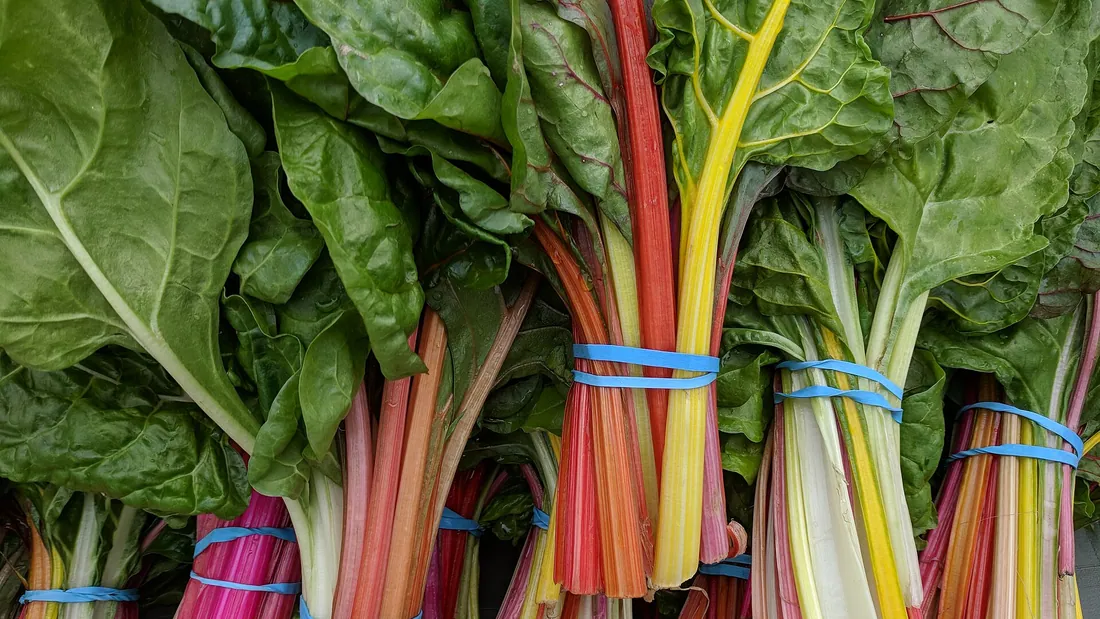

Swiss chard (Beta vulgaris subsp. cicla), also called leaf beet, is a generous, easy leafy vegetable, a close relative of beetroot. You eat two things from it: the broad leaves, like spinach, and the stalks, those fleshy ribs cooked separately. It is an ideal plant for the kitchen garden, undemanding and productive over a long period. You sow it in spring and harvest leaf by leaf all summer and autumn, without ever pulling up the plant.
Light and exposure
Chard is happy in sun as well as in partial shade, which makes it a handy vegetable to fit into the garden. In full sun it grows fast and strong, provided the soil stays cool. A slightly shaded spot during the hottest hours suits it very well and delays bolting during dry summers.
A bright but not scorching position gives the finest harvests. It tolerates well the filtered light of a corner that never gets the midday sun, where other vegetables would sulk. It is a good candidate for the less sunny plots.
Watering
Chard likes to keep its feet cool. It is a plant thirsty for water, whose broad leaves transpire a lot. Soil that dries out makes the foliage wilt and pushes the plant to bolt prematurely. Water regularly, especially in summer and in pots, to keep a steady moisture.
A mulch at the base, straw, dried grass clippings or leaves, keeps things cool and spaces out the watering. Under a cool, damp summer, watering becomes secondary, but during dry spells a steady supply avoids the slump and keeps the leaves tender.
Soil and repotting
Chard needs cool, deep soil rich in organic matter. It appreciates ground well supplied with humus, able to hold water without becoming waterlogged. An addition of mature compost at planting supports its vigorous growth and its production of leaves throughout the season.
It copes with most garden soils, including somewhat heavy ones, as long as they stay cool. In poor or sandy soil, enrich generously with compost and mulch to hold the moisture. Soil that is too dry or too lean gives puny plants that bolt fast.
Temperature and humidity
Chard is fairly hardy, more so than most leafy vegetables. It grows well in the coolness of spring and autumn, and withstands the first light frosts, which in fact make the leaves more tender. Strong heat, on the other hand, makes it bolt.
Under a mild winter, a well mulched plant often resists the cold and starts again the following spring for a second season, before flowering and running to seed. It is not fully frost-tender like basil, but a harsh winter without protection can get the better of the most exposed plants.
Pruning and upkeep
Chard is not pruned, it is picked. Harvest is done leaf by leaf, taking the largest outer stalks as needed, while the heart keeps producing new leaves. Take at the base of the stalk, in one clean cut, without pulling or wounding the heart.
This regular harvest is in itself the upkeep: it stimulates the plant and prolongs production over several months. Remove any yellowed or damaged leaves along the way to keep the plant clean and airy. A single plant can thus feed the kitchen from summer until the frosts.
Pests and diseases
Two main enemies watch for chard in a temperate climate. The first is the beet leafminer, a small fly whose larvae dig pale, blistered tunnels inside the leaves. As soon as they appear, remove and destroy the affected leaves, and put an insect-proof mesh over the young plants to break the cycle.
The second is the slug, which loves the young plants in spring and can wipe out a sowing in one damp night. Protect the seedlings by the usual means, ash, shells, bait or evening collection. Later, a leaf spot, cercospora, can mark the foliage in wet weather, without seriousness if you remove the affected leaves.
Propagation
Chard is propagated by sowing, easy and reliable. Sow from spring, April to June, either directly in place or in pots to transplant later. What is called a seed is actually a cluster containing several seeds, hence often several seedlings grouped together that will need thinning to keep only the most vigorous.
Sow one or two centimetres deep, spacing the plants thirty to forty centimetres apart, as the plant grows large. Emergence is fast and even, one to two weeks. A plant left in place and running to seed the second year produces its own seeds, easy to collect.
Climate and hardiness
Where and in which climate it thrives
Chard is a moderately hardy biennial, tougher than most leafy vegetables. The leaves take white frosts without damage and even gain in tenderness; below -7 to -10 degrees the foliage is destroyed, but a crown covered with a good mulch often starts again the following season. From USDA zone 7 upwards, overwintering works about one year in two and gives an early harvest before the plant runs to seed. Where the winter is harder, it is grown as an annual.
It clearly prefers a cool, damp climate to scorching summers: an easy crop in an oceanic or mild continental climate, trickier under a Mediterranean or subtropical summer, where shade during the hottest hours and a thick mulch become essential to delay bolting.
Everything is decided at sowing. Sow in place three weeks after your last frosts, or earlier under cover to transplant once the risk has passed. That timing is not mere caution: under an unsettled spring, where a late cold snap follows a mild spell, a young plant can be vernalised. In beetroot, of which chard is only a subspecies, fifteen to twenty cumulative days, not necessarily consecutive, below 5 degrees are enough to trigger flowering in the first year instead of the second.
As for varieties, 'Blonde à carde blanche' and 'Verte à carde blanche' remain the safe choices for production, while 'Bright Lights', with its yellow, pink and orange stalks, and 'Rhubarb Chard', with bright red stalks and a good reputation for standing up to bolting, bring colour to the plot. Under any climate, two things need watching: the leafminer from the first generation of adults, at the very start of the growing season, and slugs on young sowings.
Growing swiss chard?
Green Hub keeps a dated history of your own plant: its photos, its progress, its repottings. An AI answers about yours specifically, not a generic sheet, for free.
Identify my plantMonth-by-month care calendar
| January | Rest in the garden. Last year’s mulched plants wait under their cover. Plan the spot and order the seed for spring. |
|---|---|
| February | Still quiet. Check that the mulch of the overwintered plants is holding up. Prepare pots and potting soil for the first sowings under cover. |
| March | First sowings possible under cover, in pots in the warm, to transplant later. The overwintered plants sometimes start back, remove the mulch on fine days. |
| April | Start of direct sowings in place as soon as the soil warms, or transplant the plants raised under cover. Enrich the bed with mature compost. |
| May | Full period of sowing and planting. Thin the grouped seedlings to keep only one vigorous plant every thirty centimetres. Mulch the base. |
| June | Fast growth. First harvests of the outer leaves on the most advanced plants. Water regularly and watch for slugs and the leafminer. |
| July | Full harvest, leaf by leaf. Keep the soil cool in dry weather to avoid bolting. Remove the mined or yellowed leaves. |
| August | Production continues. Water during heat spells. A late sowing this month will give plants for the autumn and the mild winter. |
| September | Generous harvest with the coolness back, chard loves it. The leaves turn tender again. Keep taking the outer stalks. |
| October | The harvest goes on, the first light frosts tenderise the foliage. Begin preparing a mulch for the plants you want to overwinter. |
| November | Last harvests before the real cold. Mulch generously the chosen plants, dead leaves or straw, to try the winter crossing. |
| December | Rest. The mulched plants sleep under their cover. Note the spots to respect the rotation and avoid replanting in the same place. |
Green Hub tips
- Always harvest the outer leaves one by one, without touching the heart: a single plant thus produces for months.
- Keep the soil cool and mulched in summer: chard short of water bolts and stops producing fine leaves.
- A chard cluster contains several seeds. Thin without regret to leave only one vigorous plant per spot.
- Try overwintering: a well mulched plant in a mild winter restarts in spring for an early harvest.
- Watch the leaves for the leafminer: as soon as a tunnel appears, remove the leaf to break the fly’s cycle.
Related species
Beetroot
Beta vulgaris
Beetroot (Beta vulgaris) is an easy root vegetable, one of the most forgiving in the kitchen garden. You sow it…
Spinach
Spinacia oleracea
Spinach (Spinacia oleracea) is a cool-season leaf vegetable, hardy and in a hurry to live. Coolness suits it very well:…
Artichoke
Cynara scolymus
The artichoke (Cynara scolymus) is a large perennial with silvery, deeply cut foliage, as striking in an ornamental…
Asparagus
Asparagus officinalis
Asparagus (Asparagus officinalis) is an unusual perennial for a vegetable patch: once established, an asparagus bed…
Bean
Phaseolus vulgaris
The green bean (Phaseolus vulgaris) is one of the easiest vegetables in the kitchen garden, provided you respect one…
Bell pepper
Capsicum annuum
The bell pepper (Capsicum annuum) is an annual fruiting vegetable and a genuinely cold-shy one, the sweet cousin of the…
The guides that mention it
Making Compost: Steering the Thermal Biology of the Heap
A compost heap is not a pile of waste you stir, it is a thermal process you steer. The real carbon/nitrogen ratio of…
Garden Mulching: Every Mulch Has an Effect and a Drawback
Mulching is presented everywhere as a benefit with no downside. There is one for every material: what nitrogen drawdown…
Sowing Seeds Successfully: Why It Fails, and What Fixes It
A seed that never comes up was not unlucky. Germination temperatures by species, correct depth, seeds that need light,…
Accessible Gardening: Growing at Back Height, Without Bending
Adjusting the height of your crops and the width of your paths so you can keep gardening for years, without straining…
Updated on
How this sheet is written
Written for Green Hub with the help of language models, then reviewed. It offers gardening guidance, not professional advice: if you are unsure whether a plant is toxic to a child or an animal, ask a vet, a doctor or your national poison centre.