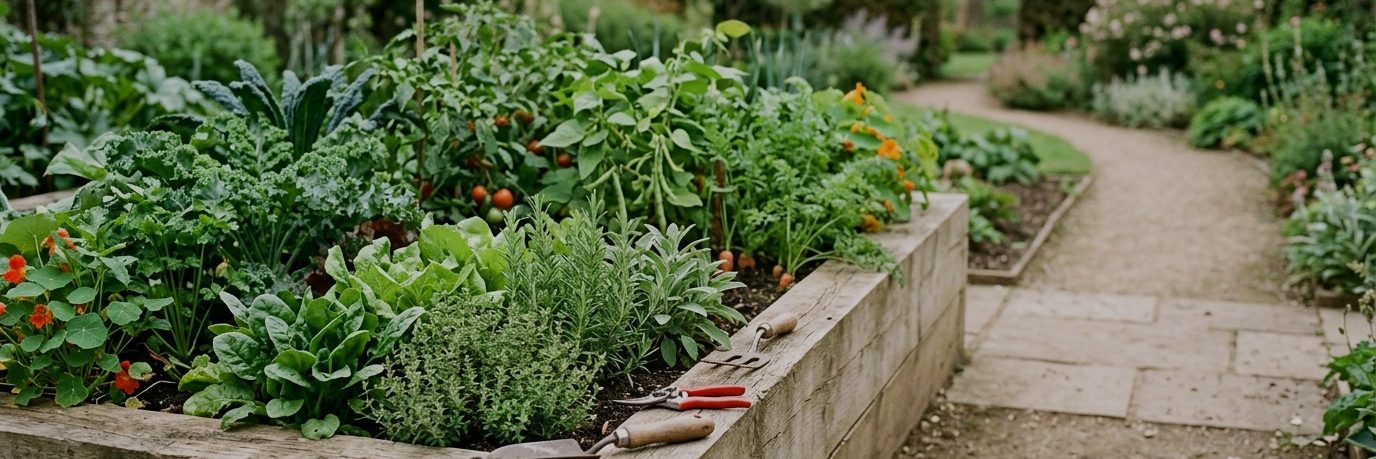
Accessible Gardening: Growing at Back Height, Without Bending
An accessible garden brings together three things: crops raised to back or hand height, paths wide enough to move through with a cane or a wheelchair, and habits that avoid repeated bending and heavy lifting. A raised bed on legs, a few stabilised paving slabs between the crops, and some long-handled tools are often enough to turn a tiring vegetable plot into a garden where you can sow, weed and harvest standing or sitting, without waking up a fragile back. People with reduced mobility, older gardeners, and anyone recovering from surgery all gain the same thing: the ability to keep gardening, not give it up.
Choosing the Right Growing Height: Raised Bed, Planter and Table on Legs
Growing height changes everything for a fragile back or painful knees. To garden standing up without ever bending over, aim for a bed edge between 80 and 90 cm, the height of a kitchen worktop: that’s the measurement of a true growing table, a bed set on four legs rather than directly on the ground. For wheelchair use or gardening seated on a stool, the principle changes: the bed needs to be raised on legs that leave a clear gap of at least 65 to 70 cm in height and depth underneath the structure, so knees can fit beneath it, with a width limited to 60 cm if access is from one side only, up to 120 cm if you can move all the way around it. For anyone who can still bend a little but wants to spare their back, a classic 40 to 50 cm high raised bed, set directly on the ground, remains simpler and cheaper to build.
Untreated wood such as robinia or larch, galvanised steel, and recycled plastic all hold up well through wet winters without leaching anything into the soil. A substrate depth of 30 to 40 cm is enough for the vast majority of vegetables, which also lightens the weight you need to handle when filling the bed. Planting density inside the bed is covered in the guide on square-foot gardening; here, it’s the height that changes everything for a fragile back, not the grid layout of the crops.
Paths Wide Enough to Move Through, Wheelchairs Included
A garden path designed for an able-bodied stroller, often 50 to 60 cm wide, becomes an obstacle as soon as a wheelchair, a walking frame, or simply a loaded wheelbarrow needs to get through. The minimum width to let a wheelchair pass is 90 cm in a straight line, with a turning space of at least 120 to 150 cm in diameter at every junction or in front of a bed, so you can turn without reversing for several metres. Between two raised beds, keep 90 cm to 1.2 m rather than the usual 60 cm of a traditional vegetable plot, even if that means fewer beds in exchange for easier movement. On a balcony or terrace where every centimetre is already accounted for, these widths are harder to keep; the guide on balcony and terrace gardens covers how to organise the available space even so.
Surface matters as much as width. Loose gravel, thick mulch and waterlogged lawn slow a wheel and tire out a cane, whereas resin-bound gravel, concrete slabs laid with tight joints, or composite wood decking all offer a flat, rollable surface even in the rain. A slope of under 5% avoids any extra effort going uphill, and a slight tilt toward a drainage point stops water pooling on the path after a shower, a frequent occurrence in a rainy climate.
The Right Movements: Protecting Your Back and Avoiding Heavy Lifting
Repeated bending of the back, more than the weight carried, wears down the lower spine season after season. The basic rule is to bend your knees and keep your back straight when picking up a bag of potting soil or a pot, never the other way round, and to bring the load close to your body before lifting rather than reaching out with your arms. A low garden stool with armrests, or a reversible kneeling bench that flips into a seat, lets you work sitting at the edge of a 40 to 50 cm raised bed without ever crouching down or standing back up for every single task.
For heavy loads, compost bags, full watering cans or bulky pots, a two- or four-wheeled garden cart avoids carrying weight at arm’s length over the whole distance between the storage point and the bed being worked; some models come with a low platform that’s easy to load without bending. Splitting the effort matters too: watering in several small passes rather than with a full ten-litre can, or filling a bed over several days rather than in one session, spares your back just as much as good posture does. Finally, alternating tasks, weeding for a few minutes, then planting, then stopping, avoids the static fatigue that often precedes pain more than the effort itself does.
Well-Suited Tools and Watering That Doesn’t Require Carrying
A poorly chosen tool turns a simple task into an ordeal. Telescopic or extended handles, on spades, hoes or cultivators, save you from bending down to the level of a low raised bed; conversely, a bed 80 to 90 cm high works very well with short-handled tools, almost the size of tabletop tools. Choose aluminium or carbon fibre over solid steel, which lightens the tool by half without losing sturdiness, and ergonomic handles with an open angle, which reduce the wrist twisting repeated with every stroke of the hoe.
When it comes to watering, the heaviest task in the garden, a fixed system changes everything. Drip irrigation connected to a timer feeds each bed without a watering can to carry, a solution particularly well suited to a growing table on legs, where a hose climbs more easily than a full watering can. A hose on a wall-mounted reel, pulled out with one motion and put away just as easily, avoids dragging a heavy, tangled hose along the paths. For areas still watered by hand, a two- to three-litre watering can with an adjustable rose, filled more often but always light to lift, spares your back more than a ten-litre model that only gets filled halfway so it can still be carried.
Which Plants Need the Least Stooped-Over Care
Some crops naturally suit a garden where you want to avoid bending down often. Climbers trained up a trellis fixed to the edge of the raised bed, such as beans, bring most of the foliage and the harvest up to hand height rather than down at ground level; tomatoes trained on a stake planted in a tall bed follow the same logic and can be picked standing up from the start of the season to the end. Courgettes benefit mainly from the height of the bed itself: their fruit stays visible and within reach without having to part the foliage on your knees, as is often the case in open ground. Everbearing strawberries, in a hanging planter or along the edge of a raised bed, let their fruit dangle within arm’s reach without ever having to crouch down to search under the leaves.
Herbs, thyme, rosemary, chives and basil, grow well in a shallow depth of substrate and can be picked in a few seconds from a tall bed, which makes them natural candidates for the row closest to a well-used path; nasturtiums, sown along the edge, fill in gaps without requiring any stooped-over care and self-seed year after year. Spinach and chard, harvested leaf by leaf rather than pulled up whole, cut down the number of trips needed for the same amount harvested. Radishes and lettuce, with their short cycles and shallow roots, are sown and harvested without ever exceeding the 30 cm depth of a standard bed, a format that’s just as productive once raised to a comfortable height.
The care sheets to read next
Every plant mentioned has its full sheet: watering, light, soil, pests and a month-by-month calendar.
Radish
Raphanus sativus
The radish (Raphanus sativus) is the fastest vegetable in the garden, ready to bite into in three to five weeks. It is…
Lettuce
Lactuca sativa
Lettuce (Lactuca sativa) is the most widely grown salad in the vegetable garden, easy and quick, harvested six to ten…
Bean
Phaseolus vulgaris
The green bean (Phaseolus vulgaris) is one of the easiest vegetables in the kitchen garden, provided you respect one…
Tomato
Solanum lycopersicum
The tomato (Solanum lycopersicum) is the queen of the vegetable garden, but it is a plant of sun and warmth that plays…
Strawberry
Fragaria x ananassa
The strawberry (Fragaria x ananassa) is a hardy perennial that fits very well into any vegetable garden. Hardy to…
Chives
Allium schoenoprasum
Chives (Allium schoenoprasum) are a small perennial of the onion family, with fine hollow stems tasting mildly of…
Basil
Ocimum basilicum
Basil (Ocimum basilicum) is an annual, cold-sensitive herb that comes from the warm regions of Asia. It is a summer…
Thyme
Thymus vulgaris
Thyme (Thymus vulgaris) is a small Mediterranean subshrub with woody stems and a powerful fragrance, hardy to about…
Rosemary
Salvia rosmarinus
Rosemary (Salvia rosmarinus, long known as Rosmarinus officinalis) is an evergreen Mediterranean shrub with needle-like…
Nasturtium
Tropaeolum majus
The nasturtium (Tropaeolum majus) is an annual native to the Andean highlands of Peru and Colombia that has become an…
Zucchini
Cucurbita pepo
The zucchini (Cucurbita pepo) is the easy summer vegetable par excellence, one plant yields more than a family can eat.…
Spinach
Spinacia oleracea
Spinach (Spinacia oleracea) is a cool-season leaf vegetable, hardy and in a hurry to live. Coolness suits it very well:…
Swiss chard
Beta vulgaris subsp. cicla
Swiss chard (Beta vulgaris subsp. cicla), also called leaf beet, is a generous, easy leafy vegetable, a close relative…
Frequently asked questions
What height should a raised bed be for gardening from a wheelchair?
Plan for a bed whose underside leaves a clear gap of at least 65 to 70 cm in height and depth, so knees and footrests can fit underneath. Limit the bed’s width to 60 cm if access is from one side only, up to 120 cm if you can move all the way around it; a substrate depth of 30 to 40 cm is enough for most vegetables.
How wide should paths be for a wheelchair-accessible garden?
Allow at least 90 cm in a straight line and a turning space 120 to 150 cm in diameter at every junction or in front of a bed, so you can turn without reversing for several metres. A stabilised or paved surface, rather than loose gravel, keeps this path rollable even after a rain shower.
How can you avoid bending over while gardening with a fragile back?
Raise your crops with a bed or growing table between 80 and 90 cm high, work sitting on a stool or a reversible kneeling bench for lower beds, and always bend your knees rather than your back to lift a bag or a pot. A wheeled cart for heavy loads and drip irrigation eliminate the two most repetitive tasks in the garden.
Which plants require the least effort in an accessible vegetable garden?
Climbers trained up a trellis, such as beans, and staked tomatoes bring the harvest up to hand height. Everbearing strawberries in a hanging planter, herbs such as thyme and chives, and spinach and chard picked leaf by leaf all cut down on the number of trips needed compared with vegetables that have to be pulled up whole.
Green Hub looks after your plants
Photograph a plant: Green Hub identifies it and writes its care sheet, with no account. Sign in afterwards to keep its dated photos and history over time.
Identify a plantUpdated on
How this sheet is written
Written for Green Hub with the help of language models, then reviewed. It offers gardening guidance, not professional advice: if you are unsure whether a plant is toxic to a child or an animal, ask a vet, a doctor or your national poison centre.