Christmas cactus
Schlumbergera
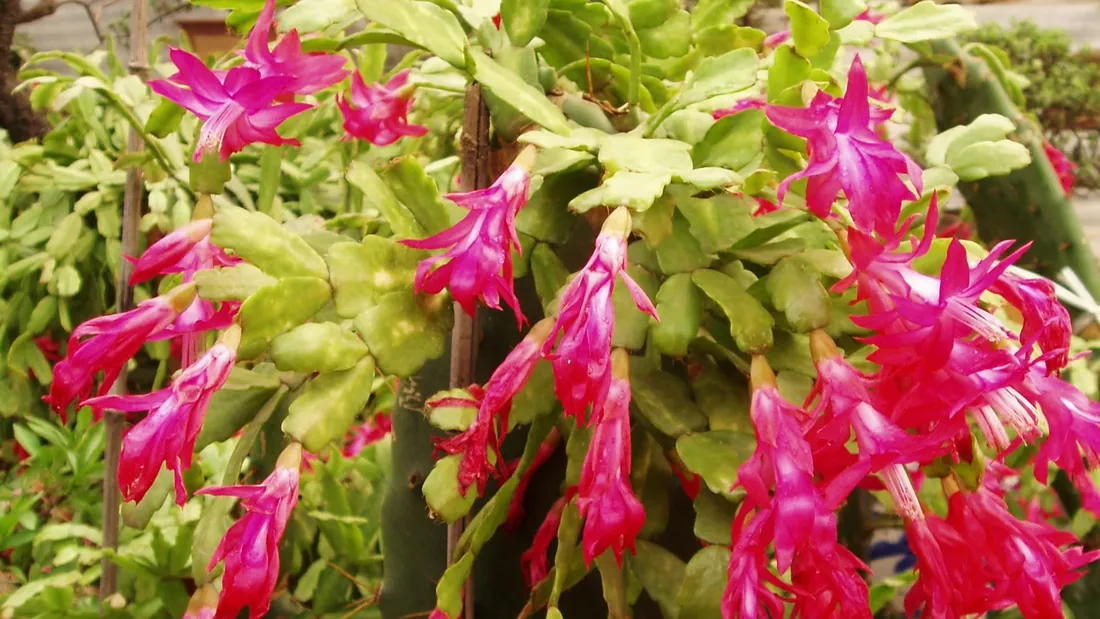

The Christmas cactus (Schlumbergera) is a spineless cactus, but not a desert cactus: it comes from the mountain forests of Brazil, where it grows perched on trees and rocks, in shade and humidity. Its flat, jointed stems cascade down and cover themselves with bright flowers in the depths of winter, often around Christmas, hence its name. It flowers exactly when the days are at their shortest, and it is precisely those long, cool nights that trigger the flowering. It is an easy and faithful plant, capable of living for decades.
Light and exposure
Unlike desert cacti, the Schlumbergera does not like full sun: as an undergrowth plant, it wants bright but filtered light. A spot near an east or north window, or set slightly back from a bright window, suits it very well. Direct summer sun reddens and burns the stems.
Light plays a key role in flowering. In autumn, it is the shortening days, combined with the cool, that trigger the buds. In a temperate climate, the lengthening nights naturally do this work: you simply must not thwart the plant with artificial lighting in the evening in the room where it spends that period.
Watering
The Christmas cactus is not a fleshy desert plant and does not like prolonged drought, but it hates excess water. Water when the first centimetre of the substrate has dried out, roughly once a week during growth. Always empty the saucer.
The watering schedule follows the flowering. During bud formation and flowering, in autumn and winter, keep the substrate lightly moist without swings, because water stress makes the buds drop. After flowering, take a break of a few weeks by watering less, then resume normally in spring. Water at room temperature, ideally soft, is ideal.
Soil and repotting
The Schlumbergera is epiphytic: in the wild, its roots cling to bark, not to heavy soil. It therefore needs a very free-draining, airy substrate. A potting mix for cacti and succulents, or a blend of potting soil, fine bark and perlite, suits perfectly. The pot must have holes.
Repot only every three or four years, just after flowering, into a pot barely larger. This plant actually flowers better a little cramped in its pot, so there is no need to repot it too often or too large.
Temperature and humidity
In full growth, the Christmas cactus is happy between 18 and 22 degrees. But the cool plays a decisive role in autumn: to trigger the buds, it needs several weeks around 12 to 15 degrees at night, at the same time as the days shorten. Below 7 degrees it suffers, and it tolerates no frost.
This requirement fits any climate with marked seasons. As the days shorten, a little-heated room, a frost-free veranda or a cool windowsill reproduce exactly the conditions the plant needs. The real trap is then full flowering: once the buds have formed, keep the plant away from scorching radiators and draughts, whose temperature swings make flowers and buds drop.
Pruning and upkeep
After flowering, in spring, you can shorten the stems to make the plant denser. Simply pinch or gently twist off one or two segments at the tip of each stem: the plant branches at that point and becomes bushier, and therefore more floriferous the following winter.
Do not throw away the segments taken off, they root very easily. Over time, remove the faded flowers and the dried or shrivelled segments at the base. That is all the care this plant needs.
Pests and diseases
The Christmas cactus is robust. Its main enemy is rot, at the base of the stems or at the roots, caused by excess water and poorly drained substrate: segments that go soft, yellow or drop, a brown and soft base. Then cut back the watering, and urgently take cuttings from the healthy segments if the base is affected.
As for pests, watch for mealybugs, small white cottony clusters between the segments, more common in winter. Remove them with cotton wool soaked in diluted methylated spirit. Bud drop, for its part, is not a disease: it almost always comes from a change of place, a temperature swing or irregular watering during flower formation.
Propagation
It is one of the simplest plants to multiply. In spring, after flowering, gently detach a section of two or three segments by twisting it at a joint. Let the cut dry for a day or two in the open air so it heals over, which prevents rot.
Then plant the section one or two centimetres deep in a free-draining, barely moist substrate. Rooting takes a few weeks. By sticking several cuttings in the same pot, you quickly obtain a well-filled plant. This is how the old family plants are passed on, often a hundred years old.
Toxicity
Not toxic to cats, dogs and children. A flowering plant you can keep safely in a home with animals, even if it is better to keep the cat from playing with the stems.
Climate and hardiness
Where and in which climate it thrives
The Christmas cactus is at home in any temperate climate, at least for the flowering. It lives indoors all year round, because it tolerates no frost, but an autumn of short days and cool nights triggers its flowering to perfection.
Through the six to eight weeks before flowering, as the days shorten, give it night-time cool, between 12 and 15 degrees, and evenings in the dark without artificial light: a little-heated room, a frost-free veranda or a cool windowsill do the job perfectly, and the buds appear. Once the buds have formed, set the plant in its final spot, in the light and at a good temperature, and do not move it again: the heat swings near a radiator and the draughts make flowers and buds drop. In the warm season, the plant can spend a few months outdoors in the light shade of a terrace, which strengthens it; bring it in before the first cold nights and frosts.
Growing christmas cactus?
Green Hub keeps a dated history of your own plant: its photos, its progress, its repottings. An AI answers about yours specifically, not a generic sheet, for free.
Identify my plantMonth-by-month care calendar
| January | End of flowering. Keep watering as soon as the surface dries, without excess. Keep the plant away from radiators and draughts to preserve the last flowers. |
|---|---|
| February | After flowering, take a break: cut back watering for a few weeks to let the plant rest. Remove the faded flowers. |
| March | Renewed growth. Repot if needed, only every 3 to 4 years. Pinch the stems to branch and take cuttings from the segments removed. |
| April | Growth. Resume regular watering. First light feed with a fertiliser low in nitrogen. |
| May | Full growth. Water about once a week. Feed every fortnight. Bright light without direct sun. |
| June | You can put the plant out in light shade on a sheltered terrace, never in full sun which reddens the stems. |
| July | High summer. Water as soon as the surface has dried. The plant enjoys the natural light to strengthen itself. |
| August | Still outdoors in light shade. Continue watering and light feeding. Prepare the return indoors at the end of the month. |
| September | Bring the plant in before the cold nights. Give it night-time cool (12 to 15 degrees) and evenings in the dark to trigger the buds. |
| October | Bud formation. Keep cool, short days and regular watering without swings. Do not move the plant again once the buds are visible. |
| November | The buds swell. Set the plant in its final spot, in the light and warmth, away from radiators. Regular watering, no stress. |
| December | Christmas flowering. Keep the substrate lightly moist, keep away from radiators and draughts. Above all, do not move the plant while in flower. |
Green Hub tips
- It is not a desert cactus: it comes from the Brazilian undergrowth, wants filtered light and does not like prolonged drought.
- Autumn does the work on its own: cool nights (12 to 15 degrees) and short days without artificial light in the evening trigger the flowering.
- Once the buds have formed, do not move the plant again: temperature swings make flowers and buds drop.
- Each segment taken off in spring roots easily; this is how the old family plants are passed on.
Related species
Aglaonema
Aglaonema commutatum
The aglaonema (Aglaonema commutatum) is a robust, easy houseplant, prized for its foliage variegated with green,…
Alocasia
Alocasia
The alocasia, nicknamed elephant ear, charms with its large, dramatically veined leaves. It is a demanding tropical…
Aloe vera
Aloe vera
Aloe vera (Aloe vera) is a succulent from the Arabian Peninsula, grown since antiquity for the soothing gel of its…
Anthurium
Anthurium andraeanum
The anthurium (Anthurium andraeanum) is a tropical houseplant known for its smooth, waxy red spathe, which people often…
Areca palm
Dypsis lutescens
The areca (Dypsis lutescens) is a tropical palm from Madagascar, frost-tender, grown indoors wherever winter freezes.…
Boston fern
Nephrolepis exaltata
The Boston fern (Nephrolepis exaltata) is a hanging indoor fern, born in the humid undergrowth of the tropics. Here,…
The guides that mention it
Indestructible Houseplants: Tolerating Drought Is Not Tolerating Shade
Tolerating drought and tolerating shade are two different adaptations, and almost every list mixes them up. What these…
Watering Plants Properly: Deciding Rather Than Following a Schedule
Beginners water too often and too little at the same time. How to read the soil instead of the calendar, tell thirst…
Repotting your plants and choosing the right potting mix
The right moment, the right technique and the right substrate for each plant, so you can repot without rotting the…
Updated on
How this sheet is written
Written for Green Hub with the help of language models, then reviewed. It offers gardening guidance, not professional advice: if you are unsure whether a plant is toxic to a child or an animal, ask a vet, a doctor or your national poison centre.