Honeysuckle
Lonicera
.jpg)
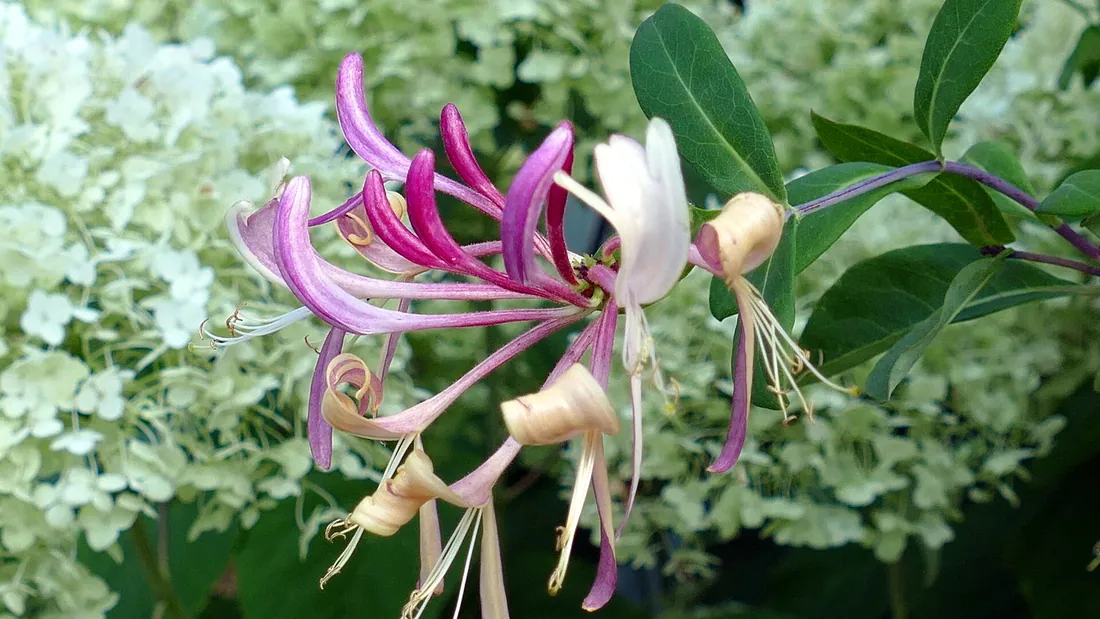
Honeysuckle (Lonicera) is a familiar plant in hedgerows and gardens, known for its very fragrant tubular flowers whose scent grows stronger at dusk and draws in moths. The European species, woodbine (Lonicera periclymenum), climbs naturally through country hedges and woodland edges, while its Asian cousin, box-leaved honeysuckle (Lonicera nitida), is grown as a neatly clipped low hedge, rather like a leafy little box. The two are often mixed up even though they neither grow the same way nor serve the same purpose in the garden.
Light and exposure
Climbing honeysuckle likes to have its head in the sun and its feet in the cool, exactly like clematis. Plant it against a wall that catches the midday and afternoon sun, on a trellis or pergola, so it enjoys the warmth up top while its base stays shaded by mulch or a low plant nearby. Partial shade suits it well too, and can even give a longer flowering period, less scorched by the full sun of high summer.
Box-leaved honeysuckle (Lonicera nitida), grown as a low hedge, is far less demanding and grows equally well in sun or partial shade. It even copes with shadier spots without complaint, which makes it a practical hedge along a wall that never sees direct sun.
Watering
For the first two years after planting, water honeysuckle regularly, especially in dry weather, while its roots settle in deep. A thick mulch at the base, dead leaves, dried grass clippings or bark, keeps things cool and saves you from watering too often, which is exactly what it likes: cool feet.
Once well rooted, climbing honeysuckle handles dry spells, but soil that dries out completely at the base, combined with a hot summer, clearly encourages powdery mildew on the foliage. Water at the base rather than over the leaves, and remember a good soak during a prolonged heatwave, even on a mature plant.
Soil and repotting
Woodbine grows naturally in the cool, humus rich soil of woodland edges and hedgerows, a leafy ground that never dries out completely. In the garden, recreate that setting with ordinary soil enriched with well rotted compost or leaf mould at planting, and keep it cool with a mulch.
Box-leaved honeysuckle (Lonicera nitida) is far less fussy about soil: it grows just as well in chalky ground as in ordinary garden soil, and tolerates drier conditions once established. It is precisely this tolerance that makes it such a popular low maintenance hedge.
Temperature and humidity
Woodbine is hardy through and through: it grows wild in country hedgerows right across temperate Europe and shrugs off, with no protection at all, frosts of around -20 °C, which makes it a plant for USDA zones 5 to 9. No particular precaution is needed, not even for plants only recently settled in, once they have made it through their first winter.
Box-leaved honeysuckle (Lonicera nitida) is a little less resistant to hard frost, more like zones 7 to 9, and keeps its small evergreen leaves almost all year round. In a particularly cold or windy winter it can lose part of its foliage, without putting the hedge at risk. It bounces back normally as soon as growth restarts.
Pruning and upkeep
Climbing honeysuckle flowers mainly on the previous year’s wood. Prune it just after flowering, in summer, cutting back the shoots that have bloomed and removing dead or tangled wood, never in late winter, or you risk cutting off every future flower bud. Light, regular pruning also stops it running away in all directions and smothering its support.
Box-leaved honeysuckle (Lonicera nitida), by contrast, is clipped like an ordinary hedge, several times a year, ideally in late spring and at the end of summer, to keep a neat shape. Unlike the climber, it does not lose its flowering by being cut hard back, since it is grown chiefly for its foliage.
Pests and diseases
Powdery mildew is the most common problem on climbing honeysuckle, especially during hot, dry summers: a white, floury coating covers the leaves and young shoots, often when the base has gone short of water or coolness. Good mulching and watering at the base during dry spells clearly limit the problem, and badly affected shoots can be cut off and removed from the garden.
Aphids readily settle on the tender young shoots in spring, forming green or black clusters that distort the tips. A firm jet of water or a spray of black soap is usually enough, especially since ladybirds and hoverflies, drawn in by the nectar rich flowers, often take care of it on their own in a garden that is not sprayed.
Propagation
Taking cuttings is the simplest and most reliable way to multiply honeysuckle. In summer, take semi-ripe cuttings ten to fifteen centimetres long, strip the lower leaves and plant them in a light mix of compost and sand, in a shaded, cool spot. Rooting takes several weeks but succeeds easily.
Layering is another option, particularly well suited to climbing honeysuckle: bend a flexible stem down into a shallow trench, leaving the tip poking out, and hold it in place with a stone or a peg. Roots form at the buried point within a few months, and you can then separate the new plant from its parent.
Climate and hardiness
Where and in which climate it thrives
Woodbine (Lonicera periclymenum) is one of the hardiest of all climbers: it takes frosts of around -20 °C with no protection at all and grows in USDA zones 5 to 9, which covers a sharp continental winter as readily as a mild oceanic one. Box-leaved honeysuckle (Lonicera nitida), which comes from China, is distinctly more tender: reckon on zones 7 to 9 and hardiness of around -15 °C, with partial leaf loss after a cold, windy winter that the hedge recovers from once growth restarts. Where the plant is truly at home is a temperate climate, cool and somewhat damp, the woodland edge it comes from: soil that never dries out completely and air that never turns scorching. It struggles in prolonged dry heat, where the foliage picks up powdery mildew as soon as the roots run short of water, so in that kind of climate give it partial shade rather than full sun and mulch it thickly. In a Mediterranean or subtropical climate flowering stays decent, but the plant needs steady watering right through the hot season. A mild, wet winter, on the other hand, poses no particular risk: honeysuckle does not mind winter wet as long as the soil is not permanently waterlogged. The rule that holds everywhere fits in one image: head in the sun, feet in cool shade, exactly like clematis.
Growing honeysuckle?
Green Hub keeps a dated history of your own plant: its photos, its progress, its repottings. An AI answers about yours specifically, not a generic sheet, for free.
Identify my plantMonth-by-month care calendar
| January | Woodbine is fully hardy and needs no protection. If the ground is not frozen, it is still a good time to plant a bare root specimen. |
|---|---|
| February | Last chance to plant bare root stock before growth starts. Use the time to cut out any wood that died or was damaged over winter. |
| March | The first buds break. Guide young climbing shoots onto their support and watch for the first aphids on tender growth. |
| April | Growth speeds up noticeably. Tie in new shoots on the climber and mulch the base to keep the roots as cool as they like. |
| May | Flower buds are forming. Water during a dry spring, especially newly planted specimens, and keep an eye out for aphids. |
| June | This is full flowering, most fragrant in the evening. Water at the base in dry weather and give the box-leaved hedge its first clip. |
| July | Prune the climber right after it flowers, cutting back faded shoots, never later. Watch for powdery mildew in hot, dry weather. |
| August | A good time to take semi-ripe cuttings. Keep watching for powdery mildew and give the shrubby hedge another trim. |
| September | Berries form on woodbine and feed the birds. It is also a good season to layer a low growing stem. |
| October | Still warm soil and returning rain make this an excellent planting time, the best of the year alongside spring. |
| November | Keep planting while the soil is easy to work. Mulch the base of young plants before the first hard frosts. |
| December | Complete rest for the plant. Use the quiet garden to look over the climber’s framework and plan any extra tying in if needed. |
Green Hub tips
- Give it a sunny head and shaded feet, exactly as with clematis: a mulch or a low plant at the base of climbing honeysuckle keeps its roots cool.
- Prune climbing honeysuckle right after it flowers, never in late winter: it blooms on the previous year’s wood, and pruning too late sacrifices every flower to come.
- Watch for powdery mildew during hot, dry summers: that white coating on the leaves almost always signals a base that has gone short of water or coolness.
- Do not mix up woodbine (Lonicera periclymenum), a fragrant climber, with box-leaved honeysuckle (Lonicera nitida), grown as a clipped low hedge: they are grown in completely different ways.
Related species
Corn salad
Valerianella locusta
Corn salad (Valerianella locusta) is the winter salad par excellence, the tender rosette that fills the vegetable…
Weigela
Weigela florida
Weigela (Weigela florida) is a deciduous shrub from East Asia that has become an unkillable classic of temperate…
Althea
Hibiscus syriacus
Althea (Hibiscus syriacus) is a hardy deciduous garden shrub that flowers when every other one has finished, from…
Beech
Fagus sylvatica
Beech (Fagus sylvatica) is the most common broadleaf tree in the temperate forests of Europe, just as happy standing…
Begonia
Begonia
Begonia is the star summer flower of window boxes, hanging baskets and shady borders. Hundreds of hybrids exist, but…
Box
Buxus sempervirens
Box (Buxus sempervirens) is an evergreen shrub that has been clipped into balls, cones and low borders in formal…
The guides that mention it
Which Hedge to Plant, and How to Get It Right
Evergreen, deciduous or marcescent, annual growth, hardiness, soil, shade and sea spray: the real criteria for…
Pruning Flowering Shrubs and Roses: Deducing Instead of Memorising
New wood or old wood: this single question gives you the pruning time for any shrub at all, including ones whose name…
How to Attract Birds to Your Garden, Season After Season
Winter feeding, well-positioned nest boxes, clean water and berry hedges: the complete method, season by season, for…
Wildflower Meadows and Beneficial Insects: Gardening for Biodiversity
Ladybirds, hoverflies, wild bees: how a wildflower meadow and a few simple habits turn an ordinary garden into a refuge…
Which flowering shrub to choose for a garden in bloom all year round
Viburnum in winter, lilac in spring, buddleia in summer, rose of Sharon in autumn: the method for stringing together…
Updated on
How this sheet is written
Written for Green Hub with the help of language models, then reviewed. It offers gardening guidance, not professional advice: if you are unsure whether a plant is toxic to a child or an animal, ask a vet, a doctor or your national poison centre.