How to Attract Birds to Your Garden, Season After Season
Attracting birds to your garden all year round takes four complementary steps: feeding only during the cold season, providing clean water in every season, putting up well-positioned nest boxes from autumn onward, and planting berry-bearing shrubs that feed birds without any human intervention. Summer feeding is best avoided, except during a marked drought, because chicks need insects rather than seeds to grow. In temperate European gardens, great tits, robins, blackbirds and sparrows will visit all year round once these four needs are met; elsewhere it is your own region’s common garden birds that respond to the same steps, and stopping pesticide use remains everywhere the single most effective way to leave them natural prey.
Feeding at the right time of year, not all year round
Bird protection organisations agree: feeding should be limited to the cold season, from the first lasting frosts until mild weather returns for good, roughly four and a half months in a temperate climate. Start gradually as temperatures drop, and taper off over seven to ten days once milder days settle in. During this window, the diet should consist almost entirely of seeds, black sunflower seed above all, along with mixes and millet; fat balls are only a top-up for spells of prolonged cold, not a daily staple. The right rhythm is a small top-up each morning, so birds can recover calories after a cold night.
Outside this window, it is better to hold off. In spring, aside from a late cold snap where a few mealworms can help out, artificial food offers little benefit. In summer, seed feeding is discouraged: parent birds need live insects, not seeds, to raise their chicks. Only a marked drought, which makes water and natural prey scarce, justifies keeping a water point going and, occasionally, a little food.
Nest boxes: which model, which orientation, which timing
The diameter of the entrance hole determines who can move in: 26 to 28 mm for the smaller tits, blue, coal, marsh or crested, 32 mm for the great tit, house sparrow or nuthatch. A hole that is too wide lets in predators and larger species.
Orientation matters as much as the model. Avoid the side the prevailing rain-bearing wind comes from, which drives damp and cold inside, as well as full afternoon sun, which can overheat a brood. The most effective compromise is an entrance facing the sunrise, sheltered from the wind and catching only the gentle morning sun. Mounting height should be between 1.5 and 3 metres, out of reach of cats, with the box tilted slightly forward so rain runs off.
The best time to put up a nest box is autumn, not spring: tits scout out their nesting site early, and wrens already use boxes as a night shelter. Cleaning should happen in late summer and autumn, before this recolonisation: remove the old nest, which harbours parasites that survive from one season to the next.
Water, the need most often overlooked
Water is the one need birds have that never stops, summer and winter alike. A shallow basin, set up on a stand or on the ground, away from thick cover where a cat could lie in wait, is enough to bring in blackbirds, tits and robins to drink and bathe. The ideal depth stays shallow, two to five centimetres with a gentle slope towards one shallow edge, so the smallest birds can still stand.
Hygiene is not optional. Stagnant water fouled by droppings becomes a breeding ground for bacteria and parasites, particularly trichomonosis, which regularly wipes out greenfinches and chaffinches, and salmonellosis. The protective habit: rinse with hot water every week, without detergent, a little white vinegar is enough, and change the water daily in summer. Chemical cleaning products should be avoided altogether, as they strip the waterproof coating from feathers.
In winter, water freezes just when birds need it most to digest seeds. Break the ice morning and evening rather than adding salt or antifreeze, both toxic to them.
Planting to feed and shelter birds, without any human intervention
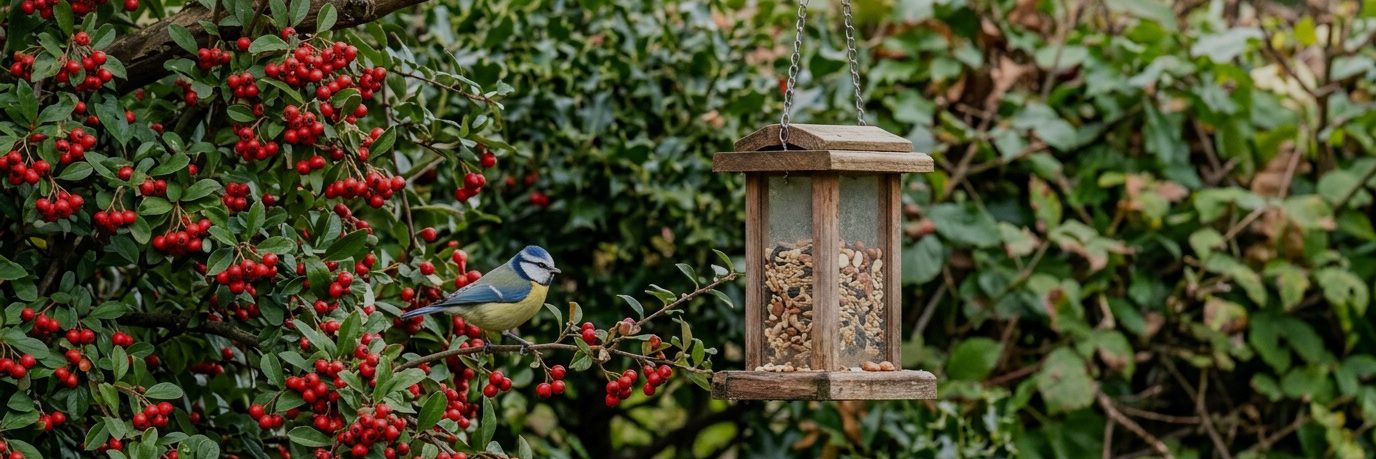
A garden that feeds itself is worth every feeder put together. Berry-bearing shrubs fruit in autumn and winter, just when insects have disappeared: elder, holly, viburnum, privet, honeysuckle and rose, whose hips last all winter, draw in blackbirds, thrushes and starlings from the first frosts onward. Yew, evergreen and dense, also offers year-round shelter; only its seed is toxic, the fleshy red aril around it is not.
Fruit trees do the same job, even without leaving all the fruit on the ground: a few windfalls under an apple, pear, plum or cherry tree provide a late-season feast. Hazel adds its nuts, prized by nuthatches and jays; a beech tree in a good mast year draws in chaffinches and bullfinches with its beech nuts.
These plantings also provide shelter: a dense hedge mixing hornbeam, beech and berry-bearing shrubs offers nesting sites protected from predators. Redcurrant and blackcurrant bushes, once the human harvest is done, still leave a few forgotten fruits behind.
Common garden species, and dangers to avoid
Four species dominate temperate European gardens all year round, and two of them, the blackbird and the house sparrow, have been introduced far beyond that range, as far as Australia, New Zealand and the Americas. Blue tits and great tits nest in cavities, readily take to a nest box, and become almost exclusively insectivorous from the moment their chicks hatch: a pair of great tits can bring up to 10,000 caterpillars to their brood over three weeks. The robin, solitary and territorial, hunts from a low perch. The blackbird combs lawns and borders for worms and fallen berries. The house sparrow nests in colonies in gaps in buildings; its numbers keep declining year after year across much of western Europe, for lack of nooks in newer construction. In other parts of the world, different species fill exactly the same roles, a cavity-nesting insect eater, a perch hunter, a ground forager, and the same features bring them in.
Three dangers threaten these visitors. Windows remain the leading direct human-caused killer, with hundreds of millions of birds dying each year across a continent the size of North America; adhesive strips 2 cm wide every 10 cm on the outer face reduce the risk. Cat predation accounts for around 16% of mortality; keeping cats indoors through the nesting and fledging weeks, from spring into early summer, and a Birdsafe collar (40-50% effective) do more good than a simple bell. Finally, pesticides cut insectivores’ prey by 50-70%: the simplest step for letting a garden feed its birds unaided.
The care sheets to read next
Every plant mentioned has its full sheet: watering, light, soil, pests and a month-by-month calendar.
Elder
Sambucus nigra
Elder (Sambucus nigra) is a large shrub native to temperate Europe that grows wild in hedgerows, along footpaths and on…
Holly
Ilex aquifolium
Holly (Ilex aquifolium) is an evergreen shrub with glossy, spiny leaves and bright red berries that light up in the…
Viburnum
Viburnum
Viburnum is not one plant but a whole family of more than a hundred and fifty shrubs, broad enough to cover almost…
Privet
Ligustrum ovalifolium
Privet (Ligustrum ovalifolium), often sold as California privet, is a shrub native to Japan that has become one of the…
Honeysuckle
Lonicera
Honeysuckle (Lonicera) is a familiar plant in hedgerows and gardens, known for its very fragrant tubular flowers whose…
Rose
Rosa
The rose (Rosa) is a hardy flowering shrub that overwinters outdoors without trouble, down to about -20 °C for most…
Yew
Taxus baccata
Yew (Taxus baccata) is a conifer native to Europe, able to live for several centuries and to regrow from old wood…
Apple tree
Malus domestica
The apple tree (Malus domestica) is the king of fruit trees in temperate climates, the one that has filled family…
Pear tree
Pyrus communis
The pear tree (Pyrus communis) is the apple tree’s cousin, a fruit tree for the family orchard that gives melting fruit…
Plum tree
Prunus domestica
The plum tree (Prunus domestica) is the classic family fruit tree, the one you find at the back of the garden or along…
Cherry tree
Prunus avium
The cherry tree (Prunus avium) is a vigorous, hardy fruit tree, perfectly at ease in a temperate climate, from USDA…
Hazel
Corylus avellana
The hazel (Corylus avellana) is a shrub native to Europe and western Asia, found for as long as anyone can remember in…
Beech
Fagus sylvatica
Beech (Fagus sylvatica) is the most common broadleaf tree in the temperate forests of Europe, just as happy standing…
Hornbeam
Carpinus betulus
The hornbeam (Carpinus betulus) is a native tree of temperate Europe, so common in hedges and woods that people often…
Redcurrant
Ribes rubrum
The redcurrant (Ribes rubrum) is a small bushy fruit shrub that produces those pretty clusters of translucent red…
Blackcurrant
Ribes nigrum
The blackcurrant (Ribes nigrum) is a small hardy fruit shrub that is genuinely happy in a cool climate, down to USDA…
Frequently asked questions
When should you stop feeding birds in spring?
Stop gradually, over seven to ten days, once temperatures rise for good at the end of winter. One exception applies to a late cold snap in the earliest days of spring, when a few mealworms can help out. Beyond that period, chicks need fresh insects rather than seeds, so seed feeding becomes pointless, or even counterproductive.
What entrance hole diameter should you choose for a tit nest box?
Allow 26 to 28 mm for the smaller tits, blue, coal, marsh or crested. For the great tit, house sparrow or nuthatch, you need a 32 mm hole. A diameter that is too wide lets in predators or larger species that drive out the rightful occupants.
Why should you clean the bird bath every week?
Stagnant water fouled by droppings becomes a breeding ground for trichomonosis and salmonellosis, two diseases that regularly wipe out greenfinches and chaffinches. A weekly rinse with hot water, without detergent, is enough to limit the risk, along with a daily water change in summer when it warms up quickly.
Which plants attract the most birds to a garden?
Shrubs bearing berries in autumn and winter are the most effective: elder, holly, viburnum, privet, honeysuckle and rose for its hips. Fruit trees, apple and pear above all, round things out nicely if you leave a few windfalls on the ground for blackbirds and thrushes at the end of the season.
Green Hub looks after your plants
Photograph a plant: Green Hub identifies it and writes its care sheet, with no account. Sign in afterwards to keep its dated photos and history over time.
Identify a plantUpdated on
How this sheet is written
Written for Green Hub with the help of language models, then reviewed. It offers gardening guidance, not professional advice: if you are unsure whether a plant is toxic to a child or an animal, ask a vet, a doctor or your national poison centre.