Peony
Paeonia
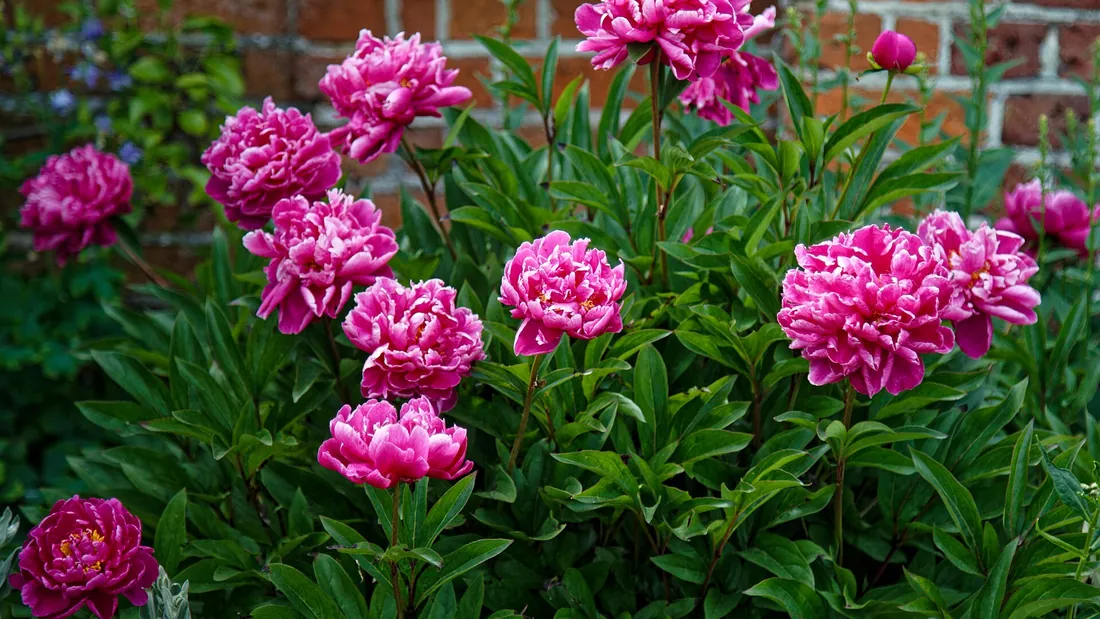

The peony (Paeonia) is a hardy perennial with remarkable longevity: once well settled, it can flower for several decades in the same spot, often outliving the gardener who planted it. It takes -30 °C without protection and fears only one thing, a winter that is too mild. One single thing decides everything: planting depth. Its eyes, the fat red buds at the base of the crown, must stay 2 to 3 cm below the surface, no deeper. Planted too deep, it makes lovely leaves but never flowers.
Light and exposure
The peony loves sun. Give it a wide open spot, in full sun or at most light partial shade, with at least five to six hours of direct light a day. The more sun it gets, the more generous the flowering and the sturdier the stems.
Avoid the foot of large trees and the dark corners of the garden. In shade it stalls, grows leggy and refuses to flower. An airy position is also a good defence against the diseases of a damp spring, common wherever the growing season starts mild and wet.
Watering
Once established, the peony asks for little and copes well with dry spells thanks to its fleshy crown. For the first two years, help it root with regular watering during prolonged drought, especially in spring when it is growing and forming its buds.
Avoid excess water and soils that stay waterlogged in winter, the crown rots quickly in cold damp. Water at the base, never on the foliage, so you do not encourage botrytis in overcast, rainy weather.
Soil and repotting
The peony wants a rich, deep, well drained soil. It sends its fleshy roots far down into the earth, so take care with the preparation: dig deep and work in mature compost or well rotted manure, keeping it away from direct contact with the eyes.
It tolerates chalky and clay soils as long as they do not stay soaked. On heavy clay soil, improve drainage with compost and a little coarse sand, or raise the planting area slightly.
Temperature and humidity
This is a genuinely hardy plant, built for sharp winters. It takes down to -30 °C and needs no winter protection once established. Better still, it needs the cold of winter to flower well: several weeks of dormancy below 4 to 7 °C trigger bud formation.
Late frosts at the end of winter can sometimes scorch a young shoot or damage an advanced bud, with no lasting consequence. The plant starts again from its crown without flinching. Overwintering raises no question at all in a temperate or cold climate; it is under a winter that is too mild, for want of cold, that flowering falls away.
Pruning and upkeep
Care depends on the type of peony, and this is a point to get clear. The herbaceous peony disappears completely in winter: cut all the foliage back to ground level in autumn, once it has yellowed, and remove it from the garden to limit disease. It will start again from its crown in spring.
The tree peony, on the other hand, has a woody framework that stays in place all year. Never cut it back to the ground: simply remove dead wood and damaged branches in spring. During the season, cut spent flowers just above a good leaf on both types.
Pests and diseases
The main enemy is peony botrytis (Botrytis paeoniae), favoured by mild, damp springs. You spot it by young shoots that blacken and wilt abruptly at the base, and by buds that brown without opening. Cut off and clear away any affected part promptly, do not leave it at the base.
To prevent it, work on airflow: do not crowd the plants, open up the centre of the clump, water at the base and cut the herbaceous foliage back cleanly in autumn. A mulch that is too thick against the crown keeps in moisture and the fungus, so stay light near the eyes.
Propagation
Division is the go to method for the herbaceous peony, but it is done in autumn, once the heat has dropped and the foliage begins to yellow, and no more often than necessary. Dig up the crown, let it dry off for a few hours, then cut it with a knife into pieces each bearing three to five eyes. Replant at once, eyes 2 to 3 cm below the surface.
Be aware that the peony hates being disturbed. After a division or a transplant it may sulk for a year or two before flowering again, the time it needs to rebuild its roots. That is normal, do not lose patience and above all do not move it again. Growing from seed is possible but calls for a lot of patience, several years before the first flower.
Climate and hardiness
Where and in which climate it thrives
The herbaceous peony is among the hardiest perennials in the ornamental garden: the crown takes -30 °C with no protection at all, which makes it growable from USDA zone 3 to 8. Its constraint is not cold but the lack of it. It needs several weeks of dormancy below 4 to 7 °C to set its flower buds, and without that cold spell the clump produces leaves and nothing else. That is what explains the repeated failures in zone 9 and beyond, in mild Mediterranean or subtropical climates: there, only a few low-chill varieties give anything, and the plant behaves like a short-lived novelty rather than the century-long perennial it is elsewhere.
In a mild, damp oceanic climate it is perfectly at ease, with one reservation: mild wet springs let botrytis settle in, blackening young shoots at the base. The answer is to open up the clump, not to spray. In a continental climate with a dry, deeply frozen winter it asks for nothing, except soil that does not become waterlogged at thaw: it is a sodden winter that rots the crown, not a severe one. Dry midsummer heat does not bother it once flowering is over, the foliage holds until the cold season. In mild-winter regions, plant at the shallowest limit of the rule, the eyes barely covered, to catch what little cold is available.
Growing peony?
Green Hub keeps a dated history of your own plant: its photos, its progress, its repottings. An AI answers about yours specifically, not a generic sheet, for free.
Identify my plantMonth-by-month care calendar
| January | Complete rest. The herbaceous crown sleeps underground, the tree type keeps its framework. Nothing to protect, the cold does it good. Plan out where future plantings will go. |
|---|---|
| February | Still dormant. Take a frost free day to spread a little mature compost on the surface around the clumps, without pressing it against the crown. |
| March | The red eyes push up out of the soil on the herbaceous type. Clean the base of old debris to limit botrytis. Keep an eye on the first shoots. |
| April | Rapid growth, the stems and buds form. Put the stakes or ring supports in place now for the large double flowered varieties. Cut off any shoot blackened by botrytis. |
| May | Flowering starts at the end of the month. The ants on the buds are normal and harmless, they come for the sweet nectar, do not spray. Water at the base if spring is dry. |
| June | Full flowering, the big moment. Stake the double flowers that flop in the rain. Cut spent flowers just above a leaf to keep the clump tidy. |
| July | Flowering is over, the foliage works to rebuild the crown for next year. Keep it good and green, water in marked drought. Do not cut the leaves. |
| August | Foliage still in place and useful. A deep watering during hot spells supports the formation of next year’s eyes. Nothing else to do. |
| September | Best time to plant or divide the herbaceous peony. Replant the pieces with the eyes only 2 to 3 cm below the surface. Remember it will sulk for a year or two after a division. |
| October | Planting and division can continue. The herbaceous foliage yellows, get ready to cut it back. On the tree peony, do not touch the woody framework. |
| November | Cut the foliage of the herbaceous peony back to ground level and clear it away to head off disease. Leave the framework of the tree peony untouched. |
| December | Winter rest. No protection needed, the plant does not care about the cold. Simply check that the crown is not sitting in soaked soil. |
Green Hub tips
- Never plant the herbaceous peony too deep: the red eyes must stay 2 to 3 cm below the surface, otherwise you will get leaves but no flowers, sometimes for years.
- Choose its spot once and for all: it hates being moved and may sulk for a year or two after planting or division before flowering again.
- Ants on the buds are not a problem, they come for the nectar. Let them be, no treatment is needed.
- Tell your peonies apart: the herbaceous type is cut back to the ground in autumn, the tree peony keeps its woody framework which must never be cut down.
- Put the stakes in early, as soon as the stems reach about twenty centimetres, before the large double flowers flop over in the first heavy rain.
Related species
Althea
Hibiscus syriacus
Althea (Hibiscus syriacus) is a hardy deciduous garden shrub that flowers when every other one has finished, from…
Beech
Fagus sylvatica
Beech (Fagus sylvatica) is the most common broadleaf tree in the temperate forests of Europe, just as happy standing…
Begonia
Begonia
Begonia is the star summer flower of window boxes, hanging baskets and shady borders. Hundreds of hybrids exist, but…
Box
Buxus sempervirens
Box (Buxus sempervirens) is an evergreen shrub that has been clipped into balls, cones and low borders in formal…
Butterfly bush
Buddleja davidii
Buddleia (Buddleja davidii), better known as the butterfly bush, is a nearly indestructible shrub that has taken over…
Cherry laurel
Prunus laurocerasus
Cherry laurel (Prunus laurocerasus) is the most widely planted evergreen hedging shrub in temperate gardens, and it is…
The guides that mention it
Perennial Flowers: Choosing, Planting and Blooming Without a Gap All Season
What genuinely comes back year after year, how to read hardiness by zone rather than by promise, and how to string…
Lawn Care: From Seeding to Mowing, and Renovation
Mowing higher changes more than any fertilizer can: turf density, drought resistance, weeds, moss. Everything else in…
Dividing, Taking Cuttings, Sowing: Multiplying Your Plants for Free
Dividing a perennial, taking cuttings from a shrub, or sowing seed straight from the garden: the techniques that fill a…
The Cutting Garden: How to Pick Flowers and Make Your Bouquet Last
Dahlias, peonies, hydrangeas: what separates a flower that lasts ten days in a vase from one that droops by the next…
Which Garden Flowers Are Edible, and How to Cook With Them
From flower bed to plate: the flowers that are genuinely edible, the harvesting method that preserves their flavour,…
Designing your garden by colour: the combinations that work
Warm harmonies, cool harmonies, monochrome schemes or bold contrasts: colour changes everything in a garden, from the…
Updated on
How this sheet is written
Written for Green Hub with the help of language models, then reviewed. It offers gardening guidance, not professional advice: if you are unsure whether a plant is toxic to a child or an animal, ask a vet, a doctor or your national poison centre.