Which Garden Flowers Are Edible, and How to Cook With Them
An edible flower is picked young, clean and untreated, then eaten raw in a salad or as a plate garnish, or dried for infusions, but never cooked for long, since that means losing both colour and flavour. Nasturtium, borage, pansy, courgette flowers, rose or peony petals, and the flowers of herbs such as chives or thyme: the list of safe species is a long one, but it excludes a number of toxic ornamental flowers that must never be confused with them. Wherever you garden, the simplest rule remains to harvest only from a garden that has had no chemical treatment at all, and to taste any new species in a small amount before making regular use of it.
The edible flowers worth knowing first
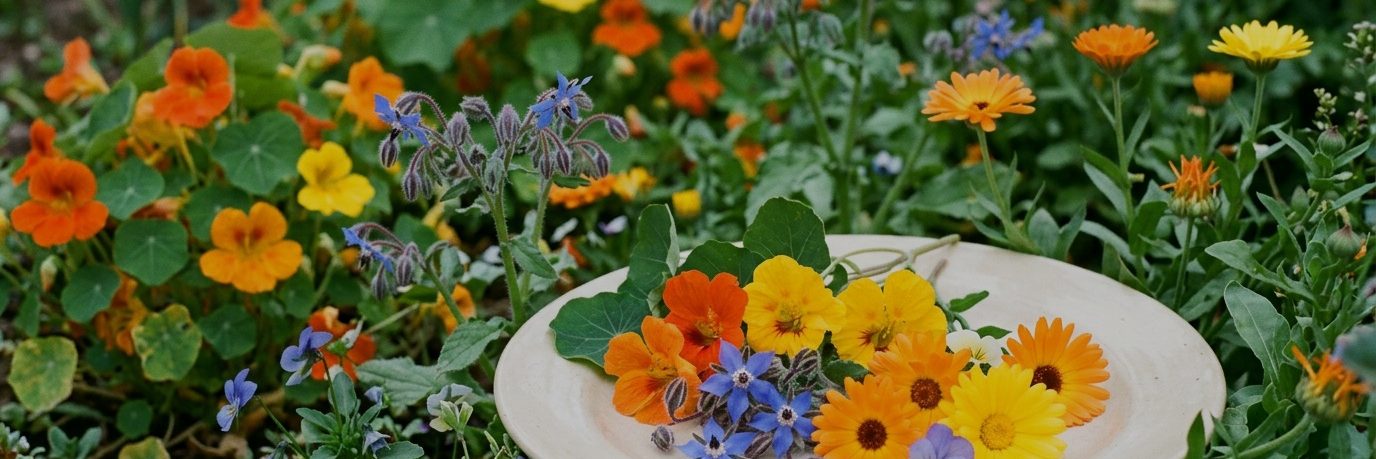
A handful of species cover most of what a temperate-climate garden needs. Nasturtium leads the way with a peppery flavour close to watercress, orange or red flowers that are edible from base to petal tip, and blooms all summer long until the first frosts. Borage, with a fresh taste reminiscent of cucumber, produces blue star shaped flowers that should be picked one by one, since they wilt fast. Pansies and horned violets add a gentle note and a colour that holds up well on a cold plate.
In the vegetable patch, courgette flowers, ideally male ones so the plant is not robbed of its future fruit, can be stuffed or coated and fried once the central pistil has been removed. The flowers of herbs extend the use of the whole plant: chives in small purple stars with an onion flavour more pronounced than the stem, basil, thyme, rosemary, sage, oregano and marjoram each produce a flower that echoes the leaf’s aroma in a subtler form. In the ornamental garden, rose and peony petals, stripped of their bitter white base, along with dahlia petals, crisp and mild in flavour, round out the palette for plate decoration.
Harvesting at the right time and preparing without losing flavour
Harvesting is best done early in the morning, once the dew has dried but before the heat of the day melts away the essential oils that carry the flower’s aroma. Choose flowers that have only just opened, firm, with no sign of wilting or of an insect tucked inside the petals: a flower past its prime has already lost much of its scent and its shape. Cut with your fingers or small scissors rather than pulling, so as not to damage the stem that carries the next buds.
Once picked, most flowers keep poorly: a few hours in the refrigerator, laid flat between two sheets of slightly damp absorbent paper, inside a closed box, is usually the limit. Borage and rose petals in particular hold up for only a short time once cut. Before use, rinse only if necessary, under a very gentle trickle of water, and dry gently: rinsing too vigorously breaks the delicate petals of pansies or nasturtiums. For larger flowers such as roses, dahlias or peonies, always remove the whitish base of the petals, which is more bitter and sometimes harsh tasting, before adding them to a dish.
In the kitchen: salads, plate decoration, infusions, preserving
The most straightforward use is in a mixed salad, where a few whole nasturtium or borage flowers, or petals plucked from roses and peonies, add colour and a hint of flavour without overpowering the dish. As a plate decoration, a dessert or a savoury dish is lifted by a flower placed on at the last moment, never cooked, so it keeps its shape and its brightness. The flowers of herbs, chives, thyme, oregano or marjoram, can be scattered over a cold soup or poultry just before serving, right at the very end of cooking, to preserve their fragrance.
For infusions, dried lavender flowers, to be used sparingly given how powerful their scent is, or dried borage, make a fragrant drink, steeped covered for five to seven minutes. Long term storage relies on drying the flowers flat, away from light, then keeping them in an airtight, dark jar; nasturtium also lends itself to flavoured vinegar, with the flowers left steeping for two to three weeks in white vinegar. Flower sugar, rose or pansy petals layered with fine sugar in a jar, then goes on to flavour pastries and drinks for months.
Safety: never confuse species, never eat a treated flower
The first rule fits in a single sentence: only eat flowers whose species has been identified with certainty and is known to be edible. Several ornamental plants very common in gardens are toxic, sometimes seriously so: lily of the valley, oleander, autumn crocus, rhododendron, foxglove, or the bulbs of daffodils and hyacinths should never end up on a plate, even in a small amount. Nasturtium seeds, for their part, are sharp tasting and are better eaten pickled, much like capers. When in doubt, it is better to abstain than to taste.
The second rule concerns how the garden has been treated: a flower that has received a fungicide or a foliar fertiliser should not be eaten, whatever the species, because these products concentrate in the petals and pollen. Harvest only in an area free of chemical treatment, well away from a treated hedge or roadside, never from a florist or a public flower bed. Finally, anyone allergic to pollen or to daisy family plants, such as marguerites or dahlias, should be cautious, and young children as well as pregnant women are better off testing any new species in a very small amount first.
Growing your own edible flowers in the garden or in pots
Most common edible flowers are easy to grow, even on a balcony. Nasturtium and borage can be sown directly where they are to grow once the last frosts have passed, in poor to moderately fertile soil: soil that is too rich pushes nasturtium into producing leaves rather than flowers. Pansies, on the other hand, do better planted out in autumn, so they flower from early the following spring. Flowering herbs, chives, thyme, rosemary, sage, oregano or marjoram, can be planted in open ground or in pots in full sun, leaving some plants to flower rather than harvesting every leaf.
For culinary use, it is better to grow your own than to buy ornamental varieties selected for how well they hold up as cut flowers, which sometimes taste blander. The individual growing guide for each species, nasturtium, courgette, chives or lavender, for instance, sets out exposure, watering and care step by step; some of these plants also have a place in a bed grown for cut flower bouquets, where the culinary use is then just one use among several others.
The care sheets to read next
Every plant mentioned has its full sheet: watering, light, soil, pests and a month-by-month calendar.
Nasturtium
Tropaeolum majus
The nasturtium (Tropaeolum majus) is an annual native to the Andean highlands of Peru and Colombia that has become an…
Zucchini
Cucurbita pepo
The zucchini (Cucurbita pepo) is the easy summer vegetable par excellence, one plant yields more than a family can eat.…
Chives
Allium schoenoprasum
Chives (Allium schoenoprasum) are a small perennial of the onion family, with fine hollow stems tasting mildly of…
Basil
Ocimum basilicum
Basil (Ocimum basilicum) is an annual, cold-sensitive herb that comes from the warm regions of Asia. It is a summer…
Lavender
Lavandula angustifolia
True lavender (Lavandula angustifolia) is a hardy Mediterranean plant that scents the air and draws bees all summer…
Rosemary
Salvia rosmarinus
Rosemary (Salvia rosmarinus, long known as Rosmarinus officinalis) is an evergreen Mediterranean shrub with needle-like…
Sage
Salvia officinalis
Common sage (Salvia officinalis) is a small aromatic shrub with evergreen grey-green foliage, originating from the dry…
Peony
Paeonia
The peony (Paeonia) is a hardy perennial with remarkable longevity: once well settled, it can flower for several…
Rose
Rosa
The rose (Rosa) is a hardy flowering shrub that overwinters outdoors without trouble, down to about -20 °C for most…
Dahlia
Dahlia
The dahlia (Dahlia) is a tuberous plant that offers one of the longest and most spectacular displays of the summer…
Thyme
Thymus vulgaris
Thyme (Thymus vulgaris) is a small Mediterranean subshrub with woody stems and a powerful fragrance, hardy to about…
Mint
Mentha
Mint (Mentha) covers several species and hybrids, from spearmint to peppermint, all perennial and fragrant. It is a…
Oregano
Origanum vulgare
Oregano (Origanum vulgare) is a tough, perennial herb built for sun and dry soils. Here is the good news: it is fully…
Marjoram
Origanum majorana
Marjoram is the gentle cousin of oregano: same family, but a finer, sweeter and less pungent scent, much prized in…
Frequently asked questions
Which edible flowers are easiest to grow in a kitchen garden?
Nasturtium and borage come out on top: sown in open ground once the last frosts have passed, they flower all summer with no particular fuss and tolerate poor soil. The flowers of herbs already growing in the vegetable patch, chives, thyme, rosemary or sage, offer a free harvest as soon as a few plants are left to flower rather than being cut back entirely for leaves.
Can you eat any flower from the garden?
No, several ornamental flowers very common in gardens are toxic, sometimes seriously so, including lily of the valley, oleander, autumn crocus and foxglove. Only eat flowers whose species has been identified with certainty and is recognised as edible, and if in doubt, abstain rather than taste.
How do you store edible flowers after picking them?
Most keep for a few hours in the refrigerator, laid flat between two sheets of slightly damp absorbent paper. For long term storage, drying the flowers flat away from light works well for lavender or borage, while nasturtium also lends itself to flavoured vinegar, with the flowers steeped for two to three weeks in white vinegar.
Should edible flowers be washed before eating?
A light rinse under a gentle trickle of water is enough, especially if the flower comes from an untreated garden, followed by gentle drying so as not to damage the delicate petals. The essential condition lies further upstream: harvest only from a part of the garden that has received no chemical treatment at all, since these products do not always come off with a simple rinse.
Green Hub looks after your plants
Photograph a plant: Green Hub identifies it and writes its care sheet, with no account. Sign in afterwards to keep its dated photos and history over time.
Identify a plantUpdated on
How this sheet is written
Written for Green Hub with the help of language models, then reviewed. It offers gardening guidance, not professional advice: if you are unsure whether a plant is toxic to a child or an animal, ask a vet, a doctor or your national poison centre.