Rainwater Harvesting for the Garden: Choosing and Sizing Your System
Harvesting rainwater in the garden means intercepting the water that runs off the roof before it disappears into the sewer, and storing it instead in a rain barrel, an above-ground tank, or an underground cistern. In a temperate climate, where annual rainfall can range from 700 millimetres in the lowlands to more than 1400 on nearby high ground, a 100 m² tiled roof can theoretically yield several tens of thousands of litres a year, more than enough to cover a vegetable garden’s watering needs during the dry spells. What remains is to size the system correctly, maintain it, and understand the regulations before connecting it to the house.
Rain Barrel, Above-Ground Tank, or Underground Cistern: Three Families of Systems
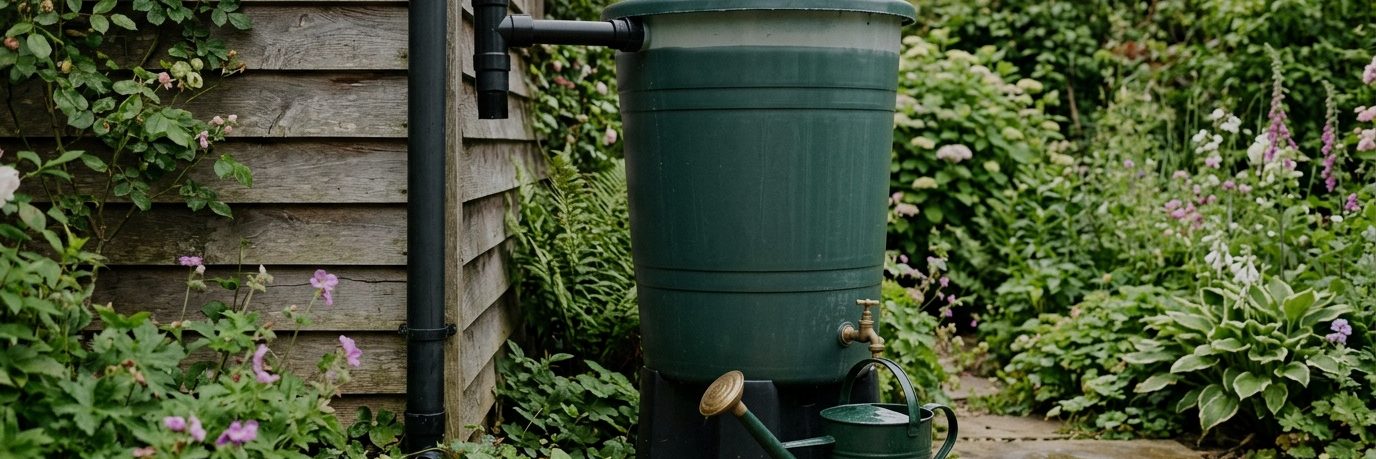
The simplest system is the barrel or rain butt placed at the foot of a downspout, holding between 200 and 300 litres, connected via a diverter that clips onto the pipe without any drilling. It already filters out large leaves and redirects the overflow to the stormwater drain once full. It is the cheapest and quickest solution to install, but its limited capacity empties after just a few waterings of a vegetable garden at the height of the dry season.
The above-ground tank, made of polyethylene and holding 500 to 1000 litres, takes over for a thirstier garden: set on a stable slab, it drains through a simple gravity tap, with no pump needed. It remains exposed to frost and light, which encourages algae growth if it is not opaque.
The underground cistern, ranging from 2000 to more than 10000 litres, provides a genuine year-round reserve: buried below the frost line, roughly 80 centimetres to a metre depending on the soil, it never freezes and stays protected from light. It requires excavation work and a pump, either submersible or surface-mounted, but pays for itself once you are watering a large vegetable garden or also supplying toilets.
Sizing Your System to Your Roof and Local Rainfall
The basic rule: one millimetre of rain on one square metre of roof yields one litre of raw water. The recoverable volume is calculated by multiplying the building’s ground-plan area, not the sloped surface, by the local rainfall, then by a coefficient that depends on the roofing material: 0.80 for tiles, 0.85 for slate, 0.90 to 0.95 for a steel or zinc sheet roof, and only 0.20 to 0.40 for a green roof.
Rainfall is the figure you have to look up, because it can vary by a factor of nearly two over a few dozen kilometres: in a temperate oceanic climate, 700 to 850 millimetres a year is common in the lowlands, against 1000 to more than 1400 on the first high ground. Use the thirty-year average for the weather station nearest to you, published by your national meteorological service. For a 100 m² tiled roof at 800 millimetres a year, that works out to around 64000 litres over the year, though never captured in full since the tank overflows between rain showers.
The tank should be sized for six to eight weeks of consumption, not for that annual total. To water a vegetable garden or flower beds, 1000 to 3000 litres are enough for most gardens. To also cover toilets or the washing machine, aim for 5000 to 10000 litres.
What You Are Allowed to Do With It: Water Quality and Regulations
Stored rainwater is naturally soft and slightly acidic, free of the lime that burdens tap water in many regions. That is a real advantage for plants that suffer from lime, such as hydrangeas or blueberry bushes, and for the whole vegetable garden, which benefits from water at ambient temperature rather than the cold water straight from the tap.
It is not drinkable as is. Sanitary regulations everywhere require a strict separation between the rainwater network and the mains water network. Every connection to the mains supply must include a non-return valve, and every draw-off point must carry a visible non-potable water pictogram. If the cistern also supplies toilets or a washing machine, an air-gap disconnection of at least two centimetres is required between the two networks.
This water remains reserved for watering the garden and vegetable patch, washing the terrace, tools or car, filling a pond, and non-food sanitary uses if the installation is compliant. Drinking it would require fine filtration and UV disinfection, which few homeowners install.
Maintenance and Winterizing: Keeping the Water Clean All Year
A neglected system clogs up and loses its value. The inlet filter, whether the basket in the gutter diverter or the strainer at the top of the cistern, should be cleaned two to four times a year, with a pass after leaf fall. An overflow that drains poorly or an unusual smell almost always signals a clogged filter.
For an above-ground tank or an underground cistern, an annual check is essential before winter: a partial drain to inspect the bottom, where sludge eventually settles, and a complete drain every one to two years if the sediment is thick. The overflow must stay fitted with a trap or a non-return valve to keep rodents and slugs from nesting inside.
Winterizing differs depending on the type of installation. A barrel or an above-ground tank should be emptied completely before the first frosts, which can arrive as early as the start of autumn at altitude or inland, and later in the lowlands and near the coast, with the tap left open to stop any remaining water from cracking the wall. An underground cistern, buried below the frost line, has nothing to fear from freezing: it is enough to drain the pipework and the pump left above ground.
Grants, Subsidies and Local Obligations Before You Buy
Funding for a cistern is almost always decided locally rather than nationally, and it comes in three forms. First the direct grant, usually tied to a minimum capacity (around 1000 litres for sanitary use, 5000 litres for a full connection to the house) and sometimes scaled to household income: the amounts commonly seen run from a few hundred to a few thousand euros, or the local equivalent. Then aid in kind: many local authorities hand out 200 to 300 litre barrels free or at cost, which settles the question for a small garden with no financial paperwork at all. Finally the obligation: in many municipalities a cistern of a minimum volume is a condition of the building permit for new construction, and the expense stops being a choice.
Three habits pay off everywhere. Check the amount with your local planning or environment department before signing a quote, because these grants are almost never retroactive: an order placed before approval loses the money. Read the technical condition, because many schemes only accept cisterns connected to a sanitary fixture, not those used purely for watering. And ask again every year, because the rates are revised with each budget and a scheme can vanish or double from one year to the next.
The care sheets to read next
Every plant mentioned has its full sheet: watering, light, soil, pests and a month-by-month calendar.
Hydrangea
Hydrangea macrophylla
The hydrangea (Hydrangea macrophylla) is the flowering shrub for cool, partly shaded gardens, and one of the very few…
Blueberry
Vaccinium corymbosum
The cultivated blueberry (Vaccinium corymbosum) is the large shrubby cousin of the wild bilberry, also called the…
Raspberry
Rubus idaeus
The raspberry (Rubus idaeus) is a small fruiting shrub, hardy down to -25 °C, that grows wild in the cool woodland of…
Strawberry
Fragaria x ananassa
The strawberry (Fragaria x ananassa) is a hardy perennial that fits very well into any vegetable garden. Hardy to…
Blackcurrant
Ribes nigrum
The blackcurrant (Ribes nigrum) is a small hardy fruit shrub that is genuinely happy in a cool climate, down to USDA…
Redcurrant
Ribes rubrum
The redcurrant (Ribes rubrum) is a small bushy fruit shrub that produces those pretty clusters of translucent red…
Tomato
Solanum lycopersicum
The tomato (Solanum lycopersicum) is the queen of the vegetable garden, but it is a plant of sun and warmth that plays…
Zucchini
Cucurbita pepo
The zucchini (Cucurbita pepo) is the easy summer vegetable par excellence, one plant yields more than a family can eat.…
Cucumber
Cucumis sativus
The cucumber (Cucumis sativus) is an annual vegetable from the warm regions of the southern Himalayas, and it shows: it…
Eggplant
Solanum melongena
The eggplant (Solanum melongena) is the most cold-sensitive and the most heat-hungry of the garden nightshades, even…
Bell pepper
Capsicum annuum
The bell pepper (Capsicum annuum) is an annual fruiting vegetable and a genuinely cold-shy one, the sweet cousin of the…
Pumpkin
Cucurbita maxima
The pumpkin (Cucurbita maxima) is a large, sprawling, hungry and frost-tender squash that came from the Andes. It is a…
Celery
Apium graveolens
Celery (Apium graveolens) covers two vegetables from the same species: stalk celery, grown for its crisp ribs, and…
Spinach
Spinacia oleracea
Spinach (Spinacia oleracea) is a cool-season leaf vegetable, hardy and in a hurry to live. Coolness suits it very well:…
Leek
Allium porrum
The leek (Allium porrum) is the winter vegetable par excellence. Very hardy, it stands in the ground all winter and is…
Frequently asked questions
What size rainwater harvester should you choose for a garden?
It depends on the intended use and the available roof surface. To water a vegetable garden or flower beds, a tank of 1000 to 3000 litres is enough for most gardens. To also cover toilets or the washing machine, aim for 5000 to 10000 litres, calculating roof surface multiplied by local rainfall and the coefficient of the roofing material.
Can you drink rainwater collected in a garden cistern?
No, not without thorough treatment. The NBN B 03-700 standard reserves this water for non-potable uses: watering, outdoor washing, flushing toilets, or the washing machine on a network strictly separated from the mains supply. Making it drinkable would require fine filtration and UV disinfection, which few domestic installations have.
Should you empty your rainwater tank before winter?
A barrel or an above-ground tank, yes: empty it completely before the first frosts, tap open, to stop it from cracking as it freezes. An underground cistern buried below the frost line does not need to be emptied; it is enough to drain the pipework and the pump left above ground.
Are there grants for installing a rainwater cistern?
Often yes, but almost always at local level rather than national: municipality, city, water authority or utility. Amounts commonly run from a few hundred to a few thousand euros, or the local equivalent, with a minimum capacity required (often 1000 litres for sanitary use, 5000 litres for a full connection) and sometimes an income condition. Some authorities even make the cistern a condition of the building permit. Ask your planning or environment department before ordering: these grants are not retroactive.
Green Hub looks after your plants
Photograph a plant: Green Hub identifies it and writes its care sheet, with no account. Sign in afterwards to keep its dated photos and history over time.
Identify a plantUpdated on
How this sheet is written
Written for Green Hub with the help of language models, then reviewed. It offers gardening guidance, not professional advice: if you are unsure whether a plant is toxic to a child or an animal, ask a vet, a doctor or your national poison centre.