Crocus
Crocus
.jpg)
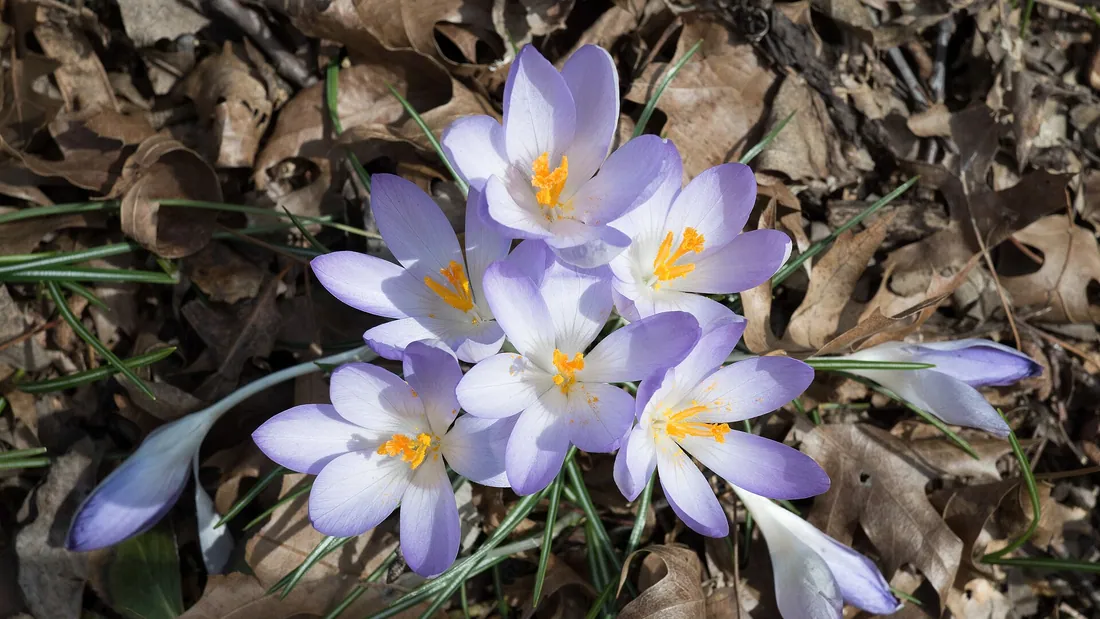
Crocus is the very first splash of colour in the garden as winter loosens its grip. It is not unusual to see it push through with the first mild spell, sometimes straight through the last patches of snow, well before the daffodils and often ahead of the snowdrops themselves. It is a corm plant, easy and remarkably tough, planted in autumn and reliably back every year with barely any attention.
Light and exposure
Crocus wants sun, or at least good light. Its cup shaped flowers open wide the moment the sun touches them and close again in the evening, on a cloudy day, or even when a passing cloud blocks the light. Plant it in full sun if you want flowers wide open rather than shyly half closed.
It also does well under deciduous trees and shrubs, a rose, an apple tree, a maple, since it flowers and finishes its cycle before the canopy closes overhead and casts shade. It is one of the few bulbs that makes full use of the light under trees that would be far too shady for almost anything else once summer arrives.
Watering
Once the corms are in the ground in autumn, watering only helps if the soil is genuinely dry at planting time, to get rooting started before the first cold snap. After that, the rain of the cold season and of spring is more than enough, crocus never needs watering while it flowers.
The real risk is not too little water but too much. Once the leaves have died back, the corm goes into summer dormancy and hates sitting in soggy soil. If you grow crocus in pots or containers, let the compost dry out fully through the summer, watering it needlessly at that stage rots the corms faster than any pest would.
Soil and repotting
Crocus is not fussy, ordinary garden soil suits it fine, even poor or stony ground, as long as it drains well. It is equally happy in chalky or neutral soil.
What it cannot cope with is standing water. In heavy clay soil, break the ground up deeply and work coarse sand or fine gravel into the bottom of the planting hole, so the corms are not sitting in damp ground through their summer rest.
Temperature and humidity
Crocus is a thoroughly hardy plant: the spring crocuses take frosts of -25 to -30 °C, which means USDA zones 3 to 8, and need no winter protection at all, neither fleece nor thick mulch. In fact it is winter cold that triggers their flowering as dormancy ends.
That need for cold explains why crocus is always planted in autumn and never in spring, it needs several months of cold soil, in the order of three months below 9 °C, to prepare its flowering. A mild winter with no real cold spell often gives a more strung out, less generous display than a proper one, and in the warmest climates the corms are chilled before planting.
Pruning and upkeep
There is no real pruning to speak of. The one essential step, and the most often ignored, is letting the foliage die back completely on its own after flowering, over six to eight weeks. It is during this time that the leaves rebuild the corm’s reserves for next year’s flowers.
Never tie the leaves up and never cut them back early, even if they start to look a bit untidy among the other spring plantings. You can deadhead the spent flowers if you prefer a tidier look, but it is not necessary, crocus barely self seeds in a maintained garden.
Pests and diseases
Crocus is one of the healthiest bulbs in the garden, it has hardly any serious disease. The one fungal problem to watch for is corm rot in soil that stays too wet through the summer, easily avoided with good drainage.
The real enemy of crocus is rodents. Field mice, voles and sometimes squirrels love freshly planted corms and can clear a whole bed in a few autumn nights. Fine mesh laid at the bottom of the planting hole, or planting in a wire basket, solves the problem. Sparrows and other small birds sometimes peck at the yellow petals in spring too, an unsightly but harmless nuisance.
Propagation
Crocus multiplies entirely on its own, with no help needed. Each corm produces small offset corms around it every year, and the clump naturally grows year after year into dense, generous colonies.
If a clump gets too crowded and flowers less well, dig it up and divide the corms in late spring, once the foliage has fully died back, then replant straight away or store them dry until autumn. Growing from seed is also possible but takes three to four years before the first flower, a method for patient gardeners or amateur botanists.
Climate and hardiness
Where and in which climate it thrives
Crocus is one of the hardiest bulbs in the garden: the spring crocuses (Crocus vernus, Crocus tommasinianus, Crocus chrysanthus) take frosts of -25 to -30 °C and grow in USDA zones 3 to 8. Saffron crocus (Crocus sativus), which flowers in autumn, is slightly less resistant, more like zones 6 to 9. No winter protection is needed, neither fleece nor thick mulch.
What matters is not the cold but the lack of it. Crocus needs a genuine cold spell, roughly three months of soil below 9 °C, to prepare its flowering: that is why it is planted in autumn and never at the end of winter. After a mild winter, flowering comes out more strung out and less generous; in a hot Mediterranean or subtropical climate, from zone 9 upwards, the corms are chilled for six to ten weeks before planting and then treated as annuals.
The second thing that changes everything from one climate to another is summer. Crocus comes from regions with dry summers: once the foliage has died back, the corm wants to stay dry. In an oceanic climate with regular summer rain, or on heavy ground, plant on a bed of coarse sand or fine gravel, or grow in pots you move out of the rain. Where summers are hot and dry, no precaution is needed at all, the corm is at home. And in the southern hemisphere the whole calendar shifts by six months: planting happens as your autumn begins.
Growing crocus?
Green Hub keeps a dated history of your own plant: its photos, its progress, its repottings. An AI answers about yours specifically, not a generic sheet, for free.
Identify my plantMonth-by-month care calendar
| January | Nothing to plant or protect, crocus is resting underground. In a mild winter, the very first buds of snow crocus (Crocus tommasinianus) can already appear late in the month. |
|---|---|
| February | This is crocus’s big month in the northern hemisphere. The first flowers often push through snow or frost as early as mid February, well before the daffodils. |
| March | Full flowering in most gardens. The flowers open wide in the sun and draw in the first bees out of the hive. |
| April | Flowering comes to an end. Leave the foliage alone, this is when it works hardest to rebuild the corm’s reserves. |
| May | The foliage starts to yellow and flop. Do not cut or tie it up, let the process finish on its own. |
| June | The foliage has finished dying back. The corms enter summer dormancy, stop watering that part of the garden. |
| July | Complete rest underground. A good time to dig up and divide a clump that has become too crowded, if needed. |
| August | Order your corms for autumn and scout out spots, lawn, borders, under deciduous trees. |
| September | Planting of the corms begins, at around five to eight centimetres deep, while the soil is still warm enough to encourage good rooting. |
| October | Carry on planting in loose, irregular groups rather than straight rows. This is also when autumn crocuses and saffron flower, not to be confused with toxic autumn crocus. |
| November | Finish off the last plantings before the soil turns too cold and too wet to work. |
| December | Complete rest. Nothing to do in the garden, the corms wait underground for the light to return. |
Green Hub tips
- Scatter crocus corms loosely across the lawn rather than planting them in straight rows for a natural look, and always wait until the foliage has turned fully yellow before the first spring mow.
- Protect freshly planted corms with a layer of fine buried mesh if field mice or voles are a problem in your garden, they can strip an entire planting overnight.
- Never confuse autumn crocus or saffron with meadow saffron. The latter looks similar from a distance but is a highly toxic plant that does not belong to the same genus at all.
- Always plant in dense groups of at least twenty corms rather than scattering single corms, the visual effect at the end of winter is not even comparable.
Related species
Althea
Hibiscus syriacus
Althea (Hibiscus syriacus) is a hardy deciduous garden shrub that flowers when every other one has finished, from…
Beech
Fagus sylvatica
Beech (Fagus sylvatica) is the most common broadleaf tree in the temperate forests of Europe, just as happy standing…
Begonia
Begonia
Begonia is the star summer flower of window boxes, hanging baskets and shady borders. Hundreds of hybrids exist, but…
Box
Buxus sempervirens
Box (Buxus sempervirens) is an evergreen shrub that has been clipped into balls, cones and low borders in formal…
Butterfly bush
Buddleja davidii
Buddleia (Buddleja davidii), better known as the butterfly bush, is a nearly indestructible shrub that has taken over…
Cherry laurel
Prunus laurocerasus
Cherry laurel (Prunus laurocerasus) is the most widely planted evergreen hedging shrub in temperate gardens, and it is…
The guides that mention it
Perennial Flowers: Choosing, Planting and Blooming Without a Gap All Season
What genuinely comes back year after year, how to read hardiness by zone rather than by promise, and how to string…
Lawn Care: From Seeding to Mowing, and Renovation
Mowing higher changes more than any fertilizer can: turf density, drought resistance, weeds, moss. Everything else in…
Wildflower Meadows and Beneficial Insects: Gardening for Biodiversity
Ladybirds, hoverflies, wild bees: how a wildflower meadow and a few simple habits turn an ordinary garden into a refuge…
The Cutting Garden: How to Pick Flowers and Make Your Bouquet Last
Dahlias, peonies, hydrangeas: what separates a flower that lasts ten days in a vase from one that droops by the next…
Designing your garden by colour: the combinations that work
Warm harmonies, cool harmonies, monochrome schemes or bold contrasts: colour changes everything in a garden, from the…
Updated on
How this sheet is written
Written for Green Hub with the help of language models, then reviewed. It offers gardening guidance, not professional advice: if you are unsure whether a plant is toxic to a child or an animal, ask a vet, a doctor or your national poison centre.