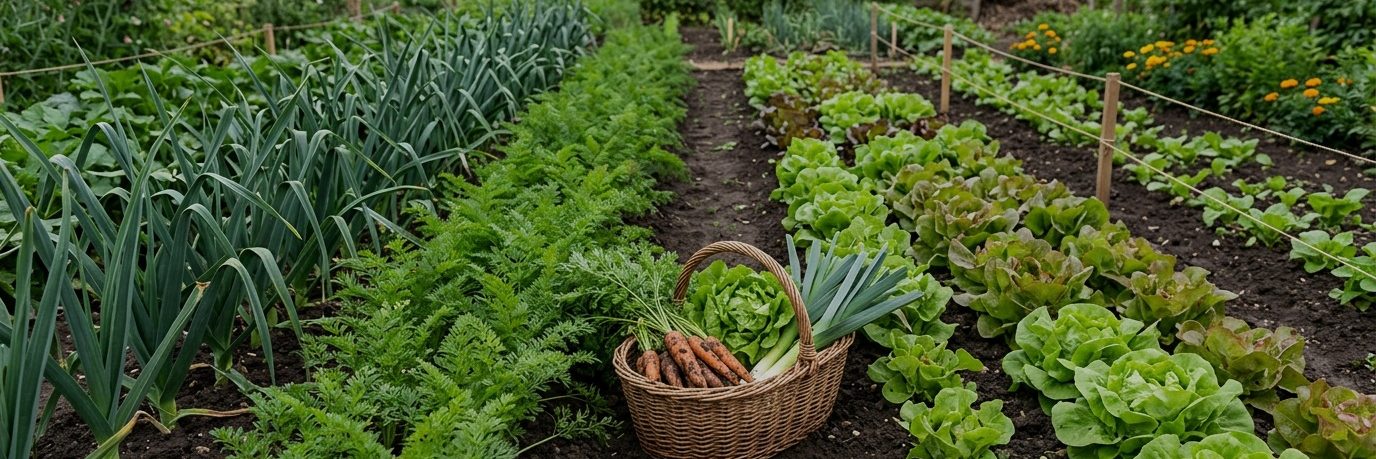
The vegetable garden calendar, from sowing to harvest
A vegetable garden calendar written in months only holds true for the place it was written in: it shifts by several weeks between southern Europe and Scandinavia, and it is flatly reversed in the southern hemisphere. The calendar that works everywhere rests on two dates you determine where you garden, your last spring frost and your first autumn frost, plus one measurement nobody can guess on your behalf: your soil temperature.
The vegetable garden calendar is not read in months but in offsets from two local anchors. The first is the average date of your last spring frost: it governs sowing under cover, two to eight weeks before depending on the species, hardy sowing directly in the ground, two to six weeks before, and setting out frost-tender crops, one to three weeks after. The second is the date of your first autumn frost: it governs, counting backward, your late-season sowings, to which you add about two weeks because growth slows as the days shorten. Between the two, a soil thermometer settles the question: almost nothing germinates below 4 °C, tomato needs 10 °C, bean and squash need 16 °C. These markers transpose from one hemisphere to the other, which no list of months can do.
Two dates, not twelve months
Almost every vegetable garden calendar is written in months, and almost every one of them is wrong for you. Advice tied to a date only holds for a band a few hundred kilometres wide: between southern Europe and Scandinavia, the same sowing shifts by six to eight weeks, and it flips seasons entirely once you cross the equator. An Australian gardener who followed a European calendar to the letter would plant tomatoes in the dead of winter.
What does transpose, on the other hand, are the events. A vegetable garden year is not a sequence of months, it is a sequence of thresholds: the soil thaws, it warms enough for hardy seeds to germinate, the risk of night frost disappears, the days lengthen enough to trigger onion bulbing, the nights turn cool, the first frost falls. These thresholds occur everywhere, in the same order; only their dates change.
This guide therefore rests on three markers you look up once and for all: the average date of your last spring frost, that of your first autumn frost, and your soil temperature at five centimetres deep. It refers to named seasons; to place them within your own calendar year, the correspondence is immediate.
| Vegetable garden season | Northern hemisphere | Southern hemisphere | Astronomical marker |
|---|---|---|---|
| Late cold season: planning and sowing under cover | January to March | July to September | after the winter solstice |
| Spring: hardy sowings, then setting out frost-tender crops | March to June | September to December | equinox to summer solstice |
| Warm season: harvests and sowing for autumn | June to September | December to March | summer solstice to equinox |
| Autumn: storage harvests and winter plantings | September to December | March to June | equinox to winter solstice |
| Depth of winter: daylight under ten hours, growth at a standstill | December to February | June to August | around the winter solstice |
Only astronomical markers are shared between the two hemispheres: the same equinox opens spring on one side of the equator and autumn on the other.
Finding the date of your last spring frost
This is the pivotal date of the entire spring calendar, and it is a statistic, not a prophecy. You find it in your national weather service’s archives, which publish the probability that a zero-degree temperature will occur after a given date: in the United States, NOAA climate normals give the date by which that risk falls below 40, 30, 20 and then 10 percent.
The key is understanding the difference between these thresholds. The so-called average date is the 50 percent date: one year out of two, it will still frost after it. That is an acceptable marker for a carrot sowing, a very bad idea for a tomato plant, which a single night at zero degrees is enough to kill. For frost-tender crops, use the 10 percent date instead, often two to three weeks later.
Then adjust for your own garden, because frost is highly local and the weather station is not in your backyard. Cold air is denser: it sinks and pools in hollows, behind a solid wall, at the bottom of a slope. A valley floor can keep frosting for several weeks longer than a hillside two hundred metres above it; a city garden gains a week on the surrounding countryside.
Plants in your neighbourhood offer a good cross-check: they integrate this year’s actual temperature history, not a thirty-year average. The classic northern-hemisphere markers work this way: sow peas when forsythia and daffodils bloom, sow corn when oak leaves reach the size of a squirrel’s ear. Pick two or three highly visible plants near you and note their stage the year your frosts finally stop.
The first autumn frost, and the real length of your season
You find the second anchor the same way, in the same archives. The gap between the two dates is your frost-free season, and it decides what you can grow: a 120-day season rules out anything that needs longer, a 250-day season allows two successive crops on the same bed.
Autumn is planned backward, and this is where most gardens fall short. Start from your first frost date, subtract the variety’s days-to-harvest, then subtract another two weeks or so: the times printed on seed packets are measured under optimal conditions, and a plant growing under shortening days takes noticeably longer. For a frost-tender crop, subtract two more weeks.
A second, harsher limit has nothing to do with temperature. Below ten hours of daylight, most vegetables practically stop growing, even under cover and even if the air stays mild: there simply is not enough light to fuel growth. American market gardener Eliot Coleman named this window the Persephone period. Its length depends only on your latitude: nonexistent in the tropics, it stretches toward the poles to roughly three months around forty-five degrees.
Hence a universal rule: a winter crop does not grow during winter, it holds. It must reach about three-quarters of its final size before daylight drops below ten hours, or it will sit frozen in place until the light returns.
The soil thermometer, the one marker that never lies
Air temperature is felt, soil temperature is measured, and yet it is soil temperature that decides whether a seed germinates or rots. A soil thermometer costs about the same as two seed packets and replaces half of any calendar.
The method comes down to three steps. Push the probe five to eight centimetres deep for a sowing, ten to fifteen for a planting. Take the reading early in the morning, around nine o’clock, when the soil is at its coldest for the day: it is this low value that matters, not the afternoon peak. Repeat on three consecutive mornings and average the readings, because one sunny day does not warm a bed for good.
The thresholds fall into four groups. Around zero degrees, lettuce, spinach, onion, leek and parsnip already germinate, very slowly. From 4 °C, carrot, beetroot, radish, turnip, cabbages and pea join in. At 10 °C, tomato and sweet corn get going. Bean, cucumber, pepper, aubergine, courgette and squash need 16 °C: sown colder, they do not germinate, they rot. These are floors, not recommendations: just above them, the seed germinates so slowly that it rots or gets eaten before it emerges.
| Crop | Soil at 10 °C | Soil at 15 °C | Soil at 20 °C | Soil at 25 °C |
|---|---|---|---|---|
| Lettuce | 7.0 | 3.9 | 2.6 | 2.2 |
| Radish | 11.2 | 6.3 | 4.2 | 3.5 |
| Spinach | 11.7 | 6.9 | 5.7 | 5.1 |
| Onion | 13.4 | 7.1 | 4.6 | 3.6 |
| Pea | 13.5 | 9.4 | 7.5 | 6.2 |
| Beetroot | 16.7 | 9.7 | 6.2 | 5.0 |
| Carrot | 17.3 | 10.1 | 6.9 | 6.2 |
| Sweet corn | 21.6 | 12.4 | 6.9 | 4.0 |
| Parsnip | 26.6 | 19.3 | 13.6 | 14.9 |
| Tomato | 42.9 | 13.6 | 8.2 | 5.9 |
| Bean | no emergence | 16.1 | 11.4 | 8.1 |
| Cucumber | no emergence | 13.0 | 6.2 | 4.0 |
| Pepper | no emergence | 25.0 | 12.5 | 8.4 |
A tomato sown in soil at 10 °C takes more than six weeks to emerge, against six days at 25 °C. At the other end of the scale, lettuce stops germinating above roughly thirty degrees: this thermodormancy explains why lettuce sowings fail in high heat.
The dashboard, crop by crop
Here is the operational core of this guide: for each common vegetable, when to sow it relative to your last frost, what soil temperature it needs, and how long it takes from sowing to harvest. It is this column of offsets, in weeks, that replaces months.
| Crop | Sowing or planting | Minimum soil temperature | Sowing to harvest |
|---|---|---|---|
| Pea | 5 to 6 weeks before | 4 °C | 55 to 85 days |
| Spinach | 4 to 6 weeks before | 0 °C | 45 to 60 days |
| Lettuce | 3 to 6 weeks before, then successively | 0 °C | 45 to 60 days |
| Spring radish | 3 to 4 weeks before, then every 7 days | 4 °C | 25 to 40 days |
| Turnip | 2 to 4 weeks before | 4 °C | 45 to 70 days |
| Beetroot | 2 to 4 weeks before | 4 °C | 50 to 70 days |
| Carrot | 2 to 4 weeks before | 4 °C | 60 to 80 days |
| Storage onion | 4 weeks before, as transplants or sets | 0 °C | 100 to 120 days |
| Leek, as transplants | 4 weeks before | 0 °C | 120 to 150 days |
| Broccoli and cabbage, as transplants | 2 to 4 weeks before | 4 °C | 50 to 90 days |
| Potato | 2 to 4 weeks before, soil at 7 °C | not applicable | 90 to 120 days |
| Parsnip | around the last frost, once soil has drained | 0 °C | 110 to 130 days |
| Bean | after the last frost | 16 °C | 50 to 70 days |
| Tomato, as transplants | 1 to 3 weeks after | 10 °C | 70 to 90 days |
| Pepper and aubergine, as transplants | 1 to 3 weeks after | 16 °C | 70 to 90 days |
| Cucumber | 2 weeks after | 16 °C | 55 to 65 days |
| Courgette | 2 weeks after | 16 °C | 50 to 60 days |
| Pumpkin and winter squash | 2 weeks after | 16 °C | 95 to 120 days |
The offset column splits crops into two families. Hardy crops are sown before the last frost: cold does not kill them, and they benefit from the soil moisture left over from winter. Frost-tender crops go out only after it, no exceptions: tomato, pepper, aubergine, bean, cucumber, courgette, squash and melon die at zero degrees, not at minus five.
Days-to-harvest, meanwhile, is added to the start date to check whether a crop actually fits inside your season. A leek needs 120 to 150 days, a parsnip 110 to 130. At the other end, a spring radish is ready in 25 to 40 days and a lettuce in 45 to 60: perfect for filling a bed between two long-season crops. If your frost-free season is short, these are the columns that decide.
Two crops partly escape the frost logic. Onion forms its bulb in response to day length, regardless of its planting date: short-day varieties bulb at around ten to twelve hours of daylight and suit low latitudes, intermediate-day varieties at around twelve to fourteen hours, long-day varieties at around fourteen to sixteen hours. A long-day variety planted near the equator will never bulb. Garlic, for its part, needs six to eight weeks between zero and ten degrees for the head to divide into cloves.
The cold season before spring: planning and sowing under cover
When the soil is frozen or waterlogged, there is nothing to do outside, and this is precisely where next season is won. Three tasks fill this time.
The rotation plan comes first. Note what grew where the previous year and move every botanical family: nightshades (tomato, potato, pepper, aubergine), cucurbits, alliums, brassicas, legumes, umbellifers. A family that returns too quickly to the same spot feeds the soil-borne diseases and pests waiting for it: three to four years apart is the usual rule.
Soil improvement comes next. Mature compost spread on the surface, empty beds covered with mulch or a cover crop: bare soil compacts under rain, loses nutrients to leaching, and warms up more poorly. In a wet oceanic climate, where winter waterlogging does more damage than cold, a raised bed that drains quickly gains two to three weeks on spring growth.
Finally, sowing under cover, where the real countdown begins. Eight weeks before the last frost for celery, parsley and leek; six to eight weeks for tomato, pepper, aubergine and onion grown from seed; four to six weeks for cabbages, lettuce and herbs; only two to three weeks for cucumber, courgette and melon, which cope badly with sitting too long in a pot. A sowing started too early gives a leggy, stretched plant that will transplant less well than a younger, stockier one.
This is also the time to chit seed potatoes, roughly six weeks before planting: a single layer, sprouts facing up, at around twenty degrees and in bright but indirect light. The sprouts stay short, and the harvest comes seven to fourteen days earlier.
Warming up: hardy sowings outdoors and hardening off
The first real sign of spring is not a date, it is a state of the soil: it no longer sticks to the spade, and a handful squeezed in your fist crumbles instead of forming a ball. Working soil that is still saturated destroys its structure for the whole season.
From this point on, anything hardy can go in, up to four to six weeks before the last frost for the toughest crops. Peas first, as soon as the soil is workable; then spinach and lettuce, then radish, turnip, beetroot and carrot, then onion, leek and cabbage transplants. These crops do not merely tolerate cold, they prefer it: lettuce sown in soil that is already warm bolts much faster and turns bitter.
Two weeks before the last frost, hardening off begins for plants raised under cover, the step most often skipped. A plant that has grown at a constant temperature, without wind and under filtered light, has neither a thick cuticle nor a rigid stem: moved abruptly into full sun, it scorches in a single afternoon. Allow seven to fourteen days, one to two hours outside on the first day, then one more hour each day until it can spend a full night outdoors.
This is also the planting window for potatoes, two to four weeks before the last frost, once the soil reaches at least seven degrees; below that, the seed potato rots before it can start growing. The foliage is frost-tender, but if it is caught by a late frost, you mound soil over it and the plant recovers. Earthing up also protects the tubers from light: an exposed tuber turns green, builds up solanine, and is not fit to eat.
Hot season: setting out frost-tender crops, staggering sowings, and already sowing for autumn
One to three weeks after the last frost, depending on your appetite for risk, frost-tender crops go out: tomato, pepper, aubergine and melon lead the way; cucumber, courgette, squash and pumpkin more like two weeks after that, because they need soil noticeably warmer than the air temperature suggests. Bean is sown directly as soon as the soil holds sixteen degrees in the early morning.
The question then is no longer what to sow, but at what pace. Staggered sowing is what separates a garden that produces all season long from one that produces everything in the same week. Market gardeners’ usual intervals are short: seven days for baby greens, radish and spinach; ten days for head lettuce, pea and dwarf bean; fourteen days for beetroot, turnip and rocket; twenty-one days for carrot and cucumber; thirty days for courgette.
The rule of never leaving soil bare applies here too: a bed freed up by peas gets replanted the same day, or you lose three weeks of growing season. This is also the moment, in the middle of the heat and without it feeling logical, when you work for autumn. Leeks to transplant, winter cabbage, Brussels sprouts, lamb’s lettuce, autumn spinach, storage carrots: all of it gets sown while the first tomatoes are turning red.
Two difficulties specific to hot weather can be planned for. Lettuce thermodormancy blocks germination above roughly thirty degrees: sow in the shade of a tall crop, water the row right before sowing, or start in pots somewhere cool. Bolting, triggered by long days and heat, can be avoided with bolt-resistant varieties.
The return of cold: storage harvests, winter crops and plantings for the year ahead
As the first frosts approach, the order of operations is dictated by each crop’s cold tolerance, not by a date. Anything frost-tender is lost the moment the thermometer touches zero: tomato, pepper, aubergine, bean, cucumber, courgette, squash, pumpkin and basil must be harvested before then. Between zero and minus two degrees, beetroot, carrot, cauliflower, lettuce, onion, garlic, parsley, pea, radish and spinach hold on. From minus two down to minus four degrees, and often beyond, broccoli, cabbage, Brussels sprouts, kale, turnip and parsnip stand firm.
These last ones do not merely survive, they improve. Exposed to cold, they convert part of their starch into soluble sugars, sucrose and fructose, which lower their cells’ freezing point and act as a natural antifreeze. The effect shows up in flavour too: a parsnip or a Brussels sprout harvested after a frost is noticeably sweeter. You leave them in the ground under a thick mulch and pick them as you go.
Finally, this is the season for plantings that prepare next year. Garlic is planted a few weeks before the soil freezes, enough time to root, then it receives its six to eight weeks of cold right in the ground. Storage onions and shallots follow the same logic, and winter broad beans ride out the cold without trouble. Where winters are mild but very wet, improve drainage before mulching: excess water kills more surely there than frost does.
Finally, write everything down: your actual last frost, your actual first frost, what came up and what failed. Three years of notes running are worth more than any printed calendar.
Common pitfalls to avoid
MistakeSetting out frost-tender crops on the average last-frost date, treating it as a safe date.
Why :That average date corresponds to a 50 percent probability: one year out of two, it will still frost after it. Yet a tomato or a basil plant does not survive a single night at zero degrees, and there is no partial damage to recover from.
Do this instead :Use the 10 percent risk date instead, often two to three weeks later, or keep a frost cover ready to throw on the moment a clear, windless night is forecast.
MistakeSowing just because the season has arrived, without ever measuring soil temperature.
Why :The air warms up well before the ground does, especially in heavy soil. A bean or squash seed sown below sixteen degrees does not germinate, it rots; a tomato sown at ten degrees takes more than six weeks to emerge instead of six days.
Do this instead :Measure at five centimetres deep, on three consecutive mornings, before every direct sowing. If the soil is too cold, warm the bed under a tarp for one to two weeks, or start the crop in pots under cover instead.
MistakeApplying a sowing calendar found online as-is, without knowing which climate it was written for.
Why :A calendar tied to specific dates only holds for the region it was written in. Between southern and northern Europe, the same sowing shifts by six to eight weeks, and in the southern hemisphere the seasons are reversed.
Do this instead :Translate any calendar into offsets from your own frost dates. If the author does not state either their hardiness zone or their last-frost date, the document is not usable.
MistakeSowing autumn and winter crops once the nights start turning cool.
Why :By then there are no longer enough growing days left. The times printed on seed packets are measured under optimal conditions, and with shortening days you need to allow about two more weeks. Worse, growth almost stops entirely once daylight drops below ten hours.
Do this instead :Sow winter crops in the middle of the warm season, at the point when it feels absurd to do so: first frost date, minus the days-to-harvest, minus fifteen days, with three-quarters of mature size reached before daylight falls to ten hours.
MistakePlanting garlic in spring, as if it were an ordinary spring vegetable.
Why :Garlic needs six to eight weeks between zero and ten degrees for the head to divide into cloves. Planted in spring, it never gets that cold spell: it produces a single round, undivided bulb, smaller and a poor keeper.
Do this instead :Plant it in autumn, a few weeks before the soil freezes. Where winters are too mild to provide that cold, put the cloves in the refrigerator for six to eight weeks before planting.
The care sheets to read next
Every plant mentioned has its full sheet: watering, light, soil, pests and a month-by-month calendar.
Tomato
Solanum lycopersicum
The tomato (Solanum lycopersicum) is the queen of the vegetable garden, but it is a plant of sun and warmth that plays…
Potato
Solanum tuberosum
The potato (Solanum tuberosum) is one of the most rewarding crops in the vegetable garden: easy, productive and…
Carrot
Daucus carota
The carrot (Daucus carota) is a staple root vegetable in the vegetable garden, keeping all winter and sown directly in…
Zucchini
Cucurbita pepo
The zucchini (Cucurbita pepo) is the easy summer vegetable par excellence, one plant yields more than a family can eat.…
Bean
Phaseolus vulgaris
The green bean (Phaseolus vulgaris) is one of the easiest vegetables in the kitchen garden, provided you respect one…
Lettuce
Lactuca sativa
Lettuce (Lactuca sativa) is the most widely grown salad in the vegetable garden, easy and quick, harvested six to ten…
Radish
Raphanus sativus
The radish (Raphanus sativus) is the fastest vegetable in the garden, ready to bite into in three to five weeks. It is…
Leek
Allium porrum
The leek (Allium porrum) is the winter vegetable par excellence. Very hardy, it stands in the ground all winter and is…
Onion
Allium cepa
The onion (Allium cepa) is a hardy, no-fuss bulb vegetable, one of the easiest crops to succeed with in a vegetable…
Garlic
Allium sativum
Garlic (Allium sativum) is one of the easiest vegetables in a kitchen garden, provided you grasp two things. You don’t…
Spinach
Spinacia oleracea
Spinach (Spinacia oleracea) is a cool-season leaf vegetable, hardy and in a hurry to live. Coolness suits it very well:…
Pea
Pisum sativum
The pea (Pisum sativum) is a cool-season legume, hardy to cold but hating heat: its seeds germinate from 4 to 5 degrees…
Pumpkin
Cucurbita maxima
The pumpkin (Cucurbita maxima) is a large, sprawling, hungry and frost-tender squash that came from the Andes. It is a…
Parsnip
Pastinaca sativa
The parsnip (Pastinaca sativa) is an old, hardy root vegetable, a cousin of the carrot, with white flesh and a mild,…
Brussels sprout
Brassica oleracea var. gemmifera
Brussels sprouts (Brassica oleracea var. gemmifera) are harvested from autumn into the heart of winter, and every frost…
Corn salad
Valerianella locusta
Corn salad (Valerianella locusta) is the winter salad par excellence, the tender rosette that fills the vegetable…
Beetroot
Beta vulgaris
Beetroot (Beta vulgaris) is an easy root vegetable, one of the most forgiving in the kitchen garden. You sow it…
Turnip
Brassica rapa
The turnip (Brassica rapa) is a hardy, fast-growing root, one of the easiest crops in the vegetable garden. Count on 6…
Cucumber
Cucumis sativus
The cucumber (Cucumis sativus) is an annual vegetable from the warm regions of the southern Himalayas, and it shows: it…
Bell pepper
Capsicum annuum
The bell pepper (Capsicum annuum) is an annual fruiting vegetable and a genuinely cold-shy one, the sweet cousin of the…
Broad bean
Vicia faba
The broad bean (Vicia faba) is one of the very first vegetables of the year, a rustic, sturdy legume that goes into the…
Sweet corn
Zea mays var. saccharata
Sweet corn (Zea mays var. saccharata) is a tall, tender annual grass grown for its sugary cobs, eaten fresh or grilled.…
Frequently asked questions
When can I safely set my tomatoes out?
One to three weeks after the average date of your last frost, and only once the soil holds ten degrees in the early morning. Tomato is frost-tender: a single night at zero degrees kills it, there is no halfway measure. If you want to plant earlier, go out on the average date but keep a floating row cover within reach for clear, windless nights. Also allow seven to fourteen days of hardening off, or the plant will scorch even without a frost.
How do I find my last-frost date if I have no local data?
Start with your national weather service’s archives, which usually publish frost probabilities by station. If your reference station is far away or poorly sited, adjust for it: cold air pools in hollows and behind obstacles, a valley floor frosts later than a hillside, a city garden less than a garden out in the countryside. Then ask gardeners who have lived on your street for ten years, and note your actual last frost every year: after three seasons, you have your own statistic.
At what depth and what time should I measure soil temperature?
Five to eight centimetres deep for a sowing, ten to fifteen centimetres for a planting, early in the morning, around nine o’clock. That is when the soil is at its coldest, and it is this value that decides the seed’s fate, not the afternoon peak. Take the measurement on three consecutive mornings and average it: a single sunny day does not warm a bed all the way down.
A late frost is forecast and I have already planted everything, what should I do?
Water the soil thoroughly in the late afternoon: moist soil stores the day’s heat and releases it overnight, which gains you one to two degrees right at ground level. Then cover each plant with a frost cloth, a cardboard box or an upturned bucket, making sure the cover touches the ground all the way around. Remove everything early the next morning. Clear, windless nights are the most dangerous.
How late can I still sow to harvest before winter?
Start from your first-frost date, subtract the variety’s days-to-harvest, then subtract another two weeks or so because growth slows as the days shorten. For a frost-tender crop, subtract two more weeks. The plant also needs to reach about three-quarters of its size before day length drops below ten hours: below that threshold, growth practically stops, even if the air stays mild and even under cover.
Does this calendar work in the southern hemisphere and in the tropics?
Yes, because it does not rest on any month. In the southern hemisphere, everything is shifted by about six months relative to the usual markers, as the season correspondence table shows; the offsets in weeks relative to frost, the soil temperatures and the days-to-harvest do not change. In the tropics and in frost-free subtropical climates, the two anchor dates give way to the rainy season and the dry season, and short-day onion varieties become the standard choice.
Green Hub looks after your plants
Photograph a plant: Green Hub identifies it and writes its care sheet, with no account. Sign in afterwards to keep its dated photos and history over time.
Identify a plantUpdated on
How this sheet is written
Written for Green Hub with the help of language models, then reviewed. It offers gardening guidance, not professional advice: if you are unsure whether a plant is toxic to a child or an animal, ask a vet, a doctor or your national poison centre.