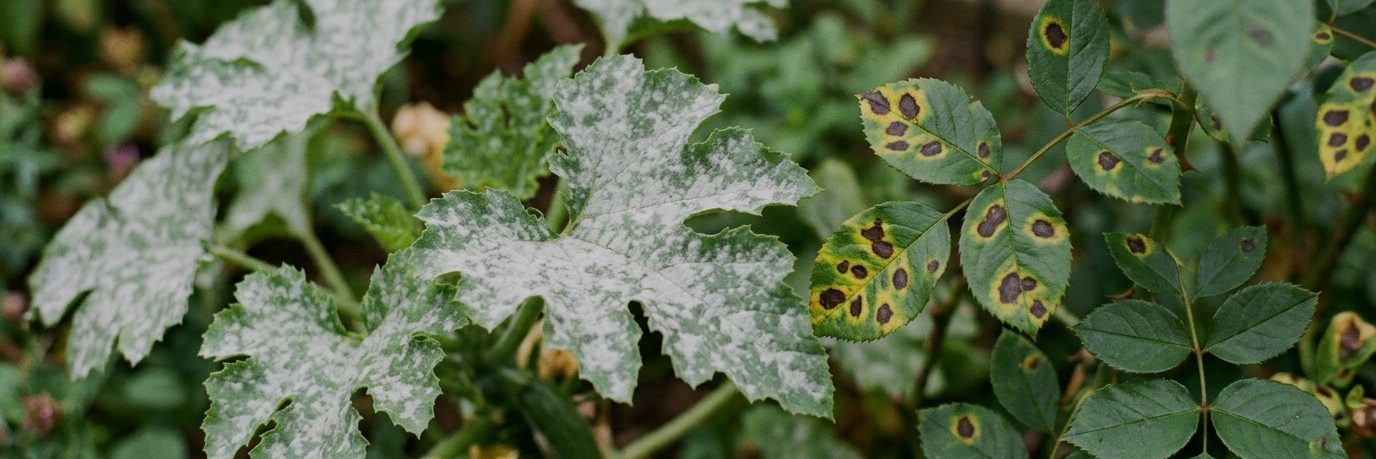
Garden Diseases: Recognising What Is Attacking Your Plants, and Acting Before the Spot Appears
Before choosing a treatment against a garden disease, you have to know which world you are dealing with, because the four major groups of parasites share neither their biology nor their weak points, and because a large share of what gets taken for a disease is not one. Late blight is not a fungus, a bacterial disease is not cured by a fungicide, a virus disease is not cured at all, and blossom end rot on tomato has no parasite behind it. What remains genuinely effective is decided before the spot appears: how long the foliage stays wet, the spacing, watering at the base, what becomes of the debris, and the choice of varieties whose resistance codes mean something precise.
A plant disease is treated first by diagnosis, and the diagnosis fits into three questions. The first: is it even a disease? A physiological disorder strikes every plant of the same age, the same exposure and the same management simultaneously, without ever advancing from one plant to its neighbour; blossom end rot on tomato, lime-induced chlorosis on calcareous soils, scorch and oedema all belong to that category, and no fungicide can do anything about any of them. The second: which group of parasites? True fungi have a chitin wall and an ergosterol membrane; the oomycetes, which cause late blight and every downy mildew, are stramenopiles with a cellulose wall, without chitin and without ergosterol as their principal sterol, so that active ingredients aimed at those two targets have literally nothing to attack in them. Bacteria make angular lesions stopped by the veins, with a water-soaked margin, that fungicides do not cure. Viruses are not treated: they are pulled out. The third question concerns the conditions: every disease has a measurable trigger, almost always a leaf wetness duration paired with a temperature range. Apple scab calls for about six hours of wet foliage in its favourable range, rose black spot for at least seven hours, late blight of potato for two consecutive days at a minimum of 10 °C with at least six hours of relative humidity greater than or equal to 90%, whereas the powdery mildews are the exception and germinate without free water. Everything else follows from that: the contact products approved for organic growing, copper and sulphur first among them, are surface protectants that have to be in place before infection and never rescue an established lesion, and copper is not innocuous since it accumulates in the soil, where the European Union caps its use at 28 kilograms per hectare over seven years. What really makes the difference over a season lies elsewhere: watering at the base rather than over the foliage, spacing and pruning to shorten the drying time, taking contaminated debris out of a compost heap that never gets hot enough, pruning Prunus in full growth rather than during dormancy, and choosing varieties whose resistance codes name a precise pathogen, in the knowledge that a resistance carried by a single gene is overcome in the end.
Before treating: is it even a disease?
The first question is not which product to spray, it is whether anything should be sprayed at all. Three families of causes produce symptoms on a leaf that look very much alike: the parasites, meaning fungi, oomycetes, bacteria and viruses; the non-parasitic disorders, that is, the accidents of management, of soil or of climate; and the animals, which sign their work differently and belong to another subject. A considerable share of the treatments applied in gardens is in fact aimed at the second family, against which no fungicide has ever been able to do anything.
The criterion that settles it fastest is not the colour of the spot, it is the distribution. A physiological disorder strikes all at once, simultaneously, on every plant sharing the same management: same variety, same age, same exposure, same watering. It does not advance from neighbour to neighbour and it rarely spares one isolated plant in the middle of the others. A disease, by contrast, starts from foci: a few leaves, one side of the plant, the row facing the prevailing wind, and then it spreads, and there is always a moment when the immediate neighbours are still clean. Two questions are usually enough: is it moving, and is it moving from one individual to another.
The costliest case in wasted treatments is blossom end rot on tomato, that brown, sunken, dry patch appearing at the end opposite the stalk. No parasite is involved: it is a physiological disorder, and it also affects pepper, eggplant and several cucurbits. The usual shortcut, there is a calcium shortage, is wrong in most gardens. The problem is not the amount of calcium present in the soil but its delivery to the growing fruit, and that delivery depends on the flow of water and above all on how steady it is. The published work on this disorder describes a disturbance of calcium homeostasis in the fruit associated with irregular watering, with a documented role for reactive oxygen species in how severe the symptoms become. In practice: adding calcium to a soil that already holds plenty changes nothing, a fungicide even less, and the useful move is to remove the abrupt swings between drought and watering, to mulch, and to accept that the fruit of one flush is lost while the ones that follow come back normal.
The second common confusion is lime-induced chlorosis. The young leaves turn yellow between the veins, which stay green, and the contrast is sharpest on the most recent shoots; hydrangea and many acid-loving shrubs give spectacular examples of it, and so do fruit trees. The detail that throws people is that soil analysis and leaf analysis alike often reveal iron in sufficient quantity: it is not the iron that is missing, it is the bicarbonate of calcareous soils that blocks its acquisition and its use by the plant. Adding iron in an unprotected form therefore means watching it precipitate in turn; what works is a chelate matched to the pH of the soil, an input of organic matter, and above all the choice of species that put up with lime, since the soil itself cannot be corrected.
That leaves three accidents regularly mistaken for diseases. Scorch, whether from the sun or following a spray, is found only on the exposed side: it spares the underside and the shade, which no fungus does. Oedema, those small corky blisters on the undersides of the leaves of container plants, comes from an excess of water taken up when evaporation is low, and it disappears when the watering regime changes. Herbicide drift, or a contaminated mulch, cups the leaves and fans out the veins on unrelated species at the same time, with a gradient pointing towards an edge or towards the place where the mulch was laid. None of the three spreads, and that is exactly what makes them recognisable.
| What you see | Most likely diagnosis | What gives the real cause away | What corrects it |
|---|---|---|---|
| Base of the fruit browned, sunken, dry and leathery, on tomato, pepper, eggplant or a cucurbit | Blossom end rot, a physiological disorder tied to the delivery of calcium within the fruit | Affects the fruit of one and the same flush of fruit set on plants that are otherwise healthy, with no sporulation at all and no spread from one plant to another | Even out the water supply, mulch, remove the jolts of drought followed by watering; neither a fungicide nor an addition of calcium to a soil that already holds plenty |
| Young leaves yellow with the veins still green, older leaves still normal | Lime-induced chlorosis | Soil and leaves often hold plenty of iron: it is the bicarbonate of the calcareous soil that blocks its acquisition, and the symptom is sharpest on the most recent shoots | Iron chelate matched to the pH of the soil, an input of organic matter, and in the longer run the choice of species that put up with lime |
| Bleached then papery patches on the exposed face of a fruit or a leaf | Sunscald, or scorch following a spray | Strictly on the exposed side, never on the underside or in the shade, appearing after a heat peak or a spray in full sun | Keep the foliage that shades the fruit, spray neither in the hot hours nor ahead of a heat spell, respect the temperature limits given for the product |
| Small corky blisters on the undersides of the leaves, mainly on container plants | Oedema, cells bursting from an excess of water taken up | Appears after a damp cool spell with low evaporation, with no lesion, no smell, and no spread from one plant to another | Space the waterings out, improve the light and the air movement; no treatment is of any use |
| Leaves cupped like spoons, veins fanned out, on several unrelated species at once | Herbicide drift, or contaminated mulch and compost | Strikes plants of different families simultaneously, with a gradient pointing towards an edge or towards the place where the mulch was laid | Identify the source before replanting, water heavily to dilute, and do not reuse the suspect batch of mulch or compost |
| Angular lesions stopped dead by the veins, margin translucent against the light, yellow halo, sometimes ooze | A bacterial disease, taken for a fungal one | The angular outline and the water-soaked margin: a fungal spot crosses the veins, turns round, and often shows small black points breaking the surface under a lens | Remove the affected parts, stop wetting the foliage, do not handle the crop while it is wet; a fungicide does not cure a bacterial disease |
Fungus, oomycete, bacterium, virus: four worlds, four sets of rules
The four groups of parasites responsible for plant diseases share neither their biology nor their weak points. The most widespread confusion in the garden concerns the first two, and it has very concrete consequences for what works.
Late blight is not caused by a fungus. The organisms behind it, the oomycetes, belong to the stramenopiles, a lineage that also includes the diatoms and the brown algae: they are closer to those than to a yeast or a button mushroom. This kinship is not a taxonomist’s affectation, it can be read in their envelope. The wall of a true fungus contains chitin and beta-1,3-glucan; that of an oomycete is made mainly of cellulose and beta-1,3-glucan, and contains virtually no chitin. Their membrane, for its part, does not have ergosterol as its principal sterol, whereas that is the rule in fungi.
The consequence is direct: an active ingredient aimed at chitin synthesis or at ergosterol synthesis simply has no target in an oomycete. That is why a product effective on powdery mildew can be completely useless on late blight or downy mildew, even though both lay a white coating on a leaf. Sulphur illustrates that divide well: it earns its keep against the powdery mildews, which are true fungi, and nobody counts on it against the downy mildews. This boundary also explains why product ranges almost always separate the two uses, and why buying on the strength of a white bloom rather than on a diagnosis leads straight to failure.
Vocabulary adds a share of confusion that varies with the language. English at least separates late blight, caused on potato and tomato by Phytophthora infestans, from the downy mildews in the strict sense, those of grapevine, lettuce, cucurbits, basil or onion, caused by different genera and strictly specialised on their host; French covers both with a single word, and the mistake follows the word. All of them are oomycetes, all of them need free water to release swimming spores, and it is that last point that matters to the gardener: without water persisting on the leaf, the infection does not start.
The bacteria form the third world, and it is recognised by the geometry of the lesions. A bacterium does not pierce the cuticle: it enters through a wound, through a stoma or through a pruning cut, and it needs water. Once inside the blade it spreads poorly across the veins, so the lesion takes on an angular outline, as though cut out by the network of veins. Its margin is water-soaked, translucent when the leaf is held up to the light, often underlined by a yellow halo, and the lesion may ooze. A fungal spot, by contrast, crosses the veins and turns round. A fungicide does not cure a bacterial disease; copper does act on the bacteria present on the surface, and only there.
The fourth world is that of the viruses, and it has no product facing it. No substance, approved for organic growing or not, cures a virus-infected plant. The symptoms are recognised by their irregularity: light and dark mosaics that respect no outline, mottling, concentric rings, thread-like or puckered leaves, one stunted plant in the middle of normal ones. Nothing sporulates, nothing wipes off, nothing spreads outwards across the leaf itself.
Two diagnostic moves are worth all the tables. The first calls for a ten times hand lens: on an established fungal spot you can often make out minute black points breaking the surface, the fruiting bodies that will produce the next generation of spores, and their presence settles the case in favour of a fungus. The second is rubbing: a fungal deposit comes away as dry dust or leaves a felted layer, whereas a dried bacterial ooze forms a shiny, translucent film that smears greasily.
Reading the signature: where the parasite grows, and how the lesion is bounded
Once the disorders are set aside, most common diseases are recognised by three clues: which surface the parasite grows on, whether or not the lesion crosses the veins, and which kind of tissue the attack starts on.
Powdery mildew grows on the outside. It is a true fungus that stays almost entirely on the surface, hence that white to greyish powdery felt present on both leaf surfaces, on the stems and sometimes on the flower buds, and wiping off on a fingertip to leave the leaf green underneath. The powdery mildews are highly specialised: the one on zucchini and cucumber is not the one on roses, and gooseberry and blackcurrant host one of their own, American gooseberry mildew, Podosphaera mors-uvae, which browns the young shoots and the fruit under a felt that turns brown in its turn.
Downy mildew, on the other hand, grows inside and only comes back out to sporulate. The down therefore appears on the underside, exactly opposite the spot visible on top, and only when the humidity allows it. On many crops the spot is yellow then brown and takes on an angular outline, because the mycelium struggles to advance across the major veins: on grapevine the early lesion is even described as an oil spot, translucent when seen against the light, before the underside becomes covered in a white down. On tomato and potato, Phytophthora infestans does something else: irregular brown patches with a greasy outline that gain ground within a few days, a whitish rim on the underside in damp weather, stems that brown, and a progression so fast that a plant healthy in the morning can be doomed two days later.
The rusts are recognised by their dust. They are obligate parasites: they feed only on living tissue and therefore never colonise dead debris. To get through the off season, some form resting spores that wait on the residues of the plant, while others pass through a second host unrelated to the first. The pustule breaks the epidermis and releases a coloured powder that marks the finger, orange to brown depending on the species and the stage. Pear trellis rust, Gymnosporangium sabinae, adds a detail that few guides explain properly: it needs two unrelated hosts, a juniper where it spends the off season in galls, and the pear where it produces its orange spots and then its lattice-like outgrowths on the underside. This is not an isolated case, it is the normal way many rusts work.
Apple scab, Venturia inaequalis, starts as velvety olive-green spots with poorly defined edges, which brown and then turn corky, distort the leaf and crack the skin of the fruit. Its starting inoculum is not on the tree: it is in the fallen leaves on the ground, where the fungus completes its cycle and produces the spores shot up at the young shoots as the buds break.
Grey mould, Botrytis cinerea, attacks differently: it starts on weakened tissue, a spent flower, a damaged fruit, a point of contact with damp soil, a pruning wound, and moves on to healthy tissue from there. Its grey felt smokes in a cloud of spores when disturbed, which no other common disease does. On strawberry, raspberry and grapevine it nearly always sets up where there is contact or a wound, and that is where it has to be stopped.
That leaves the ordinary leaf spots, the ones that all look alike and carry different names depending on the host: a brown ring with a pale centre, a yellow halo, small black points breaking the surface. The useful distinction is not their name but how they arrive, almost always by water splashing soil up onto the lower leaves, which explains why they climb from the bottom of the plant and why mulching slows them so effectively.
The triggering conditions, in figures: leaf wetness duration above all
This is where this guide diverges most from the usual advice pages. A fungal or oomycete disease is not triggered because it has rained, but because a precise combination of temperature and leaf wetness duration has been reached. That combination is known, quantified, and has been used for decades to drive agricultural warning services. The gardener can read it with a minimum and maximum thermometer and a hygrometer.
Apple scab is the historical model. The Mills table gives, for each temperature, the number of hours of continuous wetness needed for infection by the spores coming from the dead leaves: infection remains possible from about 6 to 25 °C, and the original table called for something on the order of nine hours of wet foliage in the most favourable range, around 16 to 24 °C, the requirement lengthening sharply as the temperature falls, to the point of exceeding a whole day near the lower limit. A revision published in 1989 shortened these durations by about three hours at every temperature: it is the revision that is the reference today, and it brings the requirement down to about six hours in the most favourable range. Two corollaries are worth knowing: the spores coming from lesions already present on the tree need about two thirds of the time required of the spores from the ground, and secondary infections occur about three hours earlier than primary ones. Put another way, a shower followed by rapid drying does not infect, and the first focus makes the tree more vulnerable to all the ones that follow.
For late blight on potato and tomato, the warning system in use in Great Britain, called the Hutton Criteria, is telling because it is simple: two consecutive days each with a minimum temperature of at least 10 °C and at least six hours of relative humidity greater than or equal to 90%. It replaced an older criterion, the Smith Period, which required eleven hours of high humidity per day; the duration was brought down to six hours to account for the ability of current populations of the pathogen to infect during shorter humid episodes. That detail says the essential thing: thresholds are living reference points, revised when the pathogen changes.
Grapevine downy mildew has its own field rule, known as the three tens: ten millimetres or so of rain in twenty-four hours, a temperature of at least 10 °C, and shoots that have reached ten centimetres or so. The more precise formulations use a daily mean of at least 11 °C over twenty-four hours, at least 10 millimetres of rain in one day or 13 millimetres over two to three days, and at least six hours of leaf wetness. That first infection counts double, since it then feeds every secondary cycle of the season.
Rose black spot, caused by Diplocarpon rosae, needs at least seven hours of continuous leaf wetness, with the fastest development around 24 °C, and the fruiting bodies that will produce the next generation form within a fortnight or so. Seven hours is exactly what an evening watering passed over the foliage supplies: the most emblematic disease of the rose is therefore, to a large extent, a disease of the badly held watering can.
Grey mould needs a very high relative humidity, on the order of 90% and above, or prolonged free water, in a range of about 15 to 25 °C with an optimum around 20 °C; beyond about 32 °C its growth stops.
The powdery mildews, finally, are the exception to all this logic, and that is what makes them so disconcerting. Their spores germinate without free water: air humidity between 40 and 100% is enough, and the typical microclimate of dense foliage, very humid at night and drier by day, suits them perfectly. Better still, free water harms them: beyond four hours of contact the spores are damaged, and rain is on the whole unfavourable to them. Infection occurs over a wide range, on the order of 15 to 32 °C, with an optimum around 20 to 25 °C, germination being inhibited beyond about 35 °C. It is therefore the only major garden disease that dry summers favour, and the only one against which wetting the foliage does not systematically turn against the gardener.
| Disease | Temperature | Humidity or wetness required | What that changes in practice |
|---|---|---|---|
| Apple scab (Venturia inaequalis) | Infection possible from about 6 to 25 °C, most favourable range around 16 to 24 °C | About six hours of continuous leaf wetness in the favourable range, according to the 1989 revision; the requirement exceeds a whole day near the lower limit | A shower followed by rapid drying does not infect; secondary infections start about three hours earlier than primary ones |
| Late blight of potato and tomato (Phytophthora infestans) | Minimum temperature of at least 10 °C over the day | At least six hours of relative humidity greater than or equal to 90%, on two consecutive days | A criterion you can watch with a minimum and maximum thermometer and a hygrometer; it announces the risk before the first symptom |
| Grapevine downy mildew (Plasmopara viticola) | At least 10 °C for the field rule, or a daily mean of at least 11 °C in the precise formulations | Ten millimetres or so of rain in twenty-four hours, or 13 millimetres over two to three days, with at least six hours of leaf wetness | The field rule known as the three tens, with shoots at least 10 cm long: it dates the infection that will feed every following cycle |
| Rose black spot (Diplocarpon rosae) | Fastest development around 24 °C | At least seven hours of continuous leaf wetness | An evening watering passed over the foliage supplies those seven hours on its own; watering at the base removes them |
| Grey mould (Botrytis cinerea) | About 15 to 25 °C, optimum around 20 °C, growth stopped beyond about 32 °C | Very high relative humidity, on the order of 90% and above, or prolonged free water | It enters through tissue that is spent, damaged or in contact with the soil: removing faded flowers and affected fruit takes away its doors |
| Powdery mildews (true fungi) | Infection from about 15 to 32 °C, optimum around 20 to 25 °C, germination inhibited beyond about 35 °C | No free water needed: 40 to 100% air humidity is enough, and more than four hours of free water damages the spores | The only major garden disease that rain holds back: the one case where wetting the foliage does not turn against the gardener |
From these figures comes the rule that governs everything else: the contact products approved for organic growing are surface protectants. They have to be in place on the leaf before the infection window, not after. Reading the conditions lets you anticipate; waiting for the spot only lets you record.
Copper: where “natural, therefore harmless” breaks down
Copper is the mainstay of the disease treatments approved in organic farming, and it is also the substance whose image is furthest from its actual behaviour. Three things have to be said together.
The first concerns the mode of action. Copper is a multisite protectant: it acts on the spores landing on the treated surface, before they penetrate the tissue. It is not systemic, it does not move within the plant, it does not redistribute onto a leaf that grows after the treatment, and it does not cure an established lesion. Once the parasite has entered the leaf, the wood or the bud, copper no longer reaches it. It is also washed off by rain and by irrigation. The whole logic of its use follows from those sentences: cover beforehand, renew after wash-off, and give up as soon as the tissue is already necrotic.
The second concerns accumulation. Copper is an element, it does not break down, and its mobility in the soil is low: repeated foliar applications end up accumulating in the surface horizon. That is precisely why the European Union renewed the approval of copper compounds in 2018 while listing them as candidates for substitution and capping their use at 28 kilograms of copper per hectare over seven years, that is, an average of 4 kilograms per hectare per year, with the explicit aim of limiting that accumulation. The approval has since been extended to mid-2029 for reasons of regulatory timetable, without the cap changing. For comparison, the doses commonly used in the twentieth century, before that cap, reached 20 to 30 kilograms per hectare per year.
The third concerns the non-target effects, and this is the part that natural gardening talk glosses over. Measurements made in vineyard soils report total copper contents ranging from about 23 to 566 milligrams per kilogram; yet the concentration at which half of earthworms actively avoid a soil has been estimated at 240 milligrams per kilogram of total copper, with a confidence interval of 193 to 341. In other words, the most heavily loaded soils exceed the threshold at which the earthworm leaves. Controlled application work finds the same direction: earthworm biomass reduced by about 15% after applying 200 kilograms of copper per hectare per year, microbial activity down by about 30% beyond 400 kilograms, and reproduction of springtails and enchytraeids halved at higher doses still. These experimental doses bear no relation to garden use; what they establish is the direction of the effect and the fact that it exists. To which is added a hazard classification for the aquatic environment which, in practice, rules out rinsing a sprayer anywhere near a watercourse, a ditch or a storm drain.
Sulphur, the other historical mainstay, has limits of its own. It concerns only the true fungi, powdery mildews first among them, and leaves the oomycetes indifferent. It scorches foliage when the temperature goes beyond about 32 °C, and labels advise against treating if that threshold is likely to be reached in the following days. Above all, it does not combine with oils: professional recommendations call for at least fourteen days between an oil application and a sulphur application, because the combination of the two residues traps heat and drives both products into the leaf tissue, with severe damage as a result. Sulphur is likewise incompatible with insecticidal soaps.
Potassium bicarbonate is the third common material. It is an active substance approved in the European Union as a fungicide, notably on pome fruit, stone fruit, grapevine, strawberry and cucurbits, and the published trials find it comparable in effectiveness to sulphur against the powdery mildews, without the phytotoxicity that sulphur causes on some sensitive crops. That is where the difference lies between the commercial product and the kitchen recipe: the first carries a validated use concentration and a phytotoxicity reference point, the second has neither. This rule holds for the whole of this chapter. No dose is invented: a dilution that appears neither on a label nor in a verifiable source offers no scorch reference point, no pre-harvest interval, and no guarantee about what it affects besides its target. And because registration rules differ from one country to another, a substance perfectly permitted somewhere may be banned elsewhere: what is on the shelf says nothing about what is legal where the reader gardens.
What cannot be cured: the virus diseases and the pathogens settled in the soil
There are two categories of disease where the question of treatment does not arise, and where carrying on looking for a product costs you the season.
The first is the virus diseases. No product cures a virus-infected plant, conventional, organic or homemade. The virus is replicated by the plant’s own cells; there is no target to hit that is not the plant. The only answer is to pull out the affected plant early, before it serves as a reservoir, and to refuse categorically to take a cutting, an offset or a seed from it. The move has a name in production, roguing, and there is nothing excessive about it: a virus-infected plant will never become healthy again.
Transmission deserves two clarifications. Sap-sucking insects are the main vector; that point belongs to pest management and is settled by keeping the insect from landing, not by treating it, because the so-called non-persistent viruses are acquired and inoculated within seconds. The other route, the one that depends entirely on the gardener, is mechanical: the hands, the secateurs, the tie on a stake. Some viruses, the tobamoviruses including tobacco mosaic virus, are remarkably stable and are transmitted by simple sap contact. The experimental data on tool disinfection are clear and surprising: a 20% solution of dried skim milk powder with a wetting agent added, or household bleach diluted one part in ten, completely eliminated transmission in the trials, whereas trisodium phosphate, long recommended, prevented infection in only a minority of cases. Bleach has the drawback of attacking tools. The point to hold on to: running a blade under water or wiping it on a rag disinfects nothing, and pruning ten tomato plants one after another with the same untreated secateurs is a route of contamination in its own right.
The second category is the pathogens that settle in the soil for a very long time. They are no more treatable, and their particularity is that rotation, the usual answer, no longer has much to offer against them. White rot of onion and garlic, caused by Stromatinia cepivora, produces sclerotia whose survival is reported at twenty to forty years depending on the source, and a single sclerotium in ten kilograms of soil is enough to cause the disease: a contaminated plot stays contaminated for decades. Verticillium wilt, caused by Verticillium dahliae, persists for ten to fifteen years as melanised microsclerotia and counts several hundred host species, herbaceous and woody alike, which makes any succession of crops ineffective. Clubroot, Plasmodiophora brassicae, has resting spores with a half-life on the order of four years and a survival of up to some twenty years depending on conditions. The vascular Fusarium wilts form chlamydospores that hold on for up to ten years or so.
The practical conclusion is austere but clear. Against these pathogens the only genuinely powerful lever is never to introduce them: do not bring soil back from an unknown plot, clean tools and boot soles between two gardens, be wary of plants, bulbs, cloves and rooted stock of uncertain origin, and turn down gifts of plants from a garden where the symptom has been seen. After that come the resistant varieties, grafting onto a resistant rootstock for the solanaceous crops, and the choice of non-host species.
Rotation: its real length depends on the pathogen, not on a three-year rule
Rotation is the most universally given and the most rarely quantified piece of advice. Its useful length is not decided in advance: it depends on the form in which the pathogen waits, on how long that form lives, and on how wide its host range is.
| Pathogen | Resting form and reported survival | Host range | What rotation changes |
|---|---|---|---|
| White rot of onion and garlic (Stromatinia cepivora) | Sclerotia, twenty to forty years depending on the source; a single sclerotium in ten kilograms of soil is enough to trigger the disease | Strictly the Allium species | Almost nothing: a contaminated plot stays contaminated for decades. Everything turns on never introducing it, through soil on tools, on boot soles, on transplants or on cloves |
| Clubroot (Plasmodiophora brassicae) | Resting spores, half-life on the order of four years, survival of up to some twenty years reported | The brassicas, cultivated and wild | A great deal, provided it is counted in years: three years is a floor, four to five are better, and the weed brassicas have to be pulled |
| Verticillium wilt (Verticillium dahliae) | Melanised microsclerotia, ten to fifteen years | Several hundred species, herbaceous and woody | Little: the host range is too wide. You play on resistant varieties, on grafting and on non-host species |
| Vascular Fusarium wilt (Fusarium oxysporum) | Chlamydospores, up to ten years or so | Each forma specialis affects one species or nearly so | A real but slow effect; varietal resistance, coded in the catalogues, does far more |
| Sclerotinia white mould (Sclerotinia sclerotiorum) | Sclerotia, commonly three to five years, longer in cool dry soil; viability drops sharply within the first year when they are buried | Very wide, from lettuces to beans | A clear effect if you add burying the debris and removing the affected plants before the sclerotia form |
| Apple scab (Venturia inaequalis) | Fruiting bodies in the fallen leaves, over a single off season | Apple and closely related species | No sense at all on a tree already in place: what decides the following season is the fate of the fallen leaves, gathered, shredded or buried |
| Late blight of potato (Phytophthora infestans) | Only persists in the soil where both mating types coexist and form oospores; elsewhere it starts again from stored tubers, from volunteers and from waste heaps | Solanaceous crops | Nothing on its own: the inoculum arrives through the air and in the tubers. Removing volunteers and tuber heaps does more than changing beds |
Three lessons come out of that reading. The first is that a short rotation, of two or three years, is only enough for the pathogens whose resting form runs out quickly. For clubroot, three years is a floor, four to five are better, and the wild brassicas have to be counted as hosts: a perfectly rotated bed overrun with charlock or shepherd’s purse goes on maintaining the pathogen.
The second is that rotation is counted in botanical families, never in vegetables. Tomato, potato, eggplant and pepper are the same family and share part of their diseases. Beetroot and chard are the same species. Cabbage, turnip, radish, arugula and mustard share clubroot. Moving tomatoes to where the potatoes were is not a rotation.
The third is the most important, and it is often left unsaid: rotation has no effect at all on the diseases whose inoculum arrives through the air each season. The rusts, the powdery mildews, the scab of a tree already in place and the downy mildews of annual crops are not settled by changing beds, because nothing was waiting in that bed. Late blight on potato is the textbook example: it only survives in the soil where both mating types coexist and produce oospores, which is not the case everywhere; elsewhere it starts again from stored tubers, from volunteers grown from forgotten tubers and from tuber waste heaps, which form the bridge from one season to the next. Destroying those three sources does more than any rotation.
Conversely, rotation remains very profitable against the leaf spots and the rots whose starting inoculum is local, in the debris of the previous crop. On those diseases, removing the debris at the end of the crop and changing beds genuinely transforms the starting point of the following season.
The prevention that has been measured: water, spacing, debris, pruning
Since almost everything turns on how long a leaf stays wet, the moves that shorten that time are the most profitable in the garden. Some of them have been quantified.
Watering at the base rather than over the foliage comes first, and the measured gap is considerable. In an onion trial run in the open field, foliar disease severity was 170% higher and bulb rot incidence 186% higher under overhead sprinkler irrigation than under drip; the leaf wetness duration measured under the canopy was on average 36% longer under sprinkler. On spinach, switching to drip divided the progress of downy mildew by four to five. So this is not an aesthetic preference: it is the most powerful lever available to the gardener, and it costs nothing. If overhead watering cannot be avoided, it goes on early in the day, never late, so that the foliage dries before nightfall and the six to seven hours of night-time wetness are not handed over free of charge.
Spacing and thinning cuts work through the same mechanism, and it is worth naming that mechanism properly: it is not the air that cures, it is the drying time that gets shorter. Dense foliage holds the dew several hours longer than open foliage, which decides whether or not a given disease crosses its wetness threshold. On roses, grapevine, currants and tomatoes, removing the shoots that cross and stripping leaves from the fruiting zone is worth more than one more spray. On seedlings, sowing thinner and thinning without delay is the same measure under another name.
Mulching works on another route, splash. The ordinary leaf spots and several rots start when rain or watering throws particles of contaminated soil onto the lower leaves: that is why these diseases climb from the bottom of the plant. A layer of mulch puts a barrier between the soil and the foliage, and it also isolates fruit lying on the ground, which counts particularly for strawberries.
What becomes of the debris decides the starting inoculum. Under a scabbed apple tree, it is the fallen leaves that carry the cycle through to bud break: gathering them, shredding them finely or burying them changes the starting level of the following season far more than any late treatment. For compost, the point to know is a temperature: destroying pathogens and seeds calls for holding at least 55 °C for at least three days, with turning so that the whole volume passes through the hot core of the heap. A garden compost heap, fed as material comes to hand and never turned, practically never reaches those conditions throughout its volume. Heavily contaminated debris, blighted foliage, virus-infected plants, bulbs affected by white rot, therefore leaves the composting circuit.
Disinfecting tools makes sense at two precise moments: when cutting into diseased tissue, and when moving from plant to plant on a crop susceptible to viruses. The rest of the time it is mostly a habit of good order.
The pruning date, finally, is a plant health measure in its own right on Prunus, plums and cherries in particular. Two serious diseases enter through the pruning wounds: silver leaf, caused by the fungus Chondrostereum purpureum, and bacterial canker due to Pseudomonas syringae. The spores of the first are released mainly during the cool wet season, and both pathogens are at their most active then. These trees are therefore pruned in full growth, when the tree is in leaf and growing actively, and not during dormancy, contrary to what is done on an apple tree. It is probably the most profitable calendar decision in the whole orchard.
A word on removing the alternate host, often recommended without qualification. For pear trellis rust, whose obligate host is the juniper, pulling out the neighbour’s juniper almost never settles anything: the basidiospores released by the galls on the juniper are carried by the wind over distances on the order of several kilometres, with estimates running from three to six kilometres and, in some reports, well beyond. Removing a juniper in your own garden reduces a nearby source, which makes sense; hoping to close the cycle at neighbourhood scale does not.
Resistant varieties: what the codes really say, and what they do not
Varietal resistance is the most effective lever in the repertoire, provided you know how to read what is printed on the packet, and know what the word resistant does not promise.
Two levels are standardised by the seed sector, and the abbreviations are the same in every language. High resistance, written HR, describes a variety that strongly limits the development of the parasite or the damage it causes, compared with a susceptible variety and under normal pressure; it may nonetheless show symptoms under heavy pressure, and it is not immunity. Intermediate resistance, written IR, limits the development of the parasite or the damage to a moderate degree: the variety shows more symptoms than an HR one, but clearly fewer than a susceptible variety. A variety described as tolerant, a term that is not standardised, tells you nothing verifiable.
The codes that follow name a precise parasite, and often a precise race of that parasite. On tomato, Fol stands for vascular Fusarium wilt, Fusarium oxysporum forma specialis lycopersici, and the figures accompanying it refer to the races against which the resistance is established: a variety resistant to race 0 is not resistant to race 2. Va and Vd distinguish the two Verticillium species, albo-atrum and dahliae. ToMV stands for tomato mosaic virus. These codes are not decorative: they tell you exactly what the variety has been challenged to withstand, and nothing else. A tomato carrying Fol and Va is no more resistant to late blight than any other.
The point the catalogues do not make is this: a resistance carried by a single gene is generally overcome in the end. The best documented history is that of apple scab. The resistance gene Rvi6, long called Vf, comes from an ornamental apple, Malus floribunda 821, and has been introduced into many varieties described as scab-resistant. A pathotype that appeared in Europe, later designated race 6, causes symptoms on varieties relying on this resistance, 'Prima' for instance, while the original donor remained clean; a race 7, virulent on Malus floribunda 821 itself, has also been described, and isolates able to overcome this resistance have since been reported in North America. A variety sold as scab-resistant is therefore only resistant to the populations that have not yet overcome its gene.
Hence the superiority of multiple resistances. The potato 'Sarpo Mira' held its field resistance to late blight for several years, and the genetic analysis shows why: it combines four stacked qualitative resistance genes and a quantitative resistance, which forces the pathogen to break through several locks at once. On tomato, the recent varieties bred for blight resistance give an honest idea of what resistant means: in trials where the controls were 100% infected, 'Crimson Crush' showed something on the order of 10% infection, and went on cropping where older varieties collapsed. That is not immunity, it is a shift in the threshold, and that shift is usually enough to save a harvest.
The conclusion fits in one sentence: a resistant variety excuses you from none of the previous moves, it simply makes them far more effective. It moves the moment when the disease becomes a problem, which leaves the time to harvest.
Common pitfalls to avoid
MistakeTreating with copper, sulphur or bicarbonate a symptom with no parasite behind it, such as blossom end rot on tomato or lime-induced chlorosis.
Why :These are physiological disorders. Blossom end rot comes down to the delivery of calcium to the fruit, disturbed by an irregular water supply, and not to an attack nor, in most gardens, to a soil short of calcium. Lime-induced chlorosis comes from the bicarbonate that blocks iron acquisition, while the soil and the plant often hold enough of it. No fungicidal substance has any purchase on either, and the time spent treating is time lost during which the real cause goes on working.
Do this instead :Settle it on the distribution first: a disorder strikes every plant of the same age and the same management simultaneously and uniformly, without advancing from one plant to its neighbour. For blossom end rot, even out the watering, mulch, remove the swings between drought and excess, and accept the loss of the fruit already committed. For chlorosis, an iron chelate matched to the pH, organic matter, and in the longer run the choice of species that put up with lime.
MistakeWaiting for the spots to appear before getting the sprayer out, then concluding that natural treatment does not work.
Why :Copper, sulphur and the bicarbonates are surface protectants. They act on the spores landing on the film they form, before penetration. They are not systemic, they do not move within the plant, they do not cover tissue that appears after the treatment, and they no longer reach a parasite already established under the cuticle. On a necrotic lesion, the best they can do is protect the tissue that is still healthy.
Do this instead :Work from the conditions rather than from the symptoms, since the conditions are quantified: about six hours of continuous wetness in the favourable range for apple scab, at least seven hours for rose black spot, two consecutive days at a minimum of 10 °C with at least six hours of relative humidity greater than or equal to 90% for late blight of potato. A minimum and maximum thermometer and a hygrometer are enough to see the window coming. And renew after washing rain, since the deposit leaves with the water.
MistakeWatering with a hose or a can over the foliage, and doing it late in the day because it is cooler then.
Why :That means handing over free of charge the one variable most infections depend on. In an onion trial, sprinkler irrigation gave foliar disease severity 170% higher and bulb rot incidence 186% higher than drip, with leaf wetness duration under the canopy 36% longer. On spinach, switching to drip divided the progress of downy mildew by four to five. Evening makes everything worse: the foliage no longer dries before nightfall and effortlessly accumulates the six to seven hours that trigger black spot, scab or botrytis.
Do this instead :Water at the base, from the spout or by drip, aiming at the soil and not at the plant. When overhead watering cannot be avoided, put it early in the day so that the foliage is dry before nightfall. Add a mulch, which at the same time cuts off the splashing of contaminated soil onto the lower leaves, and avoid handling or harvesting a crop that is still wet, particularly where a bacterial disease is present.
MistakePruning plums and cherries during dormancy, at the same time as the apples and the pears.
Why :Two serious diseases of Prunus enter exclusively through the wounds: silver leaf, caused by Chondrostereum purpureum, and bacterial canker due to Pseudomonas syringae. The spores of the first are released mainly during the cool wet season, precisely the one in which the tree is dormant, and both pathogens are then at their most active while the wound, for its part, heals most slowly. The move that puts an apple tree in good order therefore puts a plum tree in danger.
Do this instead :Prune Prunus in full growth, when the tree is in leaf and growing actively, so that the wound closes quickly in a warm dry period. Limit the number and the diameter of the cuts, take the affected wood away and destroy it rather than leaving it on the ground or shredding it into mulch, and disinfect the blade when moving from one tree to another if a symptom has been seen.
MistakeMoving from plant to plant with the same secateurs and merely wiping them, or relying on a rinse in clean water, when pruning or deleafing a crop susceptible to viruses.
Why :Some viruses, in particular the tobamoviruses including tobacco mosaic virus, are remarkably stable and are transmitted by simple sap contact, with no insect at all. A rag or clean water does not inactivate them. And no product cures a virus-infected plant: the contamination created by a tool is permanent for every plant concerned, and comes to light weeks later, when the whole row is affected.
Do this instead :Stick to the treatments whose effectiveness has been measured: a 20% solution of dried skim milk powder with a wetting agent added, or household bleach diluted one part in ten, completely eliminated transmission in the trials, whereas trisodium phosphate, long recommended, prevented infection in only a minority of cases. Bleach attacks tools, which argues for the milk solution on equipment worth looking after. Pull out virus-infected plants before the pruning session rather than after, never take a cutting or a seed from them, and wash your hands between a doubtful plant and a healthy one.
The care sheets to read next
Every plant mentioned has its full sheet: watering, light, soil, pests and a month-by-month calendar.
Tomato
Solanum lycopersicum
The tomato (Solanum lycopersicum) is the queen of the vegetable garden, but it is a plant of sun and warmth that plays…
Potato
Solanum tuberosum
The potato (Solanum tuberosum) is one of the most rewarding crops in the vegetable garden: easy, productive and…
Eggplant
Solanum melongena
The eggplant (Solanum melongena) is the most cold-sensitive and the most heat-hungry of the garden nightshades, even…
Bell pepper
Capsicum annuum
The bell pepper (Capsicum annuum) is an annual fruiting vegetable and a genuinely cold-shy one, the sweet cousin of the…
Zucchini
Cucurbita pepo
The zucchini (Cucurbita pepo) is the easy summer vegetable par excellence, one plant yields more than a family can eat.…
Cucumber
Cucumis sativus
The cucumber (Cucumis sativus) is an annual vegetable from the warm regions of the southern Himalayas, and it shows: it…
Pumpkin
Cucurbita maxima
The pumpkin (Cucurbita maxima) is a large, sprawling, hungry and frost-tender squash that came from the Andes. It is a…
Lettuce
Lactuca sativa
Lettuce (Lactuca sativa) is the most widely grown salad in the vegetable garden, easy and quick, harvested six to ten…
Spinach
Spinacia oleracea
Spinach (Spinacia oleracea) is a cool-season leaf vegetable, hardy and in a hurry to live. Coolness suits it very well:…
Onion
Allium cepa
The onion (Allium cepa) is a hardy, no-fuss bulb vegetable, one of the easiest crops to succeed with in a vegetable…
Garlic
Allium sativum
Garlic (Allium sativum) is one of the easiest vegetables in a kitchen garden, provided you grasp two things. You don’t…
Shallot
Allium ascalonicum
The shallot (Allium ascalonicum) is a classic of the vegetable garden, a cousin of the onion but with a finer, milder…
Leek
Allium porrum
The leek (Allium porrum) is the winter vegetable par excellence. Very hardy, it stands in the ground all winter and is…
Curly kale
Brassica oleracea var. sabellica
Curly kale (Brassica oleracea var. sabellica), also known simply as kale, is a leafy vegetable of uncommon hardiness.…
Cauliflower
Brassica oleracea var. botrytis
Cauliflower (Brassica oleracea var. botrytis) is a demanding vegetable that thrives in a cool, damp climate but never…
Turnip
Brassica rapa
The turnip (Brassica rapa) is a hardy, fast-growing root, one of the easiest crops in the vegetable garden. Count on 6…
Radish
Raphanus sativus
The radish (Raphanus sativus) is the fastest vegetable in the garden, ready to bite into in three to five weeks. It is…
Carrot
Daucus carota
The carrot (Daucus carota) is a staple root vegetable in the vegetable garden, keeping all winter and sown directly in…
Bean
Phaseolus vulgaris
The green bean (Phaseolus vulgaris) is one of the easiest vegetables in the kitchen garden, provided you respect one…
Broad bean
Vicia faba
The broad bean (Vicia faba) is one of the very first vegetables of the year, a rustic, sturdy legume that goes into the…
Strawberry
Fragaria x ananassa
The strawberry (Fragaria x ananassa) is a hardy perennial that fits very well into any vegetable garden. Hardy to…
Raspberry
Rubus idaeus
The raspberry (Rubus idaeus) is a small fruiting shrub, hardy down to -25 °C, that grows wild in the cool woodland of…
Redcurrant
Ribes rubrum
The redcurrant (Ribes rubrum) is a small bushy fruit shrub that produces those pretty clusters of translucent red…
Blackcurrant
Ribes nigrum
The blackcurrant (Ribes nigrum) is a small hardy fruit shrub that is genuinely happy in a cool climate, down to USDA…
Grapevine
Vitis vinifera
The grapevine (Vitis vinifera) is a vigorous climber that produces table grapes, grown since antiquity around the…
Apple tree
Malus domestica
The apple tree (Malus domestica) is the king of fruit trees in temperate climates, the one that has filled family…
Pear tree
Pyrus communis
The pear tree (Pyrus communis) is the apple tree’s cousin, a fruit tree for the family orchard that gives melting fruit…
Plum tree
Prunus domestica
The plum tree (Prunus domestica) is the classic family fruit tree, the one you find at the back of the garden or along…
Cherry tree
Prunus avium
The cherry tree (Prunus avium) is a vigorous, hardy fruit tree, perfectly at ease in a temperate climate, from USDA…
Rose
Rosa
The rose (Rosa) is a hardy flowering shrub that overwinters outdoors without trouble, down to about -20 °C for most…
Hydrangea
Hydrangea macrophylla
The hydrangea (Hydrangea macrophylla) is the flowering shrub for cool, partly shaded gardens, and one of the very few…
Basil
Ocimum basilicum
Basil (Ocimum basilicum) is an annual, cold-sensitive herb that comes from the warm regions of Asia. It is a summer…
Frequently asked questions
How do you tell downy mildew from powdery mildew, and why does the same product not work on both?
Both lay something white on a leaf, but everything else differs. Powdery mildew is a true fungus that stays on the surface: the powdery felt is present on both leaf surfaces, it wipes off on a fingertip, and the leaf underneath is still green at the start. Downy mildew is an oomycete that lives inside the blade and only comes back out to sporulate: the down appears on the underside, exactly opposite the spot visible on top, and the spot itself often takes on an angular outline because the veins slow its advance. The conditions separate them just as sharply: downy mildew demands free water and very high humidity, whereas powdery mildew germinates without free water, between 40 and 100% air humidity, and is actually damaged by more than four hours of free water. As for the product, the reason is biochemical: the wall of an oomycete is made of cellulose and beta-1,3-glucan, with no chitin, and its membrane does not have ergosterol as its principal sterol. An active ingredient aimed at chitin synthesis or at ergosterol synthesis therefore has no target in it. That is why sulphur earns its keep against the powdery mildews and not against the downy mildews or late blight, and why buying on the strength of a white bloom rather than on a diagnosis means treating thin air.
Can diseased leaves and plants go on the compost heap?
It depends entirely on the temperature the heap reaches, and on how evenly. Destroying pathogens and seeds calls for holding at least 55 °C for at least three days, with turning so that the whole volume passes through the hot core of the heap: a garden composter fed as material comes to hand and never turned practically never manages that throughout its contents, and the edges stay cold even when the centre heats up. Three categories therefore leave the circuit without hesitation: foliage affected by late blight or downy mildew, virus-infected plants, which no treatment will ever get the better of, and anything carrying very long-lived resting structures, bulbs affected by white rot, clubbed brassica roots, stems holding sclerotia. Conversely, leaves carrying ordinary leaf spots or powdery mildew compost without much risk in an active heap, because those parasites do not survive long away from living tissue. When in doubt, the simple rule is to take the debris out of the garden rather than bet on a heap whose temperature you do not measure.
Is Bordeaux mixture harmless because it is approved in organic farming?
No, and this is where the natural, therefore risk-free shortcut breaks down most clearly. Copper is an element: it does not break down, its mobility in the soil is low, and repeated foliar applications accumulate it in the surface horizon. That is exactly why the European Union renewed the approval of copper compounds while listing them as candidates for substitution and capping their use at 28 kilograms per hectare over seven years, that is, 4 kilograms per hectare per year on average. The effects on soil life are documented: vineyard soils show total copper contents running to several hundred milligrams per kilogram, whereas the concentration at which half of earthworms actively avoid a soil has been estimated at around 240 milligrams per kilogram. To which is added a hazard classification for the aquatic environment, which rules out rinsing equipment near a watercourse or a storm drain. Finally, copper is a surface protectant: it does not move within the plant, does not protect the tissue that appears after the treatment, leaves with the wash-off and cures no established lesion. It is therefore kept for identified windows of risk, at the dose printed on the label, and never applied routinely for peace of mind. Since registration rules vary from one country to another, it is worth checking what is permitted where you garden.
My tomatoes are going black at the bottom: is it late blight?
Almost never. A brown, sunken, dry and leathery area located opposite the stalk, that is, at the point where the flower was attached, is blossom end rot: a physiological disorder, with no parasite at all. It is recognised by three things: it is always at that precise point on the fruit, it does not sporulate, and it strikes the fruit of a single flush of fruit set simultaneously, on plants whose foliage stays healthy. Its cause is not, in most gardens, a soil short of calcium but the delivery of calcium to the growing fruit, which depends on the flow of water and above all on how steady it is. Late blight, for its part, produces large brown patches with a greasy outline that appear first on the leaves and the stems, mottle the fruit anywhere on its surface rather than specifically at its base, and move from plant to plant within a few days. Against blossom end rot a fungicide is of no use, and neither is adding calcium to a soil that already holds plenty: what works is removing the swings between drought and heavy watering, mulching, and accepting that the fruit already marked is lost while the ones that follow come back normal.
Do you have to pull out the neighbour’s juniper to save a pear tree with pear trellis rust?
The reasoning is sound, the practical conclusion is not. Pear trellis rust, Gymnosporangium sabinae, does indeed need two unrelated hosts to complete its cycle: it spends the off season in galls on a juniper, from which the spores set off to infect the pear, which then returns the favour to the juniper. No juniper, no cycle. The problem is the distance: the spores released by the galls are carried by the wind over distances on the order of several kilometres, with figures of three to six kilometres commonly quoted and, in some reports, a good deal more. Removing the junipers in your own garden reduces a close and intense source, which makes sense and is worth doing; hoping to break the cycle at the scale of a neighbourhood makes none, and souring relations with the neighbours over it is a poor bargain. The rest of the work is done on the tree: gather and destroy the affected leaves rather than leave them at the foot, cut out the affected shoots, open the crown to shorten the drying time, and remember that a vigorous pear tree carries a moderate rust without any notable loss of crop.
Can a plant with a virus disease recover?
No. No product cures a virus-infected plant, conventional, organic or homemade, and that is not for want of research: the virus is replicated by the plant’s own cells, and there is no target to hit that is not the plant. The symptom is recognised by its irregularity and its distribution: light and dark mosaics respecting no outline, mottling, concentric rings, puckered or thread-like leaves, one stunted plant in the middle of normal ones, with not the slightest felt or pustule. The only answer is to pull out the affected plant early, before it serves as a reservoir, and to refuse to take a cutting, an offset or a seed from it. Two precautions go with that move. Transmission by sap-sucking insects belongs to pest management and is not settled by a treatment, since non-persistent viruses are acquired and inoculated within seconds. Mechanical transmission, on the other hand, depends entirely on the gardener: some viruses are transmitted by simple sap contact on a tool, and the trials show that a 20% solution of dried skim milk powder with a wetting agent, or household bleach diluted one part in ten, completely eliminate that transmission, where trisodium phosphate, long recommended, prevents it in only a minority of cases.
Green Hub looks after your plants
Photograph a plant: Green Hub identifies it and writes its care sheet, with no account. Sign in afterwards to keep its dated photos and history over time.
Identify a plantUpdated on
How this sheet is written
Written for Green Hub with the help of language models, then reviewed. It offers gardening guidance, not professional advice: if you are unsure whether a plant is toxic to a child or an animal, ask a vet, a doctor or your national poison centre.