Holly
Ilex aquifolium
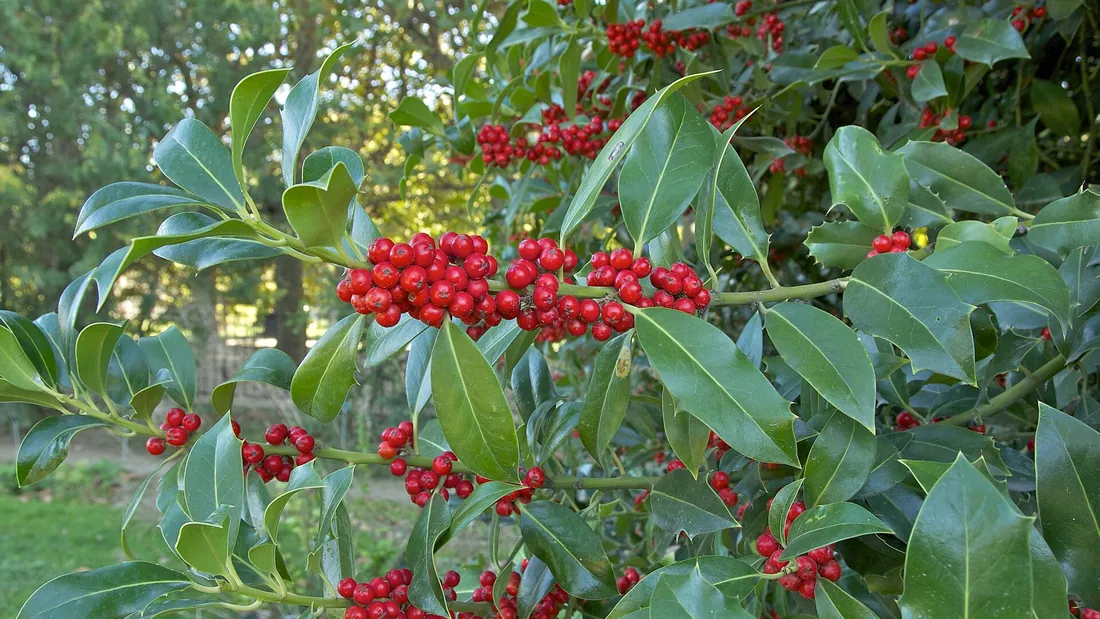

Holly (Ilex aquifolium) is an evergreen shrub with glossy, spiny leaves and bright red berries that light up in the depths of winter, which is what made it the classic Christmas plant. It grows wild in woods and hedgerows right across western Europe. It is dioecious: there are male plants and female plants, and only the females bear berries, and only if a male grows somewhere nearby to provide pollination.
Light and exposure
Holly copes with almost any exposure, from full sun to fairly deep shade. It is one of the few shrubs that thrives under the canopy of taller trees or against a wall that never gets direct sun, which makes it a real asset for the awkward corners of the garden.
That said, a female plant fruits more heavily if it gets at least a few hours of direct sun each day. In full shade it stays vigorous and green all year but produces fewer berries. For a mixed hedge or a specimen grown for cutting decorative branches, choose a spot in part shade to full sun instead.
Watering
Once established, holly copes very well with drought thanks to its deep roots and tough leaves that limit water loss. Well-rooted mature plants manage perfectly well on rainfall alone, even through dry summers.
The first two years after planting are the ones that matter: water regularly while the roots settle in, especially if you planted a container-grown shrub rather than a bare-root one. A mulch at the base keeps the soil cool underneath and cuts down on how often you need to water.
Soil and repotting
Holly prefers soil that stays moist, drains well and leans acidic to neutral, much like the woodland floor it grows in naturally. Working in some leaf mould or well-rotted compost at planting time gives it a good start, especially in heavy clay ground.
Once established it tolerates poor, stony soil too, but hates sitting in waterlogged ground. On a plot that holds winter wet, plant it slightly raised or improve drainage with grit and coarse sand.
Temperature and humidity
Holly is fully hardy across almost the whole temperate range. Its evergreen leaves shrug off frosts down to minus fifteen or even minus twenty degrees once the plant is well rooted.
Only young shrubs planted the previous autumn can suffer leaf scorch in a very windy winter, cold wind dries out the leaves faster than frozen roots can replace the moisture. A spot with a little shelter from the prevailing wind is enough to avoid this in the first couple of years.
Pruning and upkeep
Holly grows slowly, which makes it an easy shrub to shape and maintain: one prune a year is plenty. Do it in late summer, once that year's growth has finished, and never in early spring if you want to keep the berries that will form for winter.
Well managed, holly makes a formidably impenetrable defensive hedge thanks to its spiny leaves, a classic country choice for marking a boundary without fencing. Wear thick gloves to prune it, the leaves really do prick, and an overgrown plant takes hard renovation pruning very well if it needs cutting back.
Pests and diseases
The main enemy of holly is the holly leaf miner, Phytomyza ilicis, a small fly whose larva mines yellowish, blistered tunnels through the thickness of the leaves. The damage is mostly cosmetic and does not seriously weaken a mature shrub, but you can strip out the worst affected leaves in autumn to reduce next year's population.
Scale insects sometimes settle on the stems and the undersides of the leaves, leaving a sticky honeydew that encourages sooty mould. On permanently waterlogged soil, phytophthora can rot the roots, one more reason to get the drainage right at planting. Beyond those three, holly remains a very tough shrub that disease rarely troubles.
Propagation
Semi-ripe cuttings, taken in late summer from that year’s growth once it has firmed up, are by far the most reliable method. It is also the only way to reproduce a plant whose sex you already know, essential if you want to plant a male and female pair with certainty.
Sowing works too but takes patience: the seeds, protected by a very hard coat, often take two years to germinate even after cold stratification, and seedlings only reveal their sex once they flower, years later. For a garden where you want berries sooner rather than later, buying or taking cuttings from plants of known sex is the better route.
Toxicity
TOXIC. The red berries contain saponins and other irritant compounds that cause digestive upset (nausea, vomiting, diarrhoea) if eaten. They are especially dangerous for young children, who are drawn in by the bright colour around Christmas time. The leaves naturally discourage eating thanks to their spines, but they too are mildly toxic. Keep children and pets away from any berries that have fallen to the ground.
Climate and hardiness
Where and in which climate it thrives
Holly is a shrub of oceanic climates: it wants winters that are cool without being extreme, and above all humid air for a good part of the year. Once well rooted it shrugs off minus fifteen degrees and takes around minus twenty. References usually place it in USDA zones 7 to 9, some as far as zone 6 provided it is sheltered from winter wind, which scorches evergreen foliage far more reliably than frost itself. Its natural limit to the north and east follows that of mild winters: where the coldest month sits durably below zero on average, holly drops out of the landscape.
It is at ease in mild, rainy temperate oceanic climates, and in Mediterranean mountains where altitude gives it back a cool summer. It struggles in continental climates with dry, windy winters, and in the dry heat of the Mediterranean lowlands, where it needs the shade of taller trees and a thick mulch to keep the soil cool. In a humid subtropical climate it grows happily enough but fruits poorly, for want of a properly marked winter.
What really changes with the climate: where the growing season is short, growth is slower still and a single annual prune at the end of the growing season is plenty; where winters are mild and wet, phytophthora at the base is the thing to watch, not the cold; where summers are hot and dry, watering through the first two years stops being optional. One last thing worth knowing: holly self-seeds freely outside its native range and is listed as an invasive plant in the Pacific Northwest of the United States and in New Zealand, where birds spread its seed into native forest.
Growing holly?
Green Hub keeps a dated history of your own plant: its photos, its progress, its repottings. An AI answers about yours specifically, not a generic sheet, for free.
Identify my plantMonth-by-month care calendar
| January | The red berries still light up the garden and feed blackbirds and thrushes. Nothing to do in the garden, it is a complete rest period for holly. |
|---|---|
| February | The soil is still too cold for planting. Use the time to plan where a future male and female pair will go. |
| March | A good time to plant a container-grown holly, the soil is warming up and roots settle in before the summer heat. |
| April | Older plants begin a quiet flowering, small scented white flowers that already draw in the first bees. |
| May | Flowering is in full swing. Watch for the leaf miner’s yellow galleries on young leaves, nothing to worry about. |
| June | A good time to take semi-ripe cuttings from this year’s shoots, while they are still a little pliable. |
| July | Keep taking cuttings. Water any shrub planted less than two years ago if the dry spell drags on. |
| August | This is THE month to prune and shape holly hedges, once that year’s growth has finished. |
| September | Berries on pollinated female plants start swelling and turning from green to red. |
| October | An excellent time to plant, the soil is still warm and the rains return to help roots settle in. |
| November | The berries are properly red now and already drawing in the first overwintering birds looking for food. |
| December | The traditional cutting of a few berried sprigs for Christmas decoration, leaving the bulk for the birds that will need them all winter. |
Green Hub tips
- Holly is dioecious: without a male plant nearby (just a few metres away is enough), a lone female will never produce a single berry.
- Prune in late summer, once that year's growth has finished, and never in early spring, or you risk cutting off the buds that would have given you berries in winter.
- The red berries are toxic to people, especially young children drawn in by the bright colour. Keep them out of reach, even though birds eat them without any trouble once winter has properly set in.
- Thanks to its spiny leaves, holly makes a completely impenetrable defensive hedge, a country classic for marking a boundary without putting up fencing.
Related species
Althea
Hibiscus syriacus
Althea (Hibiscus syriacus) is a hardy deciduous garden shrub that flowers when every other one has finished, from…
Beech
Fagus sylvatica
Beech (Fagus sylvatica) is the most common broadleaf tree in the temperate forests of Europe, just as happy standing…
Begonia
Begonia
Begonia is the star summer flower of window boxes, hanging baskets and shady borders. Hundreds of hybrids exist, but…
Box
Buxus sempervirens
Box (Buxus sempervirens) is an evergreen shrub that has been clipped into balls, cones and low borders in formal…
Butterfly bush
Buddleja davidii
Buddleia (Buddleja davidii), better known as the butterfly bush, is a nearly indestructible shrub that has taken over…
Cherry laurel
Prunus laurocerasus
Cherry laurel (Prunus laurocerasus) is the most widely planted evergreen hedging shrub in temperate gardens, and it is…
The guides that mention it
Which Hedge to Plant, and How to Get It Right
Evergreen, deciduous or marcescent, annual growth, hardiness, soil, shade and sea spray: the real criteria for…
Toxic Plants for Cats and Dogs: Recognising the Danger Rather Than Memorising a List
A list of toxic plants is easily forgotten and always incomplete. What actually protects a cat or dog is recognising…
Pruning Flowering Shrubs and Roses: Deducing Instead of Memorising
New wood or old wood: this single question gives you the pruning time for any shrub at all, including ones whose name…
How to Attract Birds to Your Garden, Season After Season
Winter feeding, well-positioned nest boxes, clean water and berry hedges: the complete method, season by season, for…
Which Plants to Choose for a Drought-Resistant Garden
Deep roots, silvery foliage, Mediterranean origins: the plants that get through a dry summer without watering, and how…
What to Plant in a Shade Garden, Under Trees and Against Sunless Walls
Under a large tree or against a wall the sun never reaches, shade doesn’t rule out a planting bed: it calls for a…
Updated on
How this sheet is written
Written for Green Hub with the help of language models, then reviewed. It offers gardening guidance, not professional advice: if you are unsure whether a plant is toxic to a child or an animal, ask a vet, a doctor or your national poison centre.