Kiwi
Actinidia deliciosa
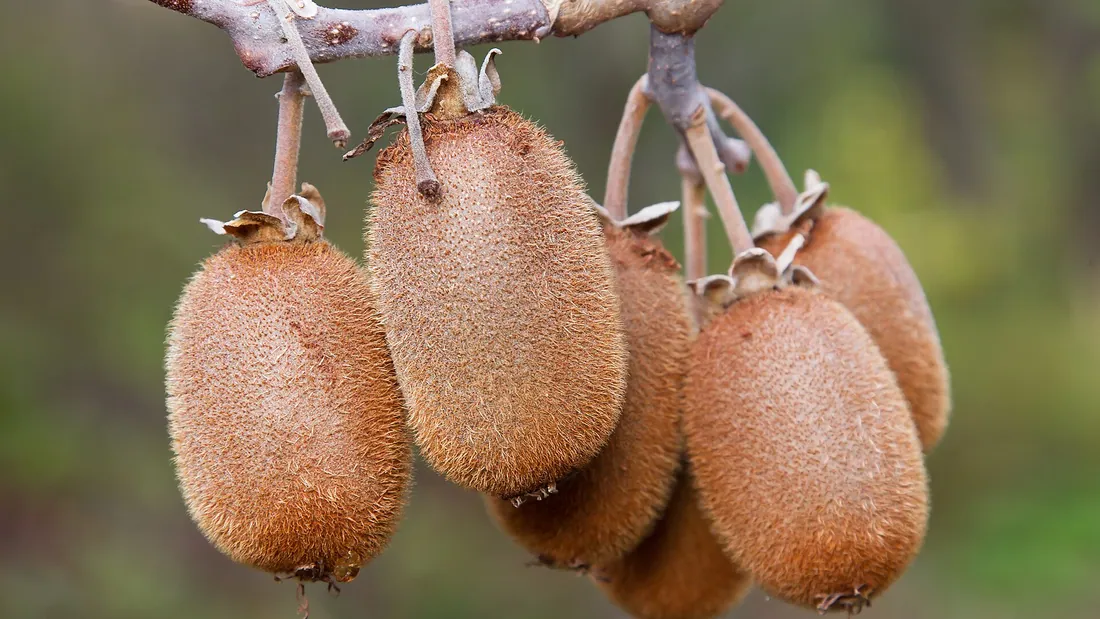

Kiwi (Actinidia deliciosa) is a vigorous fruiting vine from the mountain valleys of central China, later popularised in New Zealand during the twentieth century, which is where its trade name comes from. This is not a balcony plant: it is a powerful climber that can eventually cover fifteen square metres or more, and it needs a genuinely sturdy pergola or arbour to carry it. Hardy down to -15 °C while dormant, at ease in USDA zones 7 to 9, it does produce real kiwifruit in a temperate climate, but expect several years before the first harvest and plan generously from the moment you plant it.
Light and exposure
Kiwi wants sun, at least six hours a day, to flower well and carry its fruit through to harvest late in the season. A shaded spot gives you a leafy vine that is stingy with fruit. Pick the best-exposed wall or pergola in the garden, ideally facing the equator, sheltered from prevailing winds that damage young shoots and snap fruit-laden branches in late summer.
Shelter from wind matters almost as much as sun. A corner between two walls or along a windbreak hedge cuts down on breakage and speeds up fruiting. Put up a permanent support right at planting time, sturdy posts with tensioned wires or a solid timber pergola, because a mature vine is heavy and moving an established plant later is extremely difficult.
Watering
Kiwi drinks a lot, especially in summer once the foliage is thick and the fruit is swelling. A mature plant in open ground needs generous, regular watering right through the warm season, from fruit swelling to harvest, particularly in dry years, otherwise the fruit stays small or drops before it ripens. A thick mulch at the base holds moisture and saves you weeding around the shallow roots.
On the other hand, kiwi hates standing water. Soil that stays waterlogged after rain rots the roots within weeks, especially in heavy clay ground. Good drainage at planting time, working gravel or coarse compost into the soil, avoids this recurring problem.
Soil and repotting
Kiwi likes rich, deep, moisture-retentive soil, improved with compost or well-rotted manure at planting. A yearly top dressing of organic matter each spring keeps that richness up without needing to dig deep near the roots, which are shallow and dislike being compacted.
Crucially, kiwi prefers soil on the acid to neutral side and copes very poorly with active limestone. On chalky ground it develops a telltale iron chlorosis, leaves yellowing between veins that stay green, and the plant simply stalls. On a distinctly limy soil, you are better off planting in a large container or correcting the soil thoroughly before you start.
Temperature and humidity
Kiwi copes well with winter cold once established: a well-settled plant shrugs off -12 to -15 °C while dormant, which places it in USDA zones 7 to 9. It flowers late, several weeks after the stone fruits, which usually spares it the late frosts that ravage earlier species such as apricots.
Two moments stay risky. The young plant, for its first two or three years, is frost-tender and deserves a winter fleece or a thick mulch at the base through its early winters; the young shoots themselves are killed at -2 °C, even on a mature vine. And late in the season, an early frost can catch fruit still on the vine and spoil it, which is why it pays to pick before the first cold snap rather than wait for perfect ripeness outdoors. It also needs a long frost-free season, at least 225 days, to bring the fruit to maturity.
Pruning and upkeep
Pruning kiwi happens in two stages. In winter, outside frosty spells, you build and maintain the framework: choose the main arms that run along the support and remove dead wood, crossing branches and weak shoots. Never prune too late in winter, sap rises hard in kiwi and a late cut bleeds heavily.
In summer, green pruning finishes the job: shorten the long shoots of the year that shoot off in every direction and drain the plant for no benefit, leaving a few leaves past the last fruit set. This summer prune opens up the vine, lets light reach the fruit and makes the autumn harvest much easier.
Pests and diseases
The most serious concern with kiwi is PSA, a bacterial disease (Pseudomonas syringae pv. actinidiae) that has hit commercial orchards hard in recent years. It shows up as angular brown spots on the leaves, a reddish ooze on the trunk and branches, and can kill an entire vine in severe cases. In the garden, always disinfect secateurs between plants and avoid pruning in wet weather, the bacteria enters through fresh wounds.
More common and less serious, powdery mildew can appear on the foliage in muggy weather, and slugs happily go after tender young shoots in spring. Poorly drained soil also encourages root rot, one more reason to get drainage right at planting time.
Propagation
Cuttings are the most accessible method for a home gardener. Take semi-ripe cuttings ten to fifteen centimetres long from the current year’s wood in summer, strip the lower leaves and root them under a cold frame or in a pot kept humid under cover. Success rates are uneven but rewarding with patience.
Sowing, by contrast, is best avoided if you want reliable fruit: kiwi seed does not come true to the parent variety and, more importantly, does not reveal the seedling’s sex until it flowers several years later, a real problem since male and female vines look identical until then. To be sure of the right combination of sexes and a variety that fruits well, buy grafted or rooted plants clearly labelled by a nursery.
Climate and hardiness
Where and in which climate it thrives
The fuzzy kiwi is a plant of mild temperate climates. A mature vine takes -12 to -15 °C while dormant, which places it in USDA zones 7 to 9, and it does need cold to break its dormancy, 600 to 800 hours below 7 °C. But winter is not what decides success: the length of the frost-free season is, at least 225 days to bring the fruit to maturity. Under a short summer the vine grows magnificently and ripens nothing.
In a mild oceanic climate it grows without protection once mature, provided you give it the most sheltered, sunniest corner of the garden. Its late flowering usually spares it the spring frosts that ruin early fruit trees, but the young plant stays frost-tender for its first few years and the young shoots are killed at -2 °C. In a continental climate with a cold winter, or in zone 6 and below, change species rather than fight: Actinidia arguta, the smooth-skinned hardy kiwi, holds to zone 4, and Actinidia kolomikta goes down to zone 3 while ripening earlier, which also settles the short-summer problem.
One technical point decides everything, whatever the climate: the classic kiwi is dioecious, male and female plants are separate, and only the females bear fruit. You need at least one male to pollinate several females, one male generally being enough for six to eight of them. If there is no room for two plants, self-fertile varieties such as Jenny or Solissimo fruit on their own. Finally, expect three to four years and sometimes longer before the first fruit: the vine builds its framework first.
Growing kiwi?
Green Hub keeps a dated history of your own plant: its photos, its progress, its repottings. An AI answers about yours specifically, not a generic sheet, for free.
Identify my plantMonth-by-month care calendar
| January | Complete rest for the vine. This is the time to choose your plant, a male and a female or a self-fertile variety such as Jenny, and to pick out the sunniest, most sheltered spot in the garden. |
|---|---|
| February | Still too early to plant if the soil stays frozen. Use the time to build or reinforce the pergola or trellis, it needs to be ready before the plant arrives. |
| March | Planting is possible once the soil warms up and no longer freezes at night. Dig a generous hole, mix compost into the planting soil and water well to settle it around the roots. |
| April | Growth restarts, the young shoots are tender and still vulnerable to late frost. Mulch the base and keep a fleece within reach for cool nights. |
| May | Rapid shoot growth, which you should start training onto the support. Flowering begins late in the month depending on the year, with small, strongly scented white flowers. |
| June | Full flowering, the flowers turn from white to cream as they age. Water regularly, this is when a lack of water hurts the coming harvest the most. |
| July | This year’s shoots run off in every direction, so green-prune to open up the vine and shorten the longest growth. Keep watering well in dry spells. |
| August | Fruit is visibly swelling. Keep watering and check the trunk and leaves after storms, an early sign of PSA not to be ignored. |
| September | The fruit keeps swelling but stays firm and sour on the vine. A light trim of overly vigorous shoots lets more light reach the fruit. |
| October | Harvest before the first frost, usually sometime during the month. Pick the fruit while still firm, it finishes ripening indoors at room temperature. |
| November | Once the leaves have dropped, this is a good time for light structural pruning outside of frosty days. Clear the base and top up the mulch. |
| December | Winter rest, a mature plant copes well with the cold. For a young plant under three years old, keep a thick mulch at the base as a precaution. |
Green Hub tips
- If you are only planting one kiwi, choose a self-fertile variety such as Jenny or Solissimo. With a classic kiwi you need both a male and a female plant, only the female bears fruit.
- Put up the permanent support right at planting time, sturdy posts with tensioned wires or a solid pergola. A mature vine is heavy and almost impossible to move once it has filled out.
- Be patient, the first fruit often only comes after three to four years, sometimes more. That is normal, the vine builds its framework before it starts fruiting.
- Harvest before the first autumn frost, even if the fruit still feels firm. It ripens very well at room temperature indoors, just like shop-bought kiwifruit.
Related species
Apple tree
Malus domestica
The apple tree (Malus domestica) is the king of fruit trees in temperate climates, the one that has filled family…
Blackcurrant
Ribes nigrum
The blackcurrant (Ribes nigrum) is a small hardy fruit shrub that is genuinely happy in a cool climate, down to USDA…
Blueberry
Vaccinium corymbosum
The cultivated blueberry (Vaccinium corymbosum) is the large shrubby cousin of the wild bilberry, also called the…
Cherry tree
Prunus avium
The cherry tree (Prunus avium) is a vigorous, hardy fruit tree, perfectly at ease in a temperate climate, from USDA…
Elder
Sambucus nigra
Elder (Sambucus nigra) is a large shrub native to temperate Europe that grows wild in hedgerows, along footpaths and on…
Fig tree
Ficus carica
The fig tree (Ficus carica) is a Mediterranean tree, yet it really can be grown up to USDA zone 7 provided you shelter…
The guides that mention it
Small fruits and fruit trees: where to begin
Raspberry, redcurrant, blackcurrant, blueberry, apple, pear: what to start an orchard with and how to avoid picking the…
Overwintering your plants without losing them
Clivia, lavender, verbena, geranium, olive: which to bring indoors, which to protect outside, which to leave to face…
Pruning Fruit Trees: Deducing Instead of Memorising
An apple tree and a cherry tree are pruned neither at the same time nor for the same reason, and the peach is like…
Updated on
How this sheet is written
Written for Green Hub with the help of language models, then reviewed. It offers gardening guidance, not professional advice: if you are unsure whether a plant is toxic to a child or an animal, ask a vet, a doctor or your national poison centre.