Blueberry
Vaccinium corymbosum
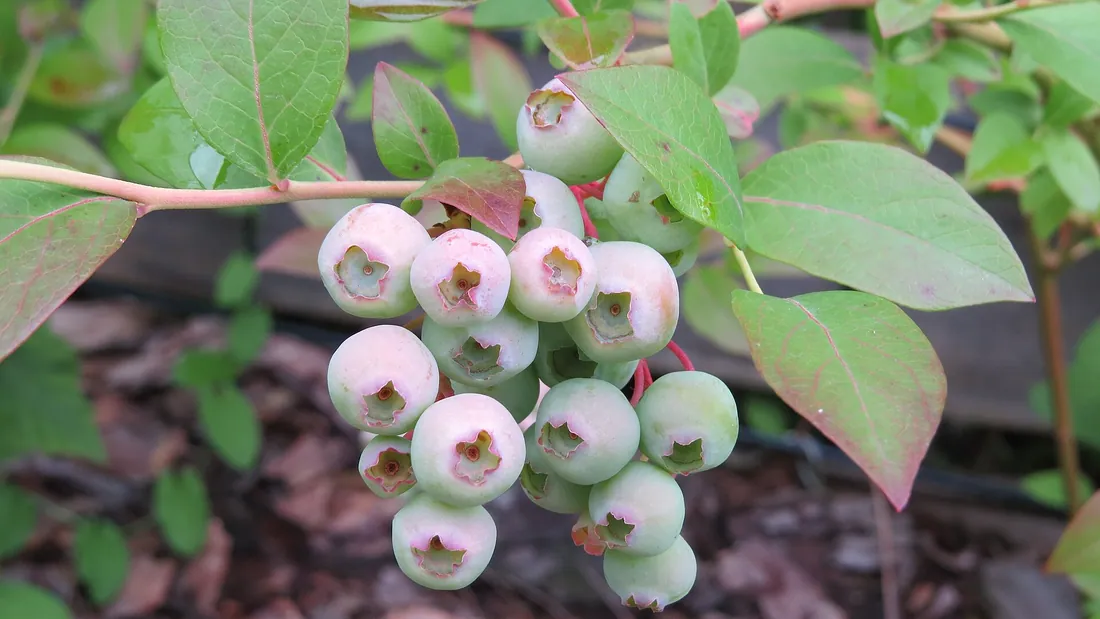
_Unripe_Vaccinium_corymbosum_(northern_highbush_blueberry)_at_Bichlh%C3%A4usl_in_Frankenfels,_Austria.jpg)
The cultivated blueberry (Vaccinium corymbosum) is the large shrubby cousin of the wild bilberry, also called the highbush blueberry. It is a fine little bush that gives big sweet blue berries in summer and takes on superb red tints in autumn. Hardy to cold, it has only one demand, but it is absolute: an acidic soil, with a pH between 4 and 5.5. Now most garden soils are neutral or chalky, which sets the plant up to fail. All the success lies in recreating that acidity and maintaining it, notably through the watering.
Light and exposure
The blueberry likes light and sun to sweeten its fruit well, while tolerating light shade during the hottest hours. In a temperate climate, a position with sun in the morning and at midday, with a little shade in the afternoon, gives excellent results without stressing the plant. Under a harsher sun, in a hot or Mediterranean climate, afternoon shade becomes plainly necessary.
Avoid spots too exposed to wind, which dry out the foliage and the soil. As it grows very well in a pot, you can place it where it makes the best of the sun, moving it with the season if need be. A sheltered, bright corner against a pale wall suits it perfectly.
Watering
This is where everything is decided, and it is the most important point to understand: water the blueberry with rainwater, never with tap water as soon as that water is hard. Chalky water raises the pH of the substrate, blocks the uptake of iron and causes chlorosis, that yellowing of the leaves between the veins that weakens the plant. Set up a rainwater butt, it is almost a must to succeed.
For the rest, the blueberry has fine, shallow roots that dislike both drought and standing water. Keep the substrate cool and moist at all times, above all in a pot where it dries fast, and above all during fruit formation. An acidic mulch on the surface reduces watering and keeps the moisture in.
Soil and repotting
The blueberry demands an acidic soil, with a pH of 4 to 5.5, rich in organic matter, light and cool. On the neutral or chalky soils that are the commonest case, the simplest and most reliable solution is growing in a pot or tub filled with ericaceous compost, or with a mix of ericaceous compost and acidic potting soil.
In open ground, only plant it if your soil is already acidic, otherwise dig a wide pit of at least sixty centimetres that you fill with ericaceous compost, cutting it off from the surrounding chalky soil. Then maintain the acidity each year with a suitable mulch. A soil that is too chalky condemns the plant to languish, whatever your good will.
Temperature and humidity
On the cold side, no worry: the shrubby blueberry is very hardy and takes frosts of minus 20 degrees and beyond without damage, which places it in USDA zones 4 to 7, a few varieties holding down to zone 3. It even needs a good spell of winter cold, in the order of 800 to 1000 hours below 7 degrees for the northern highbush varieties, to flower properly the following spring: under too mild a winter the flowering stays thin and ragged.
Flowering, in spring, remains the delicate moment, because a late frost can damage the flowers. In open ground, it spends the winter outside without protection. In a pot, the roots are more exposed to frost: during a very harsh winter, group the tubs against a wall or wrap them with a fleece or leaves to protect the root ball.
Pruning and upkeep
In the first years, the blueberry asks for almost nothing: let it fill out and just remove the dead or broken wood. A young plant above all needs to build its framework.
From the fourth or fifth year, prune in winter, during dormancy. The blueberry fruits on two to three year old wood, then the old branches exhaust themselves. Each winter remove the oldest and darkest branches at the base, the spindly wood and the shoots that cross in the centre, to open up the bush and encourage vigorous new growth. You thus take out a fifth to a quarter of the old branches per year.
Pests and diseases
The blueberry is little prone to disease when its needs are met. The main trouble you will meet is not a disease but a deficiency: iron chlorosis, due to too high a pH or to watering with chalky water. The leaves yellow between the veins, which stay green. The answer is always the same, reacidify the substrate and go back to rainwater.
In damp conditions, still watch for grey mould (botrytis) on the fruit and a few leaf spots in mild overcast weather: open up the bush by pruning and do not wet the foliage needlessly. The real predator is the birds, blackbirds first, which spot the ripe berries before you do.
Propagation
The blueberry propagates from cuttings, but it is a slightly slower and more delicate exercise than for other fruit shrubs, which explains its medium difficulty rating. In summer, take cuttings of semi ripe wood, or in winter cuttings of hardwood, and plant them in a very acidic mix, based on ericaceous compost and sand, kept constantly moist with rainwater.
Rooting can take several months and the success rate stays modest without well managed conditions. For most gardeners, buying young plants in containers remains the simplest and surest route, all the more so since you need several varieties in the garden anyway.
Climate and hardiness
Where and in which climate it thrives
Cold is not the problem for the blueberry: it takes frosts of minus 20 degrees and beyond, which places it in USDA zones 4 to 7, a few varieties holding down to zone 3. It even asks for the opposite, a real winter: the northern highbush varieties need around 800 to 1000 hours below 7 degrees to break the dormancy of their buds. That is where climate decides. In an oceanic or continental climate with a marked winter, it fruits without effort. In a mild, Mediterranean or subtropical climate, winter no longer fills that quota and the flowering comes out thin: you then turn to the so called southern varieties, bred to need only 150 to 600 chilling hours.
The real obstacle lies elsewhere, in the soil and in the water. The blueberry demands a pH of 4 to 5.5, and most garden soils are neutral or chalky. The simplest route, everywhere, is to grow it in a pot or a large tub of ericaceous compost, which makes you master of the pH. Mulch each year with pine bark or conifer needles, which acidify the soil gently as they break down, and water with collected rainwater as soon as your tap water is hard. Plant at least two different varieties side by side: cross pollination ensures much better fruiting and bigger berries. Under a hot dry summer, double your watch on the moisture of the substrate, the roots are fine and shallow. The harvest spreads over several weeks and needs a net, without which the blackbirds will leave you nothing.
Growing blueberry?
Green Hub keeps a dated history of your own plant: its photos, its progress, its repottings. An AI answers about yours specifically, not a generic sheet, for free.
Identify my plantMonth-by-month care calendar
| January | Winter rest. Protect the root ball of the pots during a hard frost with a fleece or leaves. Collect and store rainwater for the coming season. |
|---|---|
| February | Pruning period on plants over four years old: remove the dark old wood and the spindly shoots to open up the bush. |
| March | Plant or repot in ericaceous compost. Refresh the acidic mulch, pine bark or needles. Resume regular watering with rainwater. |
| April | Start of flowering. Ensure at least two neighbouring varieties for cross pollination. Watch for late frosts that can damage the flowers. |
| May | Fruit set. Keep the substrate cool at all times, rainwater remains the absolute rule. Check the colour of the foliage, a yellowing signals a rising pH. |
| June | The berries swell and start to turn blue. Set up the bird net before the first ripe berries, the blackbirds do not wait. |
| July | Start of harvest. Pick the fruit well blue and soft, in several passes as they do not all ripen at the same time. |
| August | Harvest continues, spread out according to the varieties. Carry on watering with rainwater during heatwaves so as not to stress the plant. |
| September | End of harvest. The foliage begins to redden. Keep the substrate moist, above all in a pot, to prepare next year’s buds. |
| October | Fine autumn colours. Take hardwood cuttings if you wish at the end of the month. Top up the acidic mulch before winter. |
| November | Leaf fall, entry into rest. Gather the leaves on the ground. A good moment to plant from a container in an acidic substrate. |
| December | Full rest. Protect the pots from hard cold. Check your rainwater reserve and plan the addition of a second variety if needed. |
Green Hub tips
- Rule number one as soon as your tap water is hard: water only with rainwater. Chalky water raises the pH and blocks the plant, which yellows and declines.
- Leaves that yellow between veins that stay green signal chlorosis: your substrate is no longer acidic enough, react quickly with mulch and rainwater.
- Plant at least two different varieties side by side. Cross pollination gives a more abundant harvest and clearly bigger berries.
- In neutral or chalky soil, forget classic open ground: a large tub of ericaceous compost makes you master of the pH and simplifies everything.
- Set up the bird net before the first ripe berries. Once a blackbird has spotted your blueberries, it will leave you none.
Related species
Apple tree
Malus domestica
The apple tree (Malus domestica) is the king of fruit trees in temperate climates, the one that has filled family…
Blackcurrant
Ribes nigrum
The blackcurrant (Ribes nigrum) is a small hardy fruit shrub that is genuinely happy in a cool climate, down to USDA…
Cherry tree
Prunus avium
The cherry tree (Prunus avium) is a vigorous, hardy fruit tree, perfectly at ease in a temperate climate, from USDA…
Elder
Sambucus nigra
Elder (Sambucus nigra) is a large shrub native to temperate Europe that grows wild in hedgerows, along footpaths and on…
Fig tree
Ficus carica
The fig tree (Ficus carica) is a Mediterranean tree, yet it really can be grown up to USDA zone 7 provided you shelter…
Grapevine
Vitis vinifera
The grapevine (Vitis vinifera) is a vigorous climber that produces table grapes, grown since antiquity around the…
The guides that mention it
Small fruits and fruit trees: where to begin
Raspberry, redcurrant, blackcurrant, blueberry, apple, pear: what to start an orchard with and how to avoid picking the…
Watering Plants Properly: Deciding Rather Than Following a Schedule
Beginners water too often and too little at the same time. How to read the soil instead of the calendar, tell thirst…
Repotting your plants and choosing the right potting mix
The right moment, the right technique and the right substrate for each plant, so you can repot without rotting the…
Making Compost: Steering the Thermal Biology of the Heap
A compost heap is not a pile of waste you stir, it is a thermal process you steer. The real carbon/nitrogen ratio of…
Improving Clay Soil: Diagnosis, Amendments and Drainage
Ground that clings to your boots in winter and cracks open in summer: a clay soil is not condemned, it changes with the…
Garden Mulching: Every Mulch Has an Effect and a Drawback
Mulching is presented everywhere as a benefit with no downside. There is one for every material: what nitrogen drawdown…
Vegetable Garden Pests: The Natural Method That Holds All Season
A leaf riddled with holes, a lettuce shaved to the ground overnight, a twisted and sticky shoot: every kind of damage…
Pruning Fruit Trees: Deducing Instead of Memorising
An apple tree and a cherry tree are pruned neither at the same time nor for the same reason, and the peach is like…
Updated on
How this sheet is written
Written for Green Hub with the help of language models, then reviewed. It offers gardening guidance, not professional advice: if you are unsure whether a plant is toxic to a child or an animal, ask a vet, a doctor or your national poison centre.