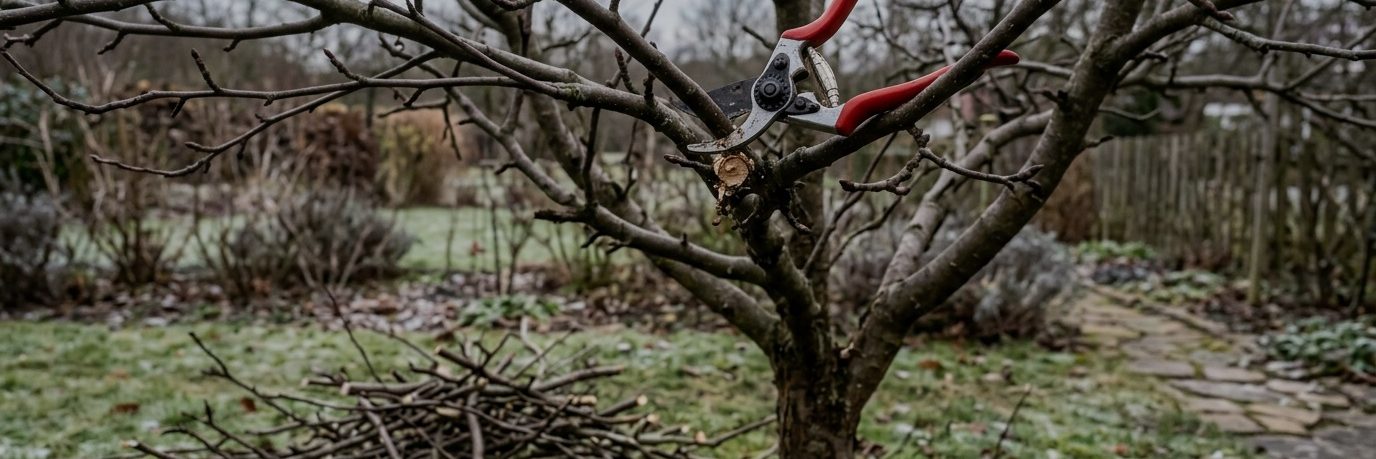
Pruning Fruit Trees: Deducing Instead of Memorising
A fruit tree is not pruned on a fixed date, but according to two answers: what wood does it carry its fruit on, and how well does it heal a wound at that point in its cycle? Pip fruits heal well during dormancy and fruit on spurs that last several years; stone fruits heal poorly at rest and want to be cut while the sap is flowing; the peach, for its part, fruits only on the previous year’s wood and has to be rebuilt every year, or its harvest retreats toward the tips of the branches.
A fruit tree is pruned according to two pieces of information, never according to a date: what wood does it carry its fruit on, and how well does it heal a wound at that point in its cycle? Pip fruits, apple and pear, heal well during dormancy and carry most of their crop on spurs that stay productive for several years: prune them while dormant, in frost-free conditions, renewing a portion of those spurs each year so they don’t all age together, which would worsen biennial bearing, that pattern of a heavy crop one year and almost nothing the next. Stone fruits, cherry and plum, bear their fruit on the same kind of spurs but heal poorly at rest, exposed at that time to two diseases that enter through the wound, silver leaf disease and bacterial canker: prune them instead while in leaf, in dry weather, shortly after harvest. The peach pushes this logic further still: it fruits only on wood that grew the previous year, never twice on the same shoot, which means rebuilding between 40 and 50 percent of its one-year wood every year, or the harvest retreats toward the tips of the branches, with smaller and smaller fruit. The fig, the grapevine and the kiwi follow a third pattern: the fruit forms on the current season’s growth, itself arising from a bud carried on one-year wood, so pruning becomes a matter of choosing how many of those buds to keep rather than choosing between young wood and old wood. Cane and bush fruits, raspberry, redcurrant, blackcurrant, blueberry and elder, are governed by renewing the wood according to its age, which varies enormously from one species to the next: a blackcurrant bush renews itself completely in three years, while a redcurrant keeps the same framework for years on end. Getting the season wrong doesn’t kill the tree, it costs one harvest, sometimes two. The one mistake that’s hard to undo is cutting an old, neglected fruit tree back hard in a single go, which triggers years of barren growth instead of fruit.
What wood does it fruit on: the question that replaces the calendar
No fruit tree is pruned on a fixed date. It is pruned according to two answers, and those two answers are enough to work out the right cut on any species at all, including a variety you don’t recognise. The first: what wood does the tree carry its fruit on, wood that lasts several years or wood that has to be rebuilt every season? The second: how well does it heal a wound at any given point in its cycle? A calendar built species by species solves both questions for one particular climate and falls apart the moment you cross into another hemisphere; the biology underneath it never changes.
The first split sets the pip fruits, apple and pear, against the stone fruits, cherry, plum and peach. Both groups fruit on short, permanent shoots called spurs, but they don’t heal the same way: pip fruits close a wound made during dormancy cleanly, stone fruits close that same wound poorly and are exposed, right at that moment, to two diseases that get in through the very cut. This one criterion, independent of what wood carries the fruit, is enough on its own to explain why an apple tree is pruned while dormant and a cherry tree while the sap is running.
The second split concerns the fruiting wood itself, and it covers at least three different cases. On apple, pear, cherry and plum, the fruit forms on spurs that stay productive for several years: pruning means renewing part of that stock year after year, never rebuilding it all at once. On the peach, nothing of the sort applies: it fruits only on wood that grew the previous year, a shoot that has already carried peaches will never flower again, and a large share of its one-year wood, not its framework, has to be rebuilt every season, or the harvest retreats toward the tips of the branches. On the fig, the grapevine and the kiwi, a third pattern takes over: the fruit forms on the current season’s growth, but that growth itself starts from a bud carried on one-year wood, which shifts the question entirely. You are no longer choosing between old wood and young wood, you are choosing how many one-year buds to keep.
Getting either question wrong almost never kills the tree, but each mistake leaves its own signature. Getting the healing wrong produces gumming that oozes from the trunk the following season. Getting the fruiting wood wrong on an apple tree left without renewal produces biennial bearing, that pattern of one outsized crop and almost nothing the next. Getting the fruiting wood wrong on a peach produces a harvest that migrates a little further out toward the branch tips every year, with smaller and smaller fruit. The rest of this guide takes these two questions in order, then applies them species by species.
Pip versus stone: why healing dictates two opposite seasons
Apple and pear tolerate being cut in full dormancy for a precise reason: their main health risk at the wound, fire blight (Erwinia amylovora), is itself largely inactive during that period. This bacterium spreads by insects, rain and tools during the growing season, but through dormancy, disinfecting tools isn’t even necessary, the transmission risk is so low. Better still: when a shoot or a canker shows active signs of the disease, sanitation pruning is done precisely during dormancy, specifically to avoid spreading the bacterium over a tree still in leaf. For pip fruits, dormancy is therefore doubly the right window: the wood heals better in the cold than stone-fruit wood does, and the pathogen that threatens them most is asleep at the same time as the tree.
Cherry and plum, like every Prunus, reverse that calculation because of two distinct diseases that both get in through a fresh wound. Silver leaf disease (Chondrostereum purpureum) releases its spores mainly during the damp spells of dormancy, and a cut stays vulnerable to infection for about a week after it’s made. As long as the sap isn’t moving, nothing pushes the spores back out of the wound; once it rises again, during active growth, it tends instead to flush them out. That’s a complete reversal of the apple tree’s case: here it’s active sap that protects the wound, not rest.
Bacterial canker (Pseudomonas syringae) follows a related but distinct logic: the bacterium gets in through pruning wounds and leaf scars during dormancy, then stays latent until the following season, when it shows up as oozing cankers, the amber gumming that gives the disease its common name. A cut made early, before growth resumes, is explicitly listed among the factors that favour its establishment. Gumming itself is not a disease but the tree’s reaction to a wound or an infection: it can appear without bacterial canker, but when it follows a dormant-season cut by a few weeks, bacterial canker is the most likely cause.
Both diseases share the same practical conclusion: prune cherry and plum while in leaf, preferably in dry weather, shortly after harvest or during the height of the growing season, never during winter dormancy. The table below sums up what actually travels by way of the pruning blade, what travels through the wound itself, and what travels by neither.
| Agent | Actual route | When the blade matters | What actually protects |
|---|---|---|---|
| Fire blight (Erwinia amylovora) | Bacteria spread by insects, rain and tools, mainly on apple and pear | While in leaf, when cutting a canker or an affected shoot | Sanitation-prune preferably during dormancy, when disinfecting tools isn’t even necessary; carry out and destroy affected wood |
| Silver leaf disease (Chondrostereum purpureum) | Airborne spores that settle on a fresh wound, mainly when the sap isn’t rising | Never directly by the blade | Prune cherry and plum while in leaf, never at rest; a sealant applied right after the cut can delay infection |
| Bacterial canker (Pseudomonas syringae) | Bacteria entering through wounds and leaf scars during dormancy, revealed as gumming the following season | Marginal: most contamination passes through the wound itself, not by blade from one tree to another | Avoid dormant-season cuts on stone fruits, prune in dry weather |
| Brown rot (Monilinia) | Spores held over in mummified fruit and shoot cankers, spread by rain and wind | Never | Remove and destroy mummified fruit and cankered shoots at every visit, in dormancy as in leaf |
Brown rot (Monilinia), which browns and rots the fruit before mummifying it on the tree, follows a third logic, independent of pruning timing altogether: the fungus overwinters in those mummified fruits and in shoot cankers, and that’s where it sets off again the following season. Systematically removing mummified fruit and cankered shoots at every visit, in dormancy as much as in leaf, cuts down the stock of spores available for the next season, whatever calendar you otherwise follow for the rest of the pruning.
Reading it for yourself: spurs, spur shoots, one-year wood and the right cut
Before cutting anything at all, a glance at the buds almost always settles the question of fruiting wood. A growth bud is flat, pointed and pressed close against the shoot; a flower bud, on both pip and stone fruits, is bigger, rounder, often noticeably swollen, sometimes carried on a small cushion of wood. On a branch with established spurs, that swelling is visible from several paces away. One-year wood, for its part, is generally recognisable by bark that’s smoother and often redder or paler than wood two years old and older, which is already grey, rough and sometimes fissured: the difference is obvious at a glance when you compare two shoots side by side on the same branch.
On apple and pear, three words name three stages of the same organ. The spur shoot is a very short shoot, often tipped with nothing more than a growth bud, that can turn productive in later years without you needing to create it yourself. The spur is the knotty swelling that forms after a first fruiting, at the base of the old fruit stalk, and it’s this structure that comes back every year, carrying now a flower, now a plain shoot. The spur branch is a fruiting shoot a little longer than a spur shoot, carrying several spurs staggered along its length. None of these words is essential to prune well, but they stop you mistaking a promising spur shoot for a plain growth bud that will never flower, and so removing it by mistake while thinking you’re tidying the tree.
Two families of cuts produce opposite effects, and confusing them accounts for a good many badly shaped trees. A thinning cut removes an entire shoot or branch at its base, at the point where it joins the wood that carries it: it triggers almost no regrowth at that spot, and it opens the tree up to light and air. A heading cut removes only the tip of a shoot, just above a retained bud: it removes that terminal bud’s dominance and triggers a cluster of new shoots just below the cut. On a mature fruit tree, thinning stays the default cut; heading is reserved for three specific uses, thickening a scaffold branch you want to keep, removing something that can’t be left as it is, or deliberately forcing new spurs on a species that fruits on that kind of wood.
The cut itself is made about five millimetres above a bud that faces outward, never toward the centre of the tree. Any closer and the bud dries out; any further and the remaining stub dies and rots before the tree has had time to grow over it. The angled face slopes away from the bud, so rainwater runs off away from it rather than pooling there, a real detail but well below the distance and cleanness of the cut in importance. For a whole branch, cut just in front of the collar at its base, without cutting into it: healing starts from that collar, and removing it along with the branch opens the trunk to rot. Wounds aren’t painted as a general rule, since sealants slow the wood’s natural compartmentalisation rather than helping it; the one documented exception concerns precisely cherry and plum, where a sealant applied right after the cut can delay the onset of silver leaf disease long enough for natural healing to take over.
Apple and pear: the life of a spur, the one-two-three rule and biennial bearing
Apple and pear carry most of their crop on spurs established on wood two years old and older. A spur can physically live for fifteen to twenty years, but it stays genuinely productive for only about eight to ten: past that point it keeps flowering but gives smaller, fewer fruit. A tree that’s never pruned again therefore ends up covered in ageing spurs, with no visible symptom giving warning before the drop in yield itself. The table below sums up, species by species, the fruiting wood, timing and severity for the five major pip and stone fruits in this guide; apple and pear are covered in detail right after it, cherry, plum and peach in the sections that follow.
| Fruit tree | Fruiting wood | Timing | Severity |
|---|---|---|---|
| Apple | Spurs on wood two years old and older | During dormancy, frost-free, between leaf fall and bud break | Moderate and regular: about a third of the year’s shoots shortened, part of the old spurs renewed each year |
| Pear | Spurs on wood two years old and older | During dormancy, frost-free, between leaf fall and bud break | Moderate and regular, the same logic as apple: renew part of the spurs each year rather than letting them all age together |
| Cherry | Spurs on two- to three-year-old wood, productive for up to about ten years | While in leaf, or in the weeks after harvest, in dry weather | Light once the framework is formed: dead wood, rubbing shoots, spurs thinned if overcrowded |
| Plum | Spurs on wood two years old and older | While in leaf, or in the weeks after harvest, in dry weather | Light once the framework is formed: dead wood, upright water sprouts, crossing branches |
| Peach | Only wood that grew the previous year | At the end of dormancy, once the flower buds are visible and distinct | Severe and systematic: on the order of 40 to 50 percent of the year’s wood removed, a replacement shoot chosen before cutting off the one that fruited |
The simplest safeguard has a name: the one-two-three rule. It means keeping, across the whole tree, a roughly even mix of one-year, two-year and three-year fruiting wood, rather than letting every spur age at the same pace. In practice, that means heading back a small share of the one-year shoots each year to force new spurs at their base, and thinning out the oldest, sparsest spurs. This rule costs less time than managing spur by spur, and it avoids the opposite result, a tree entirely covered in tired old spurs that all crop at once, which worsens biennial bearing rather than correcting it.
Biennial bearing itself comes down to a mechanism of internal competition. Next year’s flower buds differentiate during the summer that follows the current flowering, exactly when the tree is feeding its present crop. A heavy crop exhausts the reserves available for that differentiation: the year after a big harvest therefore mechanically sees fewer flower buds form, giving a light crop, which in turn lets the tree rebuild its reserves and sets up another heavy year. Pruning doesn’t remove this mechanism on its own, thinning young fruit after fruit set works the same lever by a different route, but regularly renewing the spurs limits its swing, and pruning a little more generously right after a heavy-cropping year helps rebalance the tree for the one that follows.
Cherry and plum: the same architecture, a green-season calendar
Cherry and plum carry their fruit on the same kind of spurs as apple and pear, established on wood two years old and older, with cherry spurs staying productive for up to about ten years. The architecture doesn’t change, then: the only thing that changes is the timing, for the healing reasons covered above. Once the framework is formed, these two trees actually need less annual pruning than an apple tree, not more: most of the work is removing dead wood, rubbing branches and upright water sprouts that steal light from the spurs, done during active growth and in dry weather rather than in rain, which is precisely what favours the spread of silver leaf spores and lets bacterial canker in.
On an older cherry tree, spurs eventually crowd each other so closely that they start competing; thinning them out to leave a spacing of around ten centimetres restores size to the fruit that remains, at the cost of some crop volume. The safest timing stays the weeks right after harvest: the wound then has the whole rest of the growing season to heal before dormancy sets in, which keeps it clear of the two diseases covered above. On plum, the same principle of restraint applies, with particular watchfulness over water sprouts, which often push up in numbers at the base of the large branches after a slightly too generous pruning and are best removed early, as soon as they appear, rather than left to turn into wood you’ll have to take out with a saw.
The one exception to this restraint concerns the young tree still being trained, the first three to four years, when the framework is still under construction and more structural cuts remain necessary, always within the same healing windows. Once the framework is in place, restraint becomes the rule again, and the most worthwhile move isn’t even a cut: systematically removing fruit mummified by brown rot and shoots carrying an active canker limits the inoculum available for the following season, far more effectively than harder pruning would.
The peach: the only one that demands a full rebuild every year
The peach breaks with everything above. It fruits only on wood that grew the previous season, never on a permanent spur: a shoot that has carried peaches will never flower again, whatever the age of the tree. Without renewal, the consequence is mechanical and progressive, the harvest retreats a little further toward the tips of the branches every year, to wherever the only wood still young enough to flower happens to be, with smaller and smaller fruit because the shoot carrying them keeps lengthening and thinning instead of staying short and vigorous. Nothing in the tree’s general appearance flags the problem for several seasons: it keeps growing, keeps flowering at the margins, and simply yields a little less each year.
The safeguard is to deliberately rebuild the tree every year rather than suffer that retreat. Each pruning removes on the order of 40 to 50 percent of the wood grown the previous season, a far higher figure than on any other fruit tree in this guide. The precise move is, on each scaffold branch, to pick out a one-year shoot that’s vigorous but not excessive, well placed toward the inside or underside of the branch, keep it as a replacement shoot, then cut off, just above it, the wood that has just fruited. The following season, it’s this replacement shoot, now itself one-year wood, that will carry the crop, and the cycle starts again.
The timing falls a little later in dormancy than for apple, once the flower buds are clearly distinguishable, tinged pink at the tip, but before they fully open. This wait isn’t excessive caution: peach flowers open on still-bare wood and stay exposed to a late cold snap, and the cut itself reduces, for a while, the frost tolerance of the wood that’s just been pruned, which further argues against pruning right before cold weather is forecast. Waiting until the buds are visible lets you spot any damage before deciding which shoots to keep as replacement wood, rather than cutting blind and losing, in the same stroke, healthy wood and the very marker that would have shown you which wood was already affected.
Pruning this hard naturally wakes many dormant buds below every cut, exactly as on any tree cut back hard: most of these shoots need to be removed or pinched out during the season, or the tree closes back up into a needlessly dense mass of wood the following year, instead of concentrating its vigour on the handful of replacement shoots actually chosen.
Fig, grapevine and kiwi: fruiting on the current season’s growth
These three species share a mechanism distinct from everything above. The fruit forms neither on a permanent spur nor directly on one-year wood: it forms on the current season’s growth, itself arising from a bud carried on wood at least a year old. The question is no longer choosing between young wood and old wood, but deciding how many of those buds to keep on the one-year wood, since each one will give a shoot, and each shoot will carry, or not, a flower and then a fruit, depending on the species and its position.
The fig pushes this nuance furthest, with two possible crops on the same tree. A first, early crop forms on wood that has come through dormancy, that is, on still-intact shoots from the previous season. A second, later crop forms on the current season’s growth, and it’s the more reliable of the two, especially where the growing season is short or where winter dormancy damages exposed wood: this second crop forms on new wood regardless, whatever the severity of the pruning. Cutting back hard at the end of dormancy therefore removes the first crop, since no one-year wood is left to carry it, without threatening the second. Light pruning, which preserves some of the previous year’s wood, keeps both crops at the cost of a bulkier tree. The choice depends on what you’re prioritising, not on any universal rule.
The grapevine is trained either in spurs, sections of one-year wood cut back to two or three buds on a permanent framework, or in canes, longer sections carrying more buds on a previous year’s cane left largely intact. Either way, every bud kept will give a shoot that carries the season’s bunches, which reduces the whole decision to a matter of counting rather than a choice between two kinds of wood. One-year wood is generally recognisable by bark that’s smoother and more russet than older wood, which is already grey and rough, letting you sort them even without a label.
Kiwi follows the same logic as the grapevine, with one extra calendar constraint specific to this kind of woody vine: a cut made too late in dormancy, once the sap has already risen, bleeds heavily and can weaken the plant for several weeks. Pruning is therefore done in deep dormancy, well ahead of bud break rather than as it approaches, the opposite of the peach, which prefers to wait as late as possible within its own dormancy window.
| Species | Fruiting wood | Timing | Severity |
|---|---|---|---|
| Fig | Previous year’s wood for the early crop, current year’s wood for the main crop | Light pruning at the end of dormancy; harder pruning possible if you give up the early crop | Depends on the goal: a few shoots shortened to preserve both crops, or a harder cutback to focus the tree on the more reliable main crop |
| Grapevine | Current season’s growth, arising from a bud carried on one-year wood | During dormancy, well before the sap rises again | Trained in spurs (two to three buds on a permanent framework) or in canes (more buds on a longer cane), depending on the system chosen |
| Kiwi | Current season’s growth, arising from a bud carried on one-year wood | In deep dormancy, well before bud break | Moderate to firm; pruning too late makes the wound bleed heavily and weakens the vine |
| Summer-fruiting raspberry | Previous year’s canes (two-year wood) | Right after harvest | Canes that have just fruited cut to ground level, six to eight vigorous young canes kept per thirty centimetres of row |
| Autumn-fruiting raspberry | Tip of the current year’s cane | During dormancy | All canes cut back to ground level for a single, concentrated crop |
| Redcurrant (and gooseberry) | Spurs on a permanent framework of two- to three-year-old wood | During dormancy | Light: framework kept, only wood older than four years removed |
| Blackcurrant | Base of one-year wood and spurs on two-year wood | During dormancy | Continuous renewal from the base: no stem kept past its third season |
| Blueberry | Two- to four-year-old wood, the most productive | During dormancy | A quarter to a third of the oldest canes removed each year, starting with the thickest and greyest |
| Elder | Young wood, productivity drops after two to three seasons | During dormancy | Renewal of the oldest stems at the base, keeping a mix of one-, two- and three-year wood |
| Hazel | Catkins and female flowers carried on one-year wood | During dormancy, once the catkins have opened and shed their pollen | Light: never more than a quarter of the catkin-bearing wood removed at once, centre opened up in a goblet shape |
Cane and bush fruits: a renewal cycle that varies from one extreme to the other
Summer-fruiting raspberries crop once, on canes grown the previous season. Right after harvest, cut to ground level the canes that have just fruited, recognisable by their duller bark and the dry remains of fruiting, and keep only the most vigorous of the young canes produced that year, at a rate of about six to eight per thirty centimetres of row, removing the rest.
Autumn-fruiting raspberries fruit at the tip of their own cane, the same season it grows, with no need for older wood. The simplest approach is to cut all the canes back to ground level during dormancy, which gives a single crop, late in the season but concentrated and reliable. A double-crop approach exists, shortening only the already-fruited portion of a retained cane to get an earlier second flush the following year, but it complicates management for a gain that isn’t worth it in an ordinary garden.
Redcurrant and blackcurrant look similar enough that gardeners reflexively prune them the same way, which is a mistake in both directions. Redcurrant, like gooseberry, fruits on spurs that establish themselves on a permanent framework of two- to three-year-old wood, almost like a miniature apple tree: prune it lightly, keep its framework year after year, and remove only wood older than four years, which has become unproductive by then. Blackcurrant, by contrast, fruits mainly at the base of one-year wood and on the spurs of two-year wood, and its productivity drops fast beyond that: keep no stem past its third season, in a mix continually renewed from the base, closer to a stool under constant rejuvenation than to a miniature fruit tree. Pruning blackcurrant like redcurrant leaves it clogged with old, unproductive wood; pruning redcurrant like blackcurrant destroys the very framework that carries its fruit.
Blueberry gives its best fruit on wood two to four years old; past about eight years, a cane loses productivity noticeably, signalled by bark that thickens and starts peeling away in strips. Each year, during dormancy, remove about a quarter to a third of the oldest canes, tackling the thickest and greyest first, which keeps up continuous renewal without ever stripping the bush bare in one go.
Elder grown for its fruit gives its best clusters on young wood, its productivity declining sharply after two to three seasons. Each year, during dormancy, remove the oldest stems at the base, aiming for a balanced mix of one-, two- and three-year wood rather than a permanent framework. An elder left without renewal for years is brought back into shape the same way as any neglected fruit tree: the work is spread out, removing its largest stems over several seasons rather than all at once.
Hazel follows a different logic again, because what matters here is neither a spur nor a cane but the catkin, that long, dangling male flower that releases pollen, formed on one-year wood and carried right through dormancy; the tiny female flowers that will become the hazelnuts open in the same place, on that same wood. Removing too much of this one-year wood therefore means wiping out the tree’s pollen supply for the following season in one go: limit yourself to about a quarter of the catkin-bearing wood at each pass, opening up mainly the centre of the bush, most often trained as a multi-stemmed stool, so light reaches the developing nuts. The safest timing falls once the catkins have opened and shed their pollen, rather than while they’re still closed and carrying it.
Rejuvenating an old, neglected fruit tree
The diagnosis needs no tools: a fruit tree left several years without pruning carries its crop higher and further out every year, around the edge of the crown, while the centre, starved of light, carries nothing but dead or unproductive wood. Some scaffold branches may have started competing with the trunk, others cross and wound each other in the slightest wind. None of this kills the tree, but all of it reduces its crop year after year, and the instinct to cut it all back hard in one go to make up for lost time is exactly the move to avoid.
A single brutal, sweeping cut doesn’t restart fruiting, it triggers the opposite: hard heading back wakes a mass of dormant buds all at once, and the tree responds with a hedge of vigorous upright shoots, water sprouts, clustered just below the big cuts. These shoots are typically barren the first season, sometimes the next one too, and the tree can spend several years rebuilding wood before it fruits normally again. Cutting it all back at once therefore trades a mediocre but real crop for several seasons with no crop at all.
Rejuvenating the tree instead spreads over three dormant seasons. In the first, remove dead wood, diseased wood and the worst faults in the framework, crossing branches, competitors with the trunk, without exceeding about a third of the volume that needs correcting. In the second, once you’ve seen how the tree has reacted, thin out the water sprouts that have appeared in the meantime, keeping only a few well-placed ones to fill a gap or replace a failing scaffold branch, and continue opening up the centre. The third finishes the framework. This staged approach applies to apple, pear, cherry and plum, whose old wood remains capable of fruiting again once it’s opened up to light.
The peach escapes this caution, for a reason already covered: its old wood will never bear fruit again regardless, renewed or not. On a neglected peach tree, the question isn’t how to stage the rejuvenation but accepting that a good part of the framework has to be rebuilt in one go to force out new wood, or the tree stays unproductive indefinitely, however much patience you bring to it.
A tree that has just been through hard rejuvenation pruning carries a root system out of proportion to its now-reduced crown: it benefits from regular watering through the first season that follows, while it rebuilds its foliage. Nitrogen applied at the time of cutting only worsens the reaction, feeding the surge of wood growth even more at the expense of the return to fruiting that the whole operation is meant to achieve.
Common pitfalls to avoid
MistakePruning cherry, plum or peach in full winter dormancy, at the same time as apple and pear.
Why :These three trees heal poorly as long as the sap isn’t moving, exactly the period when two distinct diseases take advantage of a fresh wound to get established: silver leaf disease, whose spores colonise the cut within days when the sap isn’t pushing them back out, and bacterial canker, which enters through the dormant-season wound and shows up as oozing gum only the following season. Nothing gives the mistake away at the moment of cutting, the trunk looks healthy, and the gumming sometimes doesn’t appear until the following growing season, long after the cause has been forgotten.
Do this instead :Prune these three trees while in active growth or in the weeks after harvest, in dry weather if possible. Apple and pear remain the only pair in this guide pruned during dormancy.
MistakeRenewing only a small part of a peach tree’s wood each year, out of caution, the way you would on an apple tree.
Why :The peach fruits only on wood grown the previous year, never twice on the same shoot. Pruning too lightly leaves most of the wood ageing without ever bearing fruit again, and the harvest retreats year by year toward the tips of the branches, with smaller and smaller fruit, with no symptom giving warning for several seasons: the tree keeps growing and flowering at the margins, which reassures you wrongly.
Do this instead :Remove on the order of 40 to 50 percent of the previous year’s wood every year, far more than on any other fruit tree in this guide, choosing a vigorous, well-placed replacement shoot on each scaffold branch before cutting off the one that has just fruited.
MistakeConfusing summer-fruiting and autumn-fruiting raspberries, and cutting at the wrong time the very canes that were about to carry the crop.
Why :Summer-fruiting types fruit on the previous season’s canes, autumn-fruiting types fruit at the tip of their own cane, the same season it grows. Cutting a summer-fruiting type back to the ground during dormancy, as you would for the autumn-fruiting type, removes all the wood that was due to flower that year; conversely, leaving an autumn-fruiting type’s old canes in place, thinking it helps, only clutters the plant without adding anything to the next crop.
Do this instead :Watch one harvest season to identify the type before pruning. Cut to ground level the canes that have just fruited, right after harvest, for the summer-fruiting type; cut all the canes back to ground level during dormancy for the autumn-fruiting type.
MistakePruning blackcurrant like redcurrant, or the other way round, assuming the same technique suits every berry bush.
Why :Redcurrant fruits on spurs established on a permanent framework of two- to three-year-old wood, like a miniature apple tree; blackcurrant fruits mainly on one-year wood and on the spurs of two-year wood, and its productivity drops off fast after that. Pruning blackcurrant like redcurrant leaves it clogged with old, unproductive wood over the years; pruning redcurrant like blackcurrant destroys the very framework that carries its fruit, since that framework was never meant to be renewed from the base.
Do this instead :Date the wood by eye: the thicker, greyer and rougher it is, the older it is. On blackcurrant, keep no stem past its third season, renewing from the base every year. On redcurrant, keep the framework and remove only wood older than four years.
MistakeCutting an old, years-neglected fruit tree back hard in a single operation, to make up for lost time all at once.
Why :A brutal, sweeping cutback wakes a mass of dormant buds all at once, and the tree responds with a hedge of vigorous, barren upright shoots, water sprouts, clustered just below the big cuts. The tree can spend several seasons rebuilding that wood before it fruits normally again, trading a mediocre but real crop for several years with no crop at all.
Do this instead :Spread the rejuvenation over three dormant seasons: in the first, remove dead wood and the worst faults in the framework; in the second, thin out the water sprouts that have appeared in the meantime, keeping only those that usefully fill a gap; in the third, finish the framework. Apple, pear, cherry and plum tolerate this staged approach; the peach, whose old wood will never bear fruit again regardless, is rebuilt separately, faster and more decisively.
The care sheets to read next
Every plant mentioned has its full sheet: watering, light, soil, pests and a month-by-month calendar.
Apple tree
Malus domestica
The apple tree (Malus domestica) is the king of fruit trees in temperate climates, the one that has filled family…
Pear tree
Pyrus communis
The pear tree (Pyrus communis) is the apple tree’s cousin, a fruit tree for the family orchard that gives melting fruit…
Cherry tree
Prunus avium
The cherry tree (Prunus avium) is a vigorous, hardy fruit tree, perfectly at ease in a temperate climate, from USDA…
Plum tree
Prunus domestica
The plum tree (Prunus domestica) is the classic family fruit tree, the one you find at the back of the garden or along…
Peach
Prunus persica
The peach tree (Prunus persica) is a fruit tree that loves far more warmth and sun than a cool temperate climate…
Fig tree
Ficus carica
The fig tree (Ficus carica) is a Mediterranean tree, yet it really can be grown up to USDA zone 7 provided you shelter…
Raspberry
Rubus idaeus
The raspberry (Rubus idaeus) is a small fruiting shrub, hardy down to -25 °C, that grows wild in the cool woodland of…
Redcurrant
Ribes rubrum
The redcurrant (Ribes rubrum) is a small bushy fruit shrub that produces those pretty clusters of translucent red…
Blackcurrant
Ribes nigrum
The blackcurrant (Ribes nigrum) is a small hardy fruit shrub that is genuinely happy in a cool climate, down to USDA…
Grapevine
Vitis vinifera
The grapevine (Vitis vinifera) is a vigorous climber that produces table grapes, grown since antiquity around the…
Kiwi
Actinidia deliciosa
Kiwi (Actinidia deliciosa) is a vigorous fruiting vine from the mountain valleys of central China, later popularised in…
Hazel
Corylus avellana
The hazel (Corylus avellana) is a shrub native to Europe and western Asia, found for as long as anyone can remember in…
Elder
Sambucus nigra
Elder (Sambucus nigra) is a large shrub native to temperate Europe that grows wild in hedgerows, along footpaths and on…
Blueberry
Vaccinium corymbosum
The cultivated blueberry (Vaccinium corymbosum) is the large shrubby cousin of the wild bilberry, also called the…
Frequently asked questions
How can I tell what wood my fruit tree fruits on if I don’t know how it behaves?
Two clues are usually enough. First, the buds at the end of dormancy: a flower bud is noticeably bigger, rounder and often swollen on a small cushion of wood, while a growth bud stays flat, pointed and pressed against the shoot. Second, the age of the wood carrying them: a flower sitting on a still-smooth, pale shoot that grew this season or the last one points to a system built on one-year wood, as on peach, grapevine or kiwi; a flower sitting on a knotty swelling established on wood that’s already grey and rough points to a permanent spur, as on apple, pear, cherry or plum. A single season of watching, without cutting anything, is enough to settle it for good.
Why does my cherry or plum tree ooze gum after pruning?
It’s the most visible sign of a cut made at the wrong time. Cherry and plum heal poorly during dormancy and become vulnerable, at that time, to two diseases that enter through the wound: silver leaf disease, a fungus whose spores take advantage of sap that isn’t moving to get established, and bacterial canker, which gets in during dormancy and shows up as gumming the following season. Gumming itself is only the tree’s reaction to a wound or an infection, not a disease in its own right, but its regular appearance after every winter pruning almost always points to one of these two causes. The fix is to prune while in active growth or in the weeks after harvest, in dry weather, never during winter dormancy.
Do you really need to prune a peach tree this hard every year?
Yes, without exception, because the peach fruits only on wood that grew the previous year, and a shoot that has already carried peaches will never flower again. Without renewal, the harvest retreats a little further toward the branch tips every season, with smaller and smaller fruit, with nothing in the tree’s general appearance giving it away for several years. Pruning therefore removes on the order of 40 to 50 percent of the year’s wood, once the flower buds are visible, choosing a well-placed replacement shoot on each scaffold branch before cutting off the one that has just fruited.
Why does my apple tree give a huge crop one year and almost nothing the next?
That’s biennial bearing, a mechanism of internal competition rather than an accident. Next year’s flower buds form during the growing season that follows the current flowering, exactly when the tree is feeding its present crop: a year of heavy production exhausts the reserves needed for that differentiation, which mechanically reduces the number of buds formed for the following year. Pruning doesn’t remove the phenomenon on its own, but regularly renewing the spurs limits its swing, and pruning a little more generously right after a heavy year helps the tree rebalance faster.
How do I prune my raspberries: do I cut back all the canes?
It depends on the type. Summer-fruiting raspberries crop once, on the previous season’s canes: cut to ground level, right after harvest, only the canes that have just fruited, recognisable by their duller bark, keeping that year’s young canes for the next crop. Autumn-fruiting raspberries fruit at the tip of their own cane, the same season it grows: the simplest approach is to cut all the canes back to ground level during dormancy, which gives a single but reliable crop. Confusing the two means cutting off the very wood that was about to carry the crop.
How do I rejuvenate an old, neglected fruit tree that’s bare in the centre and not giving much anymore?
Over several seasons rather than one, except for the peach. A brutal, sweeping cutback doesn’t restart the crop, it triggers a hedge of barren upright shoots, water sprouts, and leaves the tree without fruit for several years while it rebuilds wood. On apple, pear, cherry and plum, spread the rejuvenation over three dormant seasons: dead wood and the worst faults first, thinning the water sprouts next, finishing the framework last. The peach is the exception: its old wood will never bear fruit again regardless, which means rebuilding most of the framework in one go rather than spreading the work out.
Green Hub looks after your plants
Photograph a plant: Green Hub identifies it and writes its care sheet, with no account. Sign in afterwards to keep its dated photos and history over time.
Identify a plantUpdated on
How this sheet is written
Written for Green Hub with the help of language models, then reviewed. It offers gardening guidance, not professional advice: if you are unsure whether a plant is toxic to a child or an animal, ask a vet, a doctor or your national poison centre.