Small fruits and fruit trees: where to begin
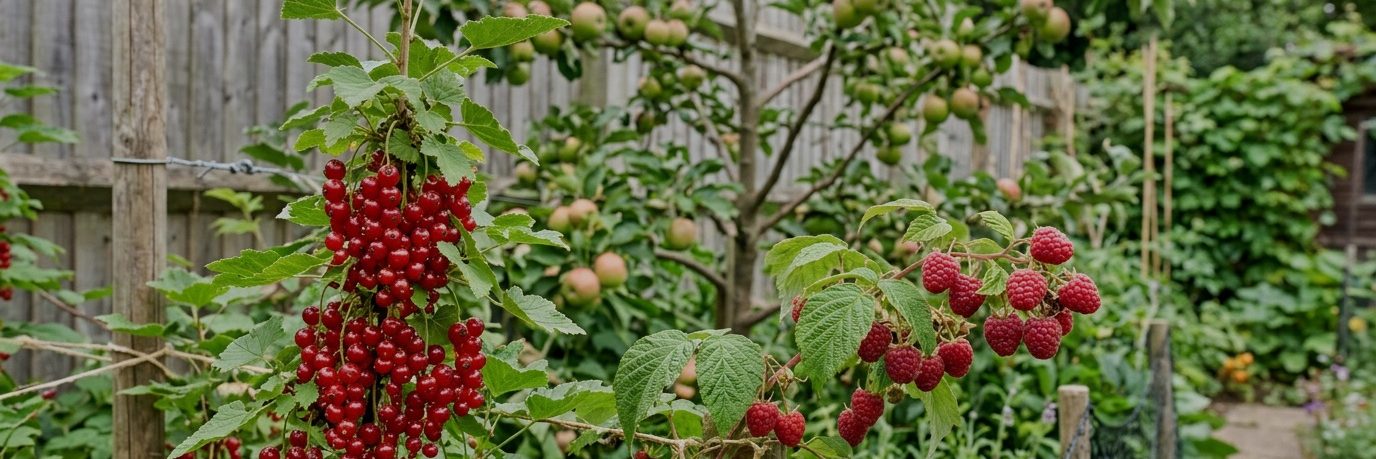
For a temperate garden, start with small fruits, which crop quickly: raspberry, redcurrant, blackcurrant and blueberry produce within one to two years. Then add fruit trees (apple, pear, cherry, plum) chosen for their pollination. The blueberry demands acid soil and rainwater; the fig calls for the garden’s warmest wall, the one that catches the midday sun.
Small fruits, the quick reward
If you are starting a fruit garden, begin with small fruits. A raspberry planted in autumn already bears fruit the following summer, and everbearing varieties sometimes produce in the very first year. The redcurrant and the blackcurrant are quicker still: a bare-root clump set out is harvested after one or two summers, with no complicated pruning and no pollinator to plan for. In a damp temperate climate, these hardy shrubs fear neither wet winters nor frosts, and they make do with ordinary soil as long as it does not stay permanently waterlogged.
The blueberry is the only fussy one of the lot. It demands a distinctly acid soil (pH around 4 to 5), which most garden soils do not offer: plant it in a large pot or a pit of ericaceous soil, and water it with rainwater rather than tap water, which is often too chalky. The grapevine, for its part, grows very well in a temperate climate provided you give it a well-exposed wall or pergola: it is a climbing small fruit that mainly wants sun and an annual pruning to stay productive.
Fruit trees: think about pollination first
Fruit trees ask for more patience, three to five years before a real harvest, but they shape the garden for decades. The apple and the pear are the safe bets of temperate climates, followed by the plum and the cherry. Before buying, ask yourself a single question: pollination. Most of these trees are self-sterile, in other words they need a second tree of a different but compatible variety, flowering at the same time, in order to set fruit. If you only have room for a single tree, choose a self-fertile variety (some plums such as the Reine-Claude d’Oullins, several modern cherries) or rely on the neighbours’ trees.
The second criterion is the rootstock. The same apple tree grafted onto a weak rootstock stays a small tree of two to three metres, easy to pick and to prune; grafted onto a seedling stock, it becomes an unmanageable giant in a town garden. For a modest plot, ask the nurseryman for dwarfing or semi-dwarfing rootstocks, and think of trained forms (cordon, espalier) that hold against a wall or along a path without taking up ground space.
Special cases: fig, kiwi, hazel, elder
Some fruiting plants fall outside the usual pattern. The fig grows in a temperate climate, but it needs the warmest spot in the garden: against a wall that catches the midday sun and stores up the day’s heat and cuts off frost, otherwise the figs do not have time to ripen before autumn. Be wary of its sap, a white latex that oozes from cuts and from the green fruit: it irritates the skin and eyes, so prune with gloves and rinse your hands. The kiwi, for its part, is almost always dioecious: you need a male plant to pollinate several female plants, without which you will have a fine vigorous vine and zero fruit. Allow room for two plants and a sturdy structure, because it climbs fast and weighs a lot.
The hazel is easy and hardy, but its enemy is the nut weevil, a small weevil whose larva devours the kernel from the inside; the hazelnuts then drop pierced with a round hole. Gathering and destroying the nuts fallen to the ground breaks the pest’s cycle from one year to the next. The elder, finally, is the toughest of them all: it grows almost by itself in hedges, flowers in early summer and yields clusters of black berries in late summer. It is a good choice for a slightly wild corner of the garden, provided you eat only the fully ripe berries, and cooked, never raw.
Planting bare-root in winter
Most small fruits and fruit trees are planted bare-root, that is, without a rootball, during their dormancy. The window runs from leaf fall to bud break, outside spells of frost and waterlogged soil: late autumn traditionally marks the start of the season, the time when all wood takes root. Bare-root plants cost far less than container-grown ones, establish better and quickly make up for lost time, because their roots set off again as soon as the ground warms up in spring.
The technique is simple. Dig a wide hole, loosen the bottom, and freshen the tips of the roots with a snip of the secateurs before dipping them in a slurry (a mud of soil and water) if you have some. Set the collar at ground level, never buried, keeping the graft union well above the soil; fill in, firming with your hand to drive out air pockets, then water generously even if it is raining, because it is this watering that brings the soil into contact with the roots. For a tree, drive in a stake on the side of the prevailing winds and tie the trunk loosely, until the anchorage takes hold.
Pruning and protecting the harvest
Pruning frightens beginners, but each tree follows its own logic. The apple and the pear are pruned in winter, during dormancy, between leaf fall and the start of growth: this is the moment to open up the centre, remove dead wood and shorten to balance the tree. The cherry and the plum, on the contrary, are pruned in leaf, in summer after the harvest: these stone-fruit trees are prone to gummosis and to diseases that enter through wounds, and a cut made when the sap is flowing heals far faster than an open wound in the middle of a wet winter.
Protecting the harvest matters as much as pruning. Birds love cherries, redcurrants and blueberries: a net laid just before ripening saves the crop without harming them. As for diseases, the grapevine and the apple keep an eye on the sky: in warm, humid weather, downy mildew and scab move in fast. Air the plants, avoid watering the foliage in the evening, gather up the diseased fallen leaves, and you will keep treatments to the strict minimum.
The care sheets to read next
Every plant mentioned has its full sheet: watering, light, soil, pests and a month-by-month calendar.
Raspberry
Rubus idaeus
The raspberry (Rubus idaeus) is a small fruiting shrub, hardy down to -25 °C, that grows wild in the cool woodland of…
Redcurrant
Ribes rubrum
The redcurrant (Ribes rubrum) is a small bushy fruit shrub that produces those pretty clusters of translucent red…
Blackcurrant
Ribes nigrum
The blackcurrant (Ribes nigrum) is a small hardy fruit shrub that is genuinely happy in a cool climate, down to USDA…
Blueberry
Vaccinium corymbosum
The cultivated blueberry (Vaccinium corymbosum) is the large shrubby cousin of the wild bilberry, also called the…
Apple tree
Malus domestica
The apple tree (Malus domestica) is the king of fruit trees in temperate climates, the one that has filled family…
Pear tree
Pyrus communis
The pear tree (Pyrus communis) is the apple tree’s cousin, a fruit tree for the family orchard that gives melting fruit…
Cherry tree
Prunus avium
The cherry tree (Prunus avium) is a vigorous, hardy fruit tree, perfectly at ease in a temperate climate, from USDA…
Plum tree
Prunus domestica
The plum tree (Prunus domestica) is the classic family fruit tree, the one you find at the back of the garden or along…
Fig tree
Ficus carica
The fig tree (Ficus carica) is a Mediterranean tree, yet it really can be grown up to USDA zone 7 provided you shelter…
Grapevine
Vitis vinifera
The grapevine (Vitis vinifera) is a vigorous climber that produces table grapes, grown since antiquity around the…
Kiwi
Actinidia deliciosa
Kiwi (Actinidia deliciosa) is a vigorous fruiting vine from the mountain valleys of central China, later popularised in…
Hazel
Corylus avellana
The hazel (Corylus avellana) is a shrub native to Europe and western Asia, found for as long as anyone can remember in…
Elder
Sambucus nigra
Elder (Sambucus nigra) is a large shrub native to temperate Europe that grows wild in hedgerows, along footpaths and on…
Rhubarb
Rheum rhabarbarum
Rhubarb (Rheum rhabarbarum) is a robust, long-lived perennial that thrives anywhere the winter is a real one. A…
Frequently asked questions
Which fruits should I plant to harvest soonest?
Small fruits, without a doubt. The redcurrant and the blackcurrant crop after one to two years, the raspberry from the summer following planting (sometimes the same year for everbearing types). Fruit trees such as the apple or the pear rather take three to five years before a real harvest.
Do I need to plant two fruit trees to get fruit?
Often, yes. Most apples, pears and cherries are self-sterile: they need a second tree of a compatible variety flowering at the same time to be pollinated. If you are short of space, choose a self-fertile variety or rely on the neighbours’ trees, since pollination works over a good ten metres or so.
When should I plant a fruit tree?
In winter, frost-free, from leaf fall to bud break, when the tree is dormant. Bare-root planting in late autumn is the most economical and the best at taking. Just avoid days when the soil is frozen or waterlogged.
Why is my blueberry turning yellow and not growing?
Almost always because of the soil. The blueberry wants acid ground (pH 4 to 5); in ordinary garden soil, often neutral or chalky, it can no longer take up iron and its leaves turn yellow, that is chlorosis. Plant it in ericaceous soil and water it with rainwater, never with tap water that is too chalky.
Green Hub looks after your plants
Photograph a plant: Green Hub identifies it and writes its care sheet, with no account. Sign in afterwards to keep its dated photos and history over time.
Identify a plantUpdated on
How this sheet is written
Written for Green Hub with the help of language models, then reviewed. It offers gardening guidance, not professional advice: if you are unsure whether a plant is toxic to a child or an animal, ask a vet, a doctor or your national poison centre.