Elder
Sambucus nigra
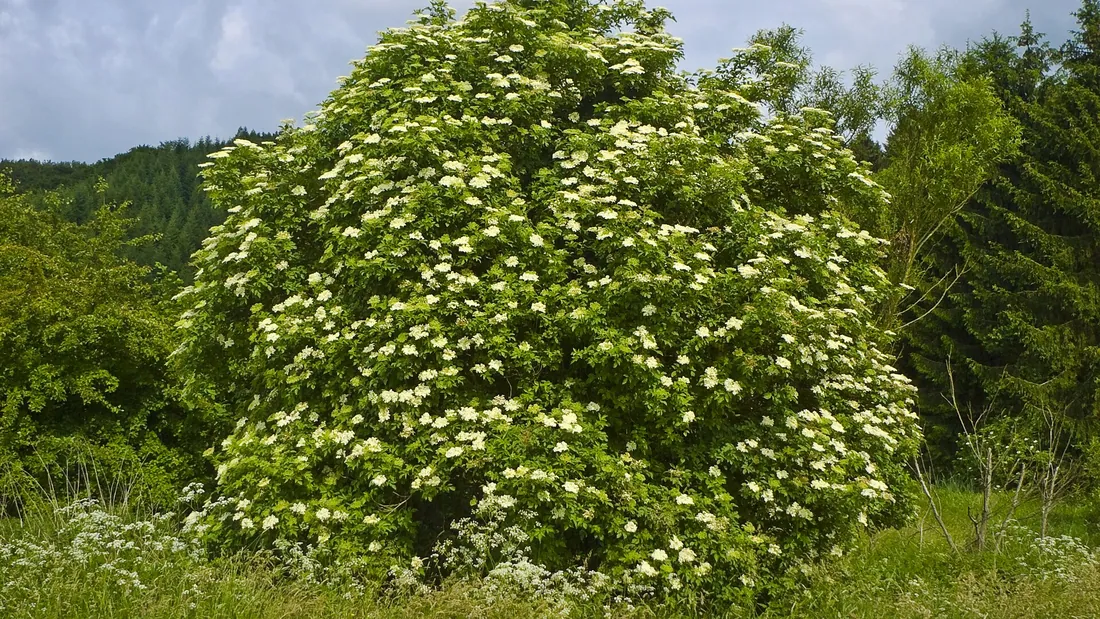

Elder (Sambucus nigra) is a large shrub native to temperate Europe that grows wild in hedgerows, along footpaths and on waste ground. It rewards you generously, covering its branches in huge, fragrant white flower heads in early summer, then heavy clusters of black berries a few months later. It is the basis of syrups and jellies loved in family kitchens everywhere, on one non-negotiable condition: the berries are always cooked, never eaten raw.
Light and exposure
Elder grows happily in full sun or in part shade, it really isn’t fussy. In a hedge or as a stand-alone shrub at the bottom of the garden, it flowers and fruits best with at least half a day of sun; in the deeper shade of a woodland edge it still grows, just with fewer flowers and berries.
It is a natural coloniser of banks, verges and waste ground, so it doesn’t need any special spot to settle in. Just give it a bit of room, as a mature plant quickly reaches three to four metres across.
Watering
Once established, elder more or less looks after its own watering, even through a dry summer. Its deep roots keep finding moisture long after other shrubs start to look thirsty.
Only the first year after planting needs any real attention: water a young plant once or twice a week during dry spells, until it has built up enough of a root system to fend for itself.
Soil and repotting
Elder likes cool, fairly rich soil, especially anything high in nitrogen. It’s no accident that you so often find it near old farmhouses, manure heaps or ruins: it’s a nitrogen-loving plant that thrives on that kind of enriched ground.
In practice it tolerates almost any soil, from heavy loam to something stonier, as long as it isn’t bone dry all the time. Poor soil will simply give you a slightly less vigorous shrub.
Temperature and humidity
Fully hardy in any temperate climate, elder shrugs off winters down to -30 °C, USDA zone 4, and late spring frosts without any trouble at all. No protection is needed, even young plants cope fine with a damp winter.
Heat isn’t a problem either: it comes through a hot summer without any real stress as long as its roots keep a bit of moisture down below. That is its only real limit, a long drought rather than a temperature: beyond zone 8, plant it in a cool bottom or on the side shaded in the afternoon.
Pruning and upkeep
Elder grows fast, really fast, and can be cut back hard in late winter, before the buds break. Don’t hold back on cutting overgrown branches right down: it resprouts from almost anywhere, even from a stump cut nearly to ground level.
This yearly cut keeps its vigour in check and renews the wood, since young shoots flower the most freely. In an informal hedge, a lighter trim every year or every other year is enough to keep a pleasant shape without sacrificing the flowers.
Pests and diseases
Elder has few real enemies. Elder aphid (Aphis sambuci), black and sticky, sometimes builds up in large numbers on young shoots in spring, curling the leaves at the tips of branches. Garden helpers, ladybirds especially, usually clear it up without any intervention needed.
Powdery mildew can show up in hot, dry summers as a white felting on the leaves, but it’s no real threat to such a vigorous shrub. Beyond these minor niggles, elder remains one of the toughest, easiest shrubs to grow in the garden.
Propagation
Cuttings are by far the simplest, most reliable method. In winter, take a woody one-year-old shoot twenty to thirty centimetres long and plant it straight into the ground, buried about halfway: it takes almost every time, no rooting hormone or heat needed.
Elder also suckers readily from the base and from shallow roots, throwing up new shoots around the parent plant that you can lift and replant elsewhere. Growing from seed works too, and the birds do most of that job for you anyway, but it takes a lot more patience before you see the first flowers.
Toxicity
Toxic when raw. The raw berries, as well as the leaves, bark and stems (all the green parts), contain cyanogenic compounds that cause nausea and digestive upset if eaten. The berries only become edible once cooked, as syrup, jelly or jam: cooking destroys these compounds. The flowers, on the other hand, can be eaten safely, raw or cooked. Take care never to confuse black elder with dwarf elder (Sambucus ebulus), a related herbaceous plant that is even more toxic and carries its berry clusters standing upright rather than hanging down.
Climate and hardiness
Where and in which climate it thrives
Black elder is a temperate-climate shrub, hardy down to USDA zone 4, winters around -30 °C; a few horticultural selections stop at zone 5. No protection is needed anywhere in that range, not even for a young plant, and late frosts do not worry it since it breaks bud late and flowers after the leaves. Its growth is spectacularly fast, a young plant can put on more than a metre in a single season.
What limits it is not the cold but the water. It is a nitrogen-loving plant of cool soils, at ease from a mild, rainy oceanic climate to a continental one with a proper winter, as long as the ground does not stay dry for weeks on end. In a Mediterranean climate you only meet it in the wild along watercourses and in shaded valley bottoms: in the garden, give it the same, a cool position shaded in the afternoon, and back-up watering through the summer drought.
The calendar reads in seasons, not in months. Cuttings and pruning during the winter rest, before bud break. The broad, richly scented white flower heads open in early summer, for flower syrup or fritters. The clusters of black berries follow about three months later, in late summer, ready to pick for jelly, syrup or jam, always cooked first. Where the summer is short those three months can run out and some of the clusters never finish ripening: harvest mainly the flowers then. In every case it is a valuable shrub for biodiversity, its flowers feed a whole crowd of pollinators and its berries feast the birds before winter.
Growing elder?
Green Hub keeps a dated history of your own plant: its photos, its progress, its repottings. An AI answers about yours specifically, not a generic sheet, for free.
Identify my plantMonth-by-month care calendar
| January | Complete rest. This is the ideal time to take hardwood cuttings from one-year-old wood and plant them straight into the ground. |
|---|---|
| February | Hard prune before the buds break: cut back any overgrown branches to keep the shrub in check and encourage young wood. |
| March | Elder starts back into growth, the first buds burst open. Finish off any cuttings and bare-root planting. |
| April | Very rapid growth, the leaves fill out almost by the day. Watch young shoots for black aphids. |
| May | Flower buds form at the branch tips. Water a young plant if the weather turns dry. |
| June | Full flower, the big white flower heads scent the whole garden. Pick some for syrup, leave the rest to turn into berries. |
| July | Green berries form and swell. Little to do, just leave the shrub be. |
| August | Clusters start to darken towards the end of the month, depending on the summer. Keep an eye on ripeness, a bit more patience yet. |
| September | Harvest the ripe black berries. Always cook them before eating, into syrup, jelly or jam. |
| October | The leaves turn yellow and drop. The last birds make the most of any berries left. |
| November | A good time to plant a new shrub, bare-root or in a container. |
| December | Winter rest. Study the bare outline of the shrub to plan February’s pruning. |
Green Hub tips
- Never eat the berries raw, or the leaves and bark: only cooking, into syrup, jelly or jam, makes them edible and destroys the toxic compounds.
- Make the most of a double harvest: flowers in early summer for syrup, berries in late summer for jelly, and the shrub won’t suffer if you leave plenty for the birds.
- To propagate an elder for free, plant a simple twenty-centimetre cutting half-buried in winter: it takes almost every time with no special care at all.
- Never confuse the woody black elder with dwarf elder, a herbaceous plant that’s far more toxic, whose berries point upwards instead of hanging in loose clusters.
Related species
Viburnum
Viburnum
Viburnum is not one plant but a whole family of more than a hundred and fifty shrubs, broad enough to cover almost…
Apple tree
Malus domestica
The apple tree (Malus domestica) is the king of fruit trees in temperate climates, the one that has filled family…
Blackcurrant
Ribes nigrum
The blackcurrant (Ribes nigrum) is a small hardy fruit shrub that is genuinely happy in a cool climate, down to USDA…
Blueberry
Vaccinium corymbosum
The cultivated blueberry (Vaccinium corymbosum) is the large shrubby cousin of the wild bilberry, also called the…
Cherry tree
Prunus avium
The cherry tree (Prunus avium) is a vigorous, hardy fruit tree, perfectly at ease in a temperate climate, from USDA…
Fig tree
Ficus carica
The fig tree (Ficus carica) is a Mediterranean tree, yet it really can be grown up to USDA zone 7 provided you shelter…
The guides that mention it
Which Hedge to Plant, and How to Get It Right
Evergreen, deciduous or marcescent, annual growth, hardiness, soil, shade and sea spray: the real criteria for…
Small fruits and fruit trees: where to begin
Raspberry, redcurrant, blackcurrant, blueberry, apple, pear: what to start an orchard with and how to avoid picking the…
Toxic Plants for Cats and Dogs: Recognising the Danger Rather Than Memorising a List
A list of toxic plants is easily forgotten and always incomplete. What actually protects a cat or dog is recognising…
Pruning Flowering Shrubs and Roses: Deducing Instead of Memorising
New wood or old wood: this single question gives you the pruning time for any shrub at all, including ones whose name…
Pruning Fruit Trees: Deducing Instead of Memorising
An apple tree and a cherry tree are pruned neither at the same time nor for the same reason, and the peach is like…
How to Attract Birds to Your Garden, Season After Season
Winter feeding, well-positioned nest boxes, clean water and berry hedges: the complete method, season by season, for…
Wildflower Meadows and Beneficial Insects: Gardening for Biodiversity
Ladybirds, hoverflies, wild bees: how a wildflower meadow and a few simple habits turn an ordinary garden into a refuge…
What to Plant in a Shade Garden, Under Trees and Against Sunless Walls
Under a large tree or against a wall the sun never reaches, shade doesn’t rule out a planting bed: it calls for a…
Updated on
How this sheet is written
Written for Green Hub with the help of language models, then reviewed. It offers gardening guidance, not professional advice: if you are unsure whether a plant is toxic to a child or an animal, ask a vet, a doctor or your national poison centre.