Square Foot Gardening: Fitting More Crops Into Less Space
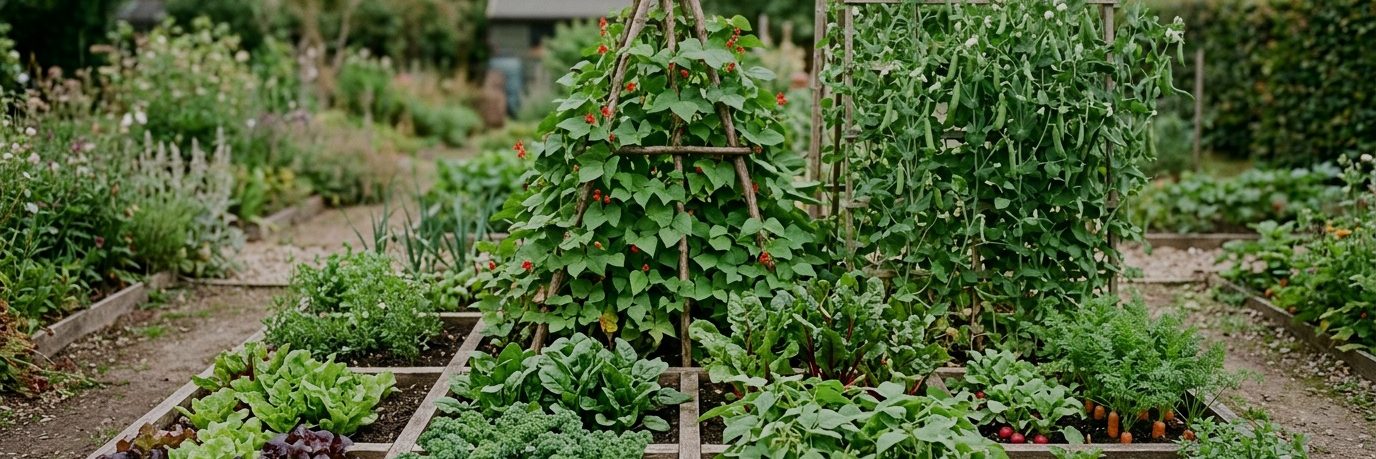
Square foot gardening means dividing a growing bed into regular squares roughly thirty centimetres on a side, each planted at a density set precisely for that vegetable, rather than in the spaced-out rows of a traditional vegetable patch. Paired with vertical trellises for climbing crops, cucumber, pole beans or squash, this grid lets a bed one metre twenty on a side produce what a traditional row would need two to three times the space to match. Every square gets exactly the number of plants it can support, and none sits empty for more than a few days between crops.
Sizing and Building Your Square Foot Bed
The reference size is one metre twenty on a side: it lets you reach the centre of every square from any edge without ever stepping onto the cultivated soil. This square is subdivided into a grid of sixteen thirty-centimetre squares, marked out with thin wooden slats or string stretched between stakes. Build the sides from untreated boards, rough pine, black locust or chestnut, at least twenty to thirty centimetres high: that depth holds a mix of potting soil, mature compost and lightened garden soil, looser than the ground beneath it, which matters most on clay or compacted soil.
When several beds sit side by side, leave a path of sixty to eighty centimetres between them, wide enough for a wheelbarrow. Orient the grid so that the taller trellises end up on the north side of the layout: no low crop then ends up shaded by a row of pole beans at the height of the season. The rule behind everything else in the system comes down to these first decisions: a square bed is never walked on, all the work happens from the edges, which keeps the growing medium loose without digging it over every spring.
The Planting Grid: How Many Plants Per Square by Vegetable
The heart of the method is a density set for each vegetable, worked out so the mature foliage fills the whole square without crowding. Vigorous plants get just one per square: staked tomatoes, courgette, pumpkin or squash, provided they are trained up a trellis rather than left to sprawl on the ground. Medium-sized vegetables go in four to a square, spaced at regular fifteen-centimetre intervals: lettuce falls into this group, whether cut-and-come-again or heading types depending on the season.
Smaller vegetables go in nine to a square, in three rows of three: spinach, beetroot and turnip do well at this spacing without excessive competition. The finest crops are sown sixteen to a square, in four rows of four, one plant every seven to eight centimetres: radish, carrot and leek, the last transplanted young and then earthed up gradually, all belong in this category. Strawberry plants, being perennial, are better given a whole square of their own along the edge, one plant per square, where they stay put for several years without entering the rest of the grid’s annual rotation.
Trellises and Supports for Climbing Crops
Training a crop upward rather than letting it sprawl is what makes a square foot bed truly productive: a cucumber or pole bean plant occupies a single square at ground level, then puts most of its foliage into height, on a plane that eats into no other square. For cucumber and pole beans, a rigid trellis, sheep wire fencing or a metal panel, set up at one metre eighty or even two metres, is more than enough; a square of pole beans holds eight seeds around the base of the trellis, against two or three for a dwarf variety grown flat. Climbing peas follow the same principle on a finer net, put up earlier in the season.
Squash and pumpkin need a sturdier support, able to bear the weight of the fruit once it forms: a thick wooden trellis or a rigid panel firmly anchored in the ground, never a simple string. Past a certain size, each fruit is cradled in a sling or a net tied to the trellis, so its own weight does not snap the stem carrying it. Fix these structures in place before planting: a trellis put up late damages roots that are already established, and a poorly anchored support ends up flat on the ground at the first summer gust.
Sowing in Succession: Rotating Crops Within a Square
A square left empty, even for two weeks, is a square producing nothing: the logic of square foot gardening is to resow as soon as a harvest frees up space, without waiting for the next season. Radish, ready in three to four weeks, suits this rhythm particularly well: one square sown in late winter under fleece, then another once the last frosts have passed, before a square of beans or courgettes takes over for the summer. Spinach follows a similar logic in the cool season, sown as soon as the soil warms and then again at the end of summer for an autumn harvest, since full summer heat makes it bolt too quickly.
Succession also works beneath the trellises: in the first few weeks, before the foliage of pole beans or cucumber closes over into a canopy, the square at the base of the trellis still gets enough light for a row of radishes or a clump of lettuce, harvested just before the shade sets in. In autumn, once the climbers are pulled out, that same square can take a sowing of turnip or autumn spinach without delay, two crops that tolerate the cold and the low light of late season well.
Rotating Families From One Square and One Year to the Next
The general principle of family rotation, and why it curbs disease and pests, is covered in the guide on companion planting in the vegetable garden; what changes with a square foot system is the scale at which it is applied. Rather than rotating long rows, each family shifts by a square, or half a bed, to a different position the following year: the square that held tomatoes moves on to legumes, and the one with root crops like carrot or beetroot takes the place of a former square of cabbages. A rough plan jotted down each winter is enough to avoid relying on memory, especially since the small size of the squares makes mistakes easy to correct from one season to the next.
Modular squares have an advantage a single long row does not: a crop can be moved from one bed to another, right across the garden if needed, without disrupting the rest of the layout. Only the squares holding perennials like strawberries escape this rotation; they are renewed instead every three to four years, by replacing the square’s growing medium and setting young plants elsewhere while the soil rests.
The care sheets to read next
Every plant mentioned has its full sheet: watering, light, soil, pests and a month-by-month calendar.
Bean
Phaseolus vulgaris
The green bean (Phaseolus vulgaris) is one of the easiest vegetables in the kitchen garden, provided you respect one…
Pea
Pisum sativum
The pea (Pisum sativum) is a cool-season legume, hardy to cold but hating heat: its seeds germinate from 4 to 5 degrees…
Cucumber
Cucumis sativus
The cucumber (Cucumis sativus) is an annual vegetable from the warm regions of the southern Himalayas, and it shows: it…
Zucchini
Cucurbita pepo
The zucchini (Cucurbita pepo) is the easy summer vegetable par excellence, one plant yields more than a family can eat.…
Pumpkin
Cucurbita maxima
The pumpkin (Cucurbita maxima) is a large, sprawling, hungry and frost-tender squash that came from the Andes. It is a…
Tomato
Solanum lycopersicum
The tomato (Solanum lycopersicum) is the queen of the vegetable garden, but it is a plant of sun and warmth that plays…
Lettuce
Lactuca sativa
Lettuce (Lactuca sativa) is the most widely grown salad in the vegetable garden, easy and quick, harvested six to ten…
Radish
Raphanus sativus
The radish (Raphanus sativus) is the fastest vegetable in the garden, ready to bite into in three to five weeks. It is…
Carrot
Daucus carota
The carrot (Daucus carota) is a staple root vegetable in the vegetable garden, keeping all winter and sown directly in…
Beetroot
Beta vulgaris
Beetroot (Beta vulgaris) is an easy root vegetable, one of the most forgiving in the kitchen garden. You sow it…
Turnip
Brassica rapa
The turnip (Brassica rapa) is a hardy, fast-growing root, one of the easiest crops in the vegetable garden. Count on 6…
Spinach
Spinacia oleracea
Spinach (Spinacia oleracea) is a cool-season leaf vegetable, hardy and in a hurry to live. Coolness suits it very well:…
Leek
Allium porrum
The leek (Allium porrum) is the winter vegetable par excellence. Very hardy, it stands in the ground all winter and is…
Strawberry
Fragaria x ananassa
The strawberry (Fragaria x ananassa) is a hardy perennial that fits very well into any vegetable garden. Hardy to…
Frequently asked questions
What size should a square foot bed be to get started?
The reference size is one metre twenty on a side, subdivided into sixteen thirty-centimetre squares: this lets you reach the centre of the bed from any edge without ever walking on the cultivated soil. Plan for bed sides at least twenty to thirty centimetres high to hold a mix of potting soil and compost, and a path of sixty to eighty centimetres between neighbouring beds.
How many tomato or squash plants per square?
Just one plant per square for vigorous crops like tomato, courgette, pumpkin or squash, against four for medium vegetables like lettuce, nine for spinach, beetroot or turnip, and up to sixteen for radish, carrot or leek. Squash and pumpkin do best trained up a sturdy trellis so they do not sprawl well beyond their original square.
Which trellis works best for climbing cucumbers and beans?
Sheep wire fencing stretched between stakes, or a rigid metal panel, set up at one metre eighty or even two metres and placed along the north edge of the bed so it does not shade the rest of the grid. Always anchor the support before planting, never after, and add a sling or net under squash or pumpkin fruit once they start putting on weight.
Can you sow a new vegetable right after harvesting radishes?
Yes, that is the main point of the method: as soon as a square frees up, it gets resown without delay, radish then lettuce, or radish then beans in the warm season. Work a handful of mature compost into the surface before the new sowing to make up for what the previous harvest drew out, keeping the square productive from spring through to the first autumn frosts.
Green Hub looks after your plants
Photograph a plant: Green Hub identifies it and writes its care sheet, with no account. Sign in afterwards to keep its dated photos and history over time.
Identify a plantUpdated on
How this sheet is written
Written for Green Hub with the help of language models, then reviewed. It offers gardening guidance, not professional advice: if you are unsure whether a plant is toxic to a child or an animal, ask a vet, a doctor or your national poison centre.