Petunia
Petunia
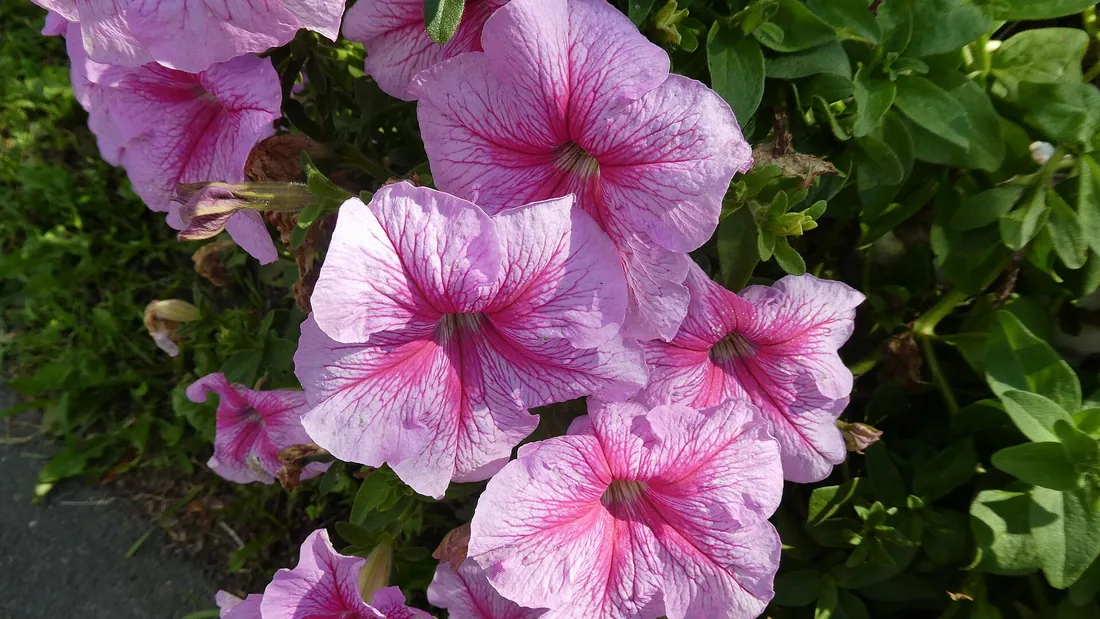

Petunia (genus Petunia), also sold under the name Surfinia for its trailing varieties, is the queen of summer window boxes and hanging baskets. Native to South America, it freezes at zero degrees and is grown purely as an annual anywhere winters drop below freezing. Once planted after the last frost risk has passed, it flowers non-stop right through to the first frosts, as long as you keep it fed and watered without holding back.
Light and exposure
Petunias want sun, plenty of it. Give them the brightest spot on the balcony or terrace, where the midday sun reaches them unobstructed, with at least six hours of direct light a day. In shade, or even partial shade, they get leggy, flower poorly and soon look weak.
This holds just as true for classic petunias in a window box as for trailing surfinias in a hanging basket. A spot that feels sheltered and cosy can be a false economy if it lacks light, the plant pays for it in flowers. Wind itself is not a problem for petunias, unlike heavy rain, which batters the flowers.
Watering
In a pot or hanging basket, petunias get seriously thirsty once the warm weather sets in. The volume of soil is small, the roots heat up fast, and the plant loses a lot of moisture through its many flowers and dense foliage. In high summer, watering every day, sometimes twice a day for a basket in full sun all day long, is nothing out of the ordinary.
Water at the base, keeping the flowers dry, since they dislike standing moisture and brown easily. A petunia that wilts by the end of the day needs water right away, not tomorrow: with this plant, drought is punished fast, with dropped buds and a sharp drop in flowering.
Soil and repotting
A rich, free-draining potting mix works well, whether the plant is in open ground, a window box or a hanging basket. A good compost for flowering plants, lightened with a little perlite for baskets, gives the best results.
Petunias are heavy feeders. In a pot, the nutrients in the compost run out within a few weeks, the plant grows and flowers that fast. A liquid feed for flowering plants every one to two weeks through the whole growing season prevents yellowing foliage and keeps the flowers coming generously right into autumn.
Temperature and humidity
Petunias cannot take frost and will not forgive a single night below zero. Anywhere winters drop below freezing they are frost-tender through and through: grown as annuals, planted out in the garden or in containers once the frost risk has passed, and gone again with the first cold of the cold season.
Never plant petunias outside before your average last frost date has gone by. A few mild weeks at the end of winter guarantee nothing: a late frost can still strike and wipe out overnight plants bought too early from the garden centre. If you do buy them ahead, keep them under cover and bring them in on risky nights.
Pruning and upkeep
Classic petunias, with their large single or double flowers, need their spent blooms removed regularly and their trailing stems pinched back. This simple, repeated task encourages branching and clearly extends the flowering right through summer.
Many surfinias and modern varieties sold today are described as self-cleaning: the spent flowers drop off on their own without setting seed or rotting. They need less upkeep, but any petunia, classic or surfinia, that gets leggy and worn out mid-summer can be cut back by a good third without hesitation: it comes back within a few weeks with flowering denser than before.
Pests and diseases
Under a humid summer, grey mould (botrytis) and various leaf spots go after petunias, especially when the foliage stays wet for long stretches or plants are crowded together with poor air circulation. Space out the containers, avoid watering over the foliage, and remove damaged flowers and leaves without delay.
Aphids happily settle on young shoots and buds, especially early in the season. Chlorosis, recognisable by yellowing between the leaf veins, is almost always a nutrient deficiency rather than a true disease: a proper feed sorts it out within a few days.
Propagation
Sow indoors, in the warmth, ten to twelve weeks before your last frost date, so as to have plants already in flower at planting time. Petunia seeds are tiny and need light to germinate: sow them on the surface, uncovered, on fine, moist compost. Germination takes one to two weeks at a temperature of 20 to 25 degrees.
Cuttings also work very well from an established plant: take a ten-centimetre, flower-free tip cutting, remove the lower leaves and pot it straight into a small pot of light, moist compost under a propagator lid. One thing to note: many shop-bought surfinias are protected varieties, and propagating them is reserved for the licensed grower.
Climate and hardiness
Where and in which climate it thrives
The petunia is a perennial of mild climates that has become an annual everywhere else: it freezes at zero degrees and does not come back. It stays perennial only where it never frosts, in USDA zones 9 to 11, where a clump comes through the winter and starts again; in any colder zone it is grown purely as an annual, sown or bought afresh each year.
It gives its best in a temperate climate with a warm, bright summer and at least six hours of direct sun a day. A cool oceanic climate still suits it very well provided you put it in full sun, but a grey, rainy summer batters the flowers and lets grey mould settle in. In Mediterranean or subtropical climates the flowering season is longer, the heat calls for far more watering, and large single-flowered varieties cope less well than the small-flowered surfinias, which stand up better to both rain and heat.
What changes the procedure depending on the climate: the only date that counts is that of your last frosts. You put the plants out once that risk has passed, never before, however mild the preceding weeks have been, and you pull them up at the first frosts of the cold season. Under a very humid summer, space the containers out and never water over the foliage. In a continental climate with a short season, sow early indoors so as not to lose half the flowering.
Growing petunia?
Green Hub keeps a dated history of your own plant: its photos, its progress, its repottings. An AI answers about yours specifically, not a generic sheet, for free.
Identify my plantMonth-by-month care calendar
| January | Nothing to do outdoors. If you want plants in flower early, this is the time to sow indoors under good light and in the warmth. |
|---|---|
| February | Continue sowing indoors if you have the space and light for it. Otherwise, be patient, garden centres will have young plants from April. |
| March | Last chance to sow your own. Young seedlings need plenty of light to avoid getting leggy, a bright conservatory or windowsill does the job. |
| April | Prick out the seedlings into individual pots. Young plants can be bought at the garden centre now, but keep them under cover, frost is still common. |
| May | Wait until the risk of night frost is definitively over before planting anything outside. Once that point is passed, put out window boxes and hanging baskets in full sun. |
| June | Full growth. Water regularly, feed weekly and remove spent flowers on any variety that is not self-cleaning. |
| July | Flowering at its peak. In hot spells, watering can become a daily job, even twice a day for baskets. Keep feeding. |
| August | A container that is running out of steam or getting leggy can be cut back by a good third to bring on a dense new flush within three weeks. Watch for grey mould after storms. |
| September | Flowering carries on as long as there is no frost. Gradually cut back on feeding as autumn approaches. |
| October | The first frosts bring the season to an end. Pull out the spent plants and empty the containers. |
| November | Petunias are annuals: they do not come back the following year. Clean and store pots and baskets. |
| December | Full rest. Browse the catalogues for colours and varieties to try next season. |
Green Hub tips
- Never plant petunias outside before your last frosts have gone by: a few mild weeks at the end of winter are a trap, a late frost often comes back right afterwards.
- In a window box or hanging basket, water and feed generously all summer: a hungry or thirsty petunia turns yellow and stops flowering outright.
- Deadhead the classic varieties regularly, or pick a self-cleaning surfinia from the start if you want less upkeep.
- Give containers a little shelter during storms: heavy rain damages petunia flowers within hours.
Related species
Bell pepper
Capsicum annuum
The bell pepper (Capsicum annuum) is an annual fruiting vegetable and a genuinely cold-shy one, the sweet cousin of the…
Eggplant
Solanum melongena
The eggplant (Solanum melongena) is the most cold-sensitive and the most heat-hungry of the garden nightshades, even…
Potato
Solanum tuberosum
The potato (Solanum tuberosum) is one of the most rewarding crops in the vegetable garden: easy, productive and…
Tomato
Solanum lycopersicum
The tomato (Solanum lycopersicum) is the queen of the vegetable garden, but it is a plant of sun and warmth that plays…
Althea
Hibiscus syriacus
Althea (Hibiscus syriacus) is a hardy deciduous garden shrub that flowers when every other one has finished, from…
Beech
Fagus sylvatica
Beech (Fagus sylvatica) is the most common broadleaf tree in the temperate forests of Europe, just as happy standing…
The guides that mention it
Perennial Flowers: Choosing, Planting and Blooming Without a Gap All Season
What genuinely comes back year after year, how to read hardiness by zone rather than by promise, and how to string…
Gardening on a Balcony or Terrace: Vegetables and Flowers in Pots
Weight, wind, exposure: what really changes when you garden up high instead of in open ground, and how to choose your…
Wildflower Meadows and Beneficial Insects: Gardening for Biodiversity
Ladybirds, hoverflies, wild bees: how a wildflower meadow and a few simple habits turn an ordinary garden into a refuge…
Sowing Seeds Successfully: Why It Fails, and What Fixes It
A seed that never comes up was not unlucky. Germination temperatures by species, correct depth, seeds that need light,…
Designing your garden by colour: the combinations that work
Warm harmonies, cool harmonies, monochrome schemes or bold contrasts: colour changes everything in a garden, from the…
Updated on
How this sheet is written
Written for Green Hub with the help of language models, then reviewed. It offers gardening guidance, not professional advice: if you are unsure whether a plant is toxic to a child or an animal, ask a vet, a doctor or your national poison centre.