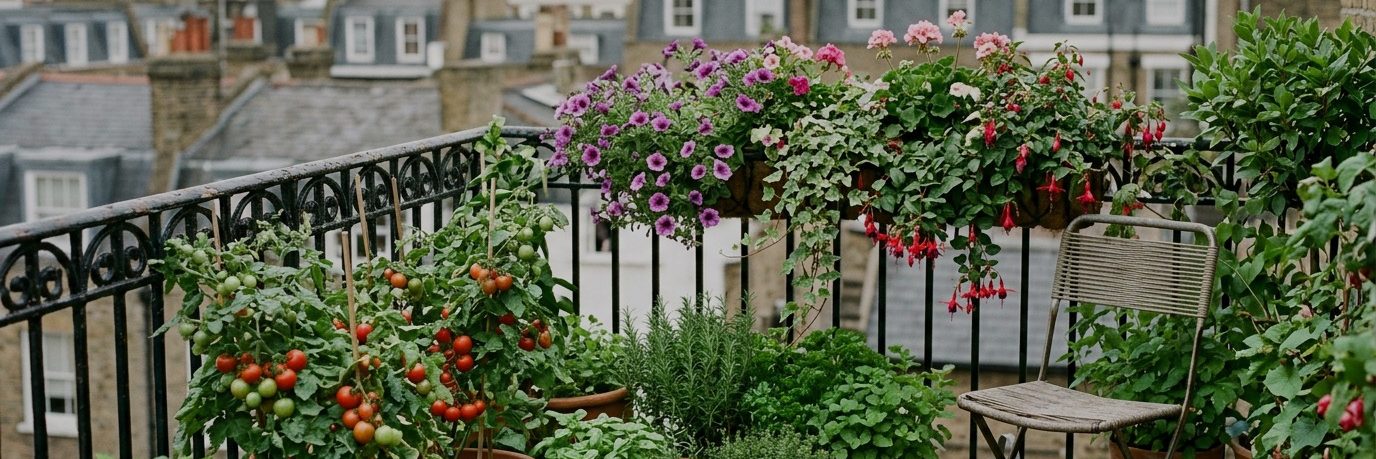
Gardening on a Balcony or Terrace: Vegetables and Flowers in Pots
Gardening on a balcony or terrace follows different rules from gardening in open ground: the weight of waterlogged potting soil, wind that dries things out faster than at ground level, and an exposure that’s often stark, scorching south-facing sun or a shaded north side depending on the facade. A modern balcony generally supports up to 350 kg per square metre of live load, but it’s best to spread pots out and stay cautious near the railing, especially on an older building. The right instinct is to start from the container: depth suited to the crop, lightened potting mix, and watering adapted to the wind rather than to a fixed schedule.
Weight: the real constraint on a balcony
Eurocode 1 (EN 1991-1-1), the European building loads standard, sets the live load of a recently built residential balcony at around 3.5 kN per square metre, or roughly 350 kg per square metre; the exact figure comes from each country’s national annex, and building codes elsewhere land in the same ballpark. That figure means nothing for an older balcony built before these standards existed, with no guaranteed reference value: on an old building, it’s worth checking with the property manager before taking on a sizeable project.
What catches people out most is the weight of water. Dry potting soil weighs 0.4 to 0.5 kg per litre, but soil soaked after rain or watering climbs to 0.8, sometimes 0.9 kg, almost double. A 60 x 20 x 20 cm planter, or 24 litres, goes from around ten kilos dry to nearly 20 kg soaked, not counting the pot itself. Multiply that by several containers and the total adds up fast. Three habits limit the risk: resin pots rather than concrete or thick terracotta, potting mix lightened with perlite or vermiculite, and loads spread across the whole slab, which is stronger at its centre than along the railing or in the corners.
Wind and urban microclimate: why things dry out faster up high
A ground-level garden benefits from soil that buffers extremes. A balcony, especially high up or on an exposed corner, has no such cushion: wind moves freely and speeds up both leaf evapotranspiration and soil evaporation. In high summer, a small pot exposed to the wind, a hanging basket or a railing planter, can dry out in a single day, when the same plant in open ground would last several days.
Heat adds to this in a particular way. A south-facing wall and concrete slab store up the day’s heat and release it in the evening, which prolongs water stress after sunset, something a bed in open ground never experiences. Three fixes work well: increasing container volume, since a larger volume of substrate dries more slowly; mulching the surface, which limits wind-driven evaporation; and grouping pots together rather than isolating them, so they shelter each other from draughts. Hanging baskets and railing planters remain the most exposed and deserve a daily check during a heatwave.
Exposure: reading your balcony before you plant
A south-facing balcony gets direct, prolonged sun, intensified by heat reflected off a pale wall or nearby glazing: an exposure for plants that like to bake. Cherry tomatoes, peppers, aubergines and Mediterranean herbs like thyme, rosemary and lavender thrive there without reservation. Ivy-leaf geranium copes with drought better than zonal geranium, surfinia petunia shrugs off heat spikes where ordinary petunia collapses, and nasturtium flowers all the more if you avoid overly rich soil, which pushes it toward foliage rather than flowers.
A north-facing balcony never sees direct sun: less water stress, substrate that never overheats, foliage that never scorches. Lettuces tolerate this shade well, as does semperflorens begonia, which flowers continuously without a single direct ray, or hosta, whose broad leaves benefit from being shielded from sun that would otherwise burn them. East and west sit somewhere between the two, gentler in the morning than in the afternoon. The real gauge is the hours of sun actually observed on site, not orientation alone, since a solid railing or the balcony above can cast unexpected shade.
The right containers: depth according to the crop
A pot too small for what it’s growing always gives the same result: a plant that stalls, dries out fast and fruits poorly. Lettuces and radishes have shallow roots and are happy with 20 to 25 cm of depth, 15 cm for radish; a rectangular planter lets you stagger sowings. Herbs like basil, chives, thyme and rosemary are satisfied with 15 to 20 cm: group the Mediterranean ones together in the same trough, and keep basil, which is thirstier, on its own.
Cherry tomatoes need at least 30 cm of depth and 20 to 30 litres, with a sturdy stake fixed to the railing, since wind easily topples a tall plant that isn’t well anchored. Peppers, and aubergines even more so, go further still, over 40 cm and 30 to 40 litres, for deep roots and a substrate that doesn’t overheat. Strawberry plants, by contrast, are content with 20 to 25 cm and thrive in a railing planter or hanging pot, where their runners can trail freely. The rule to remember: match the volume to the crop, not the reflex of always going bigger, or you’ll run straight back into the weight problem from the start.
Watering without making it a full-time job, and the flowers that forgive everything
Against the wind and heat of a balcony, two systems avoid daily hand-watering. Drip irrigation, sold as a kit with a timer, delivers a measured dose to each pot from a tap or a water tank connected to a small pump: the most reliable solution once you’re lining up ten or so containers. Self-watering pots, meanwhile, work by capillary action: a wick sits in a reservoir beneath the pot and feeds the soil continuously, with one to three weeks of autonomy, ideal for going on holiday. Either way, test the setup 48 hours before you leave, never on the day itself.
On the flower side, some varieties forgive the lapses of a windy balcony better than others. Ivy-leaf geranium and surfinia petunia hold up all summer in full sun with infrequent watering. Nasturtium, which is edible, grows almost unaided in poor soil and self-seeds from one year to the next. Verbena, in a pot or hanging basket, flowers all summer with minimal upkeep once established. For a north-facing balcony, begonia offers the same generosity without a single ray of direct sun.
The care sheets to read next
Every plant mentioned has its full sheet: watering, light, soil, pests and a month-by-month calendar.
Tomato
Solanum lycopersicum
The tomato (Solanum lycopersicum) is the queen of the vegetable garden, but it is a plant of sun and warmth that plays…
Bell pepper
Capsicum annuum
The bell pepper (Capsicum annuum) is an annual fruiting vegetable and a genuinely cold-shy one, the sweet cousin of the…
Eggplant
Solanum melongena
The eggplant (Solanum melongena) is the most cold-sensitive and the most heat-hungry of the garden nightshades, even…
Lettuce
Lactuca sativa
Lettuce (Lactuca sativa) is the most widely grown salad in the vegetable garden, easy and quick, harvested six to ten…
Radish
Raphanus sativus
The radish (Raphanus sativus) is the fastest vegetable in the garden, ready to bite into in three to five weeks. It is…
Strawberry
Fragaria x ananassa
The strawberry (Fragaria x ananassa) is a hardy perennial that fits very well into any vegetable garden. Hardy to…
Basil
Ocimum basilicum
Basil (Ocimum basilicum) is an annual, cold-sensitive herb that comes from the warm regions of Asia. It is a summer…
Chives
Allium schoenoprasum
Chives (Allium schoenoprasum) are a small perennial of the onion family, with fine hollow stems tasting mildly of…
Thyme
Thymus vulgaris
Thyme (Thymus vulgaris) is a small Mediterranean subshrub with woody stems and a powerful fragrance, hardy to about…
Rosemary
Salvia rosmarinus
Rosemary (Salvia rosmarinus, long known as Rosmarinus officinalis) is an evergreen Mediterranean shrub with needle-like…
Geranium
Pelargonium
What is commonly called a balcony geranium is actually a pelargonium, a plant from South Africa, not to be confused…
Petunia
Petunia
Petunia (genus Petunia), also sold under the name Surfinia for its trailing varieties, is the queen of summer window…
Nasturtium
Tropaeolum majus
The nasturtium (Tropaeolum majus) is an annual native to the Andean highlands of Peru and Colombia that has become an…
Lemon verbena
Aloysia citriodora
Lemon verbena (Aloysia citriodora) is a shrub whose leaves give off a clean, intense lemon scent, the one in an evening…
Lavender
Lavandula angustifolia
True lavender (Lavandula angustifolia) is a hardy Mediterranean plant that scents the air and draws bees all summer…
Begonia
Begonia
Begonia is the star summer flower of window boxes, hanging baskets and shady borders. Hundreds of hybrids exist, but…
Hosta
Hosta
The hosta (Hosta spp.) is a perennial native to the damp woodlands of East Asia, from Japan through China to Korea. It…
Frequently asked questions
What’s the maximum weight a balcony can support for a container vegetable garden?
A recently built residential balcony is designed for around 350 kg per square metre under Eurocode 1 (NBN EN 1991-1-1), but that figure only holds for new construction. On an older building, with no guaranteed reference value, it’s best to check with the property manager and stay cautious. Either way, spread pots across the whole slab rather than along the railing or in the corners, and factor in the weight of the potting soil once it’s soaked, nearly double its dry weight.
What pot depth do you need to grow cherry tomatoes on a balcony?
Allow at least 30 cm of depth and 20 to 30 litres of volume for a potted cherry tomato. A smaller container makes the plant stall and dry out too fast in summer. Also plan for a sturdy, well-anchored stake, since a balcony’s wind easily topples a tall plant that isn’t properly secured.
Which flowers should you choose for a south-facing balcony that heats up a lot?
Ivy-leaf geranium, surfinia petunia, nasturtium and verbena handle the heat and full sun of a south-facing balcony well, needing relatively infrequent watering once established. Avoid overly rich soil for nasturtium, which then produces more foliage than flowers. These varieties also tolerate wind better than more fragile flowers like classic petunia.
How do you water a very wind-exposed balcony while on holiday?
Two solutions limit the damage: a self-watering pot with capillary action, offering one to three weeks of autonomy depending on the heat, or a drip irrigation kit with a timer connected to a tap or a tank. Always test the setup 48 hours before you leave. Mulching the surface of the soil also reduces wind-driven evaporation while you’re away.
Green Hub looks after your plants
Photograph a plant: Green Hub identifies it and writes its care sheet, with no account. Sign in afterwards to keep its dated photos and history over time.
Identify a plantUpdated on
How this sheet is written
Written for Green Hub with the help of language models, then reviewed. It offers gardening guidance, not professional advice: if you are unsure whether a plant is toxic to a child or an animal, ask a vet, a doctor or your national poison centre.