Hydrangea
Hydrangea macrophylla
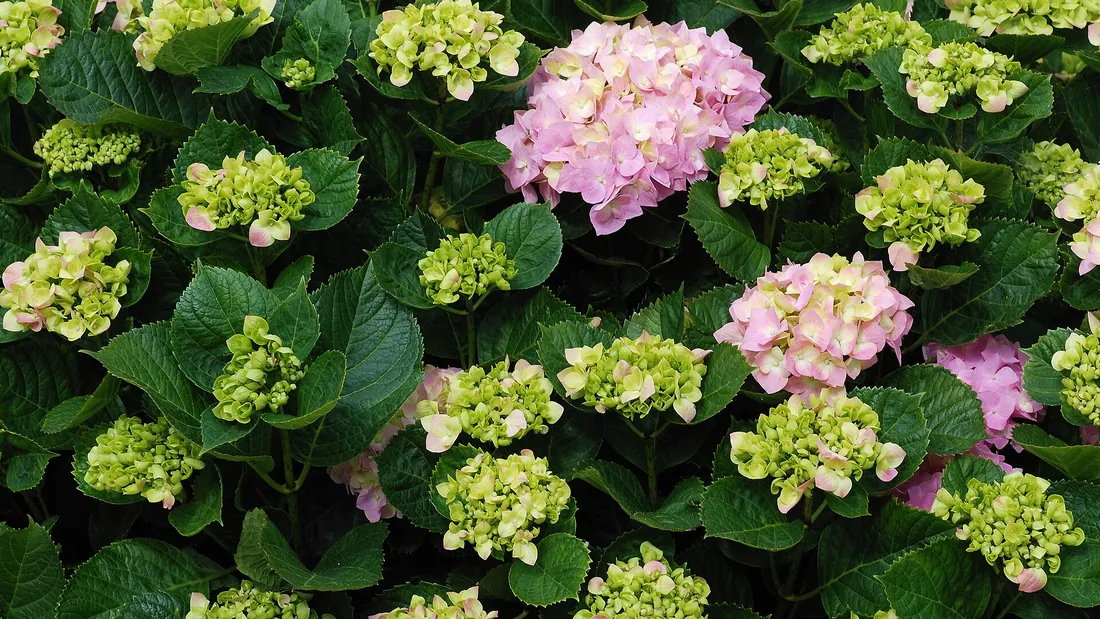

The hydrangea (Hydrangea macrophylla) is the flowering shrub for cool, partly shaded gardens, and one of the very few whose colour you get to choose. Native to the damp woodlands of Japan, it loves coolness, humidity and afternoon shade. Its big flower balls last all summer, and their shade, from pink to blue, depends directly on the soil pH. Undemanding and hardy to around minus 15 degrees, it asks only for cool soil and a tidy-up prune at the end of winter.
Light and exposure
The hydrangea does not like scorching full sun, which fades its flowers and wilts its foliage in summer. It prefers partial shade, or a spot that catches the gentle morning sun and stays in shade during the hot afternoon hours. It is a plant of light woodland.
Under cool, often hazy skies, it tolerates a slightly brighter exposure than in a warm region, but always avoid the sun of the hottest hours without any shade at all. A corner that only catches the morning sun, sheltered from the midday sun and drying winds, suits it perfectly.
Watering
Its name says it: hydrangea means water vessel. The hydrangea is thirsty and hates being short of water. It needs soil that stays permanently cool, especially in summer and especially in the first two years. A hydrangea that drops its leaves in the middle of the day is asking for water.
Water generously in dry spells, at the base, preferably in the evening. A good mulch at its base, bark or dead leaves, keeps the soil cool and spaces out the watering. In a damp temperate climate, the rain covers a large part of its needs, but the dry snaps of high summer call for vigilance.
Soil and repotting
The hydrangea likes a soil rich in humus, cool, deep, and rather acid to neutral. It dreads chalky, dry soils, where it yellows (chlorosis) and stagnates. Enrich the soil with ericaceous compost or leaf mould at planting to satisfy it.
It is also the soil that decides the flower colour of the blue-pink varieties. In acid soil, rich in available aluminium, the flowers turn blue; in neutral or chalky soil, they stay pink. A garden soil that is naturally acid therefore pushes the flowers towards blue with no effort at all. To blue them more, you add crushed slate or an aluminium sulphate-based product; to keep the pink, you avoid acidifying. The white varieties, for their part, do not change colour.
Temperature and humidity
The hydrangea is hardy to around minus 15 degrees, which leaves it comfortable across USDA zones 6 to 9, and the plant comes through winter without trouble. The real risk is not the settled winter but the late spring frosts: they can scorch the young shoots and the flower buds breaking out early in the season, and compromise the year’s flowering without killing the plant.
As most hydrangeas flower on the previous year’s wood, a bud frozen in spring means one flower fewer the following summer. Hence the value of not pruning too short and keeping the faded flowers on the plant all winter: they naturally protect the buds below against the frost. In spots with frequent late frosts, a winter fleece over the young shoots on the cold nights of early spring can save the flowering.
Pruning and upkeep
Pruning the hydrangea is simple but done at the right moment: in spring, once winter is over, not in autumn. Keep the faded flowers on the plant all winter, they protect from frost the buds just below, which will give the summer flowers. Above all, do not cut everything down to the ground.
In spring, once the severe frosts have passed, cut the dry flowers just above the first fine pair of plump buds, and remove the dead wood, the spindly branches and the oldest stems at the base to open up and rejuvenate the clump. Pruning too severely or at the wrong time removes the wood that carried the flowers, and the hydrangea then makes leaves but no balls. When in doubt, prune little.
Pests and diseases
The hydrangea is robust, but powdery mildew (Erysiphe) can cover its foliage with a white felting in hot, stuffy weather, and chlorosis makes the leaves yellow between the veins when the soil is too chalky or short of iron. Against powdery mildew, open up the planting; against chlorosis, add ericaceous soil and, if needed, a little iron.
Attacks generally stay light in a temperate climate. Foliage that wilts in full heat is most often not a disease but a simple bout of thirst: water abundantly and mulch. Also watch for leaf spots in very damp weather, of no real consequence for the plant.
Propagation
The hydrangea takes very easily from cuttings, which makes it an ideal shrub to propagate for free. In high summer, take non-flowering stems of the year, about fifteen centimetres long, remove the lower leaves and halve the large upper leaves to limit evaporation. Plant these cuttings in a light mix and keep them shaded, cool and moist.
Rooting takes a few weeks. Another even simpler method is layering: lay a low stem on the ground, cover it with soil leaving the tip sticking out, and it roots by itself. Sever and transplant the young plant the following year. Bring the young cuttings under shelter for their first winter.
Toxicity
All parts of the hydrangea are slightly toxic if eaten and can cause digestive upset. Harmless in the garden, but keep young children away from the leaves and flowers.
Climate and hardiness
Where and in which climate it thrives
The hydrangea is hardy to around minus 15 degrees, which covers USDA zones 6 to 9; in zone 5 the crown comes back from the base but the stems freeze. That is the whole subtlety: the plant survives far lower than its flower buds do. As most Hydrangea macrophylla flower on the previous year’s wood, a winter dropping below minus 12 degrees, or a late frost after the buds break, destroys the flowering without killing the shrub. Where that is a risk every year, reblooming cultivars, which also flower on the current season’s shoots, settle the matter.
It is at home in a cool, damp, often overcast oceanic climate with mild summers: those are its native conditions, the ones of the Japanese woodland floor. Under a hot dry summer, or in a Mediterranean climate, it only holds up in shade during the hottest hours, in mulched soil watered without fail. In a continental climate, winter gives the orders: earth up the base, leave the stems and the faded flowers in place, and wait for growth to restart properly before pruning. In a subtropical climate it stalls for lack of winter rest and the flowers stay small.
What really changes the handling is therefore the exposure, set against the local heat: the hotter the summer, the more shade it needs. Under cool, frequently cloudy skies it accepts a far brighter spot, as long as it escapes the sun of the hottest hours.
Growing hydrangea?
Green Hub keeps a dated history of your own plant: its photos, its progress, its repottings. An AI answers about yours specifically, not a generic sheet, for free.
Identify my plantMonth-by-month care calendar
| January | Rest. Leave the faded flowers in place, they protect the buds from frost. Do not prune. |
|---|---|
| February | Still at rest. Wait before pruning, the frosts are not over. A dressing of compost at the base is possible. |
| March | Spring pruning once the hard frosts have passed: cut the dry flowers above a fine pair of buds, remove the dead wood. |
| April | Buds breaking out. Watch for late frosts that can scorch the young shoots. Mulch the base. |
| May | Active growth. Protect with a fleece on cold nights if frost threatens the young shoots. Water if the soil dries out. |
| June | Flower buds forming and first flowers. Keep the soil cool, water generously in dry weather. |
| July | Full flowering. Water abundantly, a thirsty hydrangea wilts fast. Take cuttings from non-flowering stems. |
| August | Flowering carries on, the flowers take on their autumn tints. Keep up the watering and the cuttings. |
| September | End of flowering. Reduce the watering. A good time to plant a new one in partial shade. |
| October | Ideal autumn planting. Do not prune, leave the dry flowers on the plant for the winter. |
| November | Going to rest. Mulch the base to protect the roots. Bring the young cuttings under shelter. |
| December | Full rest. The faded flowers in place protect the buds from the cold. Nothing to prune. |
Green Hub tips
- Never prune in autumn: keep the faded flowers all winter, they protect from frost the buds that will make the summer flowers.
- A hydrangea that wilts its leaves in full heat is thirsty, not diseased: water abundantly and mulch the base.
- The colour follows the pH: an acid soil draws towards blue. Add crushed slate for a true blue, let it be for pink.
- Take cuttings in high summer from non-flowering stems, or layer a low stem: the hydrangea propagates all by itself, for free.
Related species
Althea
Hibiscus syriacus
Althea (Hibiscus syriacus) is a hardy deciduous garden shrub that flowers when every other one has finished, from…
Beech
Fagus sylvatica
Beech (Fagus sylvatica) is the most common broadleaf tree in the temperate forests of Europe, just as happy standing…
Begonia
Begonia
Begonia is the star summer flower of window boxes, hanging baskets and shady borders. Hundreds of hybrids exist, but…
Box
Buxus sempervirens
Box (Buxus sempervirens) is an evergreen shrub that has been clipped into balls, cones and low borders in formal…
Butterfly bush
Buddleja davidii
Buddleia (Buddleja davidii), better known as the butterfly bush, is a nearly indestructible shrub that has taken over…
Cherry laurel
Prunus laurocerasus
Cherry laurel (Prunus laurocerasus) is the most widely planted evergreen hedging shrub in temperate gardens, and it is…
The guides that mention it
Perennial Flowers: Choosing, Planting and Blooming Without a Gap All Season
What genuinely comes back year after year, how to read hardiness by zone rather than by promise, and how to string…
Watering Plants Properly: Deciding Rather Than Following a Schedule
Beginners water too often and too little at the same time. How to read the soil instead of the calendar, tell thirst…
Overwintering your plants without losing them
Clivia, lavender, verbena, geranium, olive: which to bring indoors, which to protect outside, which to leave to face…
Repotting your plants and choosing the right potting mix
The right moment, the right technique and the right substrate for each plant, so you can repot without rotting the…
Toxic Plants for Cats and Dogs: Recognising the Danger Rather Than Memorising a List
A list of toxic plants is easily forgotten and always incomplete. What actually protects a cat or dog is recognising…
Making Compost: Steering the Thermal Biology of the Heap
A compost heap is not a pile of waste you stir, it is a thermal process you steer. The real carbon/nitrogen ratio of…
Improving Clay Soil: Diagnosis, Amendments and Drainage
Ground that clings to your boots in winter and cracks open in summer: a clay soil is not condemned, it changes with the…
Garden Mulching: Every Mulch Has an Effect and a Drawback
Mulching is presented everywhere as a benefit with no downside. There is one for every material: what nitrogen drawdown…
Updated on
How this sheet is written
Written for Green Hub with the help of language models, then reviewed. It offers gardening guidance, not professional advice: if you are unsure whether a plant is toxic to a child or an animal, ask a vet, a doctor or your national poison centre.