Nasturtium
Tropaeolum majus
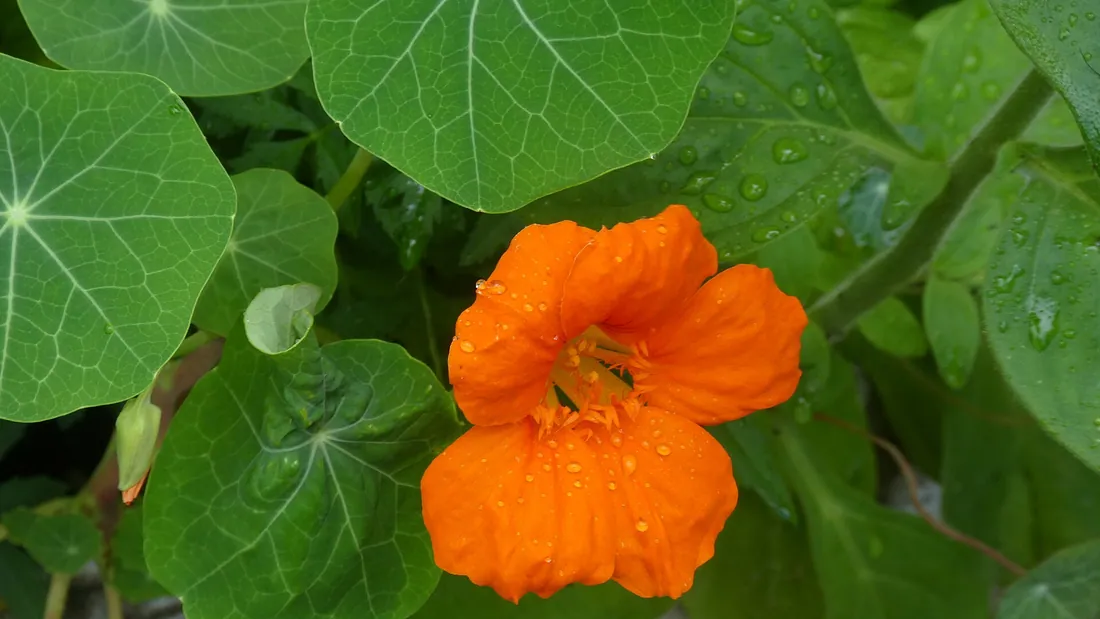

The nasturtium (Tropaeolum majus) is an annual native to the Andean highlands of Peru and Colombia that has become an indestructible favourite of gardens and vegetable patches. It is one of the rare plants that thrives on neglect: sown straight into the ground once the last frosts have passed, in poor soil and without a scrap of fertiliser, it quickly spreads its round leaves and orange, red or yellow flowers right up until the autumn frosts. Climbing up a trellis or trailing from a hanging basket, it also earns its keep in the vegetable garden by drawing black aphids away from broad beans and cabbages.
Light and exposure
Nasturtiums want full sun, at least six hours a day. It is in full sun that they flower most and that their colours, bright orange, deep red or yellow, stay truest. In part shade they still grow but put their energy into leaves rather than flowers.
They are happy almost anywhere, a tub on a sun-baked terrace, the foot of a trellis, a balcony planter or a dry slope in the garden where little else grows easily. It is precisely in poor, sun-baked corners that they perform best.
Watering
Nasturtiums cope well with drought once established and dislike being overwatered. Water moderately after sowing to help germination, then space out the watering: soil that stays a little dry between waterings pushes the plant to flower rather than to bulk up its leaves.
In a pot or hanging basket the compost dries out faster and needs a bit more attention in high summer, but keep a light hand. Too much water combined with rich soil is exactly the combination that gives you a nasturtium all leaves and no flowers.
Soil and repotting
This is the point that surprises people most: nasturtiums prefer poor, well-drained soil to rich ground. Soil that is too fertile, loaded with nitrogen, pushes the plant into lush foliage at the expense of flowers. Never feed a nasturtium, even in a pot: no fertiliser, no fresh compost, at most a little ordinary potting mix at sowing time.
A sandy, stony or simply unfertile corner of the garden, the spot where nothing else wants to grow, often makes the ideal home. It is one of the few garden flowers that does better in poverty than in comfort.
Temperature and humidity
Nasturtiums are frost-tender at every stage. Seeds only germinate from around 12 to 15 degrees of soil temperature, and a frost, even a light one, blackens the foliage and ends the flowering overnight.
You therefore never sow or plant before the last frosts have passed and the soil has warmed. After that the plant grows without any trouble all through the warm season, even in dry heat, and carries on until the first autumn frosts, which always bring the season to an abrupt end. Where winters stay frost-free the cycle is reversed: it flowers through the cool season and runs out of steam in high summer.
Pruning and upkeep
Nasturtiums need no structural pruning, but two simple habits clearly extend the flowering. Deadhead the spent flowers as you go: the plant then stops putting its energy into seed and keeps producing new blooms.
On climbing varieties, pinch out the tips of young stems to force them to branch and cover a trellis or netting more thickly. On trailing varieties in a planter, let them run freely, it is exactly that spilling habit that gives the effect you want.
Pests and diseases
Black aphids are the nasturtium’s most faithful visitor, and largely by design: the plant is used as a trap crop in the vegetable garden, planted near broad beans or cabbages to draw the colonies onto it instead of onto the crop. A nasturtium well covered in black aphids is doing its job, as long as the infestation does not weaken it too much; otherwise a firm jet of water or cutting back the worst-affected stems is enough to get it going again.
Cabbage white caterpillars sometimes riddle the round leaves with holes, especially in summer near a cabbage patch. Apart from these two visitors, the nasturtium is a tough plant, rarely troubled by the usual garden fungal diseases.
Propagation
Direct sowing is by far the simplest method, and it is the one nasturtiums prefer. Sow the large round seeds straight into the ground once the last frosts have passed, about two centimetres deep, in stations of two or three seeds spaced roughly twenty centimetres apart. Germination takes one to two weeks.
The seeds are big and easy to handle, which makes this one of the very first plants worth letting children sow themselves. Nasturtiums also often self-seed from one year to the next: do not be surprised to see new plants coming up in the same spot the following year, without you having sown a thing.
Climate and hardiness
Where and in which climate it thrives
The nasturtium is a perennial from the high tropical Andes that frost kills outright: the foliage blackens at zero degrees and the plant is gone overnight. It is genuinely perennial only in USDA zones 9 to 11, where it comes through the cold season and shoots again from the crown. Everywhere else, from zone 2 to zone 8, it is grown as an annual: sown every year, cut down by the first frosts, and never left outdoors over winter.
Its window is the mild half of the year. Seeds only germinate from a soil temperature of 12 to 15 degrees, and the plant is at its best between 15 and 25 degrees. In a temperate climate you therefore sow in place once the last frosts have passed and the soil has warmed, and flowering runs until the autumn frosts. In a Mediterranean or subtropical climate the logic is reversed: the nasturtium becomes a cool-season plant, sown at the start of the mild season and flowering all winter, while a high summer above 30 degrees, especially a humid one, stops it flowering. In a continental climate with a short summer, sowing in pots three to four weeks before planting out buys time, as long as you transplant without disturbing the rootball: it hates being disturbed.
Two traits owe nothing to climate. It demands poor soil: the more nitrogen there is, the more leaves it makes and the less it flowers, at any latitude. And it self-seeds as soon as the seeds survive on the ground, in the same spot or nearby. That is what makes it one of the very first plants worth letting a child sow: large seeds that are easy to handle, germination in one to two weeks, visible results within a few weeks. Flowers, leaves and young seeds are all edible, with a peppery taste close to watercress, and in the vegetable garden it works as a trap plant, drawing black aphids away from broad beans and cabbages.
Growing nasturtium?
Green Hub keeps a dated history of your own plant: its photos, its progress, its repottings. An AI answers about yours specifically, not a generic sheet, for free.
Identify my plantMonth-by-month care calendar
| January | Nothing to do in the garden. This is the time to order seeds and pick your colours, from classic orange to deep mahogany red. |
|---|---|
| February | Patience. Still far too early, the ground is cold and frost is still likely. |
| March | Still too early for open ground. If you want a head start, a few seeds can be started under cover in pots, though it is not necessary. |
| April | Prepare a poor, well-drained spot and resist the urge to enrich it. Frost can still strike, so hold off on sowing outside. |
| May | Direct sowing into open ground once the last frosts have passed and the soil has warmed to around twelve degrees, about two centimetres deep. |
| June | Fast germination and growth. The first flowers open towards the end of the month. |
| July | Full flowering. Deadhead spent blooms and pick young leaves and flowers for salads. |
| August | Flowering continues strongly. Watch the black aphids, part of the plan if it is acting as a trap crop, and check for cabbage white caterpillars. |
| September | Still generous flowering. A good time to pick young seed pods if you want to try pickling them. |
| October | Flowering fades with the first frosts, which usually arrive this month or the next. |
| November | The frost blackens the plant and ends the cycle. Clear away the dead growth and collect any ripe seeds for next year. |
| December | Rest. Note which corners of the garden it self-seeded into, and plan next year’s poor, sunny spot. |
Green Hub tips
- Never feed a nasturtium: poor soil gives you flowers, nitrogen-rich soil gives you leaves and almost nothing else.
- Plant it near broad beans or cabbages in the vegetable garden: it draws black aphids onto itself and works as a trap crop.
- Flowers, leaves and young seeds are all edible, with a peppery taste close to watercress, lovely for lifting a salad.
- Sow straight into open ground once the last frosts have passed, about two centimetres deep: the large seeds need no pricking out at all.
Related species
Althea
Hibiscus syriacus
Althea (Hibiscus syriacus) is a hardy deciduous garden shrub that flowers when every other one has finished, from…
Beech
Fagus sylvatica
Beech (Fagus sylvatica) is the most common broadleaf tree in the temperate forests of Europe, just as happy standing…
Begonia
Begonia
Begonia is the star summer flower of window boxes, hanging baskets and shady borders. Hundreds of hybrids exist, but…
Box
Buxus sempervirens
Box (Buxus sempervirens) is an evergreen shrub that has been clipped into balls, cones and low borders in formal…
Butterfly bush
Buddleja davidii
Buddleia (Buddleja davidii), better known as the butterfly bush, is a nearly indestructible shrub that has taken over…
Cherry laurel
Prunus laurocerasus
Cherry laurel (Prunus laurocerasus) is the most widely planted evergreen hedging shrub in temperate gardens, and it is…
The guides that mention it
Perennial Flowers: Choosing, Planting and Blooming Without a Gap All Season
What genuinely comes back year after year, how to read hardiness by zone rather than by promise, and how to string…
Vegetable Garden Pests: The Natural Method That Holds All Season
A leaf riddled with holes, a lettuce shaved to the ground overnight, a twisted and sticky shoot: every kind of damage…
Gardening on a Balcony or Terrace: Vegetables and Flowers in Pots
Weight, wind, exposure: what really changes when you garden up high instead of in open ground, and how to choose your…
Wildflower Meadows and Beneficial Insects: Gardening for Biodiversity
Ladybirds, hoverflies, wild bees: how a wildflower meadow and a few simple habits turn an ordinary garden into a refuge…
Companion Planting in the Vegetable Garden: Which Plants Belong Together
Tomatoes and basil get along beautifully, while potatoes and tomatoes make each other sick: companion planting explains…
Which Garden Flowers Are Edible, and How to Cook With Them
From flower bed to plate: the flowers that are genuinely edible, the harvesting method that preserves their flavour,…
Gardening with Children: Where to Start in the Vegetable Patch
Radishes that sprout in a week, peas nibbled straight from the row, potatoes dug up like buried treasure: the vegetable…
Sowing Seeds Successfully: Why It Fails, and What Fixes It
A seed that never comes up was not unlucky. Germination temperatures by species, correct depth, seeds that need light,…
Updated on
How this sheet is written
Written for Green Hub with the help of language models, then reviewed. It offers gardening guidance, not professional advice: if you are unsure whether a plant is toxic to a child or an animal, ask a vet, a doctor or your national poison centre.