Strawberry
Fragaria x ananassa
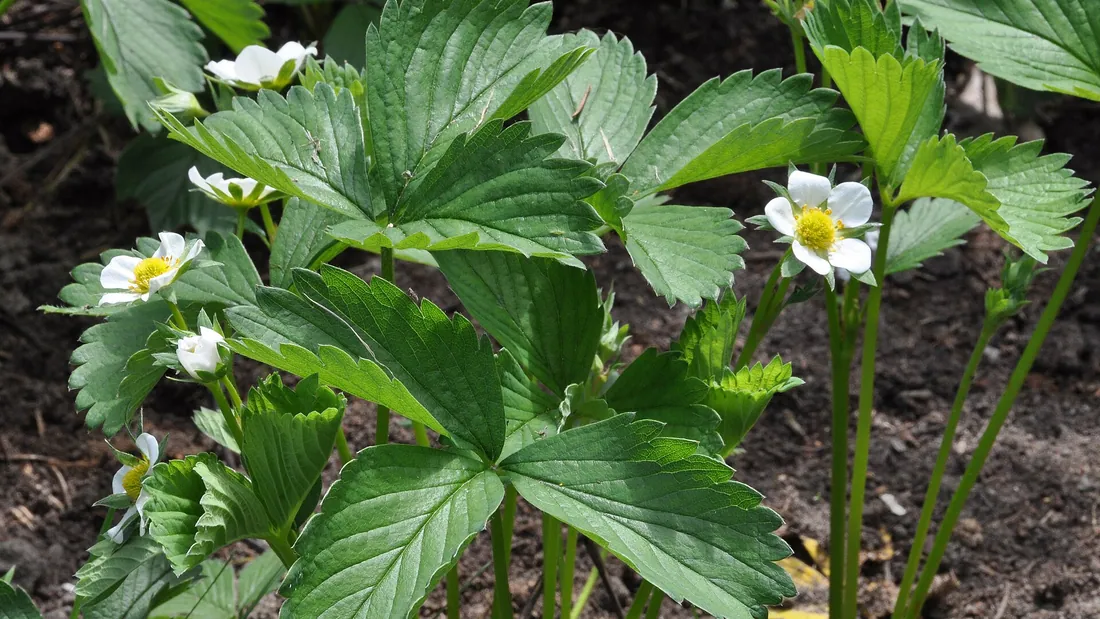

The strawberry (Fragaria x ananassa) is a hardy perennial that fits very well into any vegetable garden. Hardy to around minus fifteen degrees, it comes back every year once established and spreads on its own through its runners, those creeping stems that produce daughter plants. It likes cool summers but dreads stagnant moisture, which rots the fruit. Well-drained soil, a mulch under the strawberries and a renewal of the plants every three years ensure fine harvests from early summer into the late season.
Light and exposure
The strawberry wants sun to produce sweet fruit, at least six hours a day. A sunny spot, sheltered from the prevailing cold winds, suits it perfectly. In too shady a situation, it makes plenty of leaves and few strawberries, often bland.
Where sunshine is limited, give it the spot that catches the midday sun: that is the one which makes the most of the available light. Everbearing varieties, which produce a second wave at the end of summer, particularly appreciate a good position to ripen that late crop before the autumn rains.
Watering
The strawberry has shallow roots and needs regular watering, especially during the formation and swelling of the fruit. A lack of water at that moment gives small strawberries. Water at the base, never on the fruit or the foliage, preferably early in the morning.
Excess water and moisture at the crown are just as dangerous as drought: they rot the plant and encourage botrytis. Mulch helps keep an even moisture while holding the fruit dry, away from contact with the soil.
Soil and repotting
The strawberry likes a soil rich in humus, light, fresh and above all well drained, slightly acidic for preference. Enrich the bed with mature compost before planting. It hates heavy, waterlogged soils, where its roots suffocate.
In clayey, damp soils, common wherever winters are rainy, plant preferably on mounds or raised beds to drain off excess water, especially during the cold season. Good drainage is the key to avoiding rot of the roots and crown during the bad season.
Temperature and humidity
The strawberry is a hardy perennial that copes well with winter. Cold does not worry it: it loses part of its foliage and starts again in spring. It even needs a spell of winter cold to flower well afterwards.
The real risk is not the cold but the late frosts of the end of spring, which can burn the first flowers and compromise part of the harvest. If flowers are already open when a night frost is forecast, cover the bed with a horticultural fleece for the night. Soil moisture during the cold season remains its main constraint, hence the importance of drainage.
Pruning and upkeep
Caring for the strawberry mainly comes down to managing the runners, those long stems that set off from the plants and root nearby. During the season, cut them back regularly so the plant concentrates its energy on the fruit rather than on its multiplication. Keep only a few at the end of summer if you want to make new plants.
After the harvest, clean up the plants by removing damaged, yellowed or diseased leaves, to air the heart of the clump and limit diseases. In late autumn, a light clean-up and the removal of old leaves prepare the plant for winter.
Pests and diseases
Two fungi lie in wait for the strawberry whenever the air stays damp. Botrytis, or grey mould (Botrytis cinerea), covers the fruit with a grey felt and makes it rot on the plant in mild, humid weather. Powdery mildew (Podosphaera aphanis) marks the underside of the leaves and the fruit with a white felt. Against both, ventilation is your best weapon: space out the plants, weed, mulch to keep the fruit off the ground.
As for pests, slugs love ripe strawberries at ground level, and birds help themselves readily. A straw mulch keeps the fruit clean, and a net protects it from blackbirds. Renew the planting every three years, as old plants accumulate viruses and diseases and produce less and less.
Propagation
The strawberry multiplies very easily through its runners, without buying anything. At the end of summer, spot the well-formed daughter plants at the tip of the runners, those that already have a few roots. Let them root, holding them to the ground if need be, then cut the link with the mother plant and transplant them to their final spot in early autumn.
This regular renewal keeps the strawberry bed vigorous. Always take runners from healthy, productive plants, never from diseased or tired ones. The youngest plants, one or two years old, are the most generous.
Climate and hardiness
Where and in which climate it thrives
The strawberry is a decidedly hardy perennial: once dormant, its crown and roots take cold of the order of minus fifteen to minus twenty degrees, which makes it growable from USDA zones 5 to 8 without special protection. It even needs a spell of winter cold, vernalisation, to flower abundantly afterwards. It does best in a cool temperate climate, oceanic or mildly continental: cool summers suit it better than prolonged dry heat, and above thirty degrees fruit set drops away. In a Mediterranean or subtropical climate, grow it with afternoon shade, on drip irrigation, and often as an annual replanted each year.
The most productive planting is done at the end of summer, six to eight weeks before the first frosts, so the plants root before dormancy and give a fine harvest from the following spring. Planting pot-grown stock at the end of winter is also possible, but the first harvest is then more modest and full production is put back by a year.
Two cases change the procedure. Under a mild, wet winter, stagnant moisture becomes the main constraint: plant on a mound or on a bed raised fifteen to twenty centimetres, and see to the drainage before the rainy season. Under a dry, very cold winter it is frost heave from freeze-thaw cycles that threatens: mulch thickly once the plant is dormant. Everywhere, the costliest risk remains a late frost on an already open flower, damaged from about minus two degrees.
One last thing worth knowing: commercial production in north-western Europe rests for some 85 per cent on a single variety, 'Elsanta', valued by growers for its firmness and keeping quality rather than for its flavour. In the garden there is no transport constraint, so it pays to choose more aromatic varieties such as 'Gariguette' or 'Mara des Bois', which are almost never found in supermarkets.
Growing strawberry?
Green Hub keeps a dated history of your own plant: its photos, its progress, its repottings. An AI answers about yours specifically, not a generic sheet, for free.
Identify my plantMonth-by-month care calendar
| January | Winter rest. The plants are at a standstill. Check that water does not stagnate on the bed during thaws. |
|---|---|
| February | Still at rest. Clean up the old dead leaves and add a little compost between the rows. |
| March | Growth resumes. Lightly rake the soil, remove the mulch soiled by winter, add fertiliser. |
| April | Growth and first flowers. Watch for late frosts and cover with a fleece at night if necessary. |
| May | Abundant flowering. Mulch under the plants to keep the future strawberries dry. Water at the base in dry weather. |
| June | Full harvest of the summer varieties. Pick every two days. Protect from birds with a net. |
| July | End of harvest of the non-everbearers, the everbearers carry on. Cut the runners to concentrate the plant. |
| August | Clean up the plants after harvest. Let a few runners root to make new plants. Second wave of the everbearers. |
| September | Best planting period. Transplant the rooted daughter plants to their final spot. Last everbearing strawberries. |
| October | The plants prepare for winter. Clean up the damaged foliage, weed, add compost. |
| November | Entry into rest. Remove the old leaves. Make sure the drainage is good before the winter rains. |
| December | Complete rest. Nothing to do apart from watching that water does not stagnate around the crowns. |
Green Hub tips
- Plant at the end of summer, six to eight weeks before the first frosts: the plants root before winter and produce from the following spring.
- Mulch under the strawberries as soon as the fruit forms: they stay clean, dry, and botrytis has much less of a hold.
- Renew the strawberry bed every three years with the runners of healthy plants: old plants wear out and accumulate diseases.
- In heavy, damp soil, plant on a mound: the strawberry hates having its feet in water all through the cold season.
Related species
Apple tree
Malus domestica
The apple tree (Malus domestica) is the king of fruit trees in temperate climates, the one that has filled family…
Cherry laurel
Prunus laurocerasus
Cherry laurel (Prunus laurocerasus) is the most widely planted evergreen hedging shrub in temperate gardens, and it is…
Cherry tree
Prunus avium
The cherry tree (Prunus avium) is a vigorous, hardy fruit tree, perfectly at ease in a temperate climate, from USDA…
Peach
Prunus persica
The peach tree (Prunus persica) is a fruit tree that loves far more warmth and sun than a cool temperate climate…
Pear tree
Pyrus communis
The pear tree (Pyrus communis) is the apple tree’s cousin, a fruit tree for the family orchard that gives melting fruit…
Photinia
Photinia x fraseri
Photinia (Photinia x fraseri) is an evergreen shrub in the rose family that has become one of the most widely planted…
The guides that mention it
Watering Plants Properly: Deciding Rather Than Following a Schedule
Beginners water too often and too little at the same time. How to read the soil instead of the calendar, tell thirst…
Making Compost: Steering the Thermal Biology of the Heap
A compost heap is not a pile of waste you stir, it is a thermal process you steer. The real carbon/nitrogen ratio of…
Garden Mulching: Every Mulch Has an Effect and a Drawback
Mulching is presented everywhere as a benefit with no downside. There is one for every material: what nitrogen drawdown…
Vegetable Garden Pests: The Natural Method That Holds All Season
A leaf riddled with holes, a lettuce shaved to the ground overnight, a twisted and sticky shoot: every kind of damage…
Garden Diseases: Recognising What Is Attacking Your Plants, and Acting Before the Spot Appears
A white bloom that wipes off on a fingertip, an angular lesion stopped dead by a vein, a fruit browned from the bottom…
Gardening on a Balcony or Terrace: Vegetables and Flowers in Pots
Weight, wind, exposure: what really changes when you garden up high instead of in open ground, and how to choose your…
Rainwater Harvesting for the Garden: Choosing and Sizing Your System
Rain barrel, above-ground tank, or underground cistern: how to choose the right size so your vegetable garden no longer…
Companion Planting in the Vegetable Garden: Which Plants Belong Together
Tomatoes and basil get along beautifully, while potatoes and tomatoes make each other sick: companion planting explains…
Updated on
How this sheet is written
Written for Green Hub with the help of language models, then reviewed. It offers gardening guidance, not professional advice: if you are unsure whether a plant is toxic to a child or an animal, ask a vet, a doctor or your national poison centre.