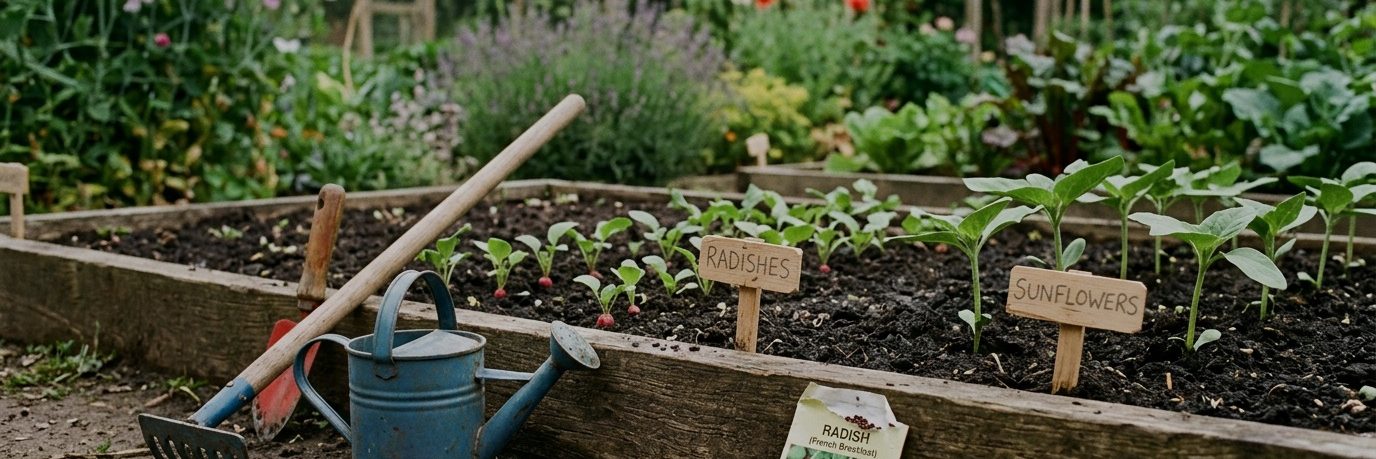
Gardening with Children: Where to Start in the Vegetable Patch
Gardening with children works when you choose plants that deliver on their promise quickly: a big, easy-to-sow seed, sprouting within days, a harvest that can be eaten right there in the patch. Radishes, beans, peas, courgettes, pumpkins and sweetcorn fulfil that contract far better than a delicate flower or a demanding vegetable. The rest comes down to organisation: a bed at child height, tools sized for small hands, and an adult willing to accept crooked rows and radishes pulled up too soon. In a temperate climate, most outdoor sowing starts once the last frosts have passed.
A Garden Corner at Child Height
Nothing motivates a child like a space that truly belongs to them. A one-metre-square bed, or a raised planter forty centimetres high, stays within reach without anyone trampling the seedlings. A small sign planted in the corner, with the child’s name on it, changes the status of the place: it’s no longer the parents’ garden, it’s theirs.
Let the child pick two or three plants from a short list rather than deciding everything for them; the desire to watch something they chose themselves grow outweighs any particular vegetable. Tools sized to their hands, a small trowel with a rounded tip, a light watering can they can carry full without tiring, spare them the frustration of a handle that’s too long.
The adult’s role is limited to showing a gesture once, then stepping back: straightening a crooked row or resowing in the child’s place robs them of the success as much as the failure. Short daily visits, five minutes to see what’s changed since the day before, build the habit better than one long weekly session. Waiting until the last frosts have passed and the soil has warmed up before sowing outdoors limits failures linked to soil that’s still cold, where germination drags on and discourages quickly.
The Vegetables That Never Disappoint
The radish remains the undisputed champion of the first sowing: a seed that’s easy to grasp, sprouting in four to six days, ready to harvest in barely three to four weeks, enough to hold a child’s patience from start to finish. Beans, whether dwarf or climbing, are sown by hand in clusters of two or three seeds and sprout within about ten days; planted at the foot of a wigwam of sticks, they visibly climb higher every day. Peas offer the same big, easy-to-handle seed, and above all the magic of opening a pod and eating the raw peas straight from the row, no kitchen required.
The courgette impresses with its speed: a single plant feeds a whole family, its leaves grow visibly by the day, and a fruit left for two days turns into a club, a measuring game children love to repeat. The pumpkin, sown in a cluster once all risk of frost has gone, sends out a long trailing stem to keep an eye on all summer before its spectacular autumn harvest. Sweetcorn often outgrows the child within a few weeks; it’s sown in a block of at least four rows to pollinate properly, and tastes best picked and cooked that same evening, noticeably sweeter than anything from the shop.
Seed Size: The Secret to Success with Small Hands
A seed as big as a bean, a pea, a pumpkin, sweetcorn or nasturtium can be placed one by one, spaced out with a finger and covered with no real effort: the best candidates for a child’s first independent sowing. Tiny seeds like carrot or basil, by contrast, quickly frustrate a child: uneven sowing, slow germination, thinning out afterwards a must. The trick that saves the session: mix these fine seeds with a little dry sand before scattering them, and let the adult finish the thinning a few days later without the child feeling left out.
The nasturtium deserves a special mention: its seed, almost as big as a pea, germinates within about a week and produces edible flowers within just six to eight weeks, with a peppery taste that always surprises. For tomatoes and basil, which need more warmth at the seedling stage, it’s better to buy young plants already sprouted and let the child transplant them: digging a hole, sliding in the root ball and firming the soil around it is just as rewarding as sowing, without the uncertain wait of the first few weeks.
The Underground Treasure Hunt: Potatoes, Carrots and Strawberries
Planting potatoes is often the activity children ask for most, once they’ve tried it. All it takes is burying a sprouted tuber in a large tub or a trench of loose soil, then waiting for summer: digging with bare hands to discover how many potatoes have formed around the plant feels exactly like a treasure hunt, and the number found quickly becomes a counting game.
Carrots demand more patience, two to three weeks of slow germination, but the reward is of the same order: giving a sharp tug on the leaves and watching a well-formed orange root appear is a moment few children forget. Sown in a row in loosened soil, free of stones and compacted earth, carrots forgive sowing mistakes more readily.
The strawberry plant plays a different game, that of time: planted once, it comes back every year and turns early summer into an eagerly awaited event. A raised planter keeps the fruit clean and within reach, and a strawberry picked warm from the sun and eaten on the spot remains, for many children, their very first taste memory from the garden.
From Harvest to Plate: The Gesture That Closes the Loop
Garden educators see it year after year: a child who has sown, watered and harvested a vegetable with their own hands is far more willing to taste it than the same vegetable simply served on a plate. This link between the action and the appetite is worth cultivating deliberately: crunching a radish with a little salt while sitting in the grass, peeling and cooking a cob of sweetcorn the very evening it’s picked, scattering nasturtium flowers over a salad for colour, all small rituals that close the loop between sowing and eating.
On the safety side, the essentials fit in a few words: age-appropriate tools, a round-tipped trowel and secateurs always handled under direct supervision, gloves for handling soil or compost, and washing hands systematically after gardening and before tasting anything. The simplest rule to enforce remains: never put anything in the mouth without the present adult’s approval, until the child learns to recognise for themselves what’s safe to eat in their own patch.
The care sheets to read next
Every plant mentioned has its full sheet: watering, light, soil, pests and a month-by-month calendar.
Radish
Raphanus sativus
The radish (Raphanus sativus) is the fastest vegetable in the garden, ready to bite into in three to five weeks. It is…
Bean
Phaseolus vulgaris
The green bean (Phaseolus vulgaris) is one of the easiest vegetables in the kitchen garden, provided you respect one…
Pea
Pisum sativum
The pea (Pisum sativum) is a cool-season legume, hardy to cold but hating heat: its seeds germinate from 4 to 5 degrees…
Zucchini
Cucurbita pepo
The zucchini (Cucurbita pepo) is the easy summer vegetable par excellence, one plant yields more than a family can eat.…
Pumpkin
Cucurbita maxima
The pumpkin (Cucurbita maxima) is a large, sprawling, hungry and frost-tender squash that came from the Andes. It is a…
Nasturtium
Tropaeolum majus
The nasturtium (Tropaeolum majus) is an annual native to the Andean highlands of Peru and Colombia that has become an…
Strawberry
Fragaria x ananassa
The strawberry (Fragaria x ananassa) is a hardy perennial that fits very well into any vegetable garden. Hardy to…
Tomato
Solanum lycopersicum
The tomato (Solanum lycopersicum) is the queen of the vegetable garden, but it is a plant of sun and warmth that plays…
Carrot
Daucus carota
The carrot (Daucus carota) is a staple root vegetable in the vegetable garden, keeping all winter and sown directly in…
Potato
Solanum tuberosum
The potato (Solanum tuberosum) is one of the most rewarding crops in the vegetable garden: easy, productive and…
Sweet corn
Zea mays var. saccharata
Sweet corn (Zea mays var. saccharata) is a tall, tender annual grass grown for its sugary cobs, eaten fresh or grilled.…
Basil
Ocimum basilicum
Basil (Ocimum basilicum) is an annual, cold-sensitive herb that comes from the warm regions of Asia. It is a summer…
Frequently asked questions
From what age can a child start gardening?
From around two or three, a child happily joins in supervised sensory activities: watering, touching the soil, watching earthworms. By around five or six, they gain enough dexterity to sow large seeds and handle small tools without constant help. From seven or eight, sowing, watering and harvesting can be done almost entirely independently on a small dedicated bed.
Which vegetables are easiest to grow with a child?
Radishes, beans, peas, courgettes, pumpkins and sweetcorn combine the two qualities that matter to a child: a big, easy-to-sow seed and a visible result within just a few weeks. The radish remains the fastest, ready to harvest in three to four weeks, which makes it the best first sowing for testing whether the child wants to carry on.
How do you adapt tools and safety in the garden for a child?
Tools sized to the child, a small round-tipped trowel and a light watering can, prevent frustration and minor mishaps caused by overly heavy equipment. Gloves protect during handling of soil or compost, and washing hands after every session quickly becomes second nature. Any cutting tool, secateurs or a grafting knife, stays in the adult’s hand and is never left within the child’s reach unsupervised.
What should you do if the child gets discouraged or loses patience in the garden?
Always start with a fast-reward plant, the radish first and foremost, before moving on to longer crops like carrots or pumpkins. Keep sessions short, five to ten minutes is enough to observe the day’s changes, and let the child choose some of what gets sown themselves. A crooked row or a failed sowing is part of learning, not a mistake for you to fix on their behalf.
Green Hub looks after your plants
Photograph a plant: Green Hub identifies it and writes its care sheet, with no account. Sign in afterwards to keep its dated photos and history over time.
Identify a plantUpdated on
How this sheet is written
Written for Green Hub with the help of language models, then reviewed. It offers gardening guidance, not professional advice: if you are unsure whether a plant is toxic to a child or an animal, ask a vet, a doctor or your national poison centre.