Pumpkin
Cucurbita maxima
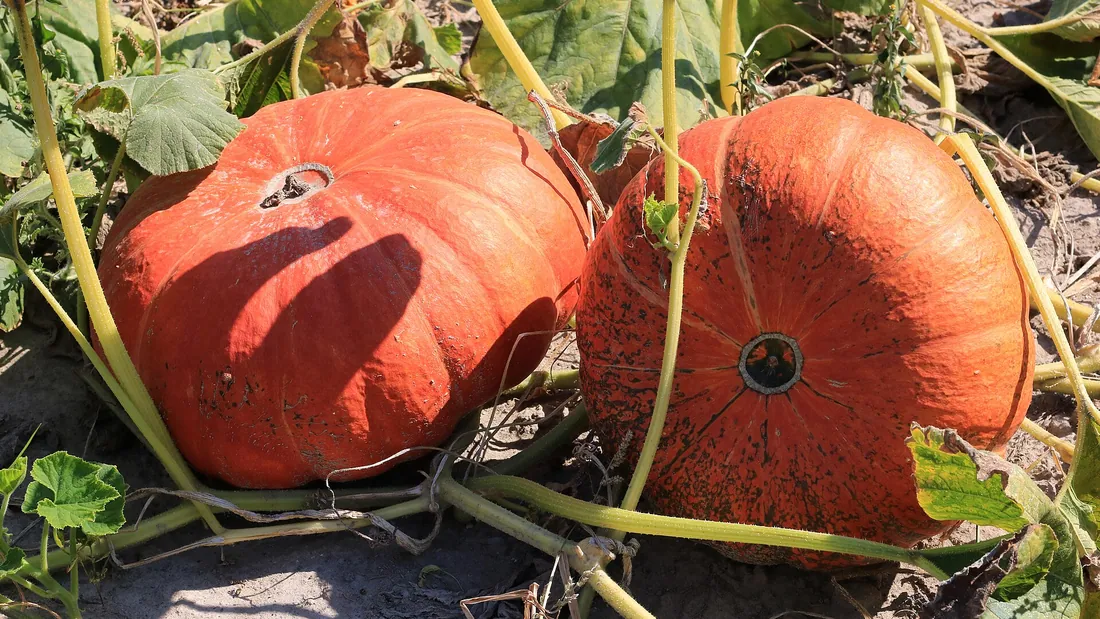

The pumpkin (Cucurbita maxima) is a large, sprawling, hungry and frost-tender squash that came from the Andes. It is a summer crop that hates the cold: the slightest frost kills it. You sow it warm in pots four to six weeks before your last frost, only move it outside once all risk of frost has passed, and harvest in autumn before the first frosts. Its great asset is storage: brought in and kept dry, a ripe pumpkin lasts for months.
Light and exposure
The pumpkin wants full sun and warmth. Give it the most exposed spot in the vegetable garden, six hours of sun a day at the very least, otherwise the fruits struggle to swell and ripen before autumn.
Above all, plan for space, plenty of space. The vines run over several metres and smother everything they meet. Allow two to three square metres per plant, or train the small varieties up a trellis to save room, supporting each fruit in a net.
Watering
The pumpkin drinks a great deal in summer. Its large leaves transpire heavily and a plant short of water abruptly stops setting fruit. Water generously at the base, two to three times a week in dry weather, more during a full heatwave.
Always water at ground level, never over the foliage. Wet leaves in the evening invite powdery mildew, which settles in quickly in late summer. A good mulch at the base keeps the soil cool and spaces out the watering.
Soil and repotting
The pumpkin is a hungry plant that demands a very rich, deep soil. Add a large amount of well-rotted compost or decomposed manure at planting, one or two buckets per plant. The classic trick is to plant it straight on the compost heap: it finds everything it loves there.
Planting is done from a pot, a single well-rooted plant per spot. Dig a wide hole, mix the soil with compost, and leave two to three metres between plants. From a pot, only transplant once the last frosts have passed and the mild nights have set in.
Temperature and humidity
This is the critical point of the crop. The pumpkin grows well between 18 and 30 degrees and tolerates no frost. A simple cold snap below 10 degrees halts growth, a frost burns the plant in a single night.
Do not be fooled by a few mild weeks at the end of winter. Late frosts still strike well after the first warm spells. Sow warm indoors, at 20 degrees, and wait until your average last frost date is clearly behind you before moving anything out. At the other end of the season, beware the first autumn frosts, which in short-season climates sometimes return as early as the end of summer.
Pruning and upkeep
Pruning is not compulsory but it helps produce fine fruits ripe in time in a short-season climate. When two or three pumpkins are well formed on a plant, pinch off the tips of the stems so that the plant feeds the fruits in place rather than running on endlessly.
Slip a board, a tile or a bed of straw under each swelling fruit. Left on damp soil, a pumpkin quickly rots from underneath. Straw insulates it from the ground and keeps it clean and healthy right up to harvest.
Pests and diseases
Powdery mildew is the pumpkin’s great enemy, almost unavoidable in late summer under a humid climate. You recognise it by a white powdery felt on the upper side of the leaves. It arrives late, often after the fruits have set, and then does little harm: the harvest is already under way. Give the plants air and water at the base to delay it.
Watch out too for fruit rot, encouraged by contact with waterlogged soil, which is why straw underneath matters. Slugs attack young plants early in the season and can strip a sowing in a single night: protect the freshly moved-out pots.
Propagation
Sowing is the only common route. Sow warm indoors four to six weeks before your last frost, at 20 degrees, one or two seeds per pot, laid on their edge to stop them rotting. Emergence is fast, less than a week at the right temperature.
Save your own seed in autumn from a fine, fully ripe fruit: rinse it, dry it and keep it dry. Beware, squashes cross easily between varieties, a saved seed can give a fruit very different from the parent, sometimes bitter. For reliability, start again from bought seed.
Toxicity
Not toxic, the flesh and the seeds can be eaten without concern. One rare caveat: some squashes turn bitter because of cucurbitacin, a substance that causes digestive upset. Never eat a squash with a distinctly bitter taste, spit it out and throw the fruit away.
Climate and hardiness
Where and in which climate it thrives
The pumpkin has no hardiness to speak of: it is a frost-tender annual that the slightest frost turns to black mush in a single night. The question is therefore not your USDA zone but the length of your frost-free season, ninety to a hundred and twenty days of steady warmth depending on the cultivar, the time a fruit needs to ripen until the stalk turns corky. The seed will not germinate below fifteen degrees in the soil and comes up in five to eight days between twenty-two and thirty degrees; the plant grows strongly between eighteen and thirty degrees, stalls below ten, and recovers poorly from a cold snap even without frost.
In a temperate, short-season climate, sow warm at around twenty to twenty-two degrees, four to six weeks before your average last frost date, and only move the plants out once that risk has passed and nights stay above ten degrees. Choose an early cultivar such as 'Uchiki Kuri' rather than a giant like 'Rouge vif d’Étampes', which will not have time to ripen. In a hot continental climate, sowing straight into the ground is enough as soon as the soil holds fifteen degrees. In a Mediterranean or subtropical climate the constraint is reversed: heat is no longer what is missing, water is, and the crop is placed either side of the hottest weeks, since fruit set suffers above thirty-five degrees.
Storage, the species’ real asset, depends only on you: after a few days of curing, a dry, airy room at ten to fifteen degrees keeps a fully ripe fruit for several months. A damp room or a cold cellar will rot it within weeks.
Growing pumpkin?
Green Hub keeps a dated history of your own plant: its photos, its progress, its repottings. An AI answers about yours specifically, not a generic sheet, for free.
Identify my plantMonth-by-month care calendar
| January | Nothing to do. This is the time to order seed and choose varieties, from the big red pumpkin to the small squashes for trellising. |
|---|---|
| February | Patience. Too early to sow. Prepare pots, potting mix and above all the spot, keeping in mind the room the vines will take up. |
| March | Enrich the future spot with a large amount of compost or well-decomposed manure so it has time to blend into the soil. |
| April | Sow warm indoors, at 20 degrees, one or two seeds per pot laid on their edge. Keep the plants sheltered, it still frosts. |
| May | Harden off the young plants by putting them out during the day. Plant in open ground only once all risk of frost has passed and nights stay above ten degrees. |
| June | The vines get going. Water generously at the base, mulch the soil. Watch for slugs on the still-young plants. |
| July | Full growth and flowering. Water heavily in dry weather. Slip a board or some straw under the first fruits that form. |
| August | The fruits swell. Pinch off the tips of the stems to concentrate the energy. Powdery mildew may appear: water at the base, give the plants air. |
| September | The fruits take on their colour. Cut back the watering to ripen them. Watch for the stalk starting to dry. |
| October | Harvest before the first frosts, when the stalk is corky and dry. Let the fruits cure for a few days in the sun. |
| November | Bring the pumpkins into a cool, dry room. Clean up the vegetable garden and compost the faded vines. |
| December | Nothing in the garden. Your pumpkins keep in the dry. Note the varieties and spots that did well this year. |
Green Hub tips
- Plant the pumpkin straight on the compost heap: it loves rich soils and you save yourself a separate feed.
- Never move the plants out while a frost is still possible. Several unusually mild weeks are a trap, a single late frost kills the plant.
- Slip a board or a bed of straw under each swelling fruit, otherwise it rots on contact with the damp soil.
- Harvest when the stalk is dry and corky, cure in the sun, then bring in somewhere cool and dry: the pumpkin lasts all winter.
Related species
Cucumber
Cucumis sativus
The cucumber (Cucumis sativus) is an annual vegetable from the warm regions of the southern Himalayas, and it shows: it…
Zucchini
Cucurbita pepo
The zucchini (Cucurbita pepo) is the easy summer vegetable par excellence, one plant yields more than a family can eat.…
Artichoke
Cynara scolymus
The artichoke (Cynara scolymus) is a large perennial with silvery, deeply cut foliage, as striking in an ornamental…
Asparagus
Asparagus officinalis
Asparagus (Asparagus officinalis) is an unusual perennial for a vegetable patch: once established, an asparagus bed…
Bean
Phaseolus vulgaris
The green bean (Phaseolus vulgaris) is one of the easiest vegetables in the kitchen garden, provided you respect one…
Beetroot
Beta vulgaris
Beetroot (Beta vulgaris) is an easy root vegetable, one of the most forgiving in the kitchen garden. You sow it…
The guides that mention it
The vegetable garden calendar, from sowing to harvest
Two dates are enough to build an entire vegetable garden year: your last spring frost and your first autumn frost.…
Making Compost: Steering the Thermal Biology of the Heap
A compost heap is not a pile of waste you stir, it is a thermal process you steer. The real carbon/nitrogen ratio of…
Garden Mulching: Every Mulch Has an Effect and a Drawback
Mulching is presented everywhere as a benefit with no downside. There is one for every material: what nitrogen drawdown…
Garden Diseases: Recognising What Is Attacking Your Plants, and Acting Before the Spot Appears
A white bloom that wipes off on a fingertip, an angular lesion stopped dead by a vein, a fruit browned from the bottom…
Rainwater Harvesting for the Garden: Choosing and Sizing Your System
Rain barrel, above-ground tank, or underground cistern: how to choose the right size so your vegetable garden no longer…
Companion Planting in the Vegetable Garden: Which Plants Belong Together
Tomatoes and basil get along beautifully, while potatoes and tomatoes make each other sick: companion planting explains…
Gardening with Children: Where to Start in the Vegetable Patch
Radishes that sprout in a week, peas nibbled straight from the row, potatoes dug up like buried treasure: the vegetable…
Square Foot Gardening: Fitting More Crops Into Less Space
A twelve-inch grid and a well-placed trellis: how a square foot garden yields more vegetables than a traditional row on…
Updated on
How this sheet is written
Written for Green Hub with the help of language models, then reviewed. It offers gardening guidance, not professional advice: if you are unsure whether a plant is toxic to a child or an animal, ask a vet, a doctor or your national poison centre.