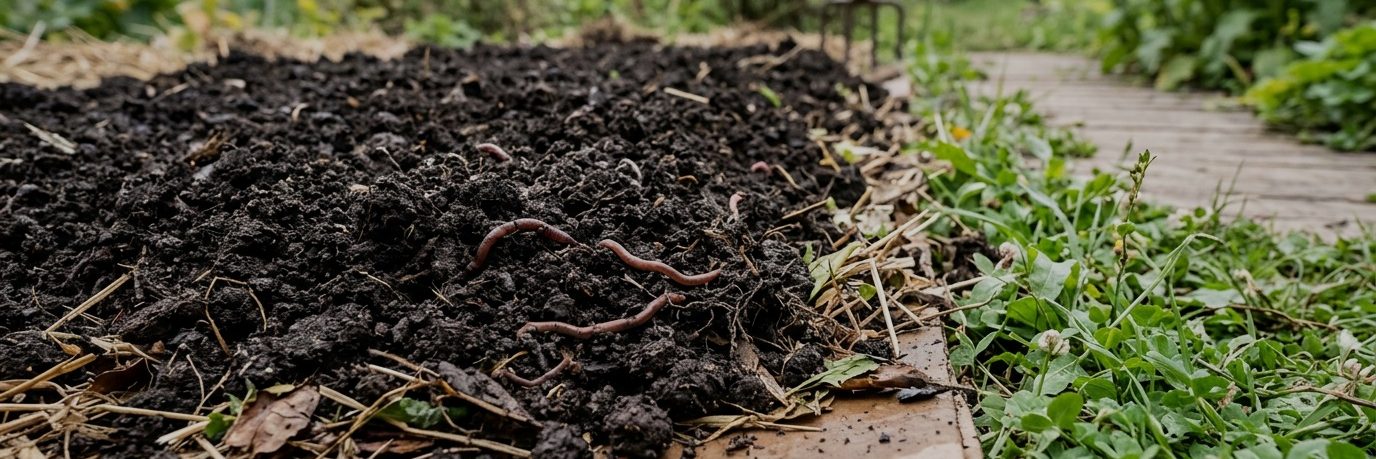
Living soil: the no-dig method for a garden that thrives without a spade
A no-dig garden rests on a simple idea: soil life, earthworms, mycorrhizal fungi, bacteria and woodlice, structures and feeds the earth far better than a tool that turns it over. Digging breaks these networks, kills off part of the soil fauna and speeds up the loss of organic matter under a rainy climate. The alternative method combines four habits: never leave the soil bare, sow green manures such as mustard, phacelia or clover between two crops, build raised beds or lasagna beds rather than turning the earth, and let the soil fauna do the work of aerating and fertilising in your place.
Soil: a living ecosystem, not just a growing medium
A single gram of garden soil is home to several billion bacteria, hundreds of metres of fungal filaments and dozens of species of worms, woodlice and springtails. This microscopic fauna and flora digest organic matter, release nutrients at the pace plants absorb them, and structure the earth into stable aggregates capable of holding both water and air. Living soil is not just a medium for roots to sit in, it is an organism in its own right, and the health of the garden depends on it.
The earthworm is its most visible engineer. By digging its tunnels, it aerates the soil at depth far better than a rotavator, and its castings are five to ten times richer in available nitrogen, phosphorus and potassium than the surrounding earth. Mycorrhizal fungi, which colonise the roots of most garden plants, play just as central a role: they extend the root system by a factor of a hundred, in exchange for a share of the sugars made through photosynthesis. Under a damp climate, organic matter breaks down fast, and this soil life runs smoothly as long as it is never starved of food or shelter.
Why digging damages the very thing you are trying to feed
Digging turns the earth over at depth and reverses the order of its layers: the aerobic micro-organisms from the surface find themselves starved of oxygen once buried, while the anaerobic bacteria from the lower layers die on contact with air. The action also breaks the network of mycorrhizal filaments, which takes several months to rebuild, and destroys earthworm tunnels, driving the worms to migrate towards less disturbed ground, or killing them outright under the blade.
The most insidious effect concerns organic matter: digging suddenly oxygenates the soil and speeds up mineralisation, the rapid conversion of humus into nitrates. Under a rainfall of roughly 900 mm a year, these freshly released nitrates are quickly leached towards the groundwater rather than absorbed by crops, a loss for the soil and for the water alike. Digging also brings dormant weed seeds back up into the light, where they germinate at once, the opposite of what was intended. A broadfork, which loosens the soil at depth with a simple rocking motion without turning the layers over, or soil left undisturbed under a covering, both preserve the structure that the soil fauna itself has built.
Green manures: covering and feeding the soil between two crops
A green manure is a crop sown not to be harvested but to cover and feed the soil between two vegetable crops. Sown as soon as a bed becomes free, it stops weeds from taking hold, protects the surface from being compacted by rain, and once cut down, returns several kilos of organic matter per square metre to the soil.
White mustard, sown from midsummer to early autumn, comes up within days and quickly covers the ground before winter; it belongs to the cabbage family, so it should be kept apart from a same-family crop in the rotation. Phacelia, a bee-friendly plant that asks for little, is sown from spring to late summer and dies back spontaneously below minus five degrees, which makes it easy to destroy without any tool. Crimson or white clover, like peas or beans in the vegetable garden, lives in symbiosis with soil bacteria that capture nitrogen from the air and store it in the earth, a free fertiliser for the next crop. Rye, sown in late summer, restructures compacted layers and copes well with frost.
The green manure is cut before it sets seed and either left to dry on the surface as mulch, or worked into the top five centimetres, never buried deep.
Raised beds and lasagna beds: growing without ever turning the soil
A raised growing mound lifts the planting area twenty to forty centimetres above ground level. This relief drains excess water better, a real asset in a climate of frequent rain and on heavy soils, and warms up faster in spring thanks to better sun exposure, allowing sowing one to two weeks earlier. The hugelkultur-style mound takes the principle further by burying dead wood at its core: this wood holds water like a sponge and releases nutrients for several years.
Lasagna gardening applies the same logic flat on the ground, with no digging at all. A layer of plain cardboard is laid over the grass or existing soil to smother the vegetation underneath, then brown materials, dead leaves, straw, and green materials, fresh grass clippings, peelings, half-mature compost, are alternated to a depth of thirty to fifty centimetres, finishing with a layer of potting soil thick enough to plant into straight away. The layers settle and decompose in place over the following months, feeding the crops continuously. It is also the fastest way to turn a patch of lawn into a vegetable bed, without a single spadeful of digging.
Permanent cover: the rule that holds everything else together
Bare soil is soil that loses out. Exposed to beating rain, it compacts at the surface and forms a crust that slows water infiltration; exposed to the sun, it dries out and microbial life slows for lack of moisture; left open, it covers itself with weeds within a few weeks, weeds that never ask permission. The central rule of no-dig gardening fits in one sentence: never leave a bed bare for more than a few days.
Between two crops, a mulch of dried grass clippings, dead leaves or straw, a technique covered in detail in the guide devoted to mulching, closes the surface again as soon as a harvest is finished. Out of season, a green manure takes over. During the season, dense plant combinations, a low ground cover such as lettuce or radish planted between taller vegetables, already limit the amount of exposed soil. This continuous cover feeds the soil fauna and cuts down watering accordingly, since covered soil holds water far longer than bare soil pounded by rain. It is the sum of these habits, permanent cover, no digging, and regular inputs such as compost or an amendment on clay soils, that makes for living soil.
The care sheets to read next
Every plant mentioned has its full sheet: watering, light, soil, pests and a month-by-month calendar.
Tomato
Solanum lycopersicum
The tomato (Solanum lycopersicum) is the queen of the vegetable garden, but it is a plant of sun and warmth that plays…
Potato
Solanum tuberosum
The potato (Solanum tuberosum) is one of the most rewarding crops in the vegetable garden: easy, productive and…
Carrot
Daucus carota
The carrot (Daucus carota) is a staple root vegetable in the vegetable garden, keeping all winter and sown directly in…
Zucchini
Cucurbita pepo
The zucchini (Cucurbita pepo) is the easy summer vegetable par excellence, one plant yields more than a family can eat.…
Bean
Phaseolus vulgaris
The green bean (Phaseolus vulgaris) is one of the easiest vegetables in the kitchen garden, provided you respect one…
Lettuce
Lactuca sativa
Lettuce (Lactuca sativa) is the most widely grown salad in the vegetable garden, easy and quick, harvested six to ten…
Radish
Raphanus sativus
The radish (Raphanus sativus) is the fastest vegetable in the garden, ready to bite into in three to five weeks. It is…
Leek
Allium porrum
The leek (Allium porrum) is the winter vegetable par excellence. Very hardy, it stands in the ground all winter and is…
Brussels sprout
Brassica oleracea var. gemmifera
Brussels sprouts (Brassica oleracea var. gemmifera) are harvested from autumn into the heart of winter, and every frost…
Onion
Allium cepa
The onion (Allium cepa) is a hardy, no-fuss bulb vegetable, one of the easiest crops to succeed with in a vegetable…
Spinach
Spinacia oleracea
Spinach (Spinacia oleracea) is a cool-season leaf vegetable, hardy and in a hurry to live. Coolness suits it very well:…
Pea
Pisum sativum
The pea (Pisum sativum) is a cool-season legume, hardy to cold but hating heat: its seeds germinate from 4 to 5 degrees…
Strawberry
Fragaria x ananassa
The strawberry (Fragaria x ananassa) is a hardy perennial that fits very well into any vegetable garden. Hardy to…
Raspberry
Rubus idaeus
The raspberry (Rubus idaeus) is a small fruiting shrub, hardy down to -25 °C, that grows wild in the cool woodland of…
Frequently asked questions
Do I really have to stop digging altogether, even to clear a new bed?
On very compacted soil, or ground overrun with tough perennial weeds, a one-off pass with a broadfork, which loosens without turning the layers over, is still preferable to classic digging. Cardboard and lasagna beds remain the gentlest way to clear a lawn without any tool. Once the soil has been loosened, it is best not to turn it again and to let the soil fauna maintain its structure year after year.
When should I sow a green manure in the vegetable garden?
Mustard and phacelia are sown as soon as a bed becomes free, from midsummer to early autumn, to cover the soil before winter. Clover is sown in spring or late summer, depending on how long you want it to occupy the ground. Rye, sown in late summer, holds through the whole winter and is destroyed in spring, a month before the next crop, by cutting it down before it sets seed.
How long before I can plant into a lasagna bed or a raised mound?
If the top layer of potting soil or mature compost is at least ten centimetres deep, undemanding vegetables such as courgette, lettuce or spinach can be planted straight away. The deeper layers keep settling and decomposing for six to twelve months, so it is better to wait for the second season for hungrier crops such as tomatoes or potatoes.
How can I tell if my soil is genuinely alive?
Dig a hole thirty centimetres on each side and count the earthworms: more than ten is a good sign, fewer than three points to depleted soil. Living earth smells of humus rather than nothing at all, breaks into crumbly clumps rather than hard clods or dust, and sometimes shows a fine white mycelium under a mulch or a rotting stump.
Green Hub looks after your plants
Photograph a plant: Green Hub identifies it and writes its care sheet, with no account. Sign in afterwards to keep its dated photos and history over time.
Identify a plantUpdated on
How this sheet is written
Written for Green Hub with the help of language models, then reviewed. It offers gardening guidance, not professional advice: if you are unsure whether a plant is toxic to a child or an animal, ask a vet, a doctor or your national poison centre.