Chinese money plant
Pilea peperomioides
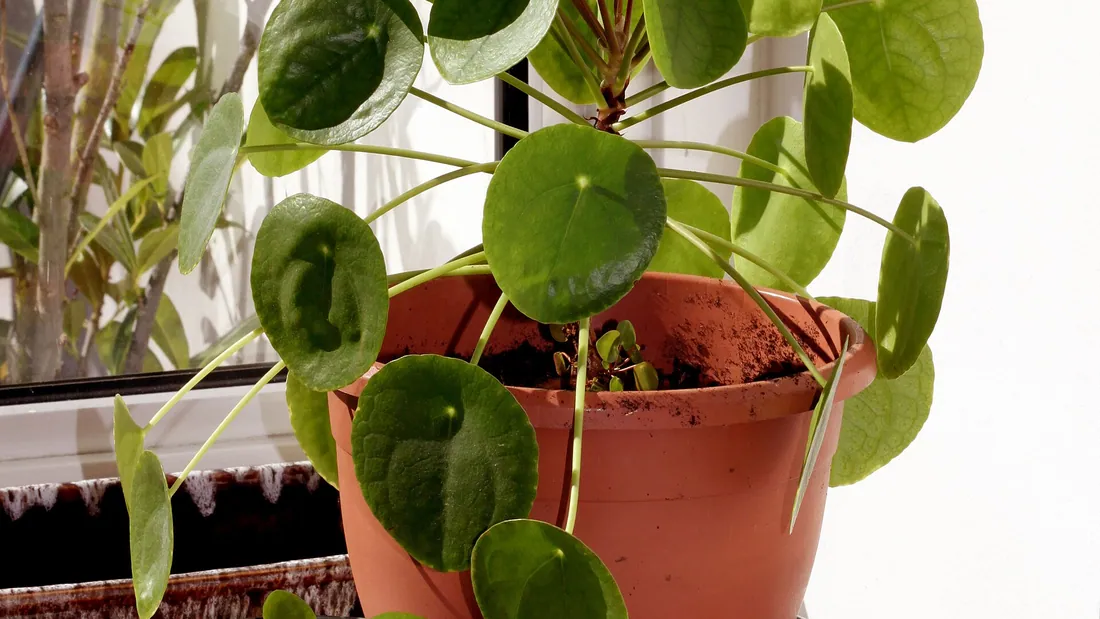

The Pilea (Pilea peperomioides) is an easy houseplant, recognisable by its round, fleshy leaves that look like little coins. Here it is grown only indoors: it does not tolerate frost and spends the whole year in the house. Its great asset is that it multiplies all by itself, producing offsets at the base and along the stem.
Light and exposure
The Pilea likes bright but filtered light. Place it near an east-facing window or a few metres from a south-facing bay behind a sheer curtain. The direct summer sun scorches its leaves, while a corner that is too dark makes it lose its compact shape and stretch towards the glass.
It always grows towards the light. A quarter turn every eight to ten days is enough to keep a regular, upright rosette, otherwise it quickly leans to one side.
Watering
Moderate watering is the rule. Let the top two centimetres of the potting mix dry out before giving water again, then water letting the excess drain away. Always empty the saucer: the Pilea fears too much water far more than thirst.
Leaves that yellow and soften at the base almost always betray one watering too many and the start of root rot. Foliage drooping over dry potting mix, on the contrary, means it is thirsty. In winter, space out clearly, one watering every ten to fifteen days is enough.
Soil and repotting
A light, free-draining potting mix suits it. Take a mix for houseplants and lighten it with a handful of perlite or coarse sand so the water passes through quickly. A pot with drainage holes is essential, standing water at the bottom is its worst enemy.
Repot in spring, every one to two years, into a pot only slightly larger. No need to drown it in a large volume. Take advantage of repotting to detach the well-rooted babies growing at the base.
Temperature and humidity
The Pilea is happy at normal indoor temperature, between 15 and 24 degrees. It tolerates a little coolness in winter but does not go below 10 degrees, and it freezes well before zero. Keep it away from a radiator as well as from a cold draught near a door.
It is not demanding about humidity and copes with the dry air of our heated homes, unlike many tropical plants. If the leaf tips brown in winter, move it away from the heat source.
Pruning and upkeep
The Pilea needs almost no pruning. Remove the old yellowed lower leaves as you go, by hand or with clean scissors. A wipe with a damp cloth now and then restores their shine.
If the main stem goes bare and stretches with age, you can cut it back firmly: the stump reshoots into new growth, and the cut top can be rooted. The offsets at the base thicken the pot if you leave them in place.
Pests and diseases
Indoors, the Pilea mainly picks up troubles linked to too much water. Root rot, encouraged by a waterlogged potting mix and a saucer that is never emptied, is by far its number one cause of death: brown, soft roots, leaves falling all at once. It is prevented by measured watering and real drainage.
As for pests, watch for mealybugs, those cottony clusters in the hollow of the leaf stalks, and spider mites which settle in when the air is dry near the heating. A cotton bud soaked in methylated spirit deals with them while the attack is limited.
Propagation
This is the great pleasure of the Pilea, and its big asset. It spontaneously produces offsets, small identical plants, at the base of the mother stem and sometimes along it. Wait for an offset from the soil to reach five to seven centimetres, clear away the potting mix, cut it off close while keeping its roots and repot it straight away in a small pot. It starts off on its own.
The offsets growing on the stem, without roots, are treated as cuttings: in a glass of water, they root in two to three weeks before repotting. A single healthy Pilea provides enough to give away plants all year round, which earned it its nickname of missionary plant.
Verified answers
Checked on 2026-07-23
Where should a Chinese money plant sit indoors?
Near a bright window, away from scorching summer sun. Rotate the pot regularly and leave a gap from cold glass in winter.
When should it be watered?
When the top two centimetres of potting mix are dry. Water thoroughly, let it drain and empty the saucer; do not follow a fixed weekday.
Why are its leaves turning yellow?
First check for potting mix that stays wet too long and for standing water. A single old lower leaf can also yellow naturally.
Is Pilea toxic to cats and dogs?
The ASPCA lists it as non-toxic to cats and dogs. Non-toxic does not mean edible: chewing a large amount of any plant may still upset digestion.
Editorial method
This sheet cross-checks IPNI nomenclature, NC State Extension horticultural guidance and the ASPCA veterinary database. Watering advice remains based on the actual condition of the potting mix: a calendar interval is only a guide, never an automatic instruction.
Climate and hardiness
Where and in which climate it thrives
The Pilea is a strictly indoor plant. It never overwinters outdoors and cannot even be put out on the terrace without risk, one cool night is enough to mark it. It is kept in the house all year round, on a bright windowsill.
The real challenge is winter. Through the darkest months, the light is weak and short: move the Pilea closer to the brightest window, even pressed against the glass, and cut back watering sharply since it grows slowly. It is in this season that too much water does the most damage, in a potting mix that dries slowly.
Its growing season covers the whole warm season, when the days lengthen. That is when it produces its offsets in abundance and when it needs a little feeding and repotting. Remember to turn the pot all year round: a window only lights from one side, and without this gesture the plant ends up all lopsided.
Growing chinese money plant?
Green Hub keeps a dated history of your own plant: its photos, its progress, its repottings. An AI answers about yours specifically, not a generic sheet, for free.
Identify my plantMonth-by-month care calendar
| January | Rest. Weak light: keep it against the brightest window. Water little, once every ten to fifteen days. |
|---|---|
| February | Still slow. Turn the pot a quarter turn each week to stop it leaning. No fertiliser. |
| March | Light returns, growth picks up. Resume more regular watering as soon as the potting mix dries faster. |
| April | Start of the real season. Repot if the roots are circling in the pot, detach the already rooted offsets. First dose of light fertiliser. |
| May | Full growth. The offsets multiply at the base and on the stem. Water as soon as the surface dries, diluted fertiliser every fortnight. |
| June | Abundant foliage. Keep turning the pot. Pot up the harvested babies in small pots, they start off quickly. |
| July | Watch the direct sun behind the glass that scorches the leaves: move it away a little or add a sheer curtain. Water without soaking. |
| August | Still growing. A good month to root the stem offsets in a glass of water. Keep up the light feeding. |
| September | Last active month. Slow down the feeding. Sort the old lower leaves and harvest the last well-formed offsets. |
| October | Growth stops. Move the plant closer to the window and reduce watering as the days shorten. |
| November | Winter rest. Minimal watering, never water standing in the saucer. Keep it away from the radiator. |
| December | Light at its lowest. Do not put it in a dark corner. Let it dry well between two waterings, no fertiliser. |
Green Hub tips
- Turn the pot a quarter turn each week. Without this gesture, the Pilea quickly leans towards the window and grows crooked.
- Let the base offsets grow to five centimetres, then detach them with their roots and repot: a Pilea to give to each friend.
- In winter, the danger is watering. Dry potting mix, emptied saucer, spaced-out waterings: it is too much water that kills the Pilea, not thirst.
- The ASPCA lists it as non-toxic to cats and dogs. Like any plant material, however, it may still cause digestive discomfort if a large amount is chewed.
Related species
Aglaonema
Aglaonema commutatum
The aglaonema (Aglaonema commutatum) is a robust, easy houseplant, prized for its foliage variegated with green,…
Alocasia
Alocasia
The alocasia, nicknamed elephant ear, charms with its large, dramatically veined leaves. It is a demanding tropical…
Aloe vera
Aloe vera
Aloe vera (Aloe vera) is a succulent from the Arabian Peninsula, grown since antiquity for the soothing gel of its…
Anthurium
Anthurium andraeanum
The anthurium (Anthurium andraeanum) is a tropical houseplant known for its smooth, waxy red spathe, which people often…
Areca palm
Dypsis lutescens
The areca (Dypsis lutescens) is a tropical palm from Madagascar, frost-tender, grown indoors wherever winter freezes.…
Boston fern
Nephrolepis exaltata
The Boston fern (Nephrolepis exaltata) is a hanging indoor fern, born in the humid undergrowth of the tropics. Here,…
The guides that mention it
Indestructible Houseplants: Tolerating Drought Is Not Tolerating Shade
Tolerating drought and tolerating shade are two different adaptations, and almost every list mixes them up. What these…
Watering Plants Properly: Deciding Rather Than Following a Schedule
Beginners water too often and too little at the same time. How to read the soil instead of the calendar, tell thirst…
Repotting your plants and choosing the right potting mix
The right moment, the right technique and the right substrate for each plant, so you can repot without rotting the…
Toxic Plants for Cats and Dogs: Recognising the Danger Rather Than Memorising a List
A list of toxic plants is easily forgotten and always incomplete. What actually protects a cat or dog is recognising…
How to Compost in an Apartment with Worm Composting
Tiered bin, red worms and worm tea: how to compost your kitchen scraps without a garden or odor, even in a city…
Botanical sources
Updated on
How this sheet is written
Written for Green Hub with the help of language models, then reviewed. It offers gardening guidance, not professional advice: if you are unsure whether a plant is toxic to a child or an animal, ask a vet, a doctor or your national poison centre.