Rhubarb
Rheum rhabarbarum
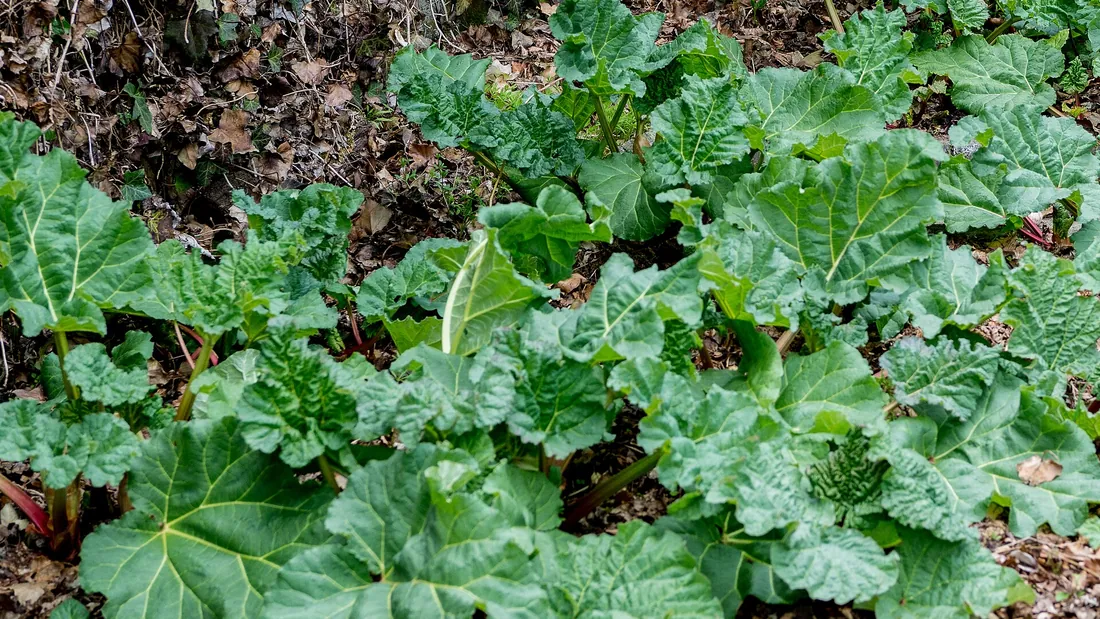

Rhubarb (Rheum rhabarbarum) is a robust, long-lived perennial that thrives anywhere the winter is a real one. A well-established plant lasts ten to fifteen years in the same spot and gives you stems every spring with almost no demands. The cold does not scare it, quite the opposite: several weeks below 4 °C are necessary for it to start again vigorously in spring. You do not harvest the first year, you let it settle in, then it produces for a decade.
Light and exposure
Rhubarb thrives from full sun to partial shade. A spot sunny in the morning with a little shade in the afternoon suits it very well and stops the soil from drying too fast once the first heat arrives; the hotter the summer, the more that afternoon shade counts. It is a large plant, an adult clump easily takes up a square metre, so plan for space.
Avoid only the dark corners and tree roots that would compete with it for water and nutrients. An open spot, at the back of the vegetable garden or along an edge, where you leave it in peace for years, is ideal. Once planted, you do not move it lightly.
Watering
Rhubarb likes the soil to stay cool. It has large leaves that transpire heavily, and a soil that dries out slows stem production. In a temperate, well-watered climate the rain is usually enough, but during the dry spells of spring and early summer, in full stem production, water generously once or twice a week rather than in small dabs.
A good mulch at the base, straw, dried clippings or dead leaves, keeps in the moisture and limits the watering. It is the most useful gesture of the season: it keeps the soil cool while feeding the earth as it breaks down. Take care only not to bury the heart of the plant under the mulch.
Soil and repotting
Rhubarb is very hungry and wants a deep, rich, cool soil. It sends thick roots down deep, so loosen the ground well at planting and bury a good dose of ripe compost or decomposed manure. A poor soil gives thin stems, a rich soil gives thick, generous stalks.
Plant preferably in autumn or at the end of winter, burying the root division so that the bud is left just at the surface, not too deep. Space the plants a good metre apart. Each autumn, bring a good spadeful of compost or manure to the base to sustain this hunger, that is what keeps a plant going ten years and more.
Temperature and humidity
This is a cold-climate plant, perfectly at ease wherever the winter is a marked one. Rhubarb is hardy down to USDA zone 3, winters below -30 °C, and takes repeated frosts without flinching. The foliage disappears completely in winter, the rootstock stays alive underground and starts again in spring.
Better still, the cold does it good. It needs several weeks below 4 °C, a vernalisation, to restart with vigour the following spring. A damp, cool winter is therefore not an obstacle but an asset: it is exactly the climate it needs, and it is the too-mild winter that lets it down. There is no point protecting it, it manages on its own.
Pruning and upkeep
Ordinary care comes down to two gestures. First, remove the flower stalks as soon as they rise in spring. Rhubarb tries to flower, a large hollow stem topped with a white plume then points up in the centre: cut it at the base without waiting, because flowering exhausts the plant and drops stem production.
Then, at the end of the season, let the foliage yellow and fade in place in autumn, it returns its reserves to the rootstock. Cut or remove only the completely dead leaves. A good clean-up going into winter, a feed of compost, and the job is done.
Pests and diseases
Good news, rhubarb is one of the healthiest plants in the vegetable garden. It has almost no diseases and no serious pests, which partly explains its reputation as an easy plant. Its robustness means you almost forget it.
The only real risk, in a damp climate, is crown rot, encouraged by waterlogged soil and a heart buried too deep or drowned under a wet mulch. Plant the bud at the surface and ensure a soil that does not stay wet. Slugs may nibble the very young leaves in spring but rarely attack an established plant. Nothing to worry about in practice.
Propagation
Rhubarb is multiplied by dividing the rootstock, and it is the best way to regenerate it at the same time. Every five to six years, in autumn or at the end of winter when the plant is at rest, dig up the rootstock and slice it into pieces with the spade. Each piece must carry at least one good visible bud and a length of fleshy root. Replant at once, bud at the surface, in well-enriched soil.
This division rejuvenates an old plant that was starting to make thinner stems and gives you new plants for free to set out or give away. Sowing exists but gives irregular, slow plants, best left to the curious: for a vegetable garden, division is faster and more reliable.
Toxicity
Careful, rhubarb is only eaten in part. You consume only the stalks, the fleshy red or green stems. The leaves are toxic: they are rich in oxalic acid and other compounds that cause nausea, vomiting, stomach pain and, in high doses, more serious trouble. This toxicity applies to humans as to animals, dogs, cats and poultry included. Never eat the leaves and do not put them without precaution into compost meant for the vegetable garden, throw them into the general compost.
Climate and hardiness
Where and in which climate it thrives
Rhubarb is a cold-climate plant, and the cold is what governs everything about it. Its rootstock is perennial down to USDA zone 3, where the minima drop below -30 °C: it spends the winter buried, the foliage disappears entirely, and nothing dies as long as the bud is not drowned. Between zones 3 and 8, no winter protection is needed at all.
That cold is not merely tolerated, it is required: several weeks below 4 °C break dormancy and trigger the spring start. A winter that is too mild leaves the plant idling with no real rest, the stalks thin out and the crown wears itself out in two or three seasons. At the other end, it wants a cool summer, a seasonal average of 24 °C at most, beyond which growth stalls and the leaves scorch. Temperate oceanic climates and continental ones with a proper winter are its ground; in hot regions, altitude often makes up for latitude. The harvest fits into the two or three months following the spring restart, then you stop to let the rootstock rebuild its reserves, and it is only full from the third year onwards.
In a Mediterranean or subtropical climate, zone 9 and beyond, it is handled differently: sown annually rather than kept as a lasting rootstock, set out at the start of the cool season, placed in partial shade, harvested before the real heat. Under a mild but very wet winter, the danger is not frost but crown rot: bud at the surface, free-draining soil, mulch kept away from the heart. Under a very cold, dry winter with no snow to insulate, a layer of dead leaves laid over the crown is enough.
Growing rhubarb?
Green Hub keeps a dated history of your own plant: its photos, its progress, its repottings. An AI answers about yours specifically, not a generic sheet, for free.
Identify my plantMonth-by-month care calendar
| January | Total rest, the rootstock sleeps underground. You can still plant or divide a piece if the soil is not frozen. |
|---|---|
| February | End of winter, the ideal moment to plant a new piece or divide an old rootstock, bud at the surface, in well-enriched soil. |
| March | The first buds point up. Bring compost or manure to the base and mulch to keep the soil cool. |
| April | The stems develop. Start of harvest on established plants, by pulling and twisting the stalks at the base. Never on a first-year plant. |
| May | Full harvest. Cut the flower stalks as soon as they rise in the centre. Water generously if the weather is dry. |
| June | Last fine harvests. Keep removing the flowers. Always leave at least a third of the stems in place on each plant. |
| July | Stop harvesting to let the plant rebuild its reserves. Keep the soil cool with a good mulch. |
| August | Harvest rest. Water during heatwaves, the foliage transpires heavily. Check that the mulch stays in place. |
| September | The foliage starts to tire. Nothing urgent, leave the plant alone. Prepare the compost for the autumn feed. |
| October | The leaves yellow and fade. Let them return their reserves to the rootstock, remove only those that are dead. |
| November | Clean up the clump, remove the faded leaves, bring a good spadeful of compost or manure to the base. A good time to plant or divide. |
| December | Winter rest. The cold is useful, it prepares a vigorous restart. Nothing to do, the plant keeps on its own. |
Green Hub tips
- Do not harvest the first year. Let the plant settle in, a little the second year, fully after that: that is what guarantees ten years of production.
- Never eat the leaves, only the stalks. The leaves are toxic, for you as for your animals.
- Harvest by pulling and twisting the stalk at the base rather than by cutting, and always leave at least a third of the stems on the plant.
- Cut the flower stalks as soon as they rise: flowering exhausts the plant and drops the stem harvest.
- Divide the rootstock every five to six years in autumn: it regenerates an old plant and gives you free plants.
Related species
Apple tree
Malus domestica
The apple tree (Malus domestica) is the king of fruit trees in temperate climates, the one that has filled family…
Blackcurrant
Ribes nigrum
The blackcurrant (Ribes nigrum) is a small hardy fruit shrub that is genuinely happy in a cool climate, down to USDA…
Blueberry
Vaccinium corymbosum
The cultivated blueberry (Vaccinium corymbosum) is the large shrubby cousin of the wild bilberry, also called the…
Cherry tree
Prunus avium
The cherry tree (Prunus avium) is a vigorous, hardy fruit tree, perfectly at ease in a temperate climate, from USDA…
Elder
Sambucus nigra
Elder (Sambucus nigra) is a large shrub native to temperate Europe that grows wild in hedgerows, along footpaths and on…
Fig tree
Ficus carica
The fig tree (Ficus carica) is a Mediterranean tree, yet it really can be grown up to USDA zone 7 provided you shelter…
The guides that mention it
Small fruits and fruit trees: where to begin
Raspberry, redcurrant, blackcurrant, blueberry, apple, pear: what to start an orchard with and how to avoid picking the…
Toxic Plants for Cats and Dogs: Recognising the Danger Rather Than Memorising a List
A list of toxic plants is easily forgotten and always incomplete. What actually protects a cat or dog is recognising…
Making Compost: Steering the Thermal Biology of the Heap
A compost heap is not a pile of waste you stir, it is a thermal process you steer. The real carbon/nitrogen ratio of…
Garden Mulching: Every Mulch Has an Effect and a Drawback
Mulching is presented everywhere as a benefit with no downside. There is one for every material: what nitrogen drawdown…
Updated on
How this sheet is written
Written for Green Hub with the help of language models, then reviewed. It offers gardening guidance, not professional advice: if you are unsure whether a plant is toxic to a child or an animal, ask a vet, a doctor or your national poison centre.