Yew
Taxus baccata
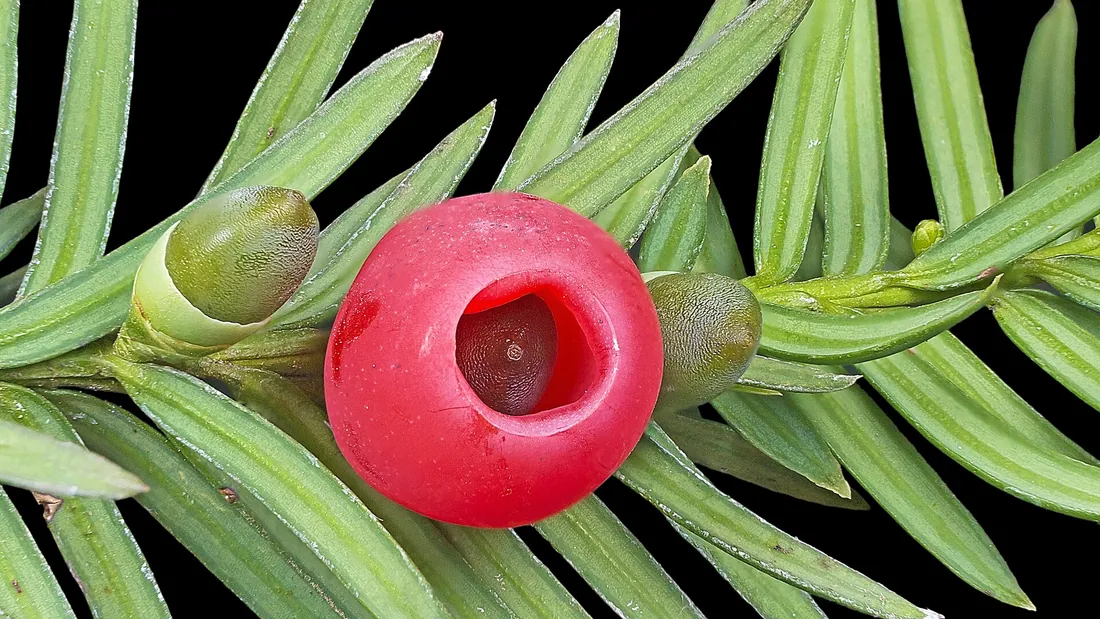

Yew (Taxus baccata) is a conifer native to Europe, able to live for several centuries and to regrow from old wood almost like no other resinous tree. Its dark green, flat, supple needles clothe the plant all year round, and on female specimens small fleshy red berries, the aril, appear at the end of summer, hanging along the shoots. It is the noble hedge above all others, dark, dense, clipped square or shaped into topiary, carrying on through generations without faltering. But it needs saying straight away: yew is one of the most toxic plants in the garden, needles, bark and seeds contain taxines that are lethal to people and livestock, only the fleshy red aril around the seed is harmless.
Light and exposure
Yew grows just as well in full sun as in the deepest shade, which makes it one of the very few conifers able to keep a dark corner of the garden green. Against a wall that never gets direct sun, under the canopy of large trees or in an enclosed courtyard that gets only a few hours of light, it stays dense and green where most conifers turn yellow and thin out.
As a hedge or a specimen, it takes full sun on an open frontage just as readily as the shade cast by a neighbouring house. That is a real asset for closing off a town garden visually or hiding a fence in a shady corner where hardly anything else really holds.
Watering
Once established, yew copes remarkably well with drought thanks to deep roots that reach far below the surface for water. A specimen planted more than two or three years ago can more or less do without watering, even during the dry summers we now see more and more often.
In the first year or two after planting, though, water regularly in dry weather, especially in sandy soil that drains fast. The real danger for yew is never a lack of water but an excess of it: soil that stays waterlogged for weeks eventually rots the roots.
Soil and repotting
Yew is not fussy about soil type: it grows just as well in chalky ground as in heavy clay, in poor stony soil as in ordinary garden loam. That is one of the reasons for its success as a hedging plant on ground that varies enormously from one plot to the next.
The one truly non-negotiable requirement is good drainage. In compact clay that holds water through the cold season, it is worth loosening the ground deeply and adding gravel or coarse compost at planting time, otherwise the roots eventually suffocate.
Temperature and humidity
Yew is perfectly hardy across temperate climates and needs no winter protection at any age. It shrugs off the harshest winters the temperate range can throw at it, late frosts as much as sudden mild spells.
The trade-off for this toughness is slow growth, ten to twenty centimetres a year for an established plant. There is no need to worry about it or force things with extra feeding: it is precisely this slowness that gives yew its density and its longevity, a yew planted today can still be standing in two centuries.
Pruning and upkeep
Pruning is done at the end of summer, once the year's growth is finished but with enough season left for the cuts to heal before the first hard weather. This is the time to clip hedges and topiary to a clean line, since yew takes a hard cut very well.
Its great advantage over other conifers is that it regrows from old wood: a hedge that has become thin, overgrown or neglected for years can be cut back hard, almost to the trunk, and it will come back. To keep a hedge full at the base, taper the sides slightly narrower at the top than at the bottom, so light still reaches the lower branches.
Pests and diseases
Yew is one of the healthiest, hardest to kill conifers in the garden, with very few serious diseases to report. The one real risk is root decline from Phytophthora, a rot that sets in in waterlogged soil and eventually browns and kills whole branches, sometimes the entire plant.
You sometimes see scale insects, small brown crusts stuck to the shoots, or the yew gall midge, a tiny insect whose larva causes an artichoke-shaped deformity at the tip of young shoots. In both cases the damage stays limited, and cutting off the affected shoots is enough to keep it in check.
Propagation
Cuttings are the most reliable way to reproduce a specimen true to type, but it takes patience: take semi-ripe shoots at the end of summer or in autumn, set them in a sandy mix in the shade, and wait, rooting often takes several months.
Sowing also works but stays slow and uncertain: the seed inside the red aril has a deep dormancy that often delays germination by two winters. In the wild it is birds, fond of the sweet aril, that spread the seeds after digesting them; for the gardener in a hurry, taking cuttings or simply buying a plant remains the more sensible route.
Toxicity
Yew is one of the most toxic plants found in gardens, and this should never be taken lightly. Every part of the tree, needles, bark, wood and above all the seeds inside the berries, contains alkaloids called taxines, extremely dangerous to people and to livestock alike. Only the aril, that fleshy, sweet red covering around the seed, is edible and safe; the seed itself, if chewed or bitten into, releases the poison. Never plant a yew near a pasture or an enclosure for horses, cows or sheep: a few handfuls of needles are enough to kill a large animal, and accidents are sadly not rare. With children, keep them away from fallen berries on the ground and watch closely if they go picking.
Climate and hardiness
Where and in which climate it thrives
Yew is a conifer of cool temperate climates, at ease where winter is properly cold and summer never scorching. It takes frosts of minus twenty degrees with no protection at all, at any age, and is usually given as USDA zones 6 to 8. Colder than that, towards zone 5, Japanese yew (Taxus cuspidata) and the hybrid Taxus x media take over, with the same dark outline and the same tolerance of clipping.
It thrives in mild, humid oceanic climates and in sub-Mediterranean mountains, where it grows wild. It struggles through long, burning summers, dry or muggy alike: beyond zone 8 it needs afternoon shade and soil that does not bake. What it really hates is standing water, far more than cold: a mild, sodden winter on clay does it more harm than a freezing dry one.
What changes the procedure with the climate: in a continental climate, winter sun on frozen foliage bronzes the needles, so water generously in late autumn before the ground freezes and shelter young plants from the prevailing cold wind. Where summers are hot, watering through the first three years decides whether the plant establishes at all. Where the growing season is short, annual growth drops below ten centimetres and a single prune at the end of the growing season is enough. Everywhere, slowness is the rule: ten to twenty centimetres a year for an established plant, and a hedge that takes eight to ten years to close up properly.
Growing yew?
Green Hub keeps a dated history of your own plant: its photos, its progress, its repottings. An AI answers about yours specifically, not a generic sheet, for free.
Identify my plantMonth-by-month care calendar
| January | Complete winter rest for the plant. This is a good time to plan a new hedge and order bare-root plants while nurseries still have stock. |
|---|---|
| February | Planting is still possible if the ground is not frozen, bare-root or root-balled. Make use of the dormant season to move a badly placed specimen. |
| March | Sap starts rising gently again. Check hedges after winter: straighten branches bent by snow or wind and remove any broken wood. |
| April | Growth gets going. Water any specimens planted that year if spring turns dry, and watch for scale insects on the young shoots. |
| May | A good time for a first light shaping of topiary and young hedges, without yet cutting into this year’s new growth. |
| June | Growth carries on quietly. Water recently planted specimens during dry spells, established ones manage on their own. |
| July | Avoid pruning in the height of the heat. Just water young plants and enjoy the deep green colour of the foliage. |
| August | This is the main pruning month. Take hedges and topiary back to a clean line from mid-August, once the year’s growth is finished. |
| September | Finish off any pruning started in August. It is also an excellent month to plant a new hedge, the still-warm soil helps roots settle before winter. |
| October | The prime planting month for yew, bare-root or in a container. Roots settle in quietly before the first cold snaps. |
| November | Keep planting as long as the soil can still be worked. Mulch the base of specimens planted that year to protect young roots from frost. |
| December | Complete winter rest. Shake heavy, wet snow off the branches to stop them breaking under the weight. |
Green Hub tips
- Never plant a yew near a pasture or an enclosure: a few needles are enough to kill a horse or a cow, taxine does not forgive.
- Prune at the end of summer, once the year's growth has finished: the cuts heal before the first hard weather and the shape stays crisp all through the cold season.
- A ruined or thin hedge is never a lost cause: yew is the only conifer that regrows from old wood, a hard cut back always saves it.
- Allow three to four plants per metre of hedge for a dense line from the start, and be patient: yew grows slowly but lasts for centuries.
Related species
Althea
Hibiscus syriacus
Althea (Hibiscus syriacus) is a hardy deciduous garden shrub that flowers when every other one has finished, from…
Beech
Fagus sylvatica
Beech (Fagus sylvatica) is the most common broadleaf tree in the temperate forests of Europe, just as happy standing…
Begonia
Begonia
Begonia is the star summer flower of window boxes, hanging baskets and shady borders. Hundreds of hybrids exist, but…
Box
Buxus sempervirens
Box (Buxus sempervirens) is an evergreen shrub that has been clipped into balls, cones and low borders in formal…
Butterfly bush
Buddleja davidii
Buddleia (Buddleja davidii), better known as the butterfly bush, is a nearly indestructible shrub that has taken over…
Cherry laurel
Prunus laurocerasus
Cherry laurel (Prunus laurocerasus) is the most widely planted evergreen hedging shrub in temperate gardens, and it is…
The guides that mention it
Which Hedge to Plant, and How to Get It Right
Evergreen, deciduous or marcescent, annual growth, hardiness, soil, shade and sea spray: the real criteria for…
Toxic Plants for Cats and Dogs: Recognising the Danger Rather Than Memorising a List
A list of toxic plants is easily forgotten and always incomplete. What actually protects a cat or dog is recognising…
Improving Clay Soil: Diagnosis, Amendments and Drainage
Ground that clings to your boots in winter and cracks open in summer: a clay soil is not condemned, it changes with the…
Pruning Flowering Shrubs and Roses: Deducing Instead of Memorising
New wood or old wood: this single question gives you the pruning time for any shrub at all, including ones whose name…
How to Attract Birds to Your Garden, Season After Season
Winter feeding, well-positioned nest boxes, clean water and berry hedges: the complete method, season by season, for…
Which Plants to Choose for a Drought-Resistant Garden
Deep roots, silvery foliage, Mediterranean origins: the plants that get through a dry summer without watering, and how…
What to Plant in a Shade Garden, Under Trees and Against Sunless Walls
Under a large tree or against a wall the sun never reaches, shade doesn’t rule out a planting bed: it calls for a…
Updated on
How this sheet is written
Written for Green Hub with the help of language models, then reviewed. It offers gardening guidance, not professional advice: if you are unsure whether a plant is toxic to a child or an animal, ask a vet, a doctor or your national poison centre.