Raspberry
Rubus idaeus
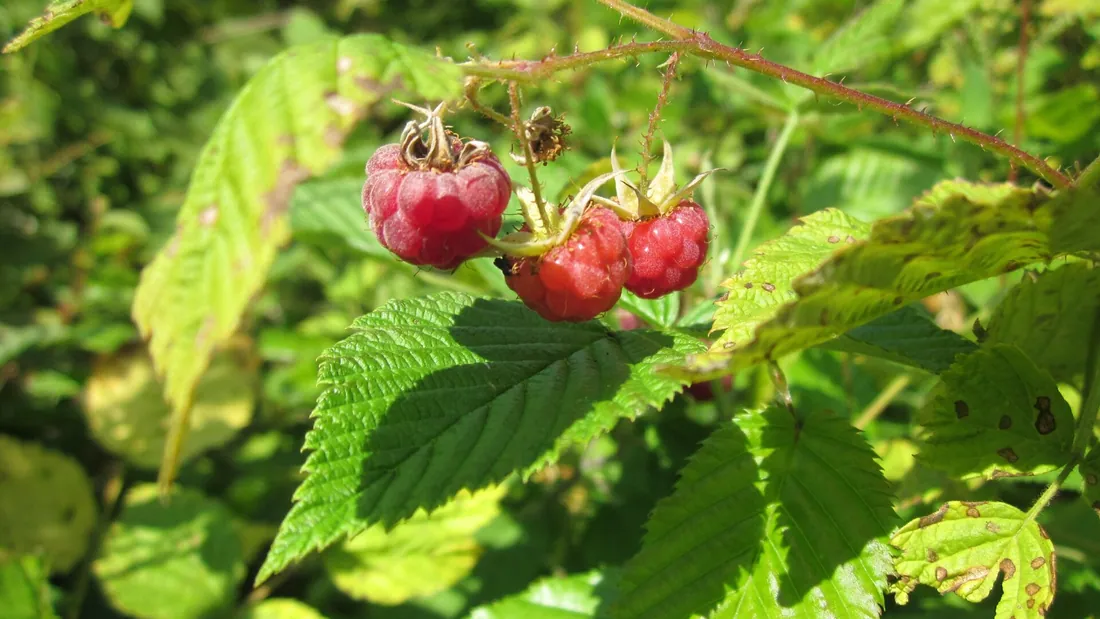

The raspberry (Rubus idaeus) is a small fruiting shrub, hardy down to -25 °C, that grows wild in the cool woodland of Europe and temperate Asia. It likes coolness and moisture, which makes it one of the easiest fruits to succeed with in a temperate climate: it thrives there without any need to coddle it. The only real choice to make at the start is the type of variety, everbearing or non-everbearing, because that is what decides how you prune.
Light and exposure
The raspberry accepts full sun as well as partial shade, and that flexibility is an asset because it can be tuned to the climate. In full sun, the fruit is sweeter and ripens earlier; at the edge of a wall or under a light tree, the soil stays cooler in summer, which the plant appreciates. The hotter and drier the summer, the more the afternoon shade helps; under a cool summer, aim for full sun instead.
Avoid the corners where the air stagnates and where moisture never dries, because that is where fruit diseases settle in. An airy spot, facing east or west, sunny a good part of the day, gives the best results.
Watering
The raspberry forms on soil that stays cool, that is the key to a fine harvest. In summer, especially from flowering to fruit ripeness, water as soon as the soil dries at the surface. A lack of water at that moment gives small, dry fruit.
Water at the base and in the morning, not on the foliage or the clusters. A mulch of compost, dried grass clippings or dead leaves keeps the moisture in the soil and limits watering. The rest of the year, under a damp temperate climate, the rain amply covers the needs; under a dry or windy climate, watering stays necessary from spring to autumn.
Soil and repotting
The raspberry wants a soil that is cool, rich in humus, light and rather acidic. It hates two things: lime, which turns its foliage yellow, and stagnant water, which rots its roots. If your soil is heavy or chalky, amend it with compost, leaf mould or ericaceous soil, and plant on a slight mound to drain.
Bare-root planting in autumn is ideal: the plants settle in over winter and start strongly in spring. Space the plants 40 to 50 cm apart along the row and set up wires stretched between two posts to train the canes, otherwise they collapse under the weight of the fruit.
Temperature and humidity
Cold is not the issue with the raspberry. Dormant canes take -25 °C without damage, and the hardiest cultivars go lower still under a blanket of snow: the plant is at home from USDA zone 3 to 8 and spends the winter outside without any protection. It even needs cold to break its dormancy, 800 to 1600 hours below 7 °C depending on the cultivar.
What it dreads is heat: growth is at its best between 22 and 25 °C, and beyond 32 °C the berries stay small, the yield drops and the quality suffers. A cool, humid summer and a mild but wet winter, and the raspberry needs nothing more. Under that regime, the point to watch is not frost but excess water in the soil during the cold season: a plant set in a waterlogged hollow can see its roots rot.
Pruning and upkeep
It all depends on the type. Non-everbearing raspberries give a single harvest in summer on the canes grown the previous year. After the harvest, cut those canes that have fruited right down, they will not fruit again, and keep the young green shoots of the year: these are the ones that will bear the fruit the following summer. Train them and thin them out to keep only the most vigorous.
Everbearing raspberries fruit in autumn on the canes of the year, then a small time the following summer on those same canes. The simplest method, and the one recommended for a home garden, is to cut everything right down at the end of winter: you give up the small summer harvest but you get a single large autumn harvest, without ever having to tell the old canes from the new.
Pests and diseases
Under a damp climate, watch the fruit first. Grey mould, botrytis, covers the raspberries with a grey felt in rainy weather, especially at the end of the harvest: remove the affected fruit and air the planting. Powdery mildew can whiten the foliage, and rust can mark it with orange pustules during very wet summers.
As for the pests, the number one enemy is the raspberry beetle, whose larva, the small white grub found in the fruit, spoils the harvests. Everbearing varieties cut right down partly escape this pest, because their late fruiting falls outside its peak. Also watch for aphids on the young shoots.
Propagation
The raspberry multiplies on its own, and even a little too much. It sends up suckers, those shoots that come out of the ground at a distance from the mother plant. You just have to dig up a well-rooted one in autumn or at the end of winter, with a portion of root, and replant it elsewhere: you have a new plant for free.
This is also how the plant becomes invasive. Taking the suckers therefore serves both to multiply and to contain the raspberry patch. Sowing exists but has no interest in the garden, because plants raised from seed do not resemble the original plant.
Climate and hardiness
Where and in which climate it thrives
The raspberry is a fruit of cold to temperate climates, and it is its hardiness that makes it easy almost everywhere. Dormant canes take -25 °C without damage and the hardiest cultivars go lower still under snow: USDA zones 3 to 8, winter outside without the slightest protection. It does need cold to break its dormancy, 800 to 1600 hours below 7 °C depending on the cultivar, which explains its failures in mild climates: from zone 9 onwards, only the low-chill cultivars, under 300 hours, break bud and fruit normally.
It is truly at home in a cool, humid oceanic climate, with moderate summers and mild winters: there it thrives without being coddled, and the only risk is then not frost but excess water in the soil during the cold season. In a continental climate with a dry, cold winter it holds up easily, provided a thick mulch protects the roots when the bare soil freezes. In a Mediterranean climate or under a hot, dry summer the difficulty changes sides: beyond 32 °C the fruit stays small, and afternoon shade plus steady watering become compulsory.
To make life simpler under any sky, choose an everbearing variety and cut it right down every end of winter: a single pruning operation in the year, no old canes to untangle, and an autumn harvest that also escapes the raspberry beetle. Plant bare-root during the dormant season, in a soil amended with compost, rather acidic and above all never chalky or waterlogged, then contain the suckers as soon as they spill over the row.
Growing raspberry?
Green Hub keeps a dated history of your own plant: its photos, its progress, its repottings. An AI answers about yours specifically, not a generic sheet, for free.
Identify my plantMonth-by-month care calendar
| January | Nothing to do in the garden, the plant is asleep. This is the time to order the bare-root plants and prepare the training supports. |
|---|---|
| February | Cut the everbearers right down for a single large autumn harvest. On the non-everbearers, thin out and shorten the tips of the frosted canes. |
| March | Planting still possible. Rake compost in at the base, mulch and train the kept canes on the wires. |
| April | Growth restarts. Watch for the first suckers and remove those coming up outside the row. Water if the spring is dry. |
| May | Flowering of the non-everbearers. Keep the soil cool and mulched. Thin out the young shoots that are too dense to air the clump. |
| June | First raspberries on the non-everbearers. Water regularly at the base, the formation of the fruit needs cool soil. |
| July | Full summer harvest. After the fruiting of the non-everbearers, cut the canes that have borne right down and keep the young shoots. |
| August | Start of the autumn harvest on the everbearers. Watch for grey mould in humid weather and remove the spoiled fruit. |
| September | The harvest of the everbearers is in full swing. Keep up the regular picking and pull out the invasive suckers. |
| October | Last autumn raspberries. Plant the new bare-root plants and dig up the suckers to replant them elsewhere. |
| November | Best period to plant bare-root in amended soil. Cut back and clean up, add compost at the base. |
| December | Winter rest. Check that the plants are not sitting in water and reinforce the posts and training wires. |
Green Hub tips
- Take an everbearing raspberry and cut it right down at the end of winter, before growth restarts: a single pruning in the year and a large autumn harvest, it is the simplest choice.
- Never any lime or stagnant water. Amend with compost, plant on a slight mound if your soil is heavy and mulch to keep the soil cool.
- Contain the suckers as soon as they spill over the row, a spade cut in spring is enough, otherwise the raspberry invades the whole bed.
- A well-rooted sucker dug up in autumn replants elsewhere and gives a new plant for free: it is the simplest way to multiply.
Related species
Apple tree
Malus domestica
The apple tree (Malus domestica) is the king of fruit trees in temperate climates, the one that has filled family…
Cherry laurel
Prunus laurocerasus
Cherry laurel (Prunus laurocerasus) is the most widely planted evergreen hedging shrub in temperate gardens, and it is…
Cherry tree
Prunus avium
The cherry tree (Prunus avium) is a vigorous, hardy fruit tree, perfectly at ease in a temperate climate, from USDA…
Peach
Prunus persica
The peach tree (Prunus persica) is a fruit tree that loves far more warmth and sun than a cool temperate climate…
Pear tree
Pyrus communis
The pear tree (Pyrus communis) is the apple tree’s cousin, a fruit tree for the family orchard that gives melting fruit…
Photinia
Photinia x fraseri
Photinia (Photinia x fraseri) is an evergreen shrub in the rose family that has become one of the most widely planted…
The guides that mention it
Small fruits and fruit trees: where to begin
Raspberry, redcurrant, blackcurrant, blueberry, apple, pear: what to start an orchard with and how to avoid picking the…
Making Compost: Steering the Thermal Biology of the Heap
A compost heap is not a pile of waste you stir, it is a thermal process you steer. The real carbon/nitrogen ratio of…
Improving Clay Soil: Diagnosis, Amendments and Drainage
Ground that clings to your boots in winter and cracks open in summer: a clay soil is not condemned, it changes with the…
Garden Mulching: Every Mulch Has an Effect and a Drawback
Mulching is presented everywhere as a benefit with no downside. There is one for every material: what nitrogen drawdown…
Vegetable Garden Pests: The Natural Method That Holds All Season
A leaf riddled with holes, a lettuce shaved to the ground overnight, a twisted and sticky shoot: every kind of damage…
Garden Diseases: Recognising What Is Attacking Your Plants, and Acting Before the Spot Appears
A white bloom that wipes off on a fingertip, an angular lesion stopped dead by a vein, a fruit browned from the bottom…
Pruning Fruit Trees: Deducing Instead of Memorising
An apple tree and a cherry tree are pruned neither at the same time nor for the same reason, and the peach is like…
Rainwater Harvesting for the Garden: Choosing and Sizing Your System
Rain barrel, above-ground tank, or underground cistern: how to choose the right size so your vegetable garden no longer…
Updated on
How this sheet is written
Written for Green Hub with the help of language models, then reviewed. It offers gardening guidance, not professional advice: if you are unsure whether a plant is toxic to a child or an animal, ask a vet, a doctor or your national poison centre.