Redcurrant
Ribes rubrum
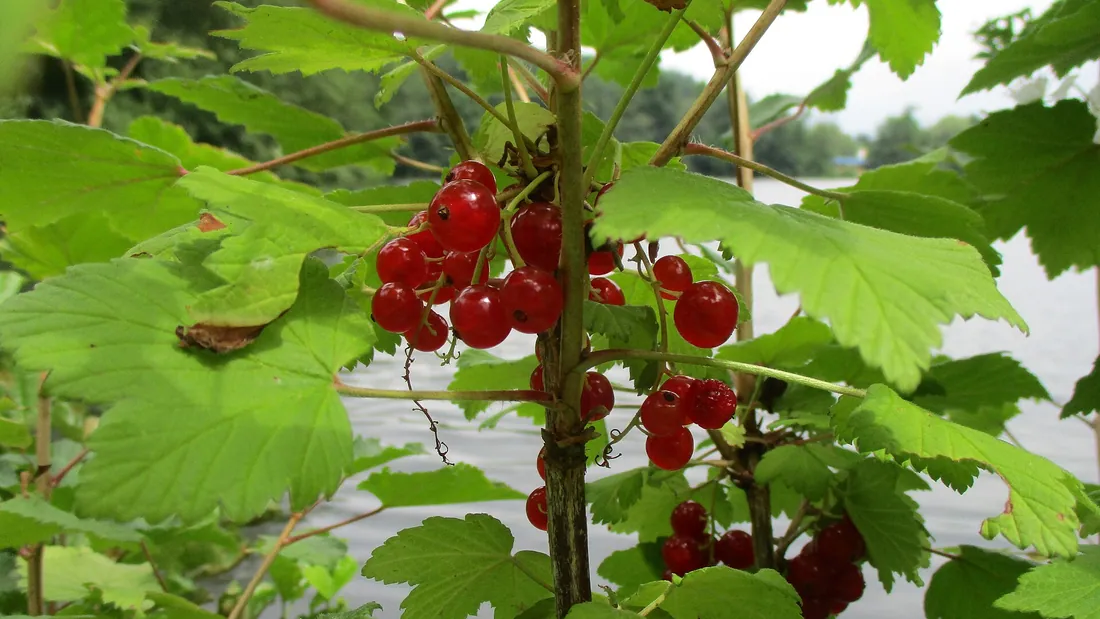

The redcurrant (Ribes rubrum) is a small bushy fruit shrub that produces those pretty clusters of translucent red berries, tart and perfect for jelly, coulis or nibbling straight off the stem. It is probably the easiest fruit shrub to grow in a temperate garden. Hardy down to -30 °C once dormant, at ease from USDA zone 3 to 7, it fears neither hard winters nor mild summers, and it even tolerates partial shade, which makes it the ideal companion for a small garden. It fruits on two and three year old wood, a detail that guides everything about how you prune it.
Light and exposure
The redcurrant accepts full sun as readily as partial shade, a flexibility that is rare among fruit shrubs. In sun the clusters are sweeter and more abundant. In partial shade, under a light tree or against an east facing wall, it produces a little less but the fruit stays juicier and ripens later, which spreads out the harvest.
This tolerance makes it the fruit shrub for the difficult corners of the garden, the ones that only see sun for part of the day. Under a cool, often overcast sky, a spot with morning sun and shelter from cold winds gives the best results; under a hot summer, look for afternoon shade instead. Either way, do not hesitate to place one in a slightly shaded angle where nothing else wants to grow.
Watering
The redcurrant likes a cool root run, as it is a woodland plant by origin. In open ground and once established, it copes very well with the rainfall of a damp temperate climate and only needs watering during the rare prolonged droughts, above all while the fruit is forming and swelling, between flowering and harvest. Under a hot dry summer, watering becomes regular instead.
For the first two years after planting, be more attentive while the root system fills out. A good mulch at the base, dead leaves, dried grass clippings or compost, keeps the soil cool and moist, cuts down on watering and feeds the plant. It is the single most useful thing you can do for a happy redcurrant.
Soil and repotting
Undemanding, the redcurrant still prefers a cool, deep, humus rich soil that holds moisture without being waterlogged. It grows in most garden soils, including the somewhat heavy, clayey ones, provided they are not permanently soaked.
It likes slightly acidic to neutral soils and dreads above all an excess of lime, which can cause chlorosis, a yellowing of the leaves between the veins. At planting, enrich the hole with well rotted compost and mulch generously. An input of organic matter each autumn keeps it vigorous year after year.
Temperature and humidity
This is a perfectly hardy fruit shrub, built for cold and temperate climates. Once dormant it shrugs off -30 °C without flinching, which puts it at ease from USDA zone 3 to 7. A spell of winter cold is actually necessary for it to flower and fruit well the following spring: it needs 800 to 1500 hours below 7 °C, and it is that chill requirement that makes it fail where the winter stays mild.
Its heat tolerance, on the other hand, is moderate: it is at its best under cool humid summers, and under a hot summer it asks for afternoon shade and a soil kept cool. The other point to watch is late spring frost, which can scorch the early flowering in a fickle year. The redcurrant flowers early, ahead of most other fruit shrubs, and a touch of frost on the flowers reduces the harvest. A slightly sheltered spot and a position that avoids frost hollows limit this risk; apart from that, the plant asks for no winter protection.
Pruning and upkeep
Pruning makes sense once you know where the redcurrant fruits: on two and three year old wood, that is to say neither on the very young shoots of the current year, nor on exhausted old wood. The aim of pruning is therefore to keep a rotation of young productive branches going, by removing the wood that is too old.
You prune in winter, during dormancy, from leaf fall to bud break, outside frosty spells. On an established bush, keep about ten framework branches of staggered ages and remove each year the oldest branches, those over 3 or 4 years old, along with dead, broken or tangled wood in the centre. This renewal pruning opens up the bush, lets light in and maintains a steady crop of good quality.
Pests and diseases
The redcurrant stays robust overall, but a few troubles recur under a damp climate. American powdery mildew covers leaves and young shoots with a white mealy felting, especially in heavy, humid weather, so open up the bush well by pruning to keep it in check. The currant blister aphid causes very characteristic red puckers and swellings on the leaves, spectacular but rarely serious, and a spring spray of soft soap on the colonies is usually enough.
Watch also for the currant clearwing, a moth whose caterpillar tunnels inside the stems and makes them die back, so cut and burn the affected wood. But enemy number one remains without question the birds, blackbirds and others, which devour the clusters just as they ripen. The only really effective remedy is a fine mesh net laid over the bush as soon as the fruit begins to colour.
Propagation
The redcurrant propagates with disconcerting ease from hardwood cuttings in autumn, and that is the method to know. At leaf fall, take well ripened shoots of the current year, twenty to thirty centimetres long, remove the lower buds, and plant them two thirds deep straight into open ground in a sheltered corner, or in a pot. The strike rate is high, winter and spring do the rest, and you get free new plants for the following autumn.
Layering also works very well: in spring peg a low branch down into a small trench, keep it in the ground, and it roots in one season and can be separated in autumn. These two methods, simple and needing no equipment, explain why the redcurrant passes so easily from garden to garden.
Climate and hardiness
Where and in which climate it thrives
The redcurrant is a fruit shrub of cold to temperate climates, and that is what makes it so easy: once dormant it takes -30 °C without the slightest protection, which puts it at ease from USDA zone 3 to 7. It needs that cold in order to flower, 800 to 1500 hours below 7 °C depending on the variety, and that is why it disappoints where the winter never drops low enough.
It is truly at home in an oceanic climate with cool, humid summers, on cool and sometimes heavy soils; in a continental climate with a hard winter it holds up just as well. It is heat that limits it: its tolerance is moderate, and under a hot dry summer it needs afternoon shade, a permanent mulch and steady watering, failing which the clusters stay small and the foliage scorches. As it flowers very early, ahead of most fruit shrubs, watch out for late frosts on the blossom as well.
One point that depends on the place rather than the climate: the genus Ribes is the alternate host of white pine blister rust (Cronartium ribicola), and planting it is still regulated in parts of North America, near five needle pines. Check the local rule before you buy. Everywhere else, plant bare root during the dormant season, expect a harvest in early summer when the clusters turn translucent and detach easily, and a well placed bush will produce for fifteen to twenty years. Two habits do the rest: the bird net as soon as the fruit colours, without which the blackbirds will leave you almost nothing, and the winter renewal pruning that removes the old wood every year.
Growing redcurrant?
Green Hub keeps a dated history of your own plant: its photos, its progress, its repottings. An AI answers about yours specifically, not a generic sheet, for free.
Identify my plantMonth-by-month care calendar
| January | Full winter pruning season, outside frosty days. Remove the old wood over 3 years, the dead wood and the tangled branches to open up the centre of the bush. |
|---|---|
| February | End of the renewal pruning. Feed the base with mature compost and refresh the mulch. Still plant bare root stock if the soil is not frozen. |
| March | The bush starts up. Last planting still possible. Check the mulch and hoe lightly to aerate the soil. Watch for the first aphids arriving on the young shoots. |
| April | Early flowering, often before mid April. Keep an eye out for late frosts that can scorch the flowers. Track the red aphid puckers on the leaves, soft soap if needed. |
| May | The young clusters form. Keep the soil cool with a watering if the weather is dry. Watch for powdery mildew in heavy weather and look out for the clearwing on wilting stems. |
| June | The clusters swell and redden. Lay the bird net as soon as the first colours show. First harvest of the early varieties at the end of the month. |
| July | Full harvest. Pick the whole clusters when the berries are translucent. Turn them without delay into jelly, coulis or syrup, as the currant keeps poorly fresh. |
| August | End of harvest. Remove the net. Water in case of drought so the plant prepares next year’s wood well. Still watch for powdery mildew on the young shoots. |
| September | The bush slows down. Clear away the diseased leaves fallen on the ground to limit powdery mildew next year. Prepare the spots for future plantings and cuttings. |
| October | Leaf fall. The ideal time to take hardwood cuttings of the current year, high strike rate. Spread compost at the base and refresh the mulch for winter. |
| November | Bare root planting, the best period. Renewal pruning can begin once the leaves have fallen. Layer a low branch if you want to propagate. |
| December | Dormancy. Carry on with the winter pruning in mild weather without frost. Check the stakes and the general state of the bush. Plan your varieties for any new plantings. |
Green Hub tips
- Lay the bird net as soon as the clusters begin to colour: blackbirds empty a redcurrant in a few days, it is by far the number one enemy of the harvest.
- Remember the pruning rule: the redcurrant fruits on two and three year old wood. Remove the wood over 3 years each winter to keep a young productive bush.
- At leaf fall, take hardwood cuttings of the current year, planted two thirds deep in the ground: the strike is almost guaranteed and you multiply your plants for free.
- Pick by the whole cluster rather than berry by berry, it is quicker and it damages the fruit less, which in any case keeps for only a short time once picked.
- Mulch the base permanently: the redcurrant, a woodland plant, loves a cool root run, and the mulch spares it the stress of the dry spells of summer.
Related species
Blackcurrant
Ribes nigrum
The blackcurrant (Ribes nigrum) is a small hardy fruit shrub that is genuinely happy in a cool climate, down to USDA…
Apple tree
Malus domestica
The apple tree (Malus domestica) is the king of fruit trees in temperate climates, the one that has filled family…
Blueberry
Vaccinium corymbosum
The cultivated blueberry (Vaccinium corymbosum) is the large shrubby cousin of the wild bilberry, also called the…
Cherry tree
Prunus avium
The cherry tree (Prunus avium) is a vigorous, hardy fruit tree, perfectly at ease in a temperate climate, from USDA…
Elder
Sambucus nigra
Elder (Sambucus nigra) is a large shrub native to temperate Europe that grows wild in hedgerows, along footpaths and on…
Fig tree
Ficus carica
The fig tree (Ficus carica) is a Mediterranean tree, yet it really can be grown up to USDA zone 7 provided you shelter…
The guides that mention it
Small fruits and fruit trees: where to begin
Raspberry, redcurrant, blackcurrant, blueberry, apple, pear: what to start an orchard with and how to avoid picking the…
Making Compost: Steering the Thermal Biology of the Heap
A compost heap is not a pile of waste you stir, it is a thermal process you steer. The real carbon/nitrogen ratio of…
Garden Mulching: Every Mulch Has an Effect and a Drawback
Mulching is presented everywhere as a benefit with no downside. There is one for every material: what nitrogen drawdown…
Garden Diseases: Recognising What Is Attacking Your Plants, and Acting Before the Spot Appears
A white bloom that wipes off on a fingertip, an angular lesion stopped dead by a vein, a fruit browned from the bottom…
Pruning Fruit Trees: Deducing Instead of Memorising
An apple tree and a cherry tree are pruned neither at the same time nor for the same reason, and the peach is like…
How to Attract Birds to Your Garden, Season After Season
Winter feeding, well-positioned nest boxes, clean water and berry hedges: the complete method, season by season, for…
Rainwater Harvesting for the Garden: Choosing and Sizing Your System
Rain barrel, above-ground tank, or underground cistern: how to choose the right size so your vegetable garden no longer…
Dividing, Taking Cuttings, Sowing: Multiplying Your Plants for Free
Dividing a perennial, taking cuttings from a shrub, or sowing seed straight from the garden: the techniques that fill a…
Updated on
How this sheet is written
Written for Green Hub with the help of language models, then reviewed. It offers gardening guidance, not professional advice: if you are unsure whether a plant is toxic to a child or an animal, ask a vet, a doctor or your national poison centre.